
Table of Contents
Table of Contents
Searches for partition placement policy kafka usually start after a cluster has already become important. The application teams are not asking what a partition is. They are asking why a broker can sit hot while another one looks quiet, why a maintenance window has to include replica movement, or why adding capacity still leaves the platform team debating disk, leader balance, consumer lag, and failure domains.
That is the real problem behind the search term. Partition placement is not a single Kafka setting that makes production risk disappear. It is a policy question about where ordered log shards live, who owns their durable bytes, how leaders move, how clients react, and what happens when capacity changes under load. A good policy turns these questions into repeatable operating rules. A weak policy leaves every incident as a custom negotiation between SRE, platform, application, and finance teams.
The useful way to approach the topic is to separate placement intent from storage architecture. Kafka gives operators mature primitives for partitions, leaders, replicas, consumer groups, offsets, transactions, KRaft metadata, and reassignment. Those primitives are powerful, but their operational cost depends heavily on whether durable data is bound to broker-local storage or placed in a shared storage layer. The checklist below is written for teams that want a production decision framework, not another generic list of Kafka tuning tips.
1Why teams search for partition placement policy kafka
A partition placement policy becomes urgent when the old mental model stops being enough. In small clusters, teams often treat placement as a byproduct of topic creation, broker count, and occasional reassignment. That works until traffic becomes uneven, retention grows, tenant count rises, or the cluster starts serving workloads with different latency and replay expectations.
The search usually maps to one of four situations:
- A hotspot has become recurring. One broker or availability zone keeps absorbing more leader traffic, disk pressure, or fetch load than expected, even though aggregate cluster capacity looks healthy.
- A capacity change is no longer routine. Adding or removing brokers requires a careful plan because partition reassignment may compete with production traffic and lengthen the maintenance window.
- Governance has entered the platform conversation. Teams need placement rules that respect tenant boundaries, regulated data classes, network paths, and rollback requirements.
- A migration or platform replacement is under review. The decision is no longer only "Can clients connect?" It is "Can this operating model survive our failure, scaling, and cost constraints?"
Those situations have different symptoms, but they share one root cause: partition placement is where logical Kafka design meets physical infrastructure. A topic may look like an API abstraction to an application team. To the platform team, its partitions consume broker CPU, memory, page cache, local disk, network bandwidth, controller attention, and operational headroom. The moment those resources become uneven, placement becomes policy.
2The production constraint behind the problem
Traditional Kafka runs on a Shared Nothing architecture. Each broker owns local log storage for the partitions assigned to it, and replication across brokers provides durability and availability. This design is proven, understandable, and still a strong fit for many workloads. Its constraint is that compute placement and durable data placement are tightly coupled.
That coupling is what makes placement decisions expensive. If a broker is overloaded because it owns too many hot partition leaders, the obvious fix is to move leadership or replicas. But moving replicas can mean copying broker-local log data, consuming network bandwidth, stressing disks, and waiting for followers to catch up. If retention is long, the physical amount of data attached to a placement decision grows. If the cluster spans multiple Availability Zones (AZs), replication and reassignment can also affect inter-zone network paths.
Tiered Storage changes part of this equation by moving older log segments to remote storage. It can reduce pressure from historical retention, and teams should evaluate it when long retention is the primary driver. It does not make every broker stateless. The active log path, leader placement, local state, ISR (In-Sync Replicas), and recovery behavior still matter for production placement policy.
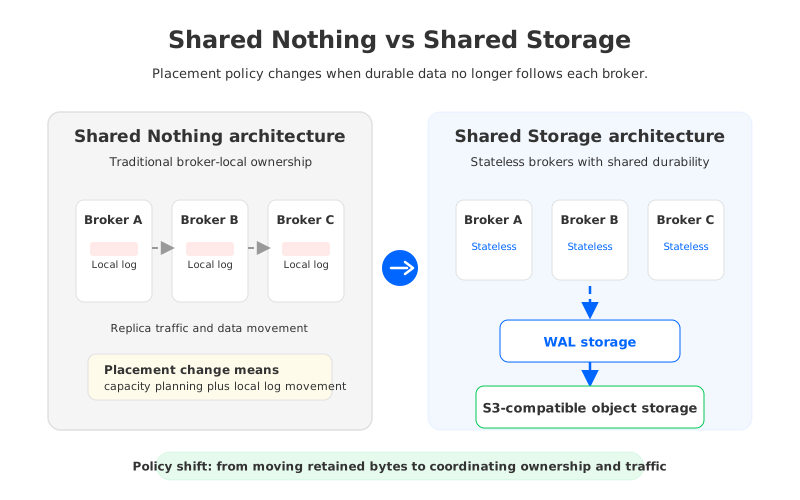
The key question is therefore not whether Kafka can rebalance. It can. The better question is what has to move when the policy changes. If every placement adjustment carries durable data movement, the team will naturally make fewer changes, reserve more headroom, and accept slower reaction time. If placement can focus on ownership, leadership, cache, and traffic routing, the policy can become more responsive.
3Architecture options and trade-offs
A production platform usually has four broad choices. None is universally right. The right answer depends on workload shape, team maturity, latency goals, cloud boundary, compliance requirements, and migration risk.
| Option | Where it fits | Placement trade-off |
|---|---|---|
| Self-managed Kafka with broker-local storage | Teams that need maximum control and have strong Kafka operations | Mature behavior, but placement remains tied to local disk, replica movement, and spare capacity |
| Managed Kafka service | Teams that want less infrastructure work while staying close to standard Kafka semantics | Provider handles more operations, but users still need to understand capacity units, quotas, placement limits, and network cost model |
| Kafka with Tiered Storage | Workloads dominated by long retention and historical replay | Reduces local storage pressure for older segments, but hot-path placement and recovery still require careful design |
| Kafka-compatible shared-storage architecture | Teams whose pain is scaling, recovery, broker replacement, or cost tied to broker-local data | Changes the policy from moving durable bytes to coordinating ownership, WAL health, cache behavior, and object storage access |
This table is deliberately architectural rather than vendor-centric. A placement policy should be portable as a decision framework even when the implementation changes. If the platform team cannot explain where durable bytes live, what moves during failover, which component owns leadership decisions, and how clients observe topology changes, the policy is not ready for production.
The same discipline applies to compatibility. Kafka clients often encode important assumptions through keys, partitioners, retries, transactions, consumer group behavior, and offset management. A platform that claims Kafka compatibility should be tested against those assumptions before placement policy is redesigned. Producer keys may define per-entity ordering. Consumer group assignment determines parallelism. Transactions and idempotent producer behavior can be sensitive to retries and broker failover. Placement policy is safe only when the client contract remains intact.
4Evaluation checklist for platform teams
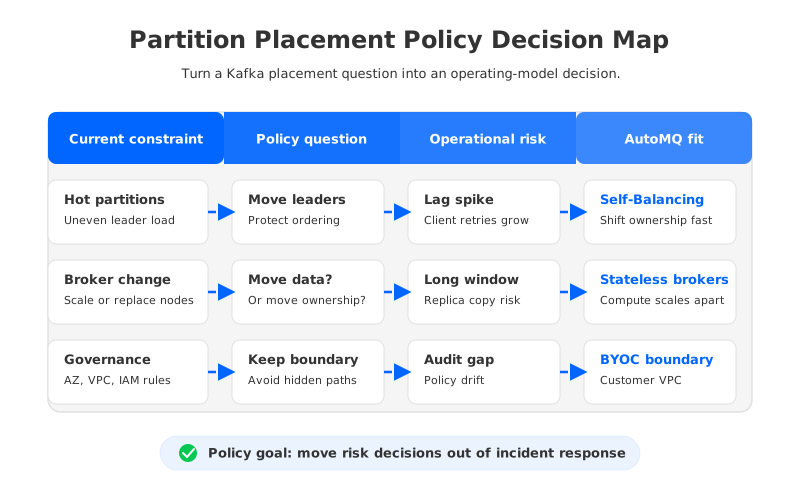
The first checklist is neutral. Use it before discussing any product, because it forces the team to define what the policy must protect.
| Evaluation area | Questions to answer before choosing a policy |
|---|---|
| Compatibility | Which client versions, partitioners, serializers, transactions, consumer groups, Connect jobs, and monitoring tools must continue to work without code changes? |
| Hot-path behavior | Which topics are latency-sensitive, which are replay-heavy, and which can tolerate slower catch-up reads or cache warm-up after movement? |
| Failure recovery | During broker loss, does recovery depend on copying retained log data, electing leaders, warming cache, replaying WAL, or a combination of these steps? |
| Cost model | How much cost comes from provisioned broker storage, replicated copies, cross-AZ traffic, object storage requests, compute headroom, and operational time? |
| Governance | Do tenant, data class, region, AZ, encryption, IAM, or audit requirements restrict where traffic and storage may live? |
| Elasticity | Can the platform add and remove compute capacity during traffic shifts, or does every change require a manual reassignment window? |
| Rollback | If the policy fails under load, can the team reverse leadership, routing, and client access without losing offset continuity or ordering guarantees? |
The answers should produce a short internal policy document. It should define the default placement rule for new topics, the exception process for hot workloads, the target leader distribution, the failure-domain rule, the maximum acceptable recovery window, and the tests required before changing platform architecture.
One useful scoring model is to rate each workload from 1 to 3 across compatibility, latency sensitivity, replay depth, governance sensitivity, and elasticity demand. A low score means the workload can tolerate a conservative placement policy. A high score means it needs explicit design review. The point is not mathematical precision. The point is to prevent a batch analytics topic and a payment authorization topic from being governed by the same placement reflex.
5How AutoMQ changes the operating model
Once the neutral framework is clear, the architectural category becomes easier to evaluate. AutoMQ is a Kafka-compatible cloud-native streaming platform that uses Shared Storage architecture: brokers remain compatible with Kafka clients and ecosystem tools, while durable stream data is stored in S3-compatible object storage through S3Stream and WAL (Write-Ahead Log) storage.
This changes what a placement policy is trying to move. In a Shared Nothing architecture, a broker often carries both compute responsibility and durable partition data. In AutoMQ's model, stateless brokers handle Kafka protocol work, leadership, caching, scheduling, and traffic, while persistent data lives in shared object storage with WAL as the durability and recovery path. Partition reassignment can therefore focus on ownership and load rather than copying a large local log from one broker to another.
That shift does not remove engineering trade-offs. It moves them. Teams need to evaluate WAL type, object storage behavior, cache warm-up, metadata correctness, observability, and cloud permissions. AutoMQ Open Source uses S3 WAL, which is operationally simple and useful for many workloads that can tolerate higher write latency. AutoMQ commercial editions can use other WAL storage choices such as Regional EBS WAL or NFS WAL depending on cloud environment and workload needs. The policy question becomes more precise: which workloads need the lowest-latency WAL path, which need simpler diskless deployment, and which are dominated by retention or elasticity?
For platform teams, the practical benefit is that placement policy can become more active. Self-Balancing and seconds-level partition reassignment are easier to reason about when broker replacement is not a large data-copying event. Auto Scaling becomes less entangled with durable storage capacity because adding compute does not require adding a proportional amount of broker-local disk. Zero cross-AZ traffic patterns also become easier to evaluate when storage and routing are designed around shared object storage rather than broker-to-broker replica traffic.
The migration boundary matters as much as the architecture. AutoMQ BYOC keeps the control plane and data plane in the customer's cloud account and VPC, which is important for teams whose placement policy includes data residency, network, IAM, or audit requirements. Kafka Linking can support migration planning by preserving Kafka-facing behavior such as topic data and consumer progress, but the safe path is still to test the workloads that encode the most placement assumptions: keyed ordering, transactional writes, long-running consumer groups, Connect pipelines, and rollback routes.
6Readiness scorecard
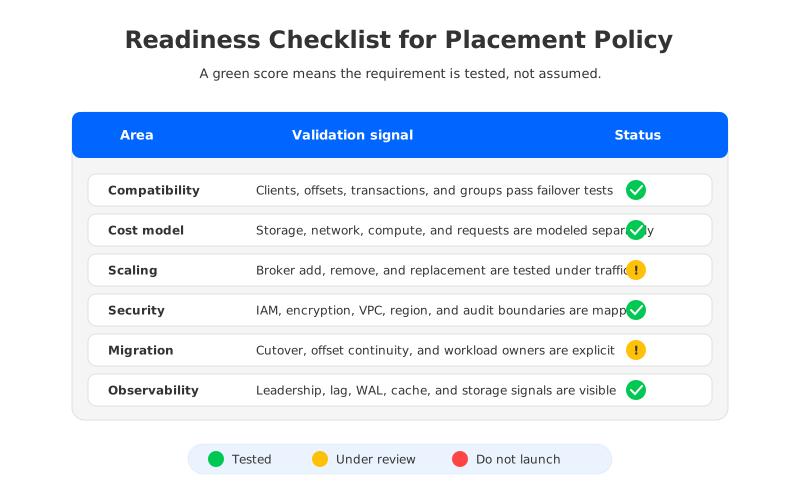
Before changing production placement policy, ask the team to mark each row as green, yellow, or red. Green means the requirement is tested. Yellow means the design is understood but not fully exercised. Red means the team is relying on hope.
| Readiness item | Green means |
|---|---|
| Client contract | Producers, consumers, transactions, offsets, and consumer groups behave correctly through broker change, leader movement, and retry storms. |
| Storage boundary | The team can explain exactly where hot data, retained data, WAL data, and metadata live. |
| Failure drill | Broker loss, AZ impairment, slow storage, and rollback have been tested with representative traffic. |
| Cost model | Storage, network, compute, object storage requests, and operations are modeled separately rather than rolled into one blended estimate. |
| Governance | IAM, encryption, VPC, region, audit, and tenant rules are mapped to the architecture, not added after deployment. |
| Observability | Dashboards include broker health, partition leadership, lag, WAL health, cache behavior, object storage latency, and reassignment progress where relevant. |
| Migration plan | The team has a cutover path, offset continuity plan, rollback condition, and owner for every workload class. |
The scorecard is intentionally strict because partition placement policy is a production contract. A cluster can pass a connectivity test and still fail the operating-model test. The goal is to make the hard parts visible while there is still time to change the architecture, the rollout plan, or the workload classification.
7FAQ
7.1Is there one best partition placement policy for Kafka?
No. A good policy depends on workload shape, client behavior, retention, failure-domain requirements, and storage architecture. The useful goal is not one universal rule, but a repeatable framework for deciding when default placement is safe and when a workload needs explicit review.
7.2Does Tiered Storage solve partition placement problems?
Tiered Storage can reduce local disk pressure for older log segments. It does not fully remove the operational relationship between active partitions, broker-local state, leader placement, and recovery. Teams should treat it as one tool in the architecture review, not a complete replacement for placement policy.
7.3How does shared storage change Kafka partition reassignment?
In a shared-storage design, durable data is not owned only by one broker's local disk. Reassignment can focus more on metadata, ownership, leadership, cache, and traffic routing. The trade-off is that WAL storage, object storage behavior, and observability become first-class parts of the policy.
7.4When should AutoMQ enter the evaluation?
AutoMQ should enter the discussion when the team's main pressure comes from broker-local storage, slow reassignment, elastic scaling limits, cross-AZ traffic, or customer-controlled cloud deployment boundaries. It should still be tested with the same client compatibility, failure, and migration gates as any Kafka-compatible platform.
7.5What is the safest next step?
Start with the readiness scorecard on one representative workload, not the whole estate. If the answers expose storage coupling, reassignment risk, or governance gaps, evaluate a shared-storage Kafka-compatible architecture and test it against your real producer, consumer, and rollback behavior. To explore AutoMQ in a customer-controlled deployment model, start from the AutoMQ BYOC console.


