
Table of Contents
Table of Contents
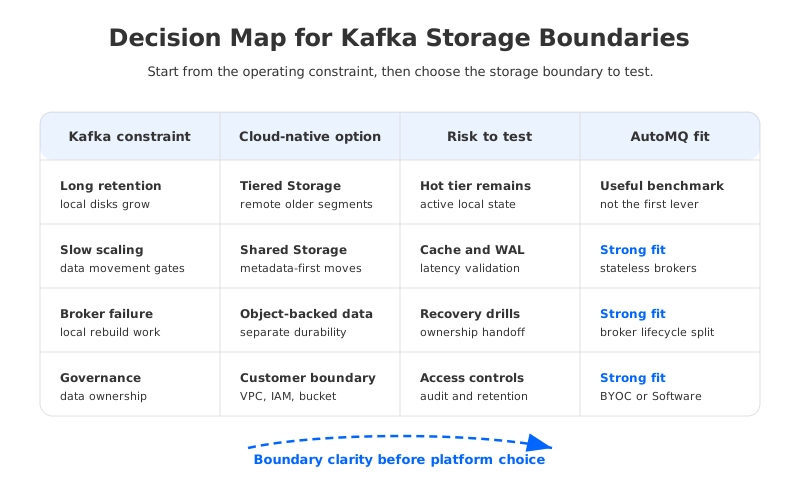
When a platform team searches for remote log storage boundaries kafka, the problem is rarely the definition of remote storage. The harder question is where the operational boundary moves after storage becomes remote. Which bytes still live on broker-local disks? Which reads depend on a remote tier? Which recovery steps still require broker-to-broker data movement? Which security and cost controls now sit in the object storage, network, and identity layers rather than inside the Kafka cluster itself?
That boundary question matters because remote storage can mean several different things in a Kafka estate. It can mean backup and archive. It can mean Apache Kafka Tiered Storage, where completed log segments move to a remote tier while the active local tier remains broker-centered. It can also mean a Kafka-compatible Shared Storage architecture, where durable stream data is designed around shared object storage and brokers become closer to stateless compute nodes. The phrase sounds narrow, but the decision touches compatibility, cost, recovery, governance, and migration risk.
1Why Teams Search for remote log storage boundaries kafka
The search usually appears after the first storage conversation has already happened. Retention is growing, replay windows are longer, or a compliance team wants historical event data kept for months instead of days. Local broker disks become expensive to size and slow to rebalance. Tiered Storage looks attractive because it lets Kafka place older log segments in remote storage while preserving the Kafka API surface that clients already use.
That is a valid direction when the pressure is historical retention. Apache Kafka documentation describes Tiered Storage as a way to use remote storage for log segments while retaining a local tier on brokers. The word "tiered" is the important part. The architecture is not the same as making brokers stateless, and it does not remove every local-storage dependency from the write path, leader placement, or recovery runbook.
For production operators, the useful question is not "Do we have remote storage?" It is "Which operational burden has actually moved?" A team that answers that question precisely can avoid treating remote log storage as a blanket fix for disk pressure, cross-AZ traffic, partition movement, and recovery time. Some of those problems may improve. Others may remain almost unchanged because the hot path still depends on broker-local state.
2The Production Constraint Behind the Problem
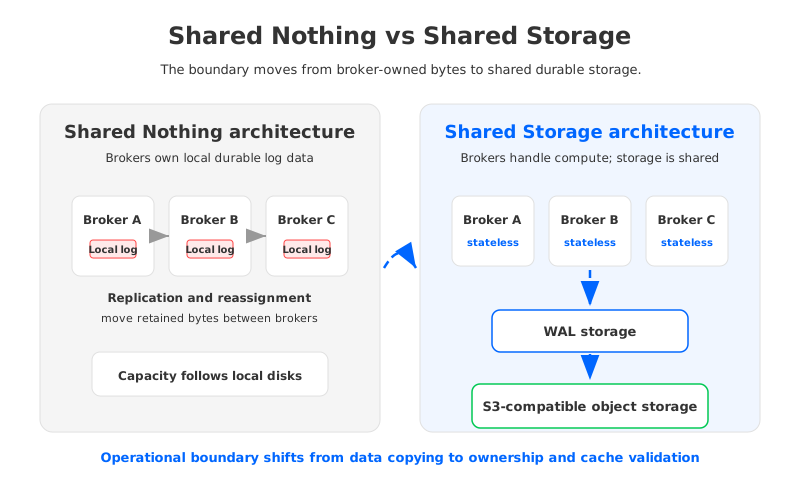
Traditional Kafka follows a Shared Nothing architecture. Each broker owns local log data, and durability comes from replication across brokers. This model was built for strong locality: the leader writes to its local log, followers replicate from the leader, and consumers read from the broker that owns the partition leader or replica path. It is a coherent model, and it is one reason Kafka became the default event streaming backbone for so many teams.
Cloud infrastructure changes the cost and failure math around that model. Broker-local disks must be provisioned before the workload fully proves its retention pattern. Replication traffic can cross Availability Zone boundaries depending on placement, client routing, and replica layout. Partition reassignment is not a metadata-only operation because retained bytes are attached to broker-local storage. When a broker fails or a cluster needs to scale, the operator has to reason about both compute capacity and data placement.
The constraint becomes visible during ordinary operations:
- Scaling a broker group adds compute, but it may also require partition movement before the new capacity is useful.
- Increasing retention can demand local disk expansion, even if most reads target recent data.
- Replacing an unhealthy broker involves replica recovery or data movement, not merely starting a fresh process.
- Moving governance boundaries from the broker layer to object storage requires new IAM, encryption, audit, and lifecycle controls.
- Estimating cost requires storage, compute, data transfer, object requests, and operational labor in one model.
Remote storage helps when it reduces the amount of historical data bound to local disks. The mistake is assuming that a remote tier automatically changes the boundary for active writes, leader failover, partition ownership, and scaling. Those are separate boundaries, and each one needs its own check.
3Architecture Options and Trade-Offs
The cleanest way to evaluate remote log storage boundaries is to separate three patterns that often get mixed together.
| Pattern | What moves remote | What usually remains local | Primary fit |
|---|---|---|---|
| Backup or archive | Copies of exported events or log data | Kafka's serving path and recovery model | Audit copies, lake ingestion, disaster recovery inputs |
| Tiered Storage | Eligible completed log segments | Active local tier and broker-centered ownership | Long retention with minimal application change |
| Shared Storage architecture | Durable stream storage as a core storage layer | Cache, WAL storage, protocol processing, and leadership work on brokers | Elastic cloud-native operations and reduced broker-local state |
Backup and archive are useful, but they do not change Kafka's serving model. Kafka Connect sink connectors, object-store exporters, and lake pipelines can preserve data outside the cluster, but the running Kafka cluster still behaves like a broker-and-disk system. This is a data distribution pattern, not a storage architecture change.
Tiered Storage changes more. It can reduce local disk pressure from long historical retention and provide a remote read path for older segments. It also preserves a familiar operating model for teams that want to keep standard Kafka semantics and avoid a larger platform migration. The trade-off is that the active tier still matters. If the operational pain comes from broker replacement, write-path locality, partition reassignment, or tight coupling between compute and durable state, tiering may address only part of the issue.
Shared Storage architecture changes the boundary more aggressively. Durable stream data lives in shared object storage, while brokers handle Kafka protocol requests, leadership, cache, scheduling, and coordination. A WAL (Write-Ahead Log) layer absorbs the latency-sensitive durability step before data is organized into object storage. The trade-off is that the platform must prove the details: write latency under the chosen WAL type, cache behavior for tailing and catch-up reads, object storage failure handling, metadata scale, and compatibility with existing Kafka clients and tools.
4Evaluation Checklist for Platform Teams
The checklist should start with the workload rather than the product category. A team running short-retention operational topics has a different boundary problem from a team keeping event history for 90 days and replaying it into analytics systems. A team with strict VPC ownership requirements has a different risk profile from a team that can use a fully hosted service. Remote storage is part of the answer only after those constraints are visible.
Use these questions before committing to an architecture:
- Compatibility boundary: Which Kafka client versions, producer settings, transactions, idempotent producers, Consumer group behavior, offset tooling, Kafka Connect jobs, and operational scripts must work without change?
- Data placement boundary: Which data is broker-local, which data is in object storage, and which metadata system controls ownership, offsets, and recovery decisions?
- Cost boundary: Which line items are in scope: broker compute, local disk, object storage capacity, object requests, cross-AZ data transfer, private connectivity, observability, and operational labor?
- Elasticity boundary: When traffic doubles or halves, does the system move data, change metadata ownership, add brokers, warm cache, or all of the above?
- Failure boundary: During broker loss, object storage impairment, network isolation, or a bad rollout, what is the recovery unit and what data must be reconstructed?
- Governance boundary: Which team controls IAM, encryption keys, bucket policies, retention lifecycle, audit logs, and region placement?
- Migration boundary: Can producers, consumers, topics, ACLs, offsets, schemas, and connectors move with a rollback path that the application team understands?
These questions prevent a common architecture shortcut: comparing systems by the existence of object storage rather than by the responsibilities that object storage actually assumes. The important boundary is not the location of old segments alone. It is the line between compute, durable storage, metadata, networking, and team ownership.
5How AutoMQ Changes the Operating Model
Once the evaluation reaches broker-local state, elastic scaling, and customer-controlled deployment boundaries, AutoMQ becomes relevant as a Kafka-compatible cloud-native streaming platform built around Shared Storage architecture. The product is not a generic remote tier bolted onto a broker-local design. It keeps Kafka protocol compatibility while changing where durable stream data lives and how brokers participate in storage.
In AutoMQ, brokers are stateless brokers. They still perform the Kafka-facing work that applications depend on: produce and fetch handling, partition leadership, request routing, caching, and coordination with KRaft metadata. The durable storage layer is built on S3Stream, which writes through WAL storage and persists stream data into S3-compatible object storage. That distinction is what changes the operating model. Scaling and broker replacement become less tied to copying retained log segments between broker disks, because retained data is no longer owned by a single broker's local volume.
The WAL layer deserves attention because it is the bridge between object storage economics and streaming latency. Object storage is durable and elastic, but it is not a drop-in replacement for a local append log on the hot write path. AutoMQ uses WAL storage as the durability buffer for writes, then organizes data into object storage for the long-lived storage layer. AutoMQ Open Source uses S3 WAL. AutoMQ commercial editions can use additional WAL storage options such as Regional EBS WAL or NFS WAL, depending on the deployment and cloud environment. The right choice should be validated against latency, durability, and failure-domain requirements.
Deployment boundaries matter as much as storage boundaries. AutoMQ BYOC runs in the customer's cloud account and VPC, and AutoMQ Software runs in the customer's private environment. That means the data plane can remain inside customer-controlled network, IAM, storage, and audit boundaries while still using a Kafka-compatible interface. For teams that searched for remote log storage because governance and placement were becoming uncomfortable, this is often as important as the storage mechanics themselves.
This does not remove the need for testing. A serious evaluation should still run compatibility checks, replay tests, failure drills, connector tests, and cost modeling under the real workload. The difference is what the test is trying to prove. With a Shared Storage architecture, the central question is no longer "How fast can we move retained partitions between brokers?" It becomes "Can the platform keep Kafka semantics while making durable storage independent from broker lifecycle?"
6Decision Scorecard
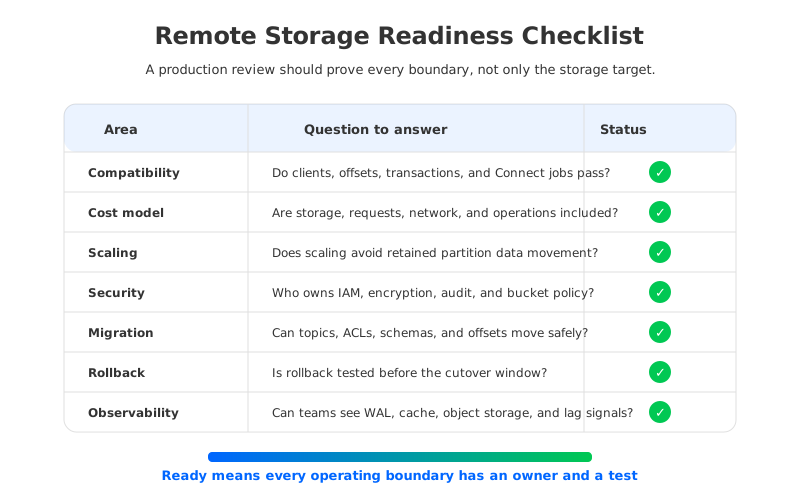
The final decision should leave the team with a written boundary map. If the map is vague, the migration plan will inherit that vagueness. A good scorecard is short enough to use in an architecture review and concrete enough to expose missing tests.
| Decision area | Green signal | Needs more work |
|---|---|---|
| Compatibility | Client behavior, offsets, transactions, and Connect jobs pass workload-specific tests | The test plan checks only produce and consume basics |
| Storage boundary | The team can explain local, WAL, object storage, and metadata responsibilities | "Uses S3" is treated as the full architecture explanation |
| Cost model | Compute, storage, request, data transfer, and operations are modeled together | Storage cost is compared without network or recovery cost |
| Scaling | Scale-out and scale-in behavior is measured under traffic and retention load | Capacity planning still assumes manual data movement windows |
| Failure recovery | Broker, storage, network, and rollout failures have tested recovery paths | Recovery claims are accepted from diagrams rather than drills |
| Governance | IAM, encryption, retention, audit, and region ownership are assigned | Object storage is added without a data governance owner |
| Migration | Cutover and rollback cover topics, offsets, ACLs, schemas, and connectors | Rollback depends on manual reconstruction during an incident |
Remote log storage is valuable when the boundary is explicit. It is risky when it becomes a phrase that hides architecture details. If your current Kafka estate is mostly struggling with long historical retention, Tiered Storage may be the right step. If the recurring pain comes from broker-local durable state, slow partition movement, cross-AZ traffic exposure, and governance pressure around where data lives, evaluate a Kafka-compatible Shared Storage architecture directly.
The practical next step is to turn the checklist into a workload test. Pick one representative topic group, write down the storage and ownership boundaries, and run the same compatibility, recovery, and cost questions against your current platform and the target architecture. To explore AutoMQ in that evaluation path, start with the AutoMQ deployment options and docs at go.automq.com/home.
7FAQ
7.1Is remote log storage the same as Tiered Storage in Kafka?
Not always. In Apache Kafka, Tiered Storage uses a remote tier for eligible log segments while retaining a local tier on brokers. Other systems may use object storage as a deeper part of the durable storage layer. Always verify which data remains broker-local.
7.2Does Tiered Storage make Kafka brokers stateless?
No. Tiered Storage can reduce historical retention pressure, but it does not automatically remove the active local tier or make broker replacement a metadata-only operation.
7.3What should be tested before adopting a Kafka-compatible Shared Storage architecture?
Test client compatibility, transactions if used, Consumer group behavior, offset migration, Kafka Connect jobs, tailing reads, catch-up reads, broker failure, object storage impairment, network isolation, observability, and rollback.
7.4Where does AutoMQ fit in this decision?
AutoMQ fits when the goal is Kafka compatibility with Shared Storage architecture, stateless brokers, object-storage-backed durability, and customer-controlled deployment boundaries through AutoMQ BYOC or AutoMQ Software.
8References
- Apache Kafka Documentation: Tiered Storage
- Apache Kafka Documentation: Consumer groups and offsets
- Apache Kafka Documentation: KRaft
- Apache Kafka Documentation: Kafka Connect
- AutoMQ Docs: Compatibility with Apache Kafka
- AutoMQ Docs: Architecture overview
- AutoMQ Docs: WAL storage
- AutoMQ Docs: Difference with Tiered Storage
- AWS Documentation: Data transfer on EC2 On-Demand pricing
- AWS Documentation: Amazon S3 pricing


