
Table of Contents
Table of Contents
When a team searches for tailing read latency kafka, the problem is rarely a single slow consumer. Something more operational is usually happening: dashboards show consumer fetch latency drifting upward, a real-time application is missing its freshness target, or a cluster that looked healthy under average load starts behaving badly when one group falls behind. The uncomfortable part is that broker CPU, disk, cache, network, partition placement, and consumer behavior can all look plausible as the culprit.
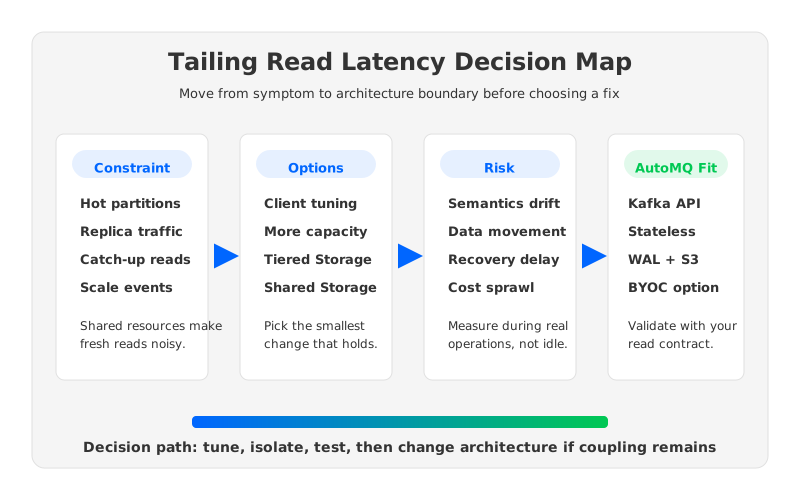
Tailing Read means reading records near the head of a stream. It is different from Catch-up Read, where a consumer scans older data after downtime, replay, or backfill. That distinction matters because a Kafka platform can be excellent at high-throughput historical replay and still disappoint applications that need stable reads at the head of the log. The platform question is not "How do we tune one consumer?" It is "Does this architecture keep hot reads predictable while the cluster scales, fails over, rebalances, and serves colder reads at the same time?"
1Why Teams Search for tailing read latency kafka
Tailing read latency becomes visible when a streaming system is treated as an application dependency rather than a passive log. Fraud scoring, feature pipelines, CDC consumers, operational analytics, alerting, and online personalization do not only care that records eventually arrive. They care that fresh records are available within a predictable window while producers, consumer groups, and platform operations continue in parallel.
The first reaction is often client tuning. Teams review fetch.min.bytes, fetch.max.wait.ms, max poll behavior, request timeouts, consumer group rebalances, and topic partitioning. That is a sensible starting point because Apache Kafka's consumer model, offsets, and consumer group assignment rules directly shape how applications read data. But once those settings are reasonable, persistent tail latency usually points below the client layer.
The common pattern is that a workload has outgrown a storage and operations model, not a single configuration value. A broker that is handling hot partitions may also be serving historical reads from local disk, copying replicas, recovering after a failure, or moving partition data during a scale event. Each activity can be valid on its own. Together, they compete for the same broker-local resources that tailing consumers need for predictable fetches.
2The Production Constraint Behind the Problem
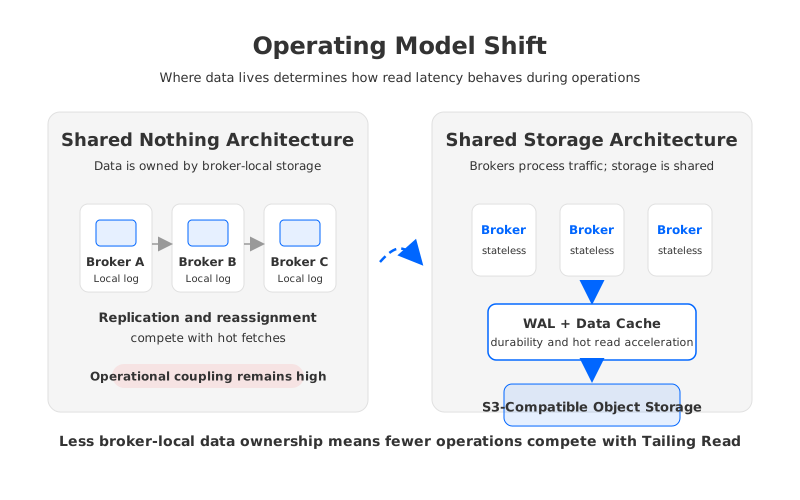
Traditional Kafka uses a Shared Nothing architecture. Each broker owns local storage for the partitions assigned to it, and durability depends on replication across brokers through leader and follower copies. This design made sense for Kafka's original data center assumptions: disks were attached to servers, replication was an application concern, and expanding a cluster meant placing more local storage behind more brokers.
In cloud environments, the same model turns tailing read latency into a capacity planning problem. Broker-local storage is not only where data lives; it is also where recovery, rebalancing, replication, and reads collide. When a broker is hot, the operator must decide whether to add brokers, move partitions, increase disk throughput, split topics, tune consumers, or accept more over-provisioning. None of those choices is wrong. The problem is that they are coupled.
That coupling shows up in four places:
- Local hot spots. A few busy partitions can concentrate read pressure on a small set of brokers even when cluster-level averages look comfortable.
- Replica traffic. Durability replication competes with client reads and writes for broker, disk, and network resources.
- Data movement. Scaling and balancing require partition reassignment, which can move large amounts of broker-local data.
- Recovery windows. When a broker fails, replacement capacity must catch up before the cluster returns to a stable operating point.
The operational lesson is blunt: average broker utilization is not a good proxy for tailing read behavior. Platform teams need to understand whether hot reads remain isolated from storage maintenance, historical replay, and cluster resizing.
3Architecture Options and Trade-Offs
The main Kafka-compatible choices are not merely product choices. They are different answers to where data should live, how compute should scale, and which layer should absorb failure. A useful evaluation compares the operating model before comparing feature lists.
| Option | What helps tailing reads | What still needs scrutiny |
|---|---|---|
| Tune existing Kafka | Fastest path when the issue is consumer configuration, batch sizing, or partition assignment. | It does not change broker-local storage coupling or data movement during scale and recovery. |
| Add capacity to traditional Kafka | More brokers, disk throughput, and network headroom can reduce contention. | Over-provisioning can mask hot spots without changing the architecture that created them. |
| Use Tiered Storage | Historical data can move to object storage, reducing pressure from long retention. | Recent data still depends on broker-local storage, so tailing reads remain tied to local broker health. |
| Adopt Shared Storage architecture | Persistent data is separated from brokers, letting compute scale and recover with less data movement. | WAL storage, cache behavior, object storage integration, and migration path must be validated. |
This table is intentionally neutral. Some teams should tune first. Some should add capacity because the business impact of migration is higher than the latency risk. Others have reached the point where keeping Kafka-compatible semantics while changing the storage model is the more durable path.
4Evaluation Checklist for Platform Teams
A tailing read latency review should start with the application contract. Without a contract, every platform looks acceptable until an incident forces a definition. Write down the freshness target, the percentile that matters, the consumer groups that are latency-critical, and the events that must not break that target: broker failure, scaling, deployment, backfill, compaction, retention growth, and regional network changes.
The checklist below is the practical version of that contract.
- Kafka compatibility. Confirm protocol compatibility, supported client versions, consumer group behavior, offset handling, transactions, idempotent producers, Kafka Connect, Kafka Streams, Schema Registry, and operational tooling. A lower-latency platform that breaks application semantics is not a migration; it is a rewrite.
- Read path isolation. Separate Tailing Read from Catch-up Read in tests. Run normal producers and latency-sensitive consumers while another consumer group performs replay or backfill. Watch whether the hot path degrades when cold reads appear.
- Scaling behavior. Test scale-out and scale-in under load. The key metric is not only whether more capacity appears, but whether adding capacity requires disruptive data movement before tailing consumers benefit.
- Failure recovery. Simulate broker replacement and leadership changes. Measure consumer-visible impact, not only cluster-internal completion.
- Cost boundaries. Include storage, compute, cross-Availability Zone traffic, load balancers, private connectivity, observability, and operational labor. A design that fixes tail latency by permanently over-provisioning may still be the wrong platform choice.
- Governance and security. Validate VPC boundaries, IAM model, encryption, audit logging, private networking, secrets handling, and where control plane and data plane components run.
- Migration and rollback. Preserve Topic configuration, offsets, ACLs, clients, observability, and a rollback path. The more latency-sensitive the workload, the less tolerance there is for a vague cutover plan.
The most useful test is not a synthetic benchmark in isolation. It is a replay of your worst normal day: peak producers, latency-critical consumers, a lagging consumer group, retention beyond the hot working set, and one planned operation such as scaling or broker replacement. If the platform cannot keep the tailing read contract in that exercise, the architecture still needs work.
5How AutoMQ Changes the Operating Model
Once the evaluation is framed around coupling, AutoMQ enters the discussion as a Kafka-compatible streaming platform built around Shared Storage architecture. It keeps Kafka protocol and API compatibility while replacing broker-local persistent storage with S3Stream, WAL storage, data caching, and S3-compatible object storage. The important shift is not that object storage is lower cost or larger. The important shift is that brokers stop being the long-term owners of the data.
In AutoMQ, brokers remain responsible for Kafka request handling, leadership, caching, and traffic processing. Durable data is written through WAL storage and uploaded to S3 storage, while data caching accelerates hot and prefetched reads. That separation makes brokers stateless in the operational sense: replacing or scaling brokers is no longer equivalent to moving the full local log for their partitions.
For tailing reads, the design goal is to protect the hot read path from the operations that make traditional clusters noisy. A broker can serve recent data from cache and nearby WAL-backed data while the durable history lives in shared object storage. Catch-up Read can use prefetch and cache behavior designed for historical access instead of forcing every historical scan through the same local disk assumptions that protect the head of the log.
The WAL layer is the part that deserves careful evaluation. Object storage by itself is not a magic answer for low-latency streaming. AutoMQ uses WAL storage as the durable write buffer and recovery layer before data is uploaded to S3 storage. AutoMQ Open Source supports S3 WAL for a minimal object-storage-only deployment. AutoMQ commercial editions support additional WAL options such as Regional EBS WAL and NFS WAL for latency-sensitive production scenarios. That choice should be matched to the workload instead of treated as a generic checkbox.
AutoMQ's operating model also changes the cost and governance discussion. In AutoMQ BYOC, the control plane and data plane run in the customer's cloud account and VPC, keeping customer business data within the customer's environment. For teams that need Kafka-compatible streaming but cannot send data through an external managed service boundary, this deployment model can be as important as latency.
6A Readiness Scorecard for Tailing Read Latency
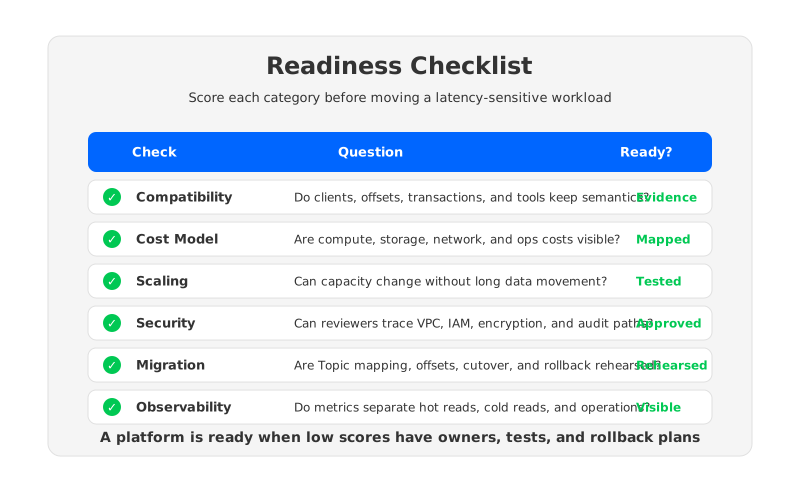
The final decision should be boring enough for SREs to trust. Assign each category a score from 1 to 5, then force a written explanation for any score below 4. The goal is not to make every platform look comparable. The goal is to expose the exact reason a platform is ready, risky, or unacceptable.
| Category | What to verify | Ready signal |
|---|---|---|
| Compatibility | Clients, offsets, consumer groups, transactions, Connect, Streams, and monitoring tools. | Existing applications can move without semantic changes. |
| Hot read behavior | Tailing Read under peak producers, replay, and planned operations. | Latency stays within the application contract. |
| Elasticity | Scale events, rebalancing, and replacement capacity. | Compute changes do not depend on long broker-local data migration. |
| Recovery | Broker failure, leadership movement, and cache warmup. | Consumer impact is measured and acceptable. |
| Cost model | Compute, storage, network, private connectivity, and operations. | The target architecture avoids permanent over-provisioning as the main latency control. |
| Governance | VPC boundary, IAM, encryption, audit, and data residency. | Security reviewers can map every data path and control path. |
| Migration | Topic mapping, offsets, ACLs, cutover, rollback, and observability. | The team can rehearse the move before production cutover. |
If the scorecard points toward an architecture change, do not start with every workload. Pick a representative Topic that has real tailing read pressure, a known consumer freshness target, and enough historical data to exercise both hot and cold paths. Then test a Kafka-compatible target with the same client behavior, the same failure drills, and the same governance review. That is where marketing claims give way to engineering evidence.
The search for tailing read latency kafka usually starts with a symptom, but the answer is a platform boundary question. If your cluster can only protect fresh reads by freezing operations, avoiding replay, and reserving excess capacity, the real checklist item is architecture. To evaluate AutoMQ against your own Kafka workload, start with the BYOC path and run the scorecard against a representative cluster: talk to the AutoMQ team.
7FAQ
7.1Is tailing read latency the same as consumer lag?
No. Consumer lag measures how far a consumer is behind the latest offset. Tailing read latency focuses on how quickly consumers can fetch fresh records near the head of the log. They can be related, but a consumer can have low lag while still experiencing unstable fetch latency during broker pressure, rebalances, or storage contention.
7.2Should teams tune Kafka clients before changing architecture?
Yes. Client tuning, topic partitioning, consumer group design, and fetch configuration should be checked first because they are lower-risk changes. Architecture becomes the topic when reasonable tuning does not protect latency during scaling, recovery, replay, or storage growth.
7.3Does Tiered Storage solve tailing read latency?
Tiered Storage can reduce pressure from long retention and historical reads by moving older segments to remote storage. It does not fully remove the broker-local storage dependency for the hot path. Teams should test tailing reads and catch-up reads separately before assuming Tiered Storage fixes both.
7.4Why does Shared Storage architecture matter for Kafka-compatible platforms?
Shared Storage architecture separates persistent data from broker-local disks. That changes scaling, recovery, and rebalancing because brokers can be replaced or resized without moving the full local history attached to their partitions. For latency-sensitive reads, this reduces the number of platform operations that compete with the hot read path.
7.5Where does AutoMQ fit in a migration plan?
AutoMQ fits after the team has defined its compatibility, latency, governance, and rollback requirements. It is most relevant when the team wants Kafka-compatible APIs with stateless brokers, object-storage-backed durability, customer-controlled deployment boundaries, and a migration path that preserves Kafka semantics.
8References
- Apache Kafka Documentation
- Apache Kafka KRaft Documentation
- Apache Kafka Tiered Storage Documentation
- Apache Kafka Connect Documentation
- AutoMQ Compatibility with Apache Kafka
- AutoMQ Architecture Overview
- AutoMQ S3Stream Shared Streaming Storage
- AutoMQ WAL Storage
- AutoMQ Kafka Linking Migration Overview


