
Table of Contents
Table of Contents
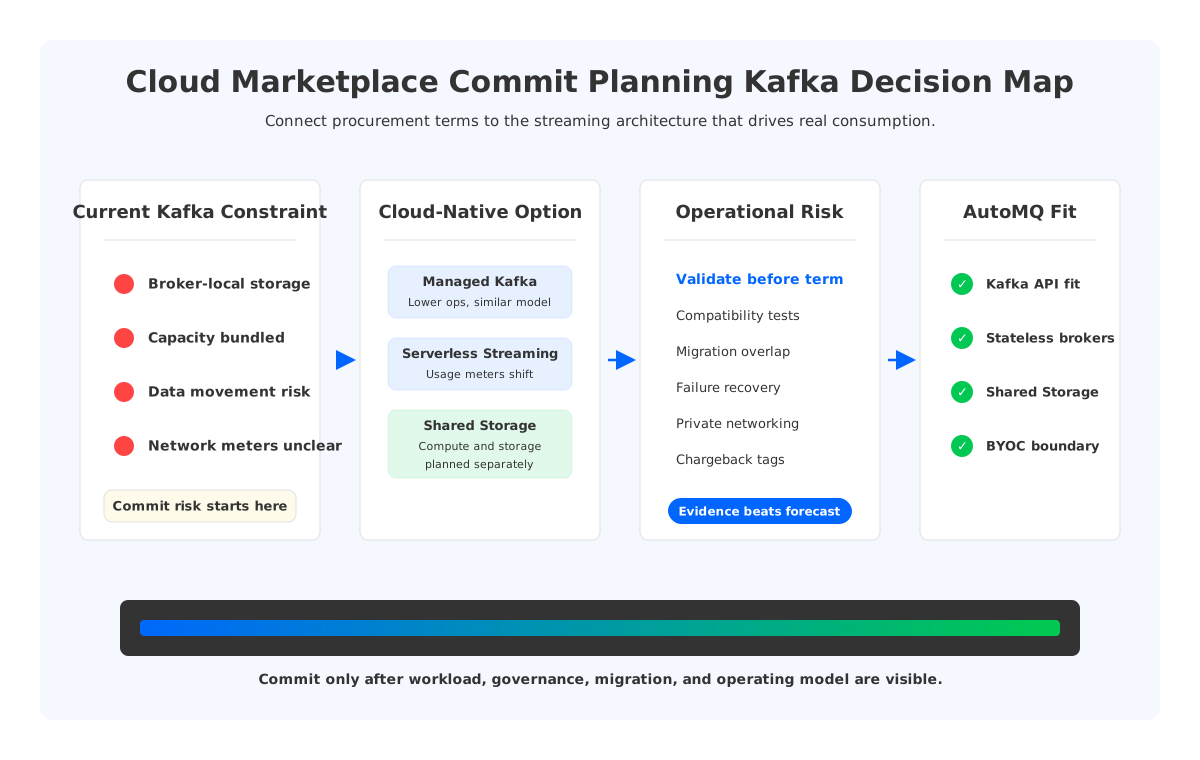
When a team searches for cloud marketplace commit planning kafka, the problem is rarely a single invoice line. It is usually a budget meeting where the Kafka platform team, FinOps, security, procurement, and application owners are all looking at the same commitment from different angles. Procurement wants to retire manual vendor contracting. FinOps wants spend to count against cloud commitments. Platform engineers want a production-grade Kafka-compatible service that will not lock them into the wrong capacity model for the next contract term.
That mix of goals is what makes marketplace planning hard. A cloud marketplace can simplify billing and procurement, but it does not make the architecture decision disappear. If the streaming platform still requires fixed broker fleets, broker-local disks, heavy data movement during scaling, and network patterns that are hard to predict, the marketplace commit can turn an operational constraint into a cleaner purchase order.
The better question is not "Which Kafka offer can we buy through the marketplace?" It is "Which streaming architecture can we responsibly commit to before workload, retention, and governance requirements change?" A FinOps decision framework should connect the commercial vehicle to the operating model underneath it.
1Why Teams Search for cloud marketplace commit planning kafka
Marketplace purchasing usually starts as a finance workflow, but Kafka turns it into a platform architecture discussion. Kafka clusters sit in the middle of application integration, analytics pipelines, payment flows, fraud detection, observability, and AI data movement. A wrong commitment does not only create shelfware; it can freeze a capacity model that every application depends on.
The search intent behind cloud marketplace commit planning kafka usually points to five linked questions:
- Commit coverage: Can the streaming platform consume an existing cloud spend commitment, private offer, or enterprise discount program without creating a separate commercial island?
- Usage predictability: Can the team forecast broker, storage, network, connector, and support usage well enough to sign a term commitment?
- Governance: Can security and procurement control which offers are approved, who can subscribe, and which accounts or projects can deploy them?
- Architecture fit: Does the service match the workload's latency, retention, scaling, and recovery requirements, or is the buyer optimizing procurement before validating the system?
- Migration risk: Can existing Kafka clients, Consumer groups, offsets, Connect pipelines, security settings, and observability workflows move without a risky rewrite?
These questions belong in the same model. Separating them creates bad decisions. A platform team may approve an architecture that meets the workload but does not fit procurement controls. A finance team may approve a commitment that looks efficient on paper but assumes static utilization. A security team may accept a marketplace route while missing data-plane boundaries, private networking, and audit requirements.
2The Production Constraint Behind the Problem
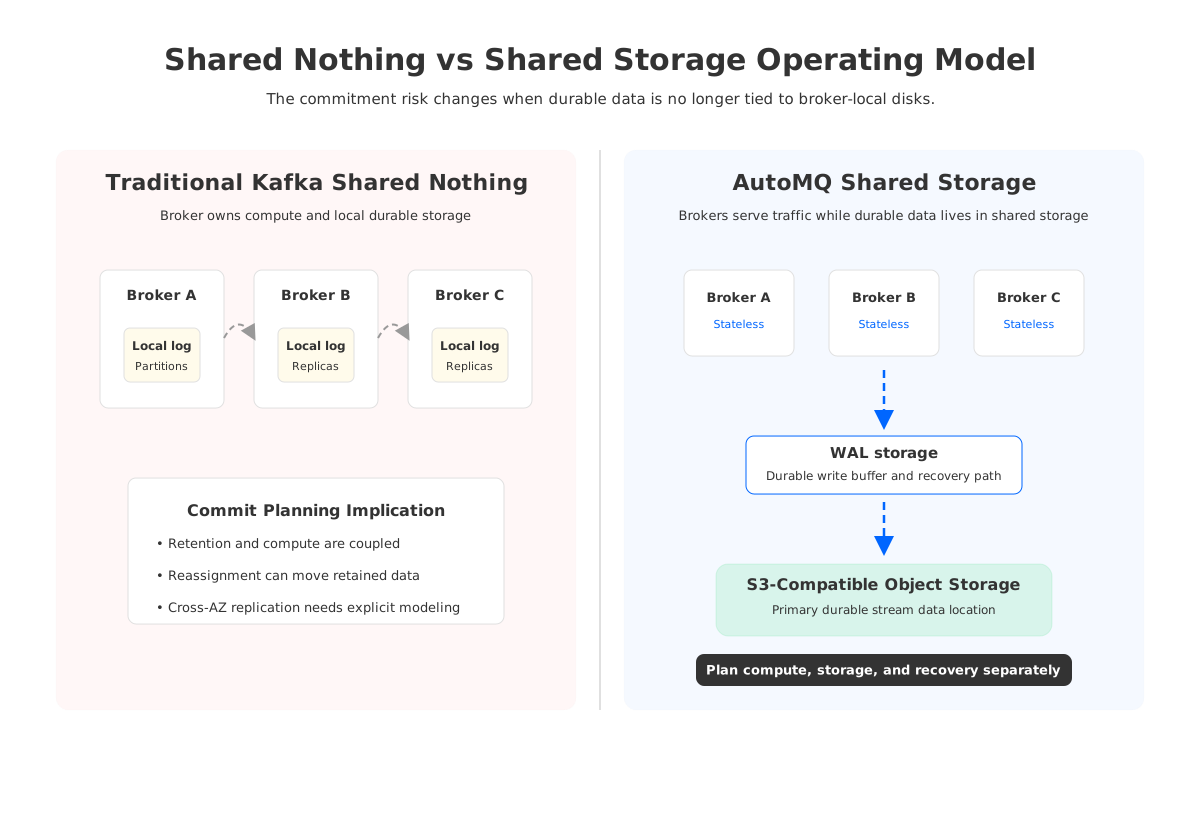
Traditional Apache Kafka was designed around a Shared Nothing architecture. Each broker owns local storage, partitions are placed on specific brokers, and durability is achieved through replication across leaders and followers. This model is well understood, and it can be operated successfully by skilled teams. The cloud changes the economics around it.
The first constraint is storage coupling. If durable log data lives on broker-local disks, capacity planning becomes a broker sizing exercise. More retention often means more disk. More disk may mean larger instances. Larger instances may bring compute headroom the workload does not need. FinOps then has to forecast a bundle of compute and storage even when the business driver is only longer retention.
The second constraint is movement. Rebalancing partitions, replacing brokers, expanding clusters, and recovering from failures can require data movement because the data is tied to broker ownership. That movement consumes time, network, and operational attention. A marketplace commitment that assumes stable clusters may look fine during planning and then become awkward when traffic growth forces repeated capacity changes.
The third constraint is cross-Availability Zone traffic. In multi-AZ Kafka deployments, replication and client placement can create inter-zone data transfer. Cloud providers publish network pricing and PrivateLink pricing as separate meters, and those meters can matter when event streams move continuously. The exact bill depends on region, architecture, and traffic pattern, so the responsible move is to model it explicitly rather than hide it inside a single platform line item.
None of this means traditional Kafka is wrong. It means a marketplace commitment should not be evaluated as a procurement shortcut. It is a term decision on a distributed system whose storage, network, and recovery behavior will shape the actual TCO (Total Cost of Ownership).
3Architecture Options and Trade-offs
Before evaluating a private offer or marketplace subscription, put the candidate platforms into architecture buckets. The categories matter more than vendor labels because they describe what the team is really committing to.
| Option | What You Are Committing To | Where It Fits | Main Watchpoint |
|---|---|---|---|
| Self-managed Kafka on cloud compute | Full control over brokers, disks, networking, upgrades, and operations | Teams with deep Kafka SRE capacity and strict customization needs | Operational burden and capacity coupling stay with the team |
| Managed Kafka service | Provider-operated Kafka with familiar Kafka semantics | Teams that want to reduce day-two operations while staying close to standard Kafka | Pricing and scaling may still reflect broker and storage coupling |
| Serverless or usage-metered streaming | Reduced capacity management with provider-defined usage meters | Variable workloads and teams that prefer less infrastructure ownership | Forecasting can shift from resources to opaque usage dimensions |
| Kafka-compatible Shared Storage architecture | Kafka protocol compatibility with durable data moved away from broker-local disks | Teams that want Kafka ecosystem continuity and a different cloud cost model | Requires validation of latency, migration, governance, and deployment boundaries |
The table is intentionally neutral. A strong FinOps process does not begin by assuming one category wins. It begins by identifying which constraint dominates the decision. If procurement speed is the main pain, marketplace access may be enough. If the core issue is that every retention or scaling change turns into a broker and disk exercise, the architecture category becomes the larger decision.
This is also where Tiered Storage needs careful handling. Apache Kafka's Tiered Storage moves older log segments to remote storage, which can help retention-heavy workloads. It does not automatically make brokers stateless or remove all local responsibilities from the active path. For commit planning, the distinction matters: remote storage can change retention economics, while Shared Storage architecture changes more of the broker operating model.
4Evaluation Checklist for Platform Teams
A useful commitment review turns vague confidence into explicit gates. The buyer should be able to show which assumptions have been tested, which are contractual, and which still need workload validation. That discipline is especially important when the commitment period is longer than the application team's release cycle.
Use the checklist below before treating a cloud marketplace purchase as production-ready:
- Workload contract: Define write throughput, read fanout, retention, partition count, message size, latency objective, recovery objective, and expected growth range. Do not size the commitment from last month's average traffic alone.
- Kafka compatibility: Verify Producer and Consumer behavior, Consumer group offsets, transactions, idempotent producers, Kafka Connect, Schema Registry integration, client versions, ACLs, and observability assumptions.
- Cost model: Break the quote into compute, storage, network transfer, PrivateLink or private networking, connector capacity, monitoring, support, and migration overlap. Keep list pricing, negotiated pricing, and cloud commitment drawdown as separate fields.
- Governance model: Confirm account boundaries, approved marketplace products, IAM roles, private offer ownership, tagging, chargeback, audit logs, and who can create or scale instances.
- Failure and scaling model: Test broker replacement, zone failure behavior, partition reassignment, cold reads, catch-up reads, and rollback. A platform with smooth procurement but slow recovery is still operational debt.
- Migration model: Plan dual-running cost, offset continuity, client cutover, connector cutover, data validation, rollback windows, and who owns each step between the source and target platforms.
The important part is not the checklist itself; it is the ordering. Compatibility and operational behavior come before financial optimization. A lower apparent commit price loses its value if the team has to overprovision for safety, hold parallel clusters for too long, or rebuild application integration patterns.
5How AutoMQ Changes the Operating Model
Once the evaluation reaches the architecture layer, AutoMQ becomes relevant as a Kafka-compatible cloud-native streaming platform that changes the storage model beneath Kafka. It keeps Kafka protocol and ecosystem compatibility while replacing broker-local durable log storage with a Shared Storage architecture built around S3-compatible object storage, S3Stream, WAL storage, data caching, and stateless brokers.
That change matters for marketplace commit planning because it separates more of the cost model. Brokers can be treated closer to compute capacity for serving Kafka traffic, while durable stream data lives in shared object storage. WAL storage handles low-latency persistence and recovery for data that has not yet been uploaded to object storage. The result is not magic pricing; it is a different set of planning variables.
In a traditional broker-local model, the FinOps spreadsheet often has to answer, "How many broker instances do we need to hold this much retained data and still serve peak traffic?" In a Shared Storage architecture, the better question becomes, "How much compute do we need for active traffic, and how much shared storage do we need for durable retention?" That is a cleaner question for commitment planning because compute growth, storage growth, and operational elasticity can be modeled with fewer hidden dependencies.
AutoMQ's stateless brokers also change the risk profile of scaling and recovery. If persistent data is not bound to a broker's local disk, broker replacement and partition reassignment are less dominated by copying retained log data between nodes. That is relevant when a marketplace commitment assumes elastic cloud behavior: the platform should be able to use cloud elasticity without turning every scale event into a storage migration project.
The deployment boundary matters as much as the storage design. AutoMQ BYOC runs control plane and data plane components in the customer's cloud environment, while AutoMQ Software supports private data center deployments. For teams that use marketplace procurement but still need customer-controlled networking, account boundaries, and data-plane ownership, this distinction belongs in the governance review rather than at the end of the buying process.
AutoMQ is not the right answer for every marketplace search. A small prototype may prefer a fully serverless service. A team with years of mature self-managed Kafka automation may choose to keep operating its own clusters. AutoMQ fits when the buyer wants Kafka compatibility, cloud-native storage economics, elastic operations, and customer-controlled deployment boundaries in the same decision.
6A Decision Matrix for Commit Planning
The final commitment decision should be scored across architecture, economics, and governance. A simple decision matrix is enough as long as each score is backed by evidence. Avoid a single blended score that hides a blocker in one dimension behind strength in another.
| Dimension | What to Score | Evidence to Require | Red Flag |
|---|---|---|---|
| Compatibility | Kafka client, ecosystem, security, and operational behavior | Test results against representative applications and tools | "Kafka-compatible" is assumed from marketing copy only |
| Cost elasticity | Ability to scale compute, storage, and network spend independently | Workload-based model with growth and failure scenarios | Quote assumes flat utilization and ignores migration overlap |
| Operational recovery | Broker replacement, reassignment, zone events, rollback | Runbook test or proof-of-concept result | Recovery path depends on large unplanned data movement |
| Governance | Marketplace controls, account boundaries, IAM, audit, tagging | Procurement and security sign-off | Subscription can be created outside approved controls |
| Migration readiness | Cutover, offsets, Consumer groups, connectors, rollback | Migration plan with owner and test window | Dual-running cost and rollback window are not budgeted |
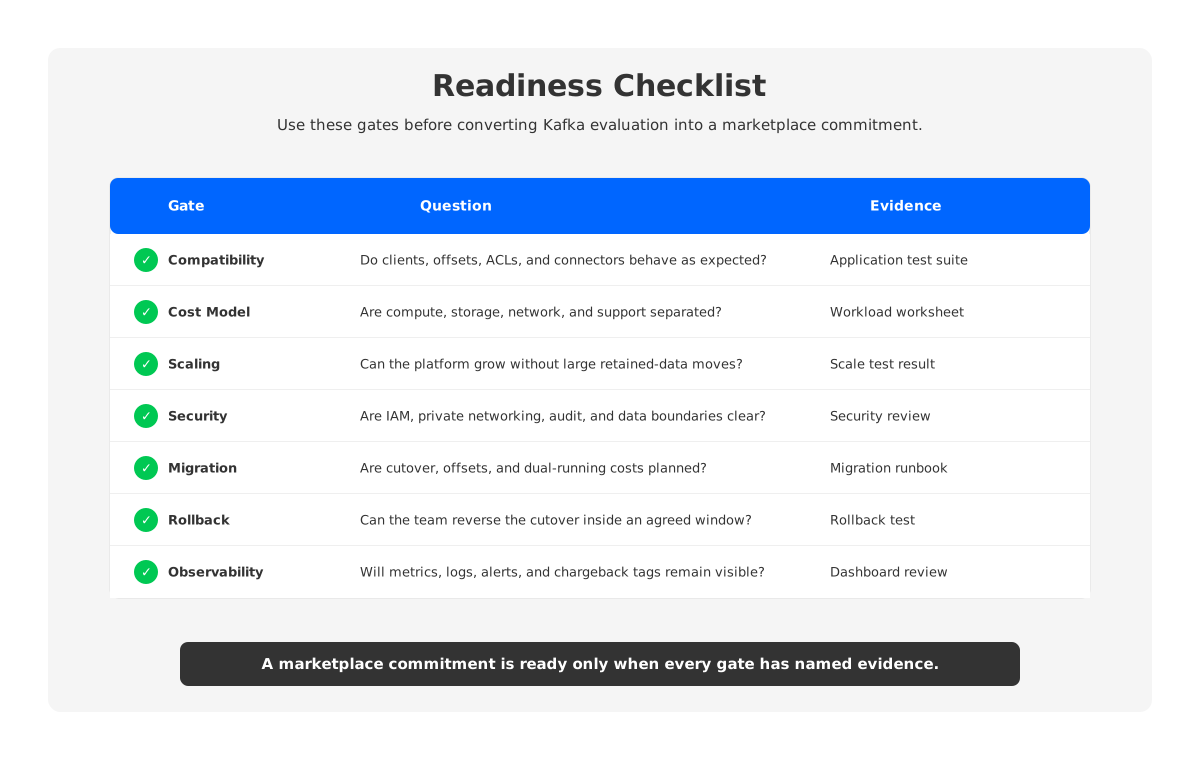
This matrix keeps the conversation honest. Finance can see how the commitment will be consumed. Platform engineering can show where architecture lowers or raises risk. Security and procurement can verify that marketplace convenience does not bypass governance. Application teams can see what will and will not change in their Kafka integration contract.
7FAQ
7.1What is cloud marketplace commit planning for Kafka?
It is the process of deciding whether a Kafka or Kafka-compatible streaming platform should be purchased through a cloud marketplace, private offer, or cloud commitment program, and how much usage the organization can responsibly commit to. For Kafka, the process must include architecture, migration, network, storage, and governance analysis, not only procurement terms.
7.2Does buying Kafka through a marketplace reduce Kafka cost by itself?
Not by itself. Marketplace purchasing can simplify billing, procurement, and commitment drawdown, but the underlying platform architecture still determines broker, storage, network, and operational cost. A poor capacity model can remain expensive even when purchased through a convenient channel.
7.3What should FinOps teams ask platform engineers before approving a Kafka marketplace commitment?
Ask for a workload model, compatibility test results, network cost assumptions, migration overlap plan, rollback plan, and scaling behavior under growth and failure. The key is to connect the commercial commitment to the technical behavior that will drive actual consumption.
7.4Where does AutoMQ fit in this decision?
AutoMQ fits when the team wants Kafka compatibility while changing the broker-local storage model that often drives Kafka cost and operations. Its Shared Storage architecture, stateless brokers, and customer-controlled deployment options make it relevant for teams evaluating cloud-native Kafka TCO and marketplace-aligned procurement.
8References
- Apache Kafka Documentation
- AutoMQ Shared Storage Architecture
- AutoMQ Compatibility with Apache Kafka
- AutoMQ WAL storage
- AutoMQ Continuous Self-Balancing
- AWS Marketplace Private Offers
- AWS Marketplace Private Marketplace
- AWS EC2 On-Demand Pricing
- AWS PrivateLink Pricing
If your marketplace review is really a Kafka architecture review in disguise, model the workload before signing the term. To test a Kafka-compatible Shared Storage architecture with customer-controlled deployment boundaries, start with AutoMQ Cloud.


