
Table of Contents
Table of Contents
Teams search for long retention storage growth kafka when the monthly bill starts exposing a design choice that used to feel harmless. A topic kept for 24 hours becomes seven days. Seven days becomes 30 days because downstream analytics, compliance review, replay testing, and incident investigation all want more history. The Kafka platform still works, but every added retention window now drags storage, broker sizing, network traffic, recovery time, and capacity reservations into the same conversation.
That is why this is a FinOps problem, not only a Kafka tuning problem. The platform team is not asking whether Kafka can retain data; Apache Kafka has clear retention controls through settings such as retention.ms and retention.bytes. The harder question is whether the storage architecture lets the business extend retention without forcing broker compute, local disks, and operational headroom to grow in lockstep. A useful decision framework follows the byte through the system, then asks who pays for each copy, each movement, each replay, and each recovery path.
1Why teams search for long retention storage growth kafka
Long-retention Kafka usually starts with a good reason. Audit teams want replayable evidence. Data engineering wants late-arriving records to remain available for lakehouse ingestion. Machine learning teams want feature backfills. SREs want enough history to recover from a bad deploy without asking application teams to reproduce data. None of these requests are wasteful by themselves.
The conflict appears when many good requests share one storage model. A platform team may accept a 30-day retention policy for one topic, then discover that another high-throughput topic has the same default. A consumer group may fall behind for a weekend and turn a normal catch-up read into a broker pressure event. A new connector may fan out retained data into multiple downstream systems. FinOps sees the result as spend growth, but operators experience it first as shrinking room to move.
The search intent is usually practical:
- How much of the Kafka bill is tied to retained bytes? Storage is visible, but retained bytes also affect replica placement, headroom, and recovery planning.
- Which workloads deserve long retention? Audit, observability, CDC, lakehouse ingestion, and replay-heavy analytics should not inherit the same policy by accident.
- Can storage grow without adding brokers? This is the architecture question behind the cost question.
- What breaks during replay? A retention plan that works only for idle data does not satisfy teams that need historical reads under production load.
Those questions are more useful than a generic cost-cutting mandate. Kafka cost optimization becomes credible only when teams separate workload classes, model operational behavior, and avoid treating all retained data as the same kind of data.
2The production constraint behind the problem
Traditional Kafka uses a Shared Nothing architecture. Each broker manages local storage, partitions are assigned to brokers, and durability is maintained through replication between leader and follower replicas. This model is one reason Kafka is robust and widely understood: producers and consumers speak a stable protocol, offsets remain ordered within partitions, and consumer groups coordinate parallel reads using familiar Kafka semantics.
Long retention stretches the lower half of that model. The retained log is not only an archive; it is part of the broker operating envelope. More retained data can mean larger broker disks, more careful partition placement, longer recovery windows, and more work during reassignment. Tiered Storage, defined in Apache Kafka through KIP-405, improves part of this equation by moving older closed log segments to remote storage. It is a meaningful option for many long-retention deployments, but it should not be confused with making brokers stateless. The active log, local capacity, remote fetch behavior, and operational recovery path still need workload-specific validation.
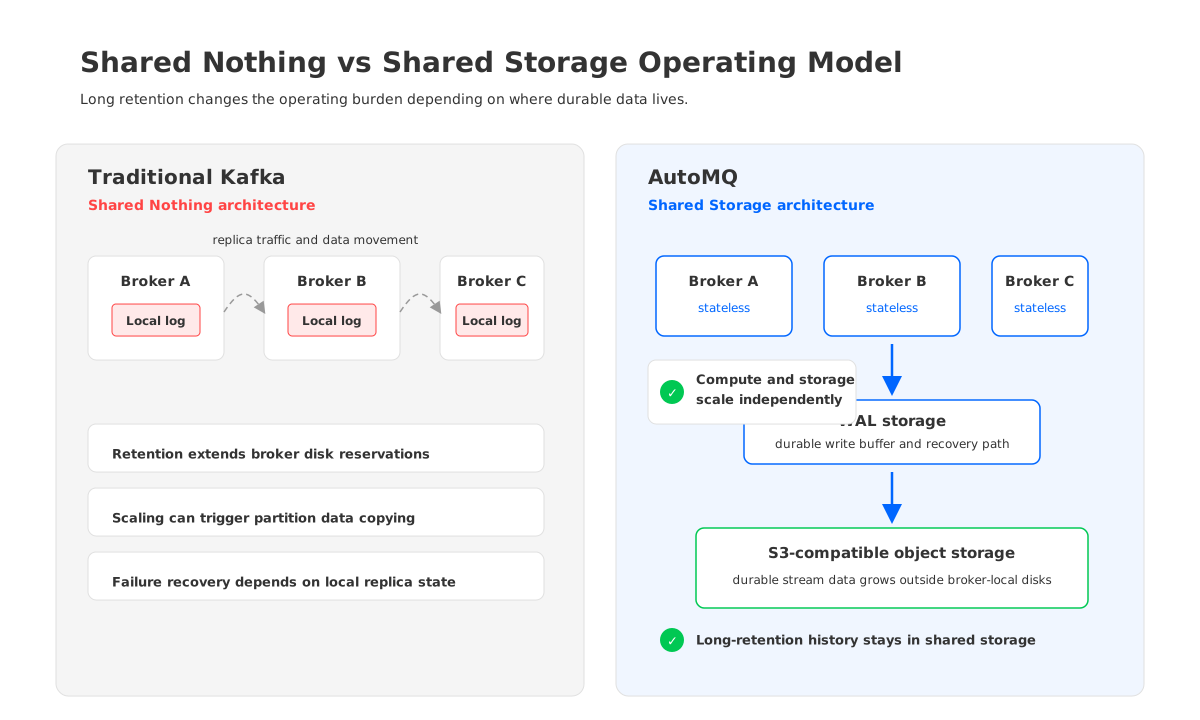
Cloud economics make the constraint sharper. In a multi-Availability Zone deployment, every replicated byte and cross-zone path deserves attention. Storage, requests, data transfer, private connectivity, and compute reservations may come from different billing categories, so the real TCO (Total Cost of Ownership) is spread across several pages of the invoice. FinOps teams can miss the root cause if they look only at a single storage line item.
The practical lesson is simple: retention growth becomes expensive when the architecture turns stored history into broker-local obligation. The bill is only the symptom. The deeper issue is that the platform loses elasticity because retained data, broker count, failure recovery, and replay behavior are tied together.
3Architecture options and trade-offs
The right architecture depends on what problem long retention is solving. A compacted operational topic, a 90-day audit stream, an observability firehose, and a CDC feed into a table format can all use Kafka APIs while needing different storage and recovery assumptions. Treating them as one workload class is how teams get surprised.
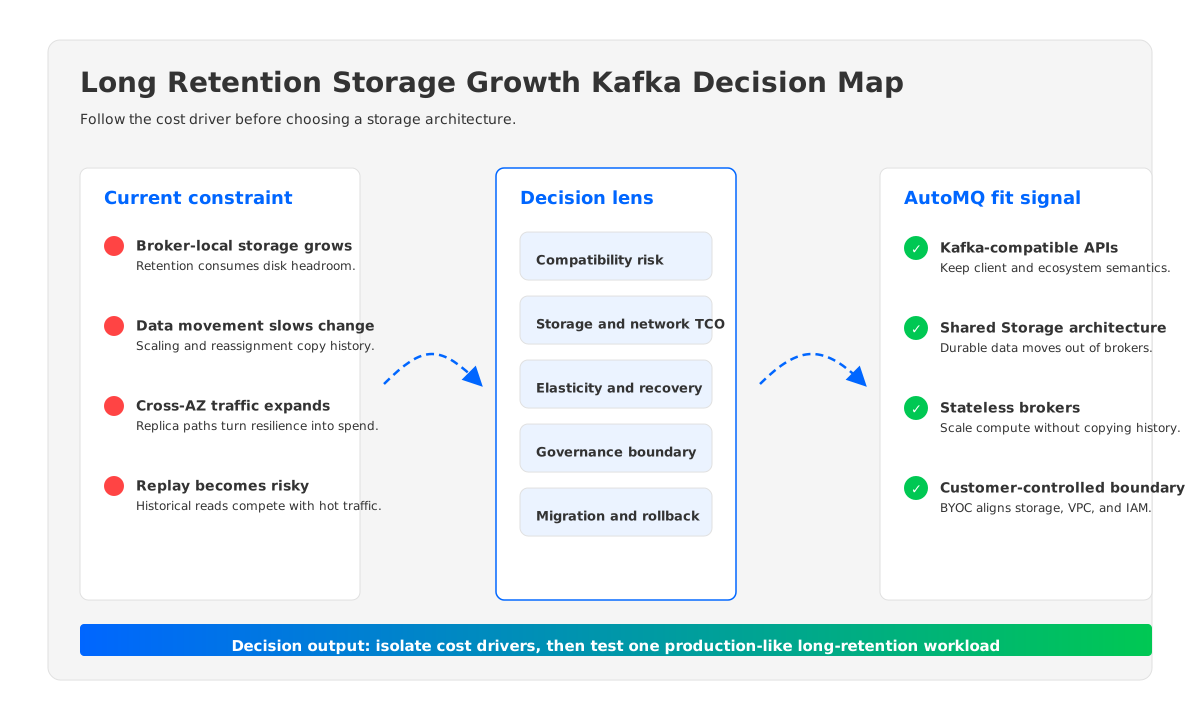
Use the decision map as a first-pass filter, then validate the surviving options against real traffic. The most common choices look like this:
| Option | What it changes | Where it fits | What to test |
|---|---|---|---|
| Bigger broker-local disks | Increases local retention capacity without changing the architecture | Stable workloads with predictable growth and strong local-latency needs | Disk utilization, broker recovery time, partition reassignment, and headroom policy |
| More clusters by workload class | Reduces blast radius and separates cost ownership | Teams with clear domain, compliance, or SLO boundaries | Operational overhead, cluster sprawl, monitoring consistency, and migration cost |
| Apache Kafka Tiered Storage | Offloads older log segments to remote storage while preserving Kafka's broker model | Long retention where historical data is mostly cold and remote fetch behavior is acceptable | Hot-tier sizing, remote read latency, replay load, metadata scale, and failure recovery |
| Kafka-compatible Shared Storage architecture | Separates durable stream storage from broker-local disks | Workloads where retained history, scaling, and data movement are the bottleneck | Client compatibility, write durability, cache behavior, object storage requests, and migration rollback |
No option is universally correct. Larger disks may be the lowest-risk move for a stable cluster. Tiered Storage may be a strong fit when the pain is mostly historical storage pressure. Separate clusters may be justified when compliance boundaries are stricter than platform efficiency goals. Shared Storage architecture deserves attention when retained history is making broker operations heavier than the business can tolerate.
This is where FinOps and SRE should work from the same worksheet. FinOps brings the cost categories; SRE brings the failure modes. A decision that lowers storage cost but creates hard-to-test replay behavior is not a win. A decision that improves elasticity but breaks client compatibility is not production-ready. The goal is not to minimize one line item; it is to reduce the cost of keeping the stream reliable as history grows.
4Evaluation checklist for platform teams
A useful checklist rejects weak plans early. It should force every architecture option to answer the same questions about compatibility, cost, elasticity, governance, failure recovery, migration risk, and team ownership. Run it against one representative topic from each workload class instead of using a toy benchmark.
| Review area | Decision question | Evidence to collect |
|---|---|---|
| Compatibility | Can existing producers, consumers, Kafka Connect jobs, Kafka Streams applications, transactions, and monitoring tools keep working? | Client inventory, protocol errors, transaction usage, consumer rebalance behavior, and tool compatibility notes |
| Cost model | Which line items grow with retained bytes, replicated bytes, replay reads, object storage requests, and idle headroom? | Topic throughput, retention windows, read fan-out, storage class, cross-AZ paths, and cloud pricing assumptions |
| Elasticity | Can compute scale independently from retained history? | Scale-out time, partition movement volume, reassignment behavior, cache warm-up, and broker replacement tests |
| Governance | Who owns data location, encryption, IAM, audit logs, and retention approval? | Cloud account boundary, bucket policy, access logs, topic ownership, and approval workflow |
| Failure recovery | What happens when a broker, zone, or storage path fails during replay? | Recovery runbook, RPO/RTO targets, lag recovery time, offset checkpoints, and failure drill results |
| Migration risk | Can the team cut over, validate offsets, and roll back without losing data or blocking consumers? | Mirror plan, offset sync, dual-write policy, validation queries, and rollback criteria |
| Team boundary | Which team operates brokers, storage, networking, observability, and security review? | RACI, escalation path, monitoring ownership, and incident review process |
The evidence matters more than the score. If a team cannot explain read fan-out, it cannot forecast replay cost. If it cannot test broker replacement, it cannot claim elasticity. If it cannot name who owns object storage policy, it cannot pass governance review. Long retention turns hidden assumptions into production requirements.
5How AutoMQ changes the operating model
After the neutral evaluation is complete, AutoMQ becomes relevant for teams whose bottleneck is the coupling between broker compute and durable storage. AutoMQ is a Kafka-compatible, cloud-native streaming platform that keeps Kafka protocol semantics while moving persistent stream data into a Shared Storage architecture backed by S3-compatible object storage.
The important change is not that object storage has a lower unit storage price in isolation. The important change is operational: stateless brokers no longer have to own retained data on local disks. AutoMQ uses S3Stream as its storage layer, with WAL (Write-Ahead Log) storage for durable writes and S3 storage as the main storage layer. Brokers handle Kafka protocol processing, leadership, caching, and routing, while durable stream data lives in shared object storage. That separation changes how teams reason about long retention, broker replacement, and scaling.
For FinOps, this creates a cleaner model. Retention growth can be modeled closer to object storage usage rather than broker disk reservation. Compute can be planned around active traffic, cache behavior, and request processing instead of retained history alone. Cross-AZ traffic also becomes part of the architecture discussion: AutoMQ's shared-storage design is built to reduce cross-AZ data replication patterns that make traditional multi-AZ Kafka costly. Teams should still validate their own cloud region, networking, WAL type, and workload profile before treating any cost outcome as guaranteed.
For platform teams, the operating model changes in four concrete ways:
- Capacity planning becomes workload-aware. Long-retention topics no longer need to force the same broker sizing assumptions as hot operational topics.
- Scaling can focus on compute pressure. Adding broker capacity is less entangled with copying retained data between broker-local disks.
- Recovery drills become more direct. Broker replacement is closer to leadership and ownership transition than full local data reconstruction.
- Governance boundaries are easier to review. In AutoMQ BYOC, the control plane and data plane run in the customer's cloud account and VPC, so storage, networking, IAM, and observability can align with customer-controlled policies.
This does not remove the need for engineering validation. Shared Storage architecture introduces its own questions around WAL storage, object layout, cache behavior, object storage request patterns, and cold-read performance. A serious proof of concept should test the same long-retention workload that caused the FinOps concern in the first place, including replay, failure recovery, migration, and observability. The benefit is that the team is testing a different operating model, not only a different broker size.
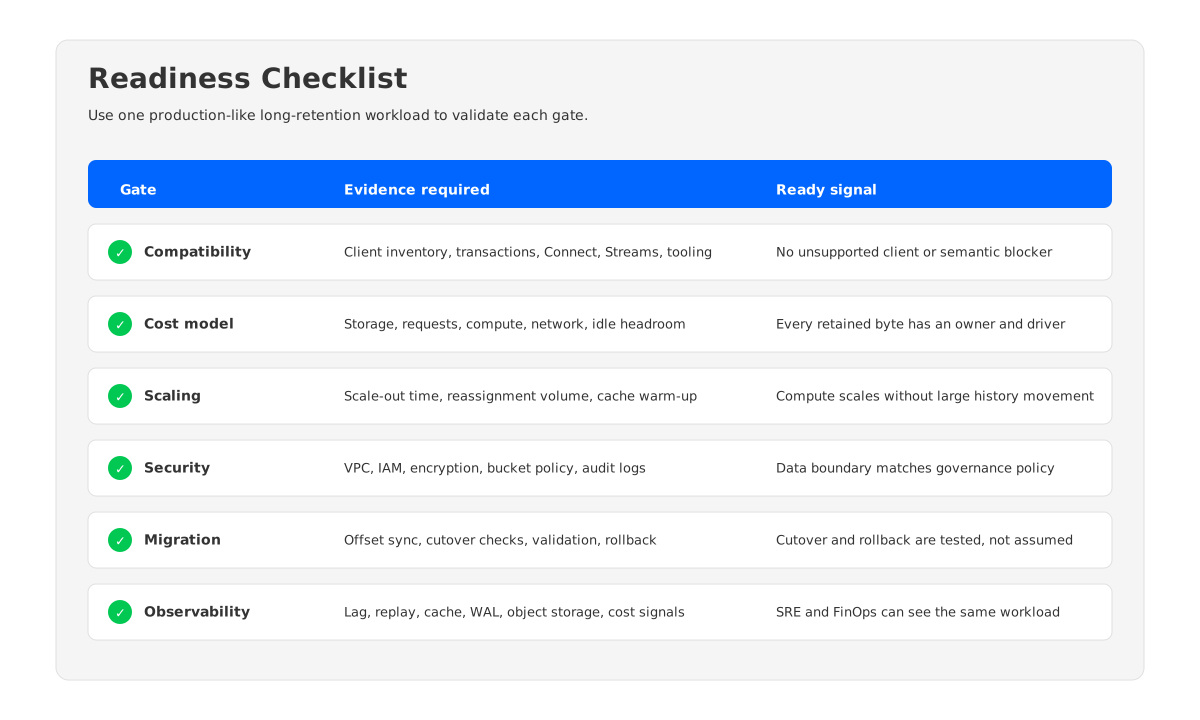
The final decision should be narrow enough to act on. Choose one topic class, define its retention window, replay requirement, fan-out pattern, and compliance boundary, then compare the options against measured behavior. If the workload is stable and local-latency-sensitive, broker-local storage or Tiered Storage may remain the right path. If retained history is blocking elasticity, recovery, or cost attribution, a Kafka-compatible Shared Storage architecture should be evaluated directly.
Long retention is not a storage checkbox. It is a commitment to keep historical events usable while the platform scales, fails, recovers, migrates, and gets audited. When teams search for long retention storage growth kafka, the useful answer is not a single feature. It is a decision framework that makes every retained byte explainable.
If your team is evaluating that architecture shift, start with one production-like workload and review AutoMQ against the checklist above: explore AutoMQ for Kafka-compatible long-retention workloads.
6FAQ
6.1Is long-retention Kafka mainly a storage pricing problem?
No. Storage pricing is only one part of the decision. Long retention also affects broker sizing, replication, recovery time, replay load, read fan-out, networking, governance, and migration planning.
6.2Does Apache Kafka Tiered Storage solve long-retention storage growth?
Tiered Storage can reduce local disk pressure by moving older closed log segments to remote storage. It is useful for many long-retention cases, but teams still need to test active-log sizing, remote reads, replay behavior, metadata scale, and failure recovery.
6.3When should teams evaluate Shared Storage architecture?
Evaluate it when retained history makes broker operations harder: slow reassignment, growing local disks, high cross-AZ replication cost, difficult recovery drills, or poor cost attribution between compute and storage.
6.4What should a proof of concept include?
Use one real long-retention workload. Test producer compatibility, consumer offsets, replay from older data, failure recovery, scaling, object storage behavior, observability, migration cutover, and rollback.


