
Table of Contents
Table of Contents
A platform team choosing a streaming system often starts with the same ritual: open a few Apache Kafka distribution comparison pages, skim the feature matrices, and finish the day less certain than when it started. The lists answer a question nobody on the evaluation asked. They rank popularity, not fit. A distribution that tops a feature count can still fail on the two or three criteria that decide whether the team ships, operates, and eventually leaves the platform without a migration crisis. Rankings hide the weightings behind them, so a reader inherits another organization's priorities without seeing the tradeoffs. The ranking feels objective, but the weighting inside it never is.
The way out is to fix the criteria and the weights before any vendor gets scored. This framework runs on four dimensions: compatibility, cost, operations, and exit. Score every candidate against the same dated evidence, write the decision down, and schedule a review. Apache Kafka stays the protocol baseline throughout, while the distribution itself can be self-managed, fully managed, brought to your own cloud, or built around object storage.
Getting it wrong is expensive in a particular way. A platform choice is a drawn-out discovery followed by an even longer obligation. Compatibility errors surface as client rewrites, cost errors as budget overruns at scale, and operations errors as an on-call load the team cannot absorb. Exit errors are the worst to discover late because they surface exactly when leaving matters.
1Why rankings do not settle platform choices
A ranked list solves a different problem than the one an evaluation team has. The list compresses dozens of attributes into one order, and that compression requires a weighting the reader never chose. The moment one dimension matters more than the others, the ranking drifts away from the decision it claims to support. A comparison page mostly measures breadth and vendor completeness, and the attributes it lists are chosen by someone trying to cover every possible buyer, not by someone bound to your workloads. That is why two teams with opposite requirements can arrive at the same top pick, and why the conclusion can feel inevitable even while it does not fit.
A ranking is one organization's weightings wearing a neutral costume.
Feature counts drift in the same direction. A platform can win on breadth while the team only needs two capabilities performed at scale. Presence in a matrix records that a feature exists, not that it holds up under the team's retention, partition counts, or failure patterns. Breadth without a workload is a point score, not evidence.
The choice is also economic and operational rather than purely technical. Someone must run the brokers, pay for compute, storage, and network traffic, and own recovery when the platform breaks. A distribution that scores well on capabilities can score poorly on those obligations, and the obligations last longer than the evaluation. A neutral framework changes the sequence: the team writes its own criteria and weights, then collects evidence, then ranks. That sequence keeps the weighting explicit, which is the part a vendor comparison page cannot supply.
2Four dimensions and how to weight them
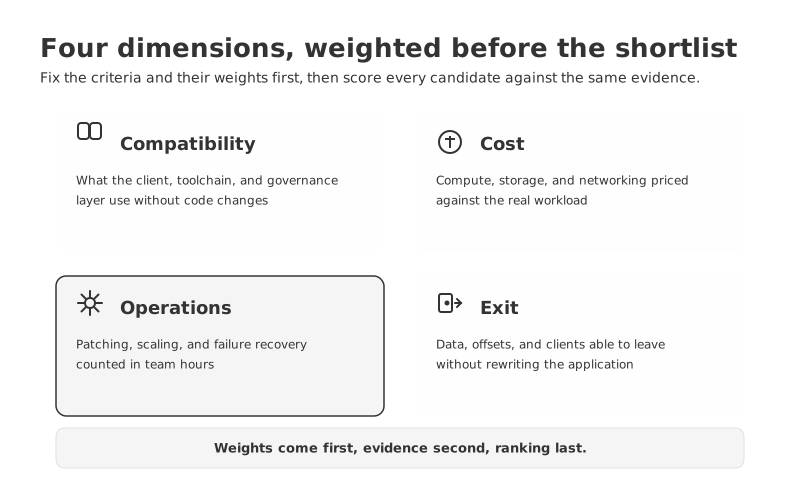
Four dimensions cover most Kafka platform decisions without growing into an unworkable scorecard. Each dimension answers one question the team can defend in a review, and each one needs its own evidence rather than a shared impression. The four buckets are broad enough to absorb most vendor differences, which keeps the scorecard short enough to finish.
| Dimension | The question it answers | What it exposes |
|---|---|---|
| Compatibility | Can existing clients, SDKs, and tools keep working without code changes? | Protocol surface, configuration behavior, and governance tooling versus what applications actually call |
| Cost | What does the platform cost at the planned scale? | Compute, storage, network traffic, and the labor required to keep it running |
| Operations | How much team time does running it consume? | Patching, scaling, rebalancing, recovery, and observability toil counted in hours |
| Exit | How do data, offsets, and clients leave later? | Retention portability, offset migration, and the tested path off the platform |
The weights belong to the workload, not to the vendor. One defensible starting point is compatibility at 40%, cost at 25%, operations at 20%, and exit at 15% for a team that is replacing an existing Kafka deployment and cannot absorb a client rewrite. A greenfield project with tight unit costs might move weight toward cost, and a regulated team might raise operations. Keep the weights documented and fixed while scoring so a later change can be audited rather than argued about.
Weights force tradeoffs to be argued before evidence arrives, which is the point. If compatibility is weighted first and a candidate fails the protocol test, the evaluation stops there regardless of a low sticker price. That early stop is not bias; it is the team honoring the criteria it wrote in advance. Change the weights later, and the same evidence yields a different order, which is exactly how a framework should behave.
3Evidence table: mapping candidates honestly
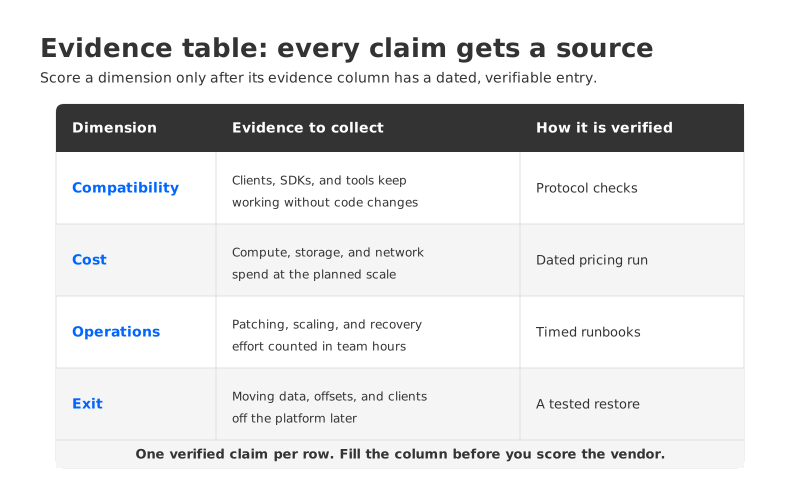
Rankings invite adjectives; an evidence table requires sources. For each row, write one verifiable claim, its source and date, and the way it was confirmed. No score until the evidence column has an entry. A claim that a platform is compatible is not evidence; a dated result of running the existing producer, consumer, and connector set against it is.
| Dimension | Verifiable claim | How it is confirmed |
|---|---|---|
| Compatibility | Existing clients, SDKs, and tools run without code changes | Protocol and integration tests against the current application suite |
| Cost | Compute, storage, and network spend at the planned scale | A dated pricing run using the real workload shape |
| Operations | Patching, scaling, and recovery effort held inside the team's budget | Timed runbooks and a completed recovery drill |
| Exit | Data, offsets, and clients can move off the platform later | A tested restore and migration path |
Evidence goes stale quickly in a market that changes between procurement cycles. Tag each claim with a collection date and a re-verification window, and disqualify rows that cannot be refreshed. A claim that was true in the previous procurement cycle belongs to that cycle, not to this one.
The table also clarifies what the solution must provide. A distribution that claims compatibility has to preserve the Kafka protocol so the client layer stays unchanged. A distribution that claims a better cost or operations profile has to change the storage design without breaking that compatibility. Apache Kafka's Tiered Storage proposal, KIP-405, separates remote log data from local storage and is the right reference for judging those claims independent of any vendor's marketing.
That bridge is where AutoMQ enters the table as a candidate rather than as a conclusion. AutoMQ is Kafka-compatible and uses S3Stream with object storage for durable stream data, while WAL storage and caching serve the low-latency write and read paths. Its compatibility with Apache Kafka and architecture overview describe the boundaries the table should test. Score it exactly like every other candidate: protocol tests for compatibility, a dated pricing run for cost, a timed recovery drill for operations, and a tested restore for exit.
4The biases that ruin evaluations
Each bias below is a reason an evaluation team signs for a platform and regrets it a year later. None of them appears on a feature matrix, because each one lives in how the team reads the matrix rather than in the matrix itself. The countermeasure is always the same shape: move the claim into the evidence table before acting on it.
- Feature-glance bias. The team scores features by presence instead of fit, and the two capabilities the workload needs are buried in the matrix. Counter it by requiring a test or a dated claim in every row before the score moves.
- Sticker-price bias. The list price hides cross-AZ traffic, storage growth, and the hours spent on patching and recovery. Counter it by pricing the real workload shape, traffic patterns included.
- Popularity bias. The team assumes the top-ranked or most discussed option will fit because other people chose it. Counter it by withholding the ranking until the team's own weights are applied.
- Exit blindness. The decision is judged on day-one migration cost while the cost of leaving is never scored. Counter it by completing the exit row before any contract is signed.
- Backfilled confirmation. The team picks a favorite early and then searches for evidence that agrees. Counter it by collecting evidence before scoring and publishing the finished table to someone who was not in the room.
The biases interact. Feature-glance bias supplies the favorite, popularity bias dresses the favorite in market authority, and backfilled confirmation finishes the job with selected evidence. Separating them matters less than the single countermeasure they share: no row moves without a source, and no score changes without a row.
5A decision record you can defend next year
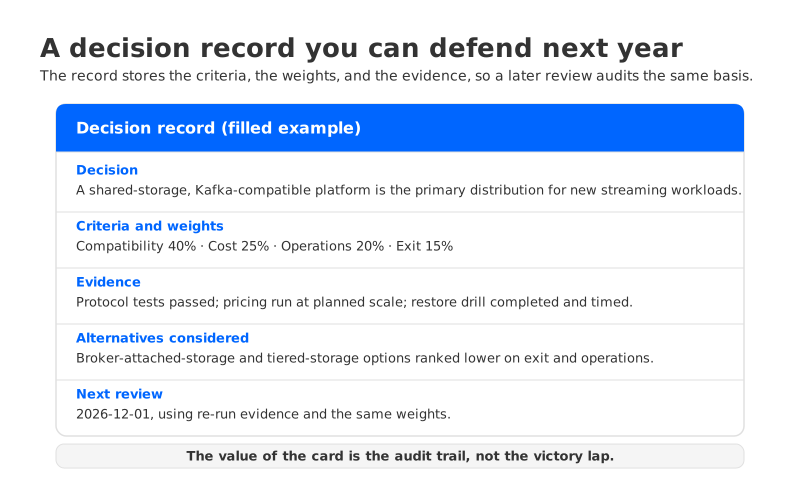
The decision record is the deliverable that survives personnel changes and annual reviews. It stores the decision in one sentence, the criteria and their weights, the evidence that supported the score, the alternatives that lost and why, the owner, and the next review date. A short card beats a long document because it forces the team to name the deciding factors.
The card template in the figure is compact because it has to fit in a pull request, a wiki page, or an architecture review. Anyone who inherits the decision should be able to read it in two minutes and see what was decided, what evidence supported it, what lost, and when the question reopens. If a decision cannot survive that summarization, the team has not finished deciding.
The decision that survives a team change is the one whose weights were written down while it was being made.
Review cadence follows the workload, not the calendar alone. Revisit the record when retention, traffic, or budget forecasts change, and re-run the evidence rather than re-reading the old numbers. The value of the card is the audit trail it leaves: next year's reviewer can see the same basis the current team used and challenge the weighting instead of relitigating the choice.
If the table surfaces broker-local storage as the recurring constraint behind cost and operations, explore the AutoMQ project on GitHub and run the same four dimensions with your own evidence. Weight the dimensions before you read the feature list, collect dated evidence for every row, and keep the exit drill in the record. The framework earns its keep when the decision outlives the sales cycle.
6References
- Apache Kafka documentation
- Apache Kafka KIP-405: Kafka Tiered Storage
- AutoMQ compatibility with Apache Kafka
- AutoMQ shared streaming storage overview
- Kafka Monitoring That Finds Problems Before Consumers Do
- How to monitor Kafka and AutoMQ
7FAQ
7.1What four dimensions should a Kafka distribution evaluation use?
Start with compatibility, cost, operations, and exit. Compatibility covers whether existing clients, SDKs, and tools keep working without code changes. Cost covers compute, storage, and network spend at the planned scale. Operations covers patching, scaling, and recovery effort in team hours. Exit covers how data, offsets, and clients can leave the platform later, with a tested path.
7.2How should the four dimensions be weighted?
The weights should follow the workload. A team replacing an existing Kafka deployment without room for a client rewrite might use compatibility at 40%, cost at 25%, operations at 20%, and exit at 15%. A cost-sensitive project moves weight toward cost, and a regulated team raises operations. Fix the weights before scoring and keep them documented so later changes can be audited.
7.3How do you keep a Kafka vendor comparison honest?
Require one verifiable claim per row before a score moves. For each dimension, record the claim, its source and date, and the way it was confirmed. Running the existing producer, consumer, and connector set counts as compatibility evidence; a feature checkbox does not. Collect the evidence before scoring and publish the finished table to a reviewer who was not in the room.
7.4Does an object-storage-native distribution still count as Kafka?
It can, when it preserves the Kafka protocol so the client layer stays unchanged while the storage design differs. Apache Kafka's KIP-405 already separates remote log data from local storage, which is the right reference for judging such claims. Test the distribution the same way as any candidate: protocol tests for compatibility, a dated pricing run for cost, a timed recovery drill for operations, and a tested restore for exit.


