
Table of Contents
Table of Contents
Searches for real time lakehouse ingestion kafka usually come from teams that already have a streaming estate. They are not asking whether events matter. They are asking why a pipeline that worked for operational consumers starts to feel brittle when the lakehouse becomes another near-real-time consumer, complete with schema rules, replay expectations, catalog ownership, and incident response paths. The uncomfortable part is that the ingestion problem rarely lives in one tool. It appears where Kafka operations, stream processing, table formats, object storage, governance, and platform budgets meet.
The platform engineer sits in the middle of that meeting. Application teams want fresh records. Analytics teams want queryable tables. Security teams want retention and auditability. SREs want bounded blast radius, clear rollback, and fewer broker emergencies. The useful question is not "Which connector should write to the lakehouse?" The better question is whether the streaming foundation can absorb lakehouse-style requirements without turning every retention, backfill, or schema event into a storage and operations project.
1Why teams search for real time lakehouse ingestion kafka
Kafka became the default interface between transactional systems and downstream data platforms because it gives teams a shared log, ordered partitions, consumer groups, offsets, and a large connector ecosystem. That model fits lakehouse ingestion well at first. A source connector, CDC service, or producer writes records into topics, while one or more consumers materialize those records into Apache Iceberg, Delta Lake, Apache Hudi, object storage files, or a query engine's staging layer. Each team can own its consumer without changing the producer's code path.
The pressure starts when the lakehouse path stops being a side export. A table writer may need longer retention for replay, stricter ordering for CDC, idempotent writes for recovery, and clean separation between raw, validated, and curated streams. A governance process may ask who can read a topic, how schema changes are approved, and how deleted or corrected records are represented in the table. A data platform team may add a second writer for a different table format or region. None of those requests sound dramatic. Together, they change the Kafka cluster's workload shape.
That workload shape has a few recognizable signals:
- More retained bytes. Lakehouse ingestion often treats Kafka as the replay buffer for table rebuilds, late data, and failed writer recovery, so retention grows beyond the operational consumer window.
- More fan-out. The same topic may feed a Flink job, a table writer, a feature pipeline, an audit scanner, and an ad hoc debugging consumer.
- More backfill behavior. Catch-up reads become normal during incident recovery, table migration, or historical reprocessing.
- More ownership boundaries. Streaming teams, data platform teams, and security teams share the same data path but measure risk differently.
Kafka can support this pattern, but the architecture underneath Kafka decides how expensive and difficult the support becomes.
2The production constraint behind the problem
Traditional Kafka uses a Shared Nothing architecture. Each broker owns local storage, and partition replicas are spread across brokers for durability and availability. This design is coherent. It gives Kafka clear ownership of logs, predictable leader and follower behavior, and a mature operational model. The trade-off is that durable data is bound to broker-local disks, so many operational changes become data movement events.
Lakehouse ingestion makes that binding more visible. When retention grows, broker disks grow. When producers and consumers spread across Availability Zones, replication and client paths can create cross-zone traffic. When a broker needs replacement or the cluster needs additional capacity, partition reassignment has to account for local data placement, replica movement, and hot partitions. When table writers fall behind, catch-up reads compete with serving traffic unless the cluster has enough headroom. The platform team can tune its way through some of this, but tuning does not change the storage contract.
Apache Kafka Tiered Storage changes part of that contract by moving older log segments to remote storage while retaining a local hot tier. That can be a practical fit when the primary pain is long retention of cold segments. It does not make brokers stateless, and it does not remove the need to reason about the local tier, leader placement, partition reassignment, or the cost of serving hot and catch-up traffic. For lakehouse ingestion, the distinction matters. A downstream table writer cares about replay and durability, but the platform team still carries the broker-local operations model.
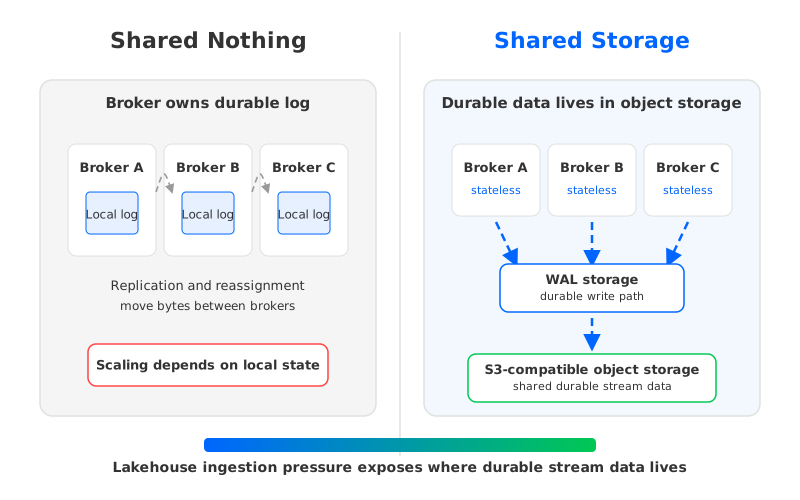
This is why the ingestion decision should start below the connector layer. A connector can choose file sizes, partitioning, exactly-once behavior, and error handling. It cannot make a stateful broker fleet elastic by itself. It cannot remove data movement from a partition reassignment. It cannot decide whether your durable stream storage should be tied to local disks or object storage. Those are platform architecture choices, and they show up later as pager load, budget variance, and migration risk.
3Architecture options and trade-offs
A practical evaluation starts by separating four layers that are often mixed together in one diagram. The first layer is the Kafka contract: producers, topics, partitions, consumer groups, offsets, transactions, ACLs, and client compatibility. The second is the ingestion runtime: Kafka Connect, Flink, Spark Structured Streaming, a custom writer, or a native table-writing path. The third is the lakehouse target: table format, catalog, object storage, compaction, and query engine. The fourth is the streaming platform's storage architecture.
Each layer has a different failure mode. A table writer bug can duplicate files or skip a checkpoint. A schema change can break consumers. A catalog outage can stop table commits while Kafka keeps accepting records. A broker storage bottleneck can slow both operational consumers and lakehouse writers. Treating all of these as "Kafka ingestion problems" hides the decision that matters most: which layer should own durability, replay, scaling, and recovery?
The table below is a useful first-pass decision map for platform teams.
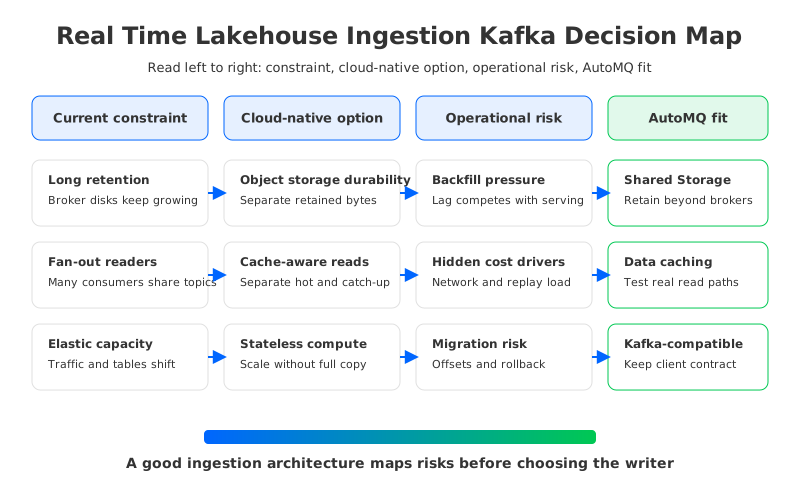
| Evaluation area | What to test | Why it matters for lakehouse ingestion |
|---|---|---|
| Kafka compatibility | Client versions, serializers, transactions, offset behavior, consumer groups, and admin tooling | Application cutover should not become a rewrite project. |
| Storage architecture | Broker-local disks, remote tiers, or shared object storage | Retention, backfill, broker replacement, and scaling all depend on where durable bytes live. |
| Cost drivers | Compute, storage, network paths, requests, retention, and operational labor | Lakehouse workloads often shift cost from steady writes to retained bytes and fan-out reads. |
| Governance | ACLs, schema controls, catalog ownership, encryption, audit logs, and data residency | The table path introduces more readers and more policy owners. |
| Recovery | Writer retry, offset reset, table rollback, replay windows, and failed broker behavior | A broken table commit should not corrupt the stream or trap the team in manual recovery. |
| Migration | Topic mapping, offset preservation, rollback, dual running, and observability | The riskiest migrations are the ones that preserve protocol but lose operational state. |
The point of the matrix is not to rank tools before testing them. It is to stop the team from over-weighting the shiny part of the lakehouse stack. File layout and catalog integration matter, but the streaming substrate decides whether the platform can handle long retention, bursty writes, backfills, and broker replacement without constant capacity theater.
4Evaluation checklist for platform teams
Once the architecture layers are separated, the next step is a readiness review that feels closer to an SRE design review than a vendor scorecard. Start with one representative topic family, not the whole company. A CDC topic with deletes, updates, and out-of-order recovery tells you more than a clean append-only demo. A high-volume observability topic tells you about retention and fan-out. A financial event topic tells you about ordering, audit, and rollback.
Use the same workload to test each candidate path:
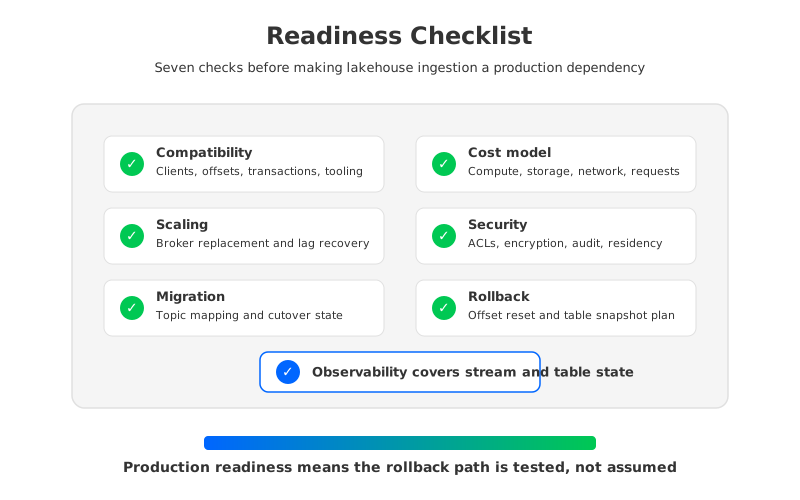
The checklist is deliberately operational. It asks whether the platform can be run, recovered, and explained under pressure. A table that looks correct during a demo is useful. A pipeline that survives a lag spike, a bad schema, a broker replacement, and a rollback drill is the one that belongs in production.
5How AutoMQ changes the operating model
After the neutral evaluation, one architecture question becomes hard to avoid: do you need Kafka compatibility, or do you specifically need broker-local durable storage? Those are different requirements. Many teams need the Kafka protocol because their producers, consumers, Flink jobs, Kafka Connect connectors, Terraform modules, and runbooks already assume Kafka behavior. Fewer teams require the operational side effect that durable bytes live on broker-attached disks.
AutoMQ is relevant in that gap. It is a Kafka-compatible, cloud-native streaming platform that keeps the Kafka API and ecosystem contract while replacing Kafka's local log storage with a Shared Storage architecture. In that model, AutoMQ Brokers are stateless, durable stream data is stored in S3-compatible object storage through S3Stream, and WAL (Write-Ahead Log) storage sits in the write path for low-latency durable acknowledgment and failure recovery.
AutoMQ also gives teams several deployment and integration choices. AutoMQ Open Source uses S3 WAL, which keeps the architecture simple for latency-insensitive workloads such as logs, monitoring, and analytics ingestion. AutoMQ commercial editions can use other WAL storage options, including Regional EBS WAL and NFS WAL, depending on cloud provider and workload requirements. AutoMQ BYOC places the control plane and data plane in the customer's cloud environment, while AutoMQ Software targets private data center deployments. Those boundaries matter when lakehouse ingestion touches regulated data, private networking, IAM, and region control.
For teams trying to reduce the number of moving parts between streaming and tables, AutoMQ Table Topic is also worth evaluating. It is designed to write streaming data into Apache Iceberg tables from the platform layer, rather than forcing every team to assemble its own writer stack. That does not remove the need to validate schema, delete semantics, catalog behavior, compaction, and rollback. It does change where the integration responsibility sits: closer to the Kafka-compatible streaming platform rather than as an external sidecar pipeline for every topic family.
6A production scorecard
The final decision should be boring in the right sense: a scorecard that everyone can inspect. Give each category a weight based on the workload, not on vendor preference. A payments-adjacent stream may weight compatibility, ordering, rollback, and audit highest. A clickstream-to-Iceberg pipeline may weight retention cost, fan-out, object storage behavior, and table writer recovery higher. A multi-region data platform may weight deployment boundary, networking, and migration path above feature breadth.
| Category | Green signal | Red signal |
|---|---|---|
| Compatibility | Existing clients, offsets, consumer groups, transactions, and tools work in the test plan | The platform requires application rewrites before architecture value is proven |
| Elasticity | Scaling and broker replacement do not turn into long data movement windows | Capacity changes require fragile reassignment planning during traffic spikes |
| Lakehouse recovery | A failed writer can catch up or roll back without corrupting stream state | Table repair depends on manual offset guessing or producer downtime |
| Cost model | Retention, fan-out, network paths, and object storage requests are modeled separately | The estimate only counts broker hours and ignores backfill behavior |
| Governance | Ownership is clear across topics, schemas, catalog, encryption, and audit | Security review begins after the ingestion path is already built |
| Migration | Cutover and rollback preserve the operational state that consumers depend on | The test validates protocol connectivity but not offsets, lag, or rollback |
Return to the search that started the work: real time lakehouse ingestion kafka. The phrase sounds like a pipeline question, but production turns it into an architecture question. If your team wants Kafka compatibility and a storage model built around object storage rather than broker-local disks, start with the AutoMQ architecture documentation and run the scorecard against one real topic family. For a hands-on path, try the project from the AutoMQ GitHub short link.
7FAQ
7.1Is Kafka still a good fit for real-time lakehouse ingestion?
Kafka is a strong fit when teams need durable streams, partitioned ordering, independent consumers, offset-based replay, and broad ecosystem support. The platform question is whether the specific Kafka-compatible architecture can handle retention, fan-out, backfill, and recovery requirements without excessive operational load.
7.2Should lakehouse ingestion use Kafka Connect, Flink, or a native table-writing feature?
Use the runtime that matches the transformation and ownership model. Kafka Connect fits standardized source and sink movement. Flink fits stateful processing, enrichment, and event-time logic. A native table-writing feature can reduce external pipeline work when the streaming platform owns the table output path. Test failure behavior before choosing.
7.3Does Tiered Storage solve the lakehouse ingestion problem?
Tiered Storage can help with older log segments and long retention, but it does not by itself make brokers stateless. Teams still need to evaluate the local hot tier, reassignment behavior, read paths, and recovery under table-writer lag.
7.4Where does AutoMQ fit in the architecture?
AutoMQ fits when the team needs Kafka compatibility but wants a Shared Storage architecture backed by S3-compatible object storage. It is especially relevant for long retention, replay-heavy ingestion, elastic scaling, and customer-controlled deployment boundaries.
7.5What should a proof of concept include?
A useful proof of concept includes real producers, at least one operational consumer, the lakehouse writer, schema changes, lag recovery, broker replacement or scaling, observability checks, and a rollback drill. A happy-path file-writing demo is not enough.


