
Table of Contents
Table of Contents
Teams usually search for schema aware transformation kafka after a transformation has stopped being a neat connector setting. A source team adds a field. A sink team expects a different naming convention. A governance team asks who approved the change. A Flink job, Kafka Connect task, or consumer service starts carrying logic that nobody wants to own permanently. The hard part is not applying a transform to a record. The hard part is deciding where that transform belongs, how it behaves when schemas evolve, and whether the Kafka platform can absorb the operational pressure that follows.
A useful answer starts with a sharper definition. A schema-aware transformation is any streaming change that interprets the structure of the record, not only its bytes. It may rename fields, drop sensitive attributes, normalize CDC envelopes, enrich records with metadata, route by schema version, or prepare events for a lakehouse table. Once the transform reads schema meaning, it also inherits schema governance, compatibility testing, observability, rollback, and migration risk.
That is why this question belongs to platform engineers as much as application developers. The platform must preserve Kafka semantics for Producers, Consumers, Consumer groups, Offsets, transactions, Kafka Connect, and stream processing jobs while giving teams enough control to evolve data contracts. If the storage and scaling model under Kafka is already tight, schema-aware work often exposes the constraint.
1Why teams search for schema aware transformation kafka
The search intent usually comes from one of four production situations. A data engineering team wants to transform records before they land in a warehouse or lakehouse. A platform team wants reusable transformation rules instead of one-off consumer code. A security team wants policy enforcement before data reaches lower-trust destinations. A migration team wants to keep offsets, topic behavior, and schema expectations stable while moving to a Kafka-compatible target.
These situations look different, but they share a common failure mode: transformation logic becomes distributed across too many places. Some rules live in connector configuration. Some live in stream jobs. Some live in application code. Some are implied by downstream table schemas. When an incident happens, operators have to reconstruct the record path from source schema to topic, from topic to transform, from transform to sink, and from sink back to the consumer offset that triggered the bad write.
Kafka is powerful precisely because it lets many systems consume the same stream independently. That fan-out becomes harder to govern when every consumer interprets the schema differently. A platform team does not need to centralize every transform, but it does need a small set of rules for where transformations should run.
Use this framing:
- Keep transformations in application code when the rule is domain-specific, low blast radius, and owned by the application team.
- Use Kafka Connect transformations or connector-level configuration when the rule is close to source or sink integration and can be tested with connector lifecycle controls.
- Use stream processing jobs when the transformation needs joins, windows, state, or business logic that exceeds simple record reshaping.
- Move transformation closer to the platform only when schema rules, access policy, replay behavior, and rollback need common governance across teams.
The important point is not the tool label. It is the ownership boundary. A transform that can corrupt downstream tables, expose sensitive data, or break replay needs a platform-grade operating model.
2The production constraint behind the problem
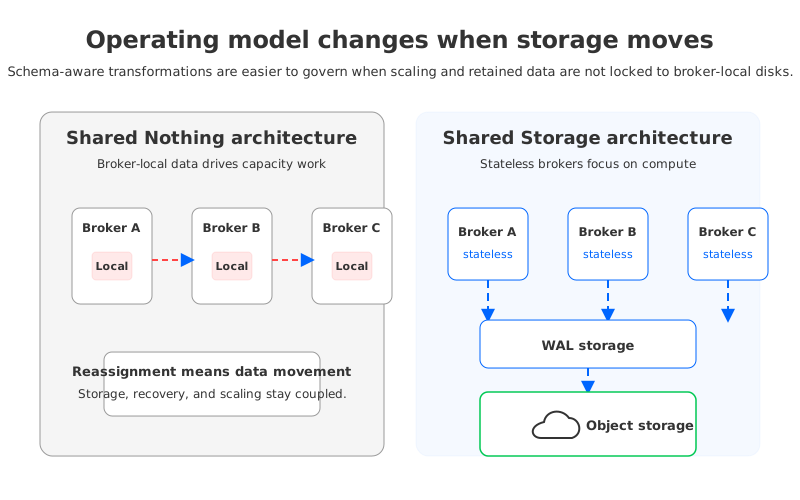
Traditional Kafka runs on a Shared Nothing architecture. Each Broker owns local storage for its partitions, and replication moves data among Brokers for durability and availability. That design has served the Kafka ecosystem well, but it turns storage growth, broker replacement, partition reassignment, and capacity planning into local-disk problems. Schema-aware transformations add pressure because they change how teams use retention, replay, and catch-up consumption.
The same pattern appears with lakehouse ingestion. Transformations that map Kafka records into table columns are sensitive to schema evolution. A harmless producer change can become a table write failure if the transform, schema registry, and table catalog disagree. Operators then need to answer a practical sequence of questions: which schema version produced the record, which transformation version handled it, which offset failed, whether the consumer can restart safely, and whether older data can be replayed without saturating the cluster.
This is where architecture matters. Schema-aware transformation is not only a data modeling question. It changes the behavior of the streaming platform along several dimensions:
| Dimension | Why it matters for schema-aware transformation |
|---|---|
| Compatibility | Existing Kafka clients, serializers, connectors, and stream jobs must keep their expected semantics. |
| Retention | Teams often need longer replay windows after schema changes, audits, or downstream rebuilds. |
| Scaling | Transformation bursts, backfills, and catch-up reads can arrive independently from normal producer traffic. |
| Recovery | Operators need offset-level restart behavior, failed-record handling, and rollback paths. |
| Governance | Schema ownership, PII handling, and audit trails must survive platform and application changes. |
If the platform cannot scale these dimensions separately, teams compensate with over-provisioning and procedural caution. That works for a while. It also turns every schema-aware project into a negotiation over broker capacity.
3Architecture options and trade-offs
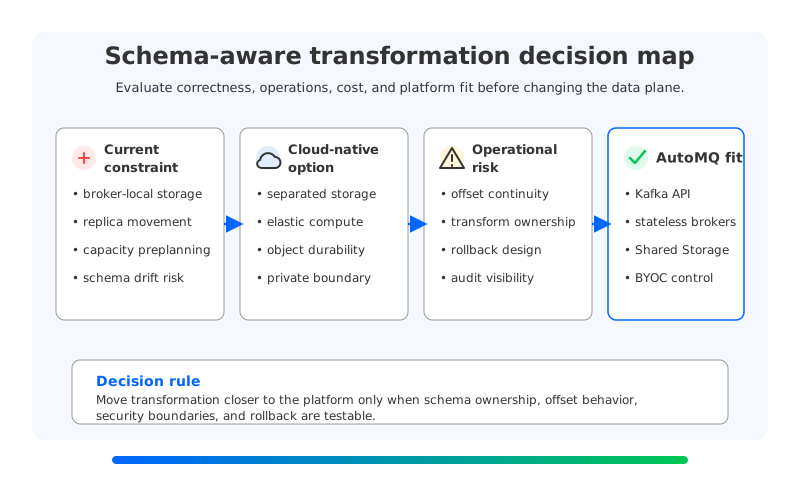
The first option is to keep the current Kafka cluster and improve discipline around transformations. This is often the right answer when traffic is predictable, retention windows are short, and the organization already operates Kafka Connect and stream processing well. The work is mostly governance: version connector configurations, test schema compatibility, isolate dead-letter paths, protect internal topics, and make offset recovery visible.
The second option is to introduce a managed integration or transformation layer. This can reduce worker operations and give teams a cleaner UI for connectors, schemas, and destinations. The trade-off is service scope. A managed layer may not cover every source, sink, private network path, authentication mode, schema format, or custom transformation library. It can simplify the integration tier while leaving broker storage, retention, and replay pressure unchanged.
The third option is to evaluate a Kafka-compatible platform with a different storage model. This is relevant when the pain is not only transformation ownership but also the Kafka operating model underneath it: local disk sizing, replica movement, cross-Availability Zone traffic, catch-up reads, and slow reassignment during scaling or recovery. In that case, the platform team is no longer asking, "Which transform should I configure?" It is asking whether the streaming substrate is fit for schema-aware workloads that need replay and elasticity.
Apache Kafka documentation is still the baseline for semantics: Consumer groups coordinate parallel consumption, Offsets define position, transactions and idempotent Producers protect write behavior, Kafka Connect provides integration, and KRaft replaces ZooKeeper for metadata management in supported Kafka releases. Any Kafka-compatible target should be tested against the surfaces your workloads use, not only against a marketing compatibility claim.
For schema-aware transformation, the test matrix should include serializers, schema registry behavior, connector plugins, SMT-style transformations where used, stream processing jobs, compaction settings, transactional writes if used, authorization rules, observability tools, and old-offset replay. Compatibility is not a single yes-or-no property. It is a set of behaviors that have to remain boring under load.
4Evaluation checklist for platform teams
The neutral evaluation framework is straightforward, but it has to be applied in the right order. Start with correctness, then operations, then cost. If cost becomes the opening question, teams tend to optimize for visible infrastructure units and miss the hidden cost of failed replays, manual cutovers, and unclear ownership.
Ask these questions before moving transformation logic closer to the Kafka platform:
A decision matrix helps separate common cases:
| Workload signal | Preferred starting point | Platform risk to validate |
|---|---|---|
| Simple field rename near one sink | Connector-level transform | Connector restart, config versioning, failed-record routing |
| Stateful enrichment or joins | Stream processing job | State recovery, schema evolution, backpressure, output compatibility |
| PII filtering across many consumers | Platform or governance layer | Policy ownership, audit trail, bypass prevention, replay behavior |
| Lakehouse table ingestion | Schema-aware sink or table feature | Schema evolution, catalog commits, offset-to-table traceability |
| Migration to a different Kafka-compatible target | Replication plus staged cutover | Offset continuity, schema registry migration, rollback, client compatibility |
The matrix should make one uncomfortable truth visible: transformations are rarely isolated. They sit between data contracts, infrastructure capacity, and team boundaries.
5How AutoMQ changes the operating model
Once the evaluation points to the streaming substrate itself, AutoMQ belongs in the discussion as a Kafka-compatible shared-storage architecture. AutoMQ keeps Kafka protocol and semantic compatibility as the adoption path, but replaces broker-local durable storage with S3Stream, WAL storage, and S3-compatible object storage. Brokers become stateless for persistent data, while durable data is stored in shared storage.
That change matters for schema-aware transformation because it weakens the coupling between retained data and broker-local disks. Platform teams can think about transformation workloads in terms of ingest, cache, replay, object storage, and compute placement instead of treating every replay window as a broker disk reservation. AutoMQ documentation describes WAL storage as the write durability layer: a Broker acknowledges writes after data is persisted to WAL, and data is uploaded to object storage for primary storage. Different WAL options have different latency and deployment profiles, so teams should choose the product shape and WAL type that match their workload.
AutoMQ does not remove the need for schema discipline. Producers still need serialization rules. Connectors and stream jobs still need tests. Consumers still need offset-aware recovery. What changes is the operational model around the Kafka-compatible data plane:
- Stateless brokers reduce the amount of local data movement involved in broker replacement and partition reassignment.
- Shared Storage architecture gives retained data a storage layer that is not tied primarily to one Broker's local disk.
- Customer-controlled deployment boundaries in AutoMQ BYOC and AutoMQ Software help teams keep the control plane, data plane, and object storage inside their approved environment.
- Kafka Linking can be evaluated for supported migration paths when offset continuity and staged cutover are part of the project.
- Table Topic is relevant when the transformation goal is to write Kafka records into Apache Iceberg tables with schema-aware lakehouse ingestion.
This is a practical fit, not a universal answer. If your current Kafka cluster is stable, your transformations are small, and your replay windows are short, improving governance may be enough. If schema-aware work is pushing you into repeated capacity reservations, risky reassignments, and long recovery drills, the storage architecture under Kafka deserves a serious look.
6A readiness scorecard
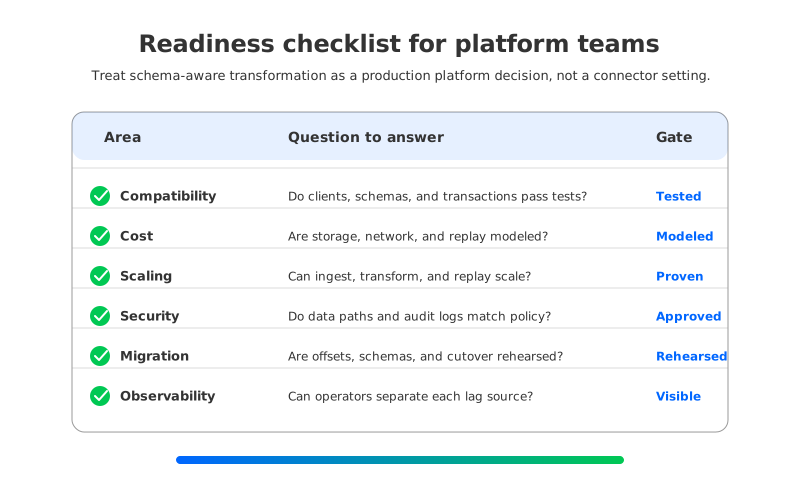
Before choosing an architecture, score the project on seven gates. A "yes" should mean tested evidence, not confidence from a design review.
| Gate | Ready when... |
|---|---|
| Compatibility | The exact clients, serializers, connectors, transactions, and admin scripts pass workload tests. |
| Cost model | Storage, network, worker compute, replay windows, and migration overlap are modeled together. |
| Scaling | The team has tested producer bursts, transform backpressure, and old-offset catch-up reads. |
| Security | Data paths, VPC boundaries, keys, secrets, and audit logs match policy requirements. |
| Migration | Source and target topics, offsets, schemas, and producer cutover have a rehearsed path. |
| Rollback | Operators know which component can be reverted and what happens to records already transformed. |
| Observability | Dashboards separate source lag, Kafka lag, transform lag, sink lag, and failed-record queues. |
If several gates are weak, do not start by buying a different tool. Fix the test harness and ownership model first. A better architecture can reduce structural pressure, but it cannot rescue a transformation rule that nobody owns.
7FAQ
7.1What does schema-aware transformation in Kafka mean?
It means the transformation interprets the structure of the Kafka record. Examples include field mapping, schema-version routing, CDC envelope normalization, PII masking, and preparing records for table formats. The transform is no longer byte-only; it depends on schema meaning and compatibility rules.
7.2Is Kafka Connect enough for schema-aware transformations?
Kafka Connect is a strong starting point for source and sink integration, and connector-level transformations can be appropriate for simple record changes. It is not a substitute for governance. Platform teams still need schema ownership, configuration versioning, failed-record handling, monitoring, and replay plans.
7.3When should a team use stream processing instead?
Use stream processing when the transformation requires state, joins, windows, deduplication, enrichment from external systems, or business logic. Connector-level transforms are better for simple reshaping close to an integration boundary.
7.4How does shared storage help with transformation workloads?
Shared storage does not transform records by itself. It changes the operating model underneath the workload. When retained data is not primarily bound to broker-local disks, replay, broker replacement, and scaling can be evaluated with fewer local-data-movement constraints.
7.5Where does AutoMQ fit?
AutoMQ fits when a team wants Kafka-compatible APIs and ecosystem continuity while changing the storage and scaling model underneath Kafka. It is most relevant when schema-aware workloads increase replay, retention, migration, and operational elasticity requirements.
8References
- Apache Kafka Documentation
- Apache Kafka Connect Transformations
- Apache Kafka KRaft Documentation
- AutoMQ Kafka compatibility
- AutoMQ Shared Storage architecture
- AutoMQ WAL Storage
- AutoMQ Kafka Linking migration overview
- AutoMQ Table Topic overview
If schema-aware transformation is becoming a platform decision rather than a connector tweak, evaluate whether your Kafka-compatible data plane can handle replay, retention, and migration without tying every choice to broker-local storage. The next step is to test AutoMQ against your own client, connector, and schema matrix: start from the AutoMQ environment portal.


