
Table of Contents
Table of Contents
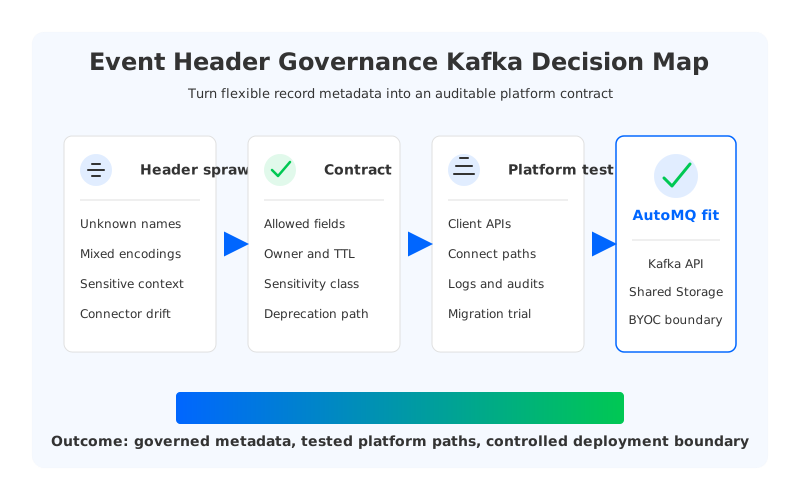
The search for event header governance kafka usually starts when a small technical convenience becomes a security review item. Kafka record headers are useful because they travel with the event while staying outside the serialized value. Teams use them for correlation IDs, tenant identifiers, schema hints, trace context, routing signals, and producer metadata. The trouble starts when those headers become a second control plane that nobody owns.
Security teams rarely worry about headers because headers exist. They worry because headers are easy to add, hard to inventory, and often invisible to the schema rules that protect payloads. A producer can place sensitive context in a header, a downstream connector can forward it into another system, and an audit team may discover later that the governance policy only covered the event value. The practical thesis is this: event header governance in Kafka is not a serializer setting. It is a platform contract that has to survive client compatibility, storage architecture, observability, migration, and operational change.
1Why Teams Search for event header governance kafka
Kafka headers sit in an awkward place. Apache Kafka client APIs expose headers as part of producer and consumer records, so application teams can attach metadata without changing the payload schema. That is useful in production systems where different consumers need traceability, routing, or contract metadata. It also means headers can bypass the habits that teams have built around Avro, Protobuf, JSON Schema, and schema registries.
The search intent is usually concrete. A governance owner wants to know whether schema-id, tenant-id, pii-class, data-domain, or traceparent should be allowed in headers. A platform owner wants to know whether those headers are copied by Kafka Connect, retained in logs, visible in observability tooling, or preserved during migration. A security architect wants to know whether a Kafka-compatible platform can enforce the same boundary for headers as it does for payloads, offsets, topics, ACLs, and network paths.
Those questions should be answered before a header convention spreads across hundreds of producers. Once application teams depend on header semantics, removing a field becomes a compatibility event. Worse, a header policy that only lives in a wiki will drift from the actual platform behavior. The review has to turn header usage into an explicit operating model.
2The Production Constraint Behind the Problem
Kafka gives teams a durable, ordered commit log, not a complete data-governance product by itself. A record has a topic, partition, offset, timestamp, key, value, and headers. Consumer groups coordinate parallel reads and commit offsets. Transactions and idempotent producers add stronger write semantics for applications that need them. Kafka Connect moves records into and out of external systems. Each of those pieces can touch headers, preserve headers, ignore headers, or expose headers through logs and debugging tools depending on client code and connector behavior.
That is why header governance becomes bigger than naming rules. The review has to follow a header through the full event lifecycle:
- Producer creation: which client libraries can write headers, and whether application code has a contract for allowed names, value formats, and sensitivity levels.
- Broker path: whether platform logs, quotas, authorization hooks, or observability pipelines can expose header-derived information.
- Consumer path: whether downstream services treat headers as trusted control signals or untrusted metadata from another team.
- Connector path: whether source and sink connectors preserve, transform, drop, or map headers into external systems.
- Migration path: whether a target Kafka-compatible platform keeps headers, offsets, and consumer expectations stable during cutover.
Traditional Kafka Shared Nothing architecture adds a second layer of operational pressure. Broker-local log storage makes capacity, rebalancing, and recovery depend on where partition data lives. Header governance does not directly cause disk movement, but the platform that carries governed events still has to scale, fail over, retain data, and migrate under policy. If a security review says that regulated header fields must stay inside a specific network and storage boundary, the architecture has to prove that boundary during normal operations, not only during a happy-path produce and consume test.
The same pattern appears in cost and operations. A cluster that uses broker-local replicas needs enough disk, replication bandwidth, and headroom for reassignment. A governance review may then include cross-Availability Zone traffic, log export controls, backup location, and recovery runbooks. Header policy is the visible problem, but the platform review is really asking whether the streaming layer can make metadata control predictable at production scale.
3Architecture Options and Trade-Offs
There is no universal answer for header governance because organizations use headers for different purposes. Some teams keep headers limited to trace context and harmless routing metadata. Others use headers to carry schema identifiers, consent status, data classification, or tenant context. The risk profile changes when a header affects authorization, routing, retention, or downstream masking decisions.
The platform evaluation should compare options against the same questions instead of treating governance as an add-on feature.
| Review dimension | What to validate | Failure mode to avoid |
|---|---|---|
| Header contract | Allowed names, value encoding, sensitivity class, ownership, and deprecation process | Headers become unversioned payloads outside schema review. |
| Kafka compatibility | Producer, Consumer, Admin APIs, offsets, transactions, Kafka Connect, and ecosystem tools | A migration breaks applications that rely on standard record semantics. |
| Storage boundary | Broker-local disks, object storage, WAL storage, retention, encryption keys, and deletion path | Sensitive metadata is retained or recovered outside approved controls. |
| Network boundary | VPC routes, private endpoints, connector egress, inter-zone paths, and support access | Header-bearing records leave the intended trust boundary. |
| Observability | Metrics, logs, traces, debug dumps, dead-letter queues, and audit events | Header values appear in logs or tickets without the same protection as records. |
| Migration and rollback | Byte preservation, offset continuity, producer cutover, consumer resume, and rollback criteria | Governance is preserved in steady state but lost during transition. |
This matrix often exposes a split between application governance and platform governance. Application teams can define a good header schema, but the platform team still has to prove that brokers, connectors, storage, and operational tooling do not create another uncontrolled copy. Platform teams can provide strong network isolation, but application teams still need a contract that prevents sensitive data from being placed in headers casually.
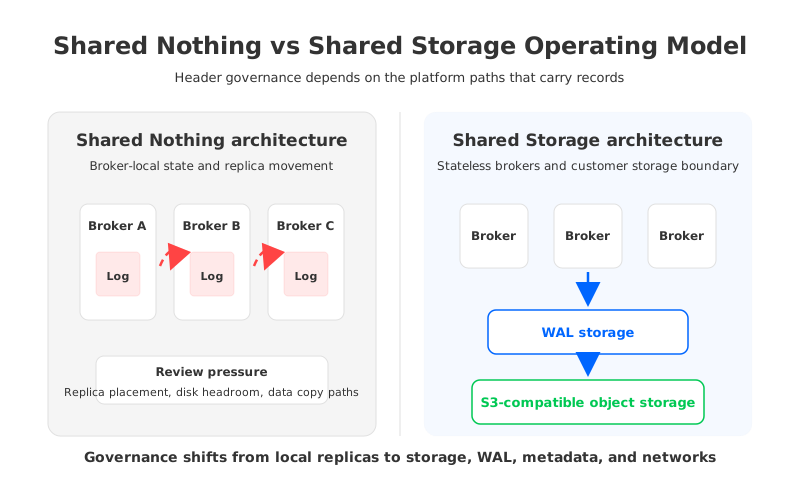
The biggest architecture question is whether persistent state is tied to brokers. In Shared Nothing architecture, brokers own local log segments and use replication for durability. Scaling, broker replacement, and partition reassignment are therefore data-placement events. In Shared Storage architecture, durable data is placed in shared storage, while brokers focus on protocol handling, leadership, caching, and coordination. That does not make governance automatic. It changes the review from "where did each broker replica place the data?" to "how do shared storage, WAL storage, metadata, cache, and network boundaries enforce the policy?"
4Evaluation Checklist for Platform Teams
A useful checklist should produce evidence that security, platform, and application owners can inspect together. Start with the header contract itself. Require a registry of approved header names, an owner for each name, allowed value encodings, whether the header may contain personal or regulated data, and whether downstream systems are allowed to make control decisions from it. The safest default is to treat headers as metadata that needs the same classification discipline as payload fields.
Then test the runtime behavior. Produce records with representative headers through the same clients, connectors, and stream processors that production uses. Consume them from the target applications. Send them through retry topics and dead-letter queues. Trigger the operational paths that people forget during design reviews: failed deserialization, connector errors, debug logging, lag investigations, and incident response. A header governance policy that fails during troubleshooting is not a policy; it is a document.
The platform review should answer these questions before production approval:
- Can every header be explained? Each approved header has a business purpose, owner, format, sensitivity level, and removal process.
- Can every header be observed safely? Logs and metrics show enough context to operate the system without dumping sensitive header values.
- Can every header survive required compatibility paths? Producers, consumers, transactions, Connect tasks, schema tooling, and migration tools preserve or intentionally transform headers.
- Can unapproved headers be detected? CI checks, producer libraries, stream validation, or audit consumers flag unknown names before they become dependencies.
- Can the platform boundary be proven? Storage, network, encryption, access control, observability, and support procedures match the classification of header-bearing records.
- Can rollback be tested? A failed connector change, schema rollout, broker upgrade, or platform migration has a documented rollback path that preserves offsets and header semantics.
The checklist is deliberately operational. A team that only defines header names will miss the controls that matter during incidents. A team that only hardens infrastructure will miss the semantic drift that happens when a developer adds one more "temporary" header to solve a release problem. Governance works when both layers share the same evidence.
5How AutoMQ Changes the Operating Model
After the neutral review is complete, AutoMQ is relevant as a Kafka-compatible cloud-native streaming platform that changes where persistent state lives. AutoMQ keeps Kafka protocol and API compatibility while replacing broker-local log storage with a Shared Storage architecture. Brokers are stateless compute nodes, and S3Stream organizes the storage path with WAL storage, data caching, object metadata, and S3-compatible object storage.
For event header governance, the value is not that AutoMQ invents a separate header policy. The value is that the operating model becomes easier to review. Durable data can be evaluated through customer-controlled object storage and WAL storage instead of many broker-local disks. Broker replacement and scaling no longer require the same style of partition data copying that dominates Shared Nothing architecture. Self-Balancing and seconds-level partition reassignment are useful because the governance boundary does not have to be re-argued whenever the cluster needs to rebalance traffic.
Deployment boundary matters as much as storage design. AutoMQ BYOC places the control plane and data plane in the customer's cloud account and VPC. AutoMQ Software places them in the customer's private environment. In both cases, security teams can review IAM, private networking, object storage policies, encryption keys, observability export, RBAC, and support procedures against their own requirements. That boundary is especially important when header fields carry tenant context, classification labels, or schema-contract metadata that should not leave a customer-controlled environment.
Migration is the last test. AutoMQ Linking is designed for Kafka migrations that need topic replication, offset continuity, and controlled cutover. A header governance review should still test representative records, connector behavior, dead-letter topics, and consumer resume behavior before approving a migration. The goal is not to trust a migration label. The goal is to prove that headers, payloads, offsets, and operational evidence remain consistent across the move.
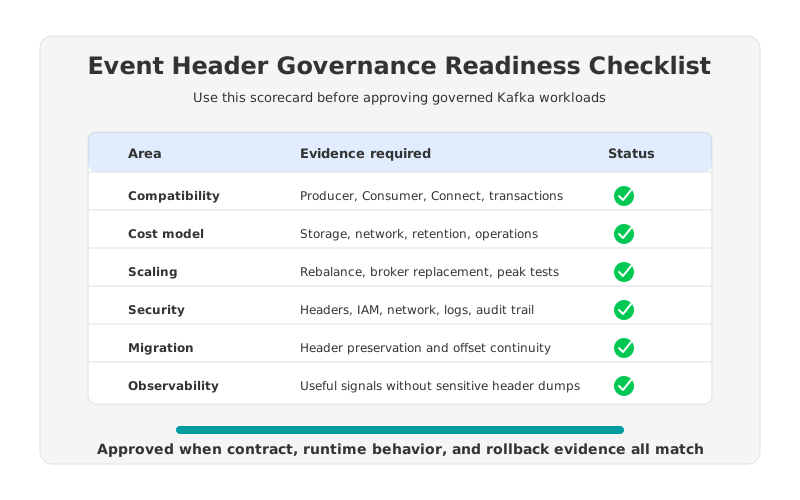
There are cases where existing Kafka is enough. A small internal workload with harmless trace headers, stable capacity, and no migration pressure may not need an architecture change. A fully managed SaaS platform may also fit teams that prefer vendor-operated boundaries over customer-side infrastructure control. AutoMQ is strongest when the same team needs Kafka-compatible behavior, customer-controlled deployment boundaries, cloud object storage economics, elastic operations, and a cleaner way to reason about governed event metadata.
The review should end with a scorecard, not a promise. Mark each dimension as approved, needs evidence, or rejected. Require a named owner for every "needs evidence" item. If you are evaluating event header governance for a Kafka-compatible estate, map your current header usage against the checklist, run it through your connector and incident paths, and then test whether Shared Storage architecture removes the most expensive operational constraints. To evaluate AutoMQ inside your own boundary, start a technical review here: go.automq.com/home.
6FAQ
6.1Are Kafka headers part of the record?
Yes. Kafka producer and consumer APIs expose headers as part of the record alongside topic, partition, key, value, timestamp, and offset-related context. That is why header governance should be treated as part of the event lifecycle, not as a logging convention.
6.2Should schema IDs or data classifications live in Kafka headers?
They can, but only with an explicit contract. Define the allowed header names, value formats, owner, sensitivity level, and compatibility behavior. Then verify that clients, connectors, logs, dead-letter queues, and migration tools preserve or handle those headers correctly.
6.3Do schema registries govern Kafka headers automatically?
Usually, schema governance focuses on serialized payloads. Some teams add custom validation around headers, producer libraries, CI checks, or audit consumers. Do not assume a payload schema policy covers headers unless the implementation has been tested.
6.4What is the main security risk of event headers?
The main risk is uncontrolled metadata. Headers can carry sensitive context, routing signals, or contract identifiers outside the normal schema review path. They may also appear in logs or connector error handling if teams do not define safe observability rules.
6.5Where does AutoMQ fit in event header governance?
AutoMQ fits when governance requirements are tied to Kafka compatibility, customer-controlled deployment boundaries, elastic operations, and a Shared Storage architecture. It does not replace the need for a header contract, but it can make the platform boundary easier to review.
7References
- Apache Kafka ProducerRecord API
- Apache Kafka ConsumerRecord API
- Apache Kafka consumer configuration
- Apache Kafka transactions
- Apache Kafka Connect documentation
- Apache Kafka KRaft documentation
- Apache Kafka Tiered Storage documentation
- AutoMQ overview
- AutoMQ Shared Storage architecture
- AutoMQ WAL storage
- AutoMQ Kafka Linking migration overview
- AWS PrivateLink concepts
- AWS S3 security best practices


