
Table of Contents
Table of Contents
The search for data lineage event streams kafka rarely starts as an abstract governance exercise. It usually starts when a security reviewer asks a direct question: if a regulated field appears in a Kafka record, can you prove where it came from, where it went, who changed its schema, which consumers read it, and whether the same answer remains true during failover or migration? Event streams are moving logs with producers, consumers, connectors, offsets, retries, schema changes, and retention policies all acting at the same time.
Data lineage for event streams reconstructs the path and meaning of an event across its lifecycle: producer, topic, schema, transformation, consumer, storage tier, retention window, and operational boundary. In batch systems, lineage often follows scheduled jobs and table dependencies. In Kafka, it follows records through append-only partitions, Consumer groups, Kafka Connect tasks, stream processing applications, and operational events such as rebalancing or recovery.
The practical thesis is simple: a lineage review should not stop at schema ownership or catalog integration. Those controls matter, but infrastructure choices decide where records are stored, how offsets are preserved, how failures recover, and how much evidence the team can produce after the fact. A Kafka-compatible platform is ready when it makes those paths visible without turning every scale-out, migration, or recovery event into a data movement investigation.
1Why Teams Search for data lineage event streams kafka
Security teams tend to ask for lineage after the streaming platform has become shared infrastructure. One group may use Kafka for application events, another for analytics ingestion, another for fraud signals, and another for telemetry. At that point, a topic name is no longer enough context. A record may contain a customer identifier, model input, payment state, entitlement decision, or device event that crosses team boundaries before anyone classifies it.
That pressure shows up in several concrete review questions:
- Which producer owns the event contract, and what approval process governs schema changes?
- Which topics, partitions, connectors, and stream processing jobs can carry sensitive fields?
- Which Consumer groups read the data, and can their offsets prove whether a consumer caught up before a policy change?
- Which logs, metrics, dead-letter queues, and retries may expose keys, headers, or payload fragments?
- Which storage layer keeps durable records, and how does retention or deletion align with policy?
These are not only catalog questions. A catalog can say that a topic contains a regulated field, but the platform still needs to explain producer authentication, ACLs, schema compatibility, connector configuration, offset continuity, and recovery behavior. If governance metadata cannot connect to runtime behavior, the map looks complete until an incident asks for evidence.
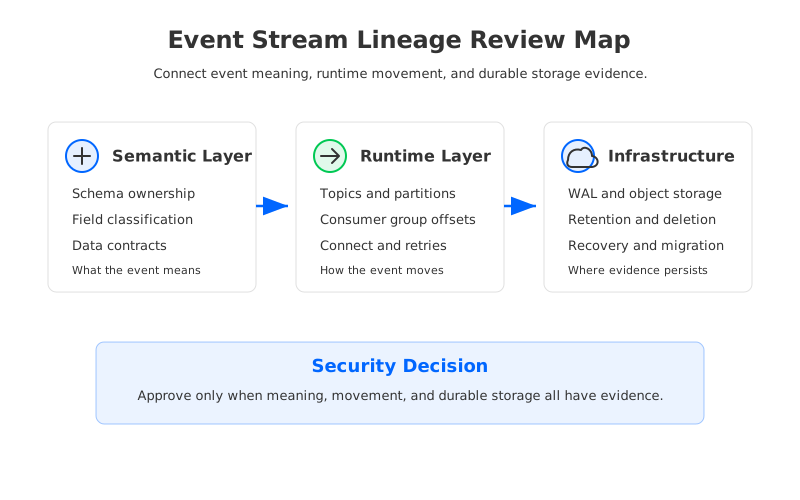
The first useful move is to separate lineage into three layers. The semantic layer answers what the event means: schema, field definitions, ownership, and data contracts. The runtime layer answers how it moves: topics, partitions, offsets, producers, consumers, connectors, transactions, and retries. The infrastructure layer answers where it becomes durable and how it is recovered: broker storage, WAL (Write-Ahead Log) storage, object storage, backups, logs, metrics, and migration tooling. A gap in any layer can break the evidence chain.
2The Production Constraint Behind the Problem
Traditional Kafka stores partition logs on broker-local storage in a Shared Nothing architecture. Each broker owns local replicas, and Kafka maintains durability through replication between leaders and followers. This design gives clear Kafka semantics and remains a strong foundation for many deployments. It also means lineage has to account for physical placement and operational movement. A record is not only "in a topic"; it may also be in partition replicas, local log segments, remote tiers if Tiered Storage is enabled, and recovery paths that depend on broker state.
That broker-local state affects ordinary operations. When a cluster scales out, partitions may be reassigned. When a broker fails, replicas catch up. When retention changes, storage policies must be checked. When migration begins, teams must preserve topic data, offsets, ACLs, schemas, and client cutover order. Each operation can be correct for availability while still creating lineage questions: did the record cross an unapproved boundary, did a retry write a duplicate, and can the team prove what happened?
Apache Kafka provides important building blocks for this review. Consumer groups define how partitions are assigned and consumed. Offsets provide position evidence for replay and catch-up. Transactions and idempotent producers help control duplicate writes and multi-partition consistency. Kafka Connect standardizes source and sink movement. KRaft removes the ZooKeeper dependency for metadata quorum. Tiered Storage moves older log data to remote storage while retaining Kafka's log abstraction. These capabilities are relevant, but the operating boundary underneath them still needs inspection.
Lineage evidence becomes expensive when normal platform operations require large data movement or manual coordination. The review should ask how much state is tied to broker identity. If scaling, recovery, and migration all require heavy broker-local data work, governance teams need more runbooks and failure-mode tests. If durable state can be evaluated through fewer storage and metadata boundaries, the review can focus on policy enforcement instead of chasing every operational copy.
3Architecture Options and Trade-Offs
There are several valid ways to build secure lineage for Kafka event streams. A self-managed Kafka deployment gives direct control over network, storage, ACLs, connector configuration, and observability. The trade-off is ownership: the team maintains broker sizing, upgrades, replica placement, schema controls, incident response, and migration procedures. A managed Kafka service can reduce operational burden, but the customer still has to map service boundaries, support access, private connectivity, logging, and data residency against security requirements.
A Kafka-compatible cloud-native platform changes a different part of the problem. Instead of treating brokers as durable storage owners, it can keep the Kafka protocol surface while moving persistent data into shared cloud storage and making brokers replaceable compute. That does not make governance automatic. It shifts the review from "which broker has this replica?" toward "which storage boundary owns durable records, which metadata maps records to streams, and which administrative paths can affect those objects?"
The following matrix is a practical way to keep the review neutral before discussing any product:
| Review dimension | What to verify | Security impact |
|---|---|---|
| Compatibility | Producer, Consumer, Admin APIs, offsets, transactions, Kafka Connect, and client tooling | Application rewrites create blind spots and migration risk. |
| Contract ownership | Schema compatibility, field classification, producer approval, and breaking-change workflow | Lineage fails when no team owns event meaning. |
| Runtime evidence | Topic ACLs, Consumer group offsets, connector tasks, retry topics, and dead-letter queues | Auditors need to know who read or moved the record. |
| Storage boundary | Broker logs, WAL storage, object storage, encryption keys, retention, and deletion | Durable data placement defines the hard security boundary. |
| Operational movement | Rebalancing, recovery, scale-out, tiering, migration, and rollback | Normal operations should not create untracked copies. |
| Observability | Metrics, logs, traces, audit events, and support workflows | Operational data can leak sensitive context even without payloads. |
The matrix keeps trade-offs visible. A platform can have strong schema governance and weak migration evidence. It can have private networking and still export logs with sensitive topic names or record keys. It can be Kafka-compatible for basic produce and consume paths but fail a workload that depends on transactions, idempotent producers, or offset-preserving cutover. Secure lineage is the consistency of many controls under production pressure.
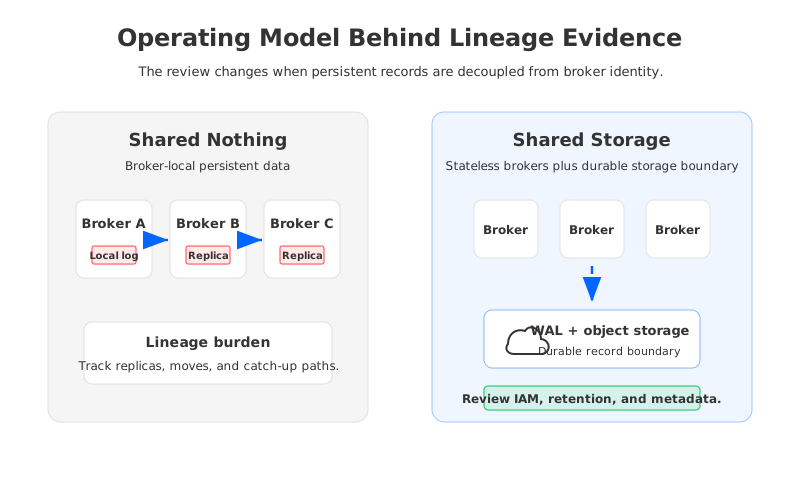
The most important architectural distinction is whether persistent data is coupled to brokers. In a Shared Nothing architecture, broker identity, replica placement, and storage capacity are part of lineage evidence. In a Shared Storage architecture, the durable record boundary can be concentrated in object storage and WAL storage, while brokers focus on protocol handling, caching, and leadership. That model still needs strict IAM, encryption, metadata protection, and observability controls, but it reduces the places where durable record movement has to be explained.
4Evaluation Checklist for Platform Teams
A security review should end with a checklist that platform, governance, and application owners can sign together. The checklist below is operational. It does not assume that a catalog, a schema registry, or a managed service is enough by itself.
- Define the event ownership model. Every regulated topic should have a business owner, producer owner, schema owner, and operational owner. If one topic has many producers, require a contract process for adding fields or changing compatibility rules.
- Map sensitive fields to runtime paths. Trace fields through topics, partitions, connectors, stream processors, retry topics, dead-letter queues, and downstream stores. Include headers and keys, not only values.
- Verify identity and authorization. Review producer principals, consumer principals, service accounts, ACLs, admin permissions, connector credentials, and automated deployment roles. Lineage evidence is weak if many actors share credentials.
- Validate offset and replay behavior. Document which systems may replay data, how far retention allows replay, how Consumer group offsets are backed up or migrated, and how replay is approved for regulated events.
- Audit storage and retention boundaries. Confirm where records become durable after acknowledgment, which storage tier holds them, how encryption keys are owned, and how deletion or compaction interacts with policy.
- Inspect operational data exports. Logs, metrics, traces, and alerts should avoid payload fragments and sensitive headers. Topic names, principal names, and connector errors can also be sensitive in regulated environments.
- Test recovery and migration as lineage events. Failover, scale-out, partition reassignment, connector restart, and platform migration should each produce evidence that records remained inside approved paths and offsets remained understandable.
This checklist turns lineage from documentation into operating discipline. Manual screenshots of ACLs or schema pages may satisfy a one-time audit, but they do not scale when topics and consumers change every week. Platform teams should favor controls that can be exported, versioned, tested, and tied to deployment workflows.
5How AutoMQ Changes the Operating Model
After the neutral review is complete, AutoMQ is worth evaluating as a Kafka-compatible cloud-native streaming platform because it changes where persistent state lives. AutoMQ keeps Kafka protocol and API compatibility while replacing broker-local persistent storage with a Shared Storage architecture. AutoMQ Brokers are stateless, and durable data is organized through WAL storage and S3-compatible object storage rather than long-lived local broker disks.
For event stream lineage, that shift gives security teams a cleaner boundary to review. Durable records can be evaluated through customer-controlled storage, encryption, IAM, retention, and network policies. Brokers can be replaced or scaled with less emphasis on moving partition data between local disks. The platform still needs governance controls around schemas, ACLs, Connector access, observability, and audit events, but the infrastructure story is clearer: compute handles Kafka requests, and shared storage owns durable state.
AutoMQ BYOC and AutoMQ Software are relevant when deployment boundary is part of the security decision. In AutoMQ BYOC, the control plane and data plane run inside the customer's cloud account and VPC (Virtual Private Cloud). In AutoMQ Software, they run in the customer's private environment. That boundary helps reviewers reason about customer data, private connectivity, IAM, storage accounts, logging, and support procedures.
Migration is also part of lineage. AutoMQ Linking is designed for Kafka migrations that need data synchronization and offset continuity. In a security review, the important question is whether the migration plan preserves lineage evidence. Teams should verify which topics are linked, how offsets are mapped, how producer cutover is controlled, how rollback works, and whether migration logs avoid sensitive payload content.
AutoMQ is not the right answer for every review. A small Kafka cluster with stable workloads, limited sensitive data, and no cloud elasticity requirement may be adequately governed with existing tooling. A team that prefers a vendor-operated service boundary will evaluate a different risk model. AutoMQ is strongest when the organization wants Kafka-compatible behavior, customer-controlled deployment, object-storage-backed durability, and lower-data-movement scaling and recovery.
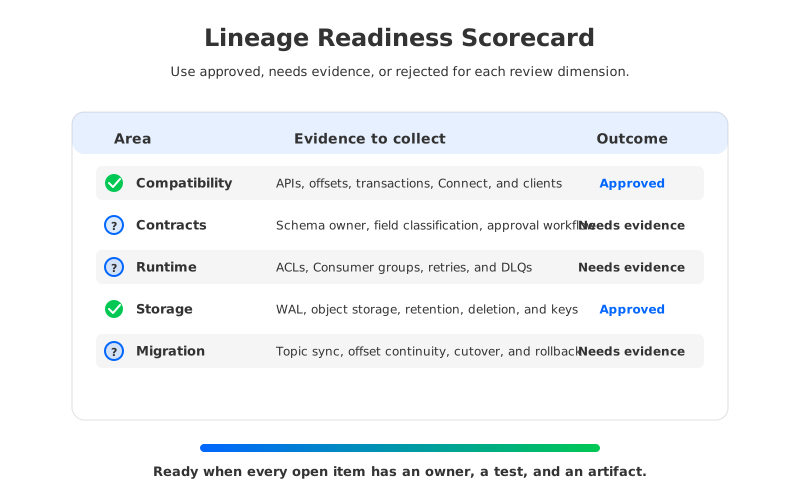
The final scorecard should be blunt. Mark each dimension as approved, needs evidence, or rejected. Do not let "needs evidence" become permanent; assign an owner, a test, and an artifact. A streaming platform is ready when the team can prove what each event means, where it became durable, who could read or transform it, how offsets behaved, and how the evidence survives recovery and migration.
If your platform team is reviewing Kafka lineage for regulated event streams, start with the matrix above and run it against one high-risk topic. Then compare how much operational evidence your current architecture needs versus a Shared Storage architecture. To evaluate AutoMQ inside your own deployment boundary, start a technical review.
6FAQ
6.1Is data lineage for Kafka the same as schema governance?
No. Schema governance explains the structure and meaning of records. Data lineage also tracks runtime movement: producers, topics, partitions, Consumer groups, connectors, stream processors, storage layers, retries, and recovery paths.
6.2Which Kafka features matter most for lineage?
Consumer group offsets, ACLs, transactions, idempotent producers, Kafka Connect, retention, and Tiered Storage are common review points. The exact list depends on whether the workload uses replay, connector pipelines, transactional writes, or long retention.
6.3Does a data catalog solve event stream lineage?
A catalog helps, but it is not enough by itself. The catalog should connect to runtime evidence such as topic ownership, schema versions, access control, connector configuration, offset behavior, and storage boundaries.
6.4How should teams inspect logs and metrics?
Treat operational data as part of lineage. Logs and metrics may include topic names, record keys, principal names, connector errors, schema IDs, or other sensitive context. Route them through approved observability systems and avoid payload fragments.
6.5Where does AutoMQ fit in the checklist?
AutoMQ fits after the team has defined its neutral requirements. It is relevant when Kafka compatibility, customer-side deployment control, Shared Storage architecture, stateless brokers, and reduced operational data movement are important to the review.


