
Table of Contents
Table of Contents
The search for regional data sovereignty kafka usually starts after a security review has become specific. A team is no longer asking whether Kafka can move events between services. They are asking where records are stored, which network paths they cross, who can administer the platform, what happens during failover, and whether the same controls still hold when the cluster scales or migrates. That is a different problem from picking a streaming product. It is an architecture ownership problem.
Kafka makes the question sharper because it is rarely a small system. A production estate may include producers in several business units, consumer groups owned by analytics and operations teams, Kafka Connect pipelines, stream processing jobs, schema controls, and audit requirements attached to regulated datasets. Regional sovereignty means each of those moving parts has to respect a residency boundary. The review cannot stop at "the cluster is deployed in Region A." It has to follow data through storage, replication, recovery, observability, and migration.
The practical thesis is simple: a regional sovereignty review should judge a Kafka-compatible platform by its operating boundary, not only by its feature list. Compatibility keeps existing applications stable, but sovereignty depends on where durable data lives, how brokers recover, how private connectivity is enforced, and how much data has to move during normal operations.
1Why Teams Search for regional data sovereignty kafka
Most teams arrive at this topic from one of four pressures. The first is regulatory: a workload that was acceptable as an internal event bus becomes part of a regulated customer-data path. The second is commercial: an enterprise buyer asks for evidence that data stays inside an approved jurisdiction. The third is cloud architecture: a platform team wants to standardize on one streaming design across regions without creating hidden network paths. The fourth is migration: an existing Kafka deployment needs to move to a new platform, but the security team will not approve a cutover unless offset continuity, audit logs, and rollback behavior are documented.
Those pressures converge on the same set of questions:
- Which component stores durable Kafka records, and in which region?
- Does the platform rely on broker-to-broker replication across Availability Zones or regions?
- Can administrators, support workflows, or control-plane services read customer payloads?
- Are producer, consumer, Connect, and schema-governance paths isolated from public networks?
- What evidence can the team show during audit, incident response, and disaster recovery testing?
The phrase "data sovereignty" can sound legal, but the implementation is technical. A policy can say that data must remain in one country or one cloud region. Kafka will only satisfy that policy if the storage layer, replication design, network routing, identity model, and operational tools all line up with the same boundary.
2The Production Constraint Behind the Problem
Traditional Kafka was designed around a Shared Nothing architecture. Each broker owns local log segments, and partitions are replicated across brokers through leader and follower replicas. This model is understandable and battle-tested. It also makes state a broker-local concern. When a broker fails, scales, or rebalances, the platform has to reason about where partition replicas live and how much data needs to be copied or caught up.
That design creates a sovereignty review burden in cloud environments. If the cluster spans multiple Availability Zones, replication traffic may cross zone boundaries. If the cluster has to scale out, new brokers are not useful until partition leadership and replica placement are adjusted. If the cluster has to move to another platform, topic data, offsets, ACLs, schema dependencies, and client bootstrap paths become migration objects. None of that means traditional Kafka is wrong. It means the review surface is wider than a line item that says "Kafka runs in the approved region."
Apache Kafka's own evolution reflects this tension. KRaft replaces ZooKeeper for metadata management, Tiered Storage moves older log segments to remote storage while preserving local active logs, and the transaction protocol defines how transactional state and producers interact with brokers. These are important capabilities, and they should be reviewed directly in any production platform decision. But regional sovereignty also asks a broader question: how much of the operating model still depends on broker-local persistent data?
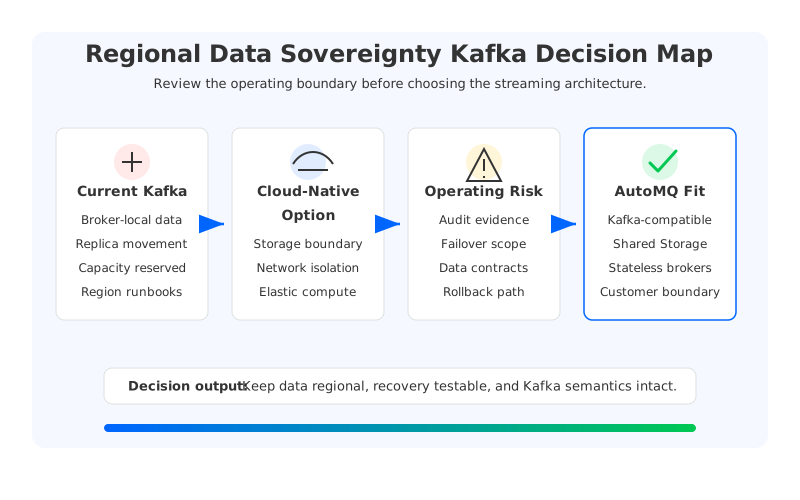
When broker-local storage remains the center of the architecture, the operational model must reserve enough disk, replica placement, and recovery headroom for worst-case events. That headroom becomes part of the compliance story. Security teams may ask whether a failover procedure copies data into another jurisdiction, whether observability exports include payloads, and whether support access can cross the customer's environment boundary. The answer has to be documented before the incident, not improvised during it.
3Architecture Options and Trade-Offs
There are several valid ways to satisfy a regional streaming requirement. Self-managed Kafka gives maximum control, but the team owns every detail: broker sizing, disks, upgrades, rebalancing, private connectivity, backup, monitoring, and disaster recovery tests. A managed Kafka service can reduce operational work, but its data-plane, control-plane, support, and metadata boundaries have to be mapped against the organization's sovereignty policy. A Kafka-compatible cloud-native platform can change the storage and scaling model, but the security review must verify compatibility, ownership boundaries, and migration behavior.
The review works best when each option is scored against the same dimensions instead of debated as a vendor preference.
| Review dimension | What to verify | Why it matters |
|---|---|---|
| Kafka compatibility | Producer, Consumer, Admin APIs, offsets, transactions, Kafka Connect, and ecosystem tooling | Application rewrites create new security and migration risk. |
| Storage boundary | Region, bucket, volume, encryption keys, retention controls, and deletion process | Sovereignty depends on durable data placement. |
| Network boundary | VPC routing, private endpoints, public internet exposure, and inter-zone paths | Data can leave policy boundaries through operational traffic, not only storage. |
| Elasticity model | Whether scaling requires partition data movement or only compute replacement | Slow scaling increases over-provisioning and complicates recovery. |
| Governance model | Schema controls, data contracts, ACLs, audit logs, and change approval | Compliance needs evidence, not only configuration intent. |
| Migration model | Topic copy, offset continuity, producer cutover, consumer resume, and rollback | A clean architecture can still fail review if migration is risky. |
This matrix keeps the conversation concrete. A platform may score well on managed operations but poorly on customer-side isolation. Another may score well on control but require more staffing. A cloud-native architecture may reduce data movement but require careful validation of WAL storage, object storage permissions, and private networking. The right choice is the one whose trade-offs match the organization's threat model and operating capacity.
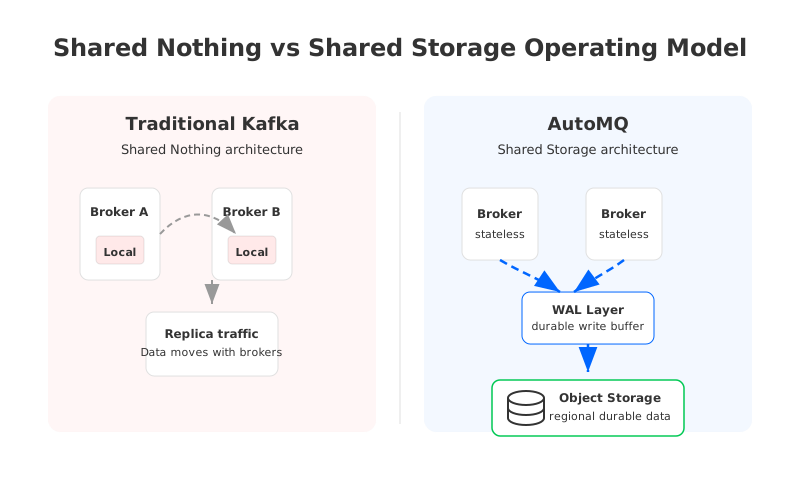
The most important architectural distinction is not "managed versus self-managed." It is whether persistent Kafka data is coupled to brokers. If state is broker-local, scaling and recovery are data-placement events. If state is placed in shared regional storage and brokers are replaceable compute, scaling and recovery become more about metadata, ownership, cache warming, and traffic routing. That shift does not remove the need for security review. It changes where the review should focus.
4Evaluation Checklist for Platform Teams
A useful review checklist should read like an operating procedure. It should be specific enough for security, platform, and application owners to sign off together.
- Define the residency boundary. Name the approved cloud account, region, VPC, object storage location, encryption-key ownership, and any prohibited paths. Avoid vague phrases such as "EU data" or "local deployment" without a concrete cloud-region mapping.
- Trace durable data. Follow records from producer acknowledgment through WAL or local log storage, long-term storage, retention, compaction, backup, and deletion. Include metadata that can reveal customer or business context.
- Trace operational data. Metrics and logs are not always harmless. Confirm whether logs contain record keys, headers, topic names, principal names, error payloads, or connector configuration. Route them through approved observability systems.
- Test private connectivity. Validate client access, admin access, connector access, and control-plane access. Cloud private-link services are helpful, but they still need endpoint policies, route tables, DNS, and identity review.
- Validate Kafka semantics. Consumer groups, offsets, idempotent producers, transactions, and Connect tasks are often where migrations expose hidden assumptions. Treat compatibility as a test plan, not a checkbox.
- Score failure modes. A zone failure, broker loss, object storage permission error, bad schema rollout, and failed migration cutover should each have an owner, runbook, rollback path, and observable signal.
- Keep audit evidence close to the system. Configuration snapshots, access logs, deployment manifests, change approvals, and recovery-test results should be available without relying on memory or tribal knowledge.
The checklist also prevents a common mistake: separating governance from operations. Streaming data governance is not only a schema registry meeting. It includes who can create topics, who can change retention, who can deploy connectors, who can read logs, and whether data contracts are enforced before producers put regulated fields into a shared stream.
5How AutoMQ Changes the Operating Model
After the neutral review is complete, AutoMQ is worth evaluating as a Kafka-compatible cloud-native streaming platform because it changes the state boundary. AutoMQ keeps Kafka protocol and API compatibility while replacing broker-local persistent storage with a Shared Storage architecture backed by object storage. Brokers become stateless compute nodes, and the storage path is organized around WAL storage plus S3-compatible object storage.
For a regional sovereignty review, that matters in four ways. First, durable data can be evaluated as a customer-controlled storage boundary rather than as many broker-local disks. Second, broker replacement and scaling no longer require the same style of partition data movement that dominates a Shared Nothing architecture. Third, object-storage-backed durability can align naturally with cloud-region, bucket, encryption, and IAM controls that security teams already review. Fourth, the operating model gives platform teams a cleaner way to separate application compatibility from infrastructure elasticity.
AutoMQ BYOC and AutoMQ Software are especially relevant when the deployment boundary is part of the compliance requirement. In AutoMQ BYOC, the control plane and data plane run in the customer's cloud account and VPC. In AutoMQ Software, they run in the customer's private environment. That does not eliminate security work; it makes the boundary explicit enough to review. The team still needs to validate IAM, network paths, object storage policies, encryption keys, RBAC, audit logs, and support procedures against its own policy.
Migration also belongs in the review. AutoMQ Linking is designed for Kafka migrations that need topic replication, offset continuity, and controlled producer or consumer cutover. For sovereignty-sensitive systems, the key question is not whether a migration tool exists. The key question is whether the migration path can be tested without moving data outside the approved boundary, whether rollback preserves application expectations, and whether the post-cutover cluster still satisfies Kafka client and governance requirements.
There are also cases where AutoMQ should not be the first answer. If a team needs a pure SaaS model where the vendor owns the operational boundary, the review will have a different shape. If a small internal workload has no regulated data, no migration pressure, and no elasticity problem, existing Kafka may be enough. The strongest fit is a team that wants Kafka-compatible behavior, customer-side deployment control, cloud object storage economics, and a lower-data-movement operating model.
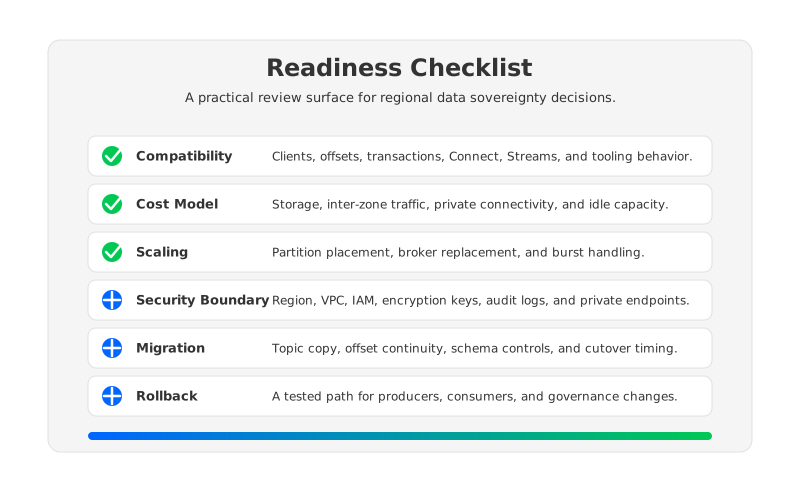
The security review should end with a scorecard, not a slogan. Give each dimension an outcome: approved, needs evidence, or rejected. Require a named owner for any "needs evidence" item before production. A regional Kafka platform is ready when the team can explain exactly where records live, how they move, how they recover, who can administer them, and how the same rules survive scaling and migration.
If your platform team is evaluating regional data sovereignty for a Kafka-compatible estate, start by mapping your current data paths and recovery runbooks against the checklist above. Then test whether a Shared Storage architecture changes the parts of the review that are most expensive to operate. To evaluate AutoMQ in your own boundary, use the AutoMQ BYOC entry point: start a technical review.
6FAQ
6.1Is regional data sovereignty the same as data residency?
No. Data residency usually focuses on where data is stored. Data sovereignty adds control questions: which laws apply, who can access the data, how operations are audited, and whether recovery or support processes can move data outside the approved boundary.
6.2Can Kafka satisfy regional data sovereignty requirements?
Yes, but the answer depends on deployment design. Review storage placement, replication paths, network routing, identity, logs, metrics, schema governance, and migration procedures. Kafka compatibility alone does not prove sovereignty.
6.3Does Tiered Storage solve the sovereignty problem?
Tiered Storage can help move older log data to remote storage, but it does not by itself remove the need to review local active logs, broker recovery, replica placement, private networking, and operational data exports.
6.4What should security teams ask first?
Ask where durable records are stored after producer acknowledgment, what network paths records and metadata can take, who administers the platform, and what happens during failover or migration.
6.5Where does AutoMQ fit in the evaluation?
AutoMQ fits when teams want Kafka-compatible APIs with a Shared Storage architecture, stateless brokers, and customer-controlled deployment boundaries through AutoMQ BYOC or AutoMQ Software.
7References
- Apache Kafka Tiered Storage documentation
- Apache Kafka KRaft documentation
- Apache Kafka transaction protocol documentation
- AutoMQ Shared Storage architecture
- AutoMQ comparison with Apache Kafka
- AutoMQ Kafka Linking migration overview
- AWS S3 FAQ
- AWS PrivateLink concepts
- Azure regions and Availability Zones overview
- Google Cloud geography and regions


