
Table of Contents
Table of Contents
Teams search for acl lifecycle management kafka when the permission model has become a delivery bottleneck. A service needs to publish to a topic, a data product needs a read-only consumer group, a contractor account must expire, or an audit asks why a principal still has write access after the application was retired. None of those requests is conceptually hard. The problem is that each request touches a production streaming system where a small authorization mistake can stop traffic or expose data.
Kafka access control lists sit at the intersection of platform engineering, security, and application ownership. The Kafka project defines authorization around principals, resources, operations, and pattern types, but the production lifecycle around those objects is broader than the broker command that creates an ACL. Teams need request intake, approval, deployment, validation, audit evidence, expiry, and cleanup. If the lifecycle is too manual, application teams wait. If it is too loose, security teams inherit invisible risk.
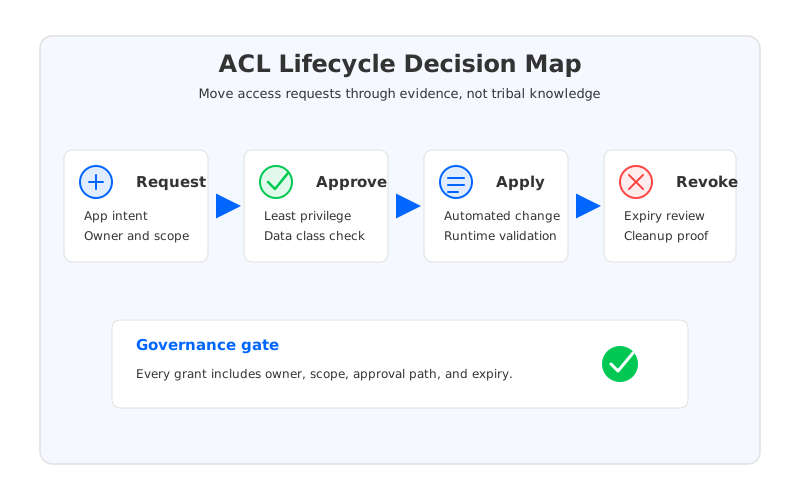
The right goal is not to make every developer an ACL administrator. The goal is to let application teams request access through a predictable contract while the platform keeps the cluster, audit trail, and rollback path under control. That distinction matters because Kafka authorization is not a one-time configuration task. It is a long-running operating model.
1Why Teams Search for acl lifecycle management kafka
The search usually starts after a platform team has outgrown a ticket queue. Early Kafka deployments can survive with a small set of long-lived service accounts and a few manually created ACLs. As the estate grows, topic names change faster than tickets close, consumer groups appear during testing, service accounts remain after projects end, and emergency grants become permanent because nobody wants to break a running pipeline.
The pressure is strongest in organizations that treat Kafka as shared infrastructure. A payments team, a risk team, and a data science team may all depend on the same cluster, but their access patterns are different. Producers write to topics, consumers read from topics and groups, connectors touch internal topics, and operators need debugging access without turning administrator rights into a standing privilege.
That creates four lifecycle questions that a mature platform cannot avoid:
- Who is allowed to request access, and what evidence proves the request is tied to an application owner?
- How is the grant applied across environments without hand-editing production commands?
- How does the team verify that the permission works without granting more access than requested?
- When the application, user, or project ends, who removes the grant and proves that it was removed?
These are governance questions, but they are not paperwork. They directly affect delivery speed. A data product team that waits several days for a topic ACL will build workarounds. A security team that sees uncontrolled wildcard grants will slow every request down. Good ACL lifecycle management gives both sides a smaller blast radius and a faster path.
2The Production Constraint Behind the Problem
ACL management becomes expensive when authorization changes are entangled with broker operations. Traditional Kafka runs with broker-local storage and a shared-nothing cluster model. That model is proven, but it makes every production change compete with broker capacity planning, partition placement, replication, and recovery work. Authorization itself does not move data, yet the systems around authorization often do: topics, consumer groups, connector deployment, tenant migration, and cluster expansion all tend to arrive with ACL changes.
In a small cluster, an ACL request may be a single command. In a multi-team platform, it becomes a release process. The platform team has to know whether the topic exists, whether the principal maps correctly through SASL or mTLS, whether the resource pattern is literal or prefixed, and whether the same application also needs schema registry, connector, network, or object storage permissions. The Kafka ACL is one row in a larger access graph.
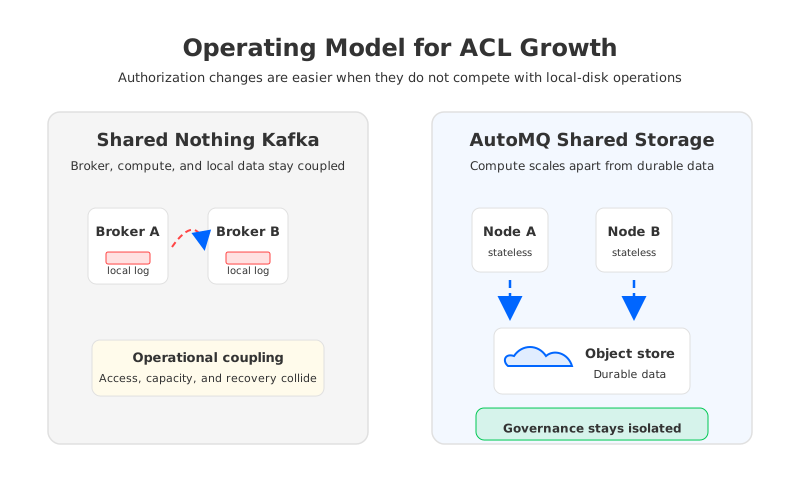
The hidden operational cost appears during change and failure. If a cluster is under storage pressure, if partition reassignment is already running, or if a broker replacement is pending, platform teams become conservative about anything that might trigger more application traffic. That conservatism is rational. It is also why access management can feel slower than the application teams expect.
Cloud networking adds another constraint. Many teams operate across availability zones, private network boundaries, and customer-controlled environments. A permission grant that works in one VPC path may fail in another because the network route, identity provider mapping, or private endpoint policy is different. ACL lifecycle management has to treat Kafka authorization as one control in a layered access model, not as the entire security boundary.
3What a Practical ACL Lifecycle Looks Like
A useful lifecycle starts with intent, translates that intent into a least-privilege grant, applies it through automation, tests the access path, and later removes it when the owner or application no longer needs it. The lifecycle should be visible enough for security review and direct enough that application teams do not bypass it. A strong starting point is a small permission vocabulary: produce, consume, administer a bounded namespace, run connector, or operate emergency break-glass access.
| Lifecycle stage | Platform responsibility | Application responsibility |
|---|---|---|
| Request | Define approved access patterns, required metadata, and owner fields. | State the topic, group, environment, service account, and business purpose. |
| Approve | Check least privilege, data classification, and separation of duties. | Confirm ownership and expected lifetime. |
| Apply | Deploy ACLs through a controlled path and record the change. | Use the approved principal and avoid out-of-band credentials. |
| Validate | Test authentication, authorization, and observability signals. | Prove the application works with the granted scope. |
| Review | Report grants by owner, age, resource, and risk. | Renew or retire access before expiry. |
| Revoke | Remove stale grants with rollback instructions. | Stop using retired principals and update deployments. |
The table works because the operating contract is clear. A narrow vocabulary gives platform teams a place to encode Kafka details while application teams interact with a stable request model.
4Evaluation Checklist for Platform Teams
The neutral way to evaluate ACL lifecycle management is to separate policy quality from infrastructure friction. Policy quality asks whether the grant is correct, reviewable, and reversible. Infrastructure friction asks whether the platform can apply the grant quickly without creating unrelated operational risk.
Start with compatibility. Kafka-compatible infrastructure should preserve the authorization semantics your clients and tools expect: principals, resources, operations, resource pattern types, and behavior under denied access. Compatibility also matters for migration because you need to move service accounts, ACL definitions, client configurations, and monitoring rules without turning security into a separate rewrite project.
Then examine where the lifecycle state lives. The durable source of truth may be Git, Terraform, an internal portal, an identity governance tool, or a control plane API. The broker stores authorization state used at runtime, but the organization needs a history that answers who requested the grant, who approved it, what automation applied it, and when it should expire.
The production checklist should include seven checks:
- Compatibility: Can existing Kafka clients, command-line tools, and automation workflows continue to use familiar authorization semantics?
- Least privilege: Are request types constrained enough to prevent accidental wildcard grants across topics, groups, and transactional IDs?
- Propagation safety: Can the team apply, validate, and roll back ACL changes without restarting unrelated applications?
- Auditability: Can security review grants by owner, resource, environment, age, and approval path?
- Tenant boundaries: Are network, identity, and deployment boundaries aligned with the Kafka permission model?
- Operational isolation: Does an ACL change remain an ACL change, or does it collide with broker storage, scaling, or recovery work?
- Migration readiness: Can grants be exported, compared, replayed, and validated when moving to another Kafka-compatible environment?
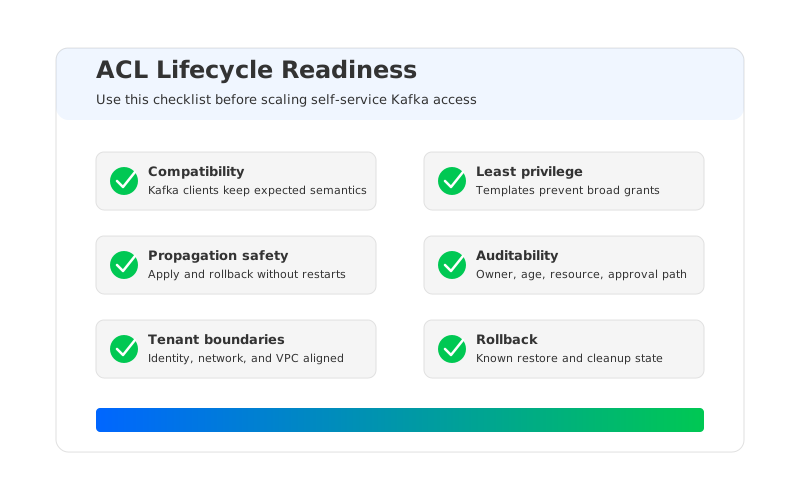
The last two checks are often underestimated. A permission model can be logically correct and still slow the business if every grant must wait behind cluster maintenance. ACL lifecycle management belongs in the platform architecture conversation, not only in the security tooling backlog.
5Architecture Options and Trade-Offs
There are three common operating models for Kafka ACL lifecycle management. Manual administration keeps humans close to the risk, but the same engineers become the bottleneck for each topic, consumer group, connector, and service account. GitOps improves auditability and repeatability, but it works best when application teams submit intent and platform automation expands that intent into concrete Kafka grants. Self-service with policy guardrails scales further, as long as the system detects unknown topics, invalid principals, overly broad patterns, missing expiry, and conflicts with data classification before the request reaches production.
None of these models removes operational judgment. Break-glass access still needs a path, bulk revocation still needs rollback, and migration still needs comparison between source and target authorization state. Mature lifecycle management turns those events into documented procedures rather than improvisation.
6How AutoMQ Changes the Operating Model
After the governance model is clear, the infrastructure question becomes sharper: can the streaming platform absorb access changes, tenant growth, and migration work without turning every permission update into a cluster operations event? This is where a Kafka-compatible shared storage architecture changes the operating model.
AutoMQ is a Kafka-compatible cloud-native streaming platform that separates compute from storage and persists data on object storage. Brokers can be treated more like stateless compute nodes because durable stream data is not tied to broker-local disks in the traditional way. For ACL lifecycle management, the immediate benefit is not that authorization becomes magical. The benefit is that access governance can evolve with less interference from storage placement and broker recovery concerns.
Consider the common case where an application team needs a namespace, topics, service account, and ACLs. In a broker-local model, the access request often arrives together with capacity questions: partitions, retention, broker placement, and future growth. In a shared storage model, compute and storage scale more independently, so the platform team can separate the security decision from the storage placement decision.
AutoMQ's customer-controlled deployment model also fits security and compliance workflows. Teams can run Kafka-compatible infrastructure within their own cloud account or private environment, keep data boundaries aligned with their VPC and identity controls, and still use a cloud-native operating model. For organizations evaluating BYOC, data sovereignty, private networking, TLS, OIDC, and audit requirements, this matters because Kafka ACLs are only one layer. The surrounding environment has to support the same governance story.
The architectural effect is practical:
- Access requests can be evaluated against application intent instead of broker anxiety.
- Scaling decisions can respond to workload growth without treating local disk placement as the dominant constraint.
- Migration planning can focus on compatibility, authorization parity, and validation rather than rebalancing a large broker-local storage estate.
- Security teams can keep deployment boundaries under customer control while platform teams preserve Kafka-compatible application behavior.
7Operating Principles for Fast, Safe Access
The fastest ACL process is not the one with no approval. It is the one where ordinary requests are boring because the platform already knows what to do. Use least privilege as a template, not a negotiation. Application teams should not have to invent the correct ACL set for common patterns; producer, consumer, connector, and bounded-namespace templates cover most cases with fewer mistakes than raw operation selection.
Keep ownership attached to the grant. Every long-lived permission should have an application, team, environment, and expiry or review date. Validate the negative path as well as the positive path: a successful produce or consume test proves the intended grant works, but it does not prove the grant is bounded. Test that the same principal cannot access neighboring topics, unrelated groups, or admin operations outside its scope.
Cleanup needs the same discipline as creation. Immediate deletion can be dangerous if the application still has hidden dependencies, but indefinite access is worse. A safer pattern is to mark grants for retirement, notify owners, monitor for use, and remove after the agreed window. These principles are the difference between access management as a queue and access management as a platform capability.
8Closing the Loop
The original search for acl lifecycle management kafka usually comes from a delivery problem: teams need access faster, but the platform cannot afford loose grants. The way out is to make authorization lifecycle state explicit, automate the repeatable parts, and choose infrastructure that does not turn every application request into a storage and capacity discussion.
If you are evaluating Kafka-compatible infrastructure for a governance-heavy environment, include ACL lifecycle management in the architecture review. AutoMQ's Kafka-compatible shared storage model is worth evaluating when you want application teams to keep familiar Kafka behavior while platform and security teams keep deployment boundaries, auditability, and cloud operations controlled. Start with the AutoMQ overview, then map your ACL lifecycle against the checklist above.
9References
- Apache Kafka documentation: security and authorization
- Apache Kafka documentation: operations
- AutoMQ documentation: What is AutoMQ
- AutoMQ documentation: Kafka compatibility
- AutoMQ documentation: architecture overview
- AWS PrivateLink documentation
- Amazon S3 user guide
10FAQ
10.1What is ACL lifecycle management in Kafka?
ACL lifecycle management is the process of requesting, approving, applying, validating, auditing, renewing, and revoking Kafka access grants. It covers the Kafka ACL objects themselves and the surrounding ownership, identity, automation, and evidence needed to operate them safely in production.
10.2Why is Kafka ACL management difficult at scale?
The difficulty comes from coordination, not only from Kafka syntax. Each grant may depend on topic ownership, consumer group naming, service account mapping, connector behavior, network boundaries, approval rules, and expiry requirements. Manual administration becomes slow because every request requires platform, security, and application context.
10.3Should Kafka ACLs be managed with GitOps?
GitOps is a strong fit when it gives the organization a reviewed source of truth and repeatable deployment path. It works best when application teams request intent and platform automation converts that intent into concrete ACLs. Raw low-level ACL files can still become hard to review if ownership and request templates are missing.
10.4How does shared storage affect ACL lifecycle management?
Shared storage does not change the need for Kafka authorization policy. It changes the operational context around access changes. When durable data is not tied to broker-local disks, platform teams can separate permission workflows from many storage placement, scaling, and recovery concerns that slow traditional broker-local operations.
10.5Where should AutoMQ fit in an ACL evaluation?
Evaluate policy, ownership, and automation first. Then evaluate whether the streaming platform preserves Kafka compatibility while reducing operational friction around scaling, migration, and customer-controlled deployment boundaries. AutoMQ fits the second part of that review as a Kafka-compatible platform built around shared storage and cloud-native operations.


