
Table of Contents
Table of Contents
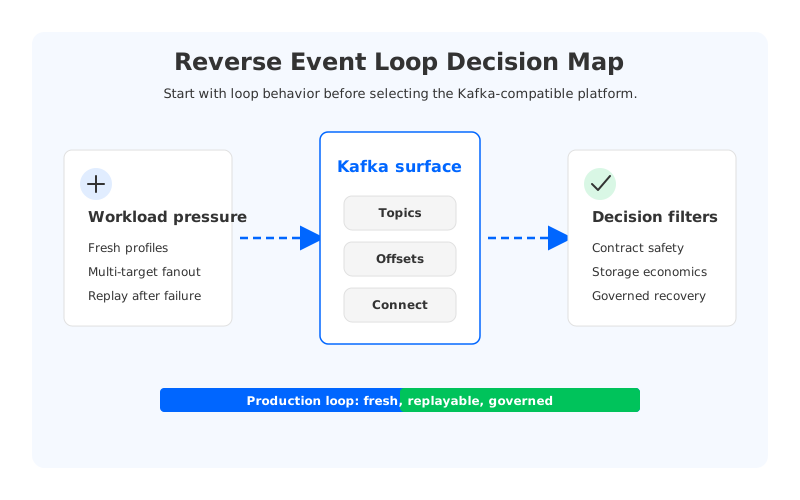
Searching for reverse etl event loop kafka usually means the customer data platform has crossed a line. It is no longer enough to sync modeled customer attributes from a warehouse into SaaS tools. Product surfaces, support workflows, fraud checks, campaigns, entitlement services, and AI personalization now depend on customer signals that must be fresh, governed, replayable, and recoverable. Once those signals influence user-visible behavior, reverse ETL becomes an activation control loop.
That loop has a stricter contract than a dashboard feed. A segment update may trigger a campaign, the campaign response may become a behavioral event, the behavioral event may update the profile, and the next profile state may change what the customer sees in the application. Kafka is attractive because it gives teams durable topics, consumer groups, offsets, replay, backpressure, and a broad connector ecosystem. The trap is assuming that adding Kafka automatically makes the loop operationally safe. It gives you the substrate; the platform team still has to design the contracts, failure boundaries, and storage economics.
1Why teams search for reverse etl event loop kafka
Most CDP projects begin with a useful one-way promise: collect events, resolve identity, model customer state, and activate audiences downstream. That model works for campaigns and operational enrichment when freshness expectations are measured in hours. The search term changes when teams add "event loop" to reverse ETL. They need to close the path from analytical decisions back into operations without losing evidence.
The pressure shows up in three places. First, activation targets multiply. The same customer profile update may feed a CRM, support console, recommendation service, feature store, experimentation platform, and suppression list. Second, consumers recover at different speeds. A personalization service may need tail reads, while a support-system connector may need to replay hours of missed changes after an outage. Third, governance becomes part of runtime behavior. Consent withdrawal, deletion requests, segment exclusion, and eligibility rules must travel with the same seriousness as revenue-generating activation.
Kafka fits the middle of that problem because it decouples producers from consumers without throwing away ordering and replay. A profile service can publish customer-state events keyed by customer ID. Connectors and applications can consume those events in independent consumer groups. If a target system fails, its group can resume from committed offsets or replay from a known point. Apache Kafka documents these mechanics through consumers, offsets, transactions, producer configuration, and Kafka Connect. The real question is whether the platform around Kafka can keep that loop governable as retention, fanout, and recovery load grow.
2The operational constraint behind connector-heavy platforms
Connector-heavy platforms create a misleading first impression because the first integration usually looks clean. One source connector, one topic, one sink connector, one target. The diagram fits on a slide, and the first demo works. Production looks different because the connectors become the visible edge of a broader operating model: who owns schema changes, how target writes become idempotent, how failed records are quarantined, how offsets are reset, and how replay is approved when customer-facing systems are involved.
A CDP activation loop also mixes event types that need different controls:
- Raw behavior events preserve what happened, often at high volume and with broad analytical value. They are useful for rebuilding profile state, but they are rarely safe to push directly into every target.
- Profile projection events represent interpreted customer state, such as lifecycle stage, churn risk, account tier, or eligibility. These need clear ownership because consumers treat them as business facts.
- Activation command events tell a target system to do something, such as update a field, suppress a message, open a case, or refresh a feature. These need stronger idempotency and rollback semantics than passive facts.
- Governance events carry consent, deletion, residency, and policy changes. They may be lower volume, but they have higher priority because stale governance can make the whole loop unsafe.
Traditional Kafka can carry all of these streams, but its Shared Nothing architecture ties durable data to broker-local storage. Each broker owns partitions on local disks, and replication places additional copies across brokers for durability. That design is familiar, yet it makes connector-heavy CDP workloads sensitive to disk sizing, partition movement, cross-zone replication, and recovery traffic. When retention grows from a short buffer into an operational audit window, the cost and work move from the connector layer into the broker layer.
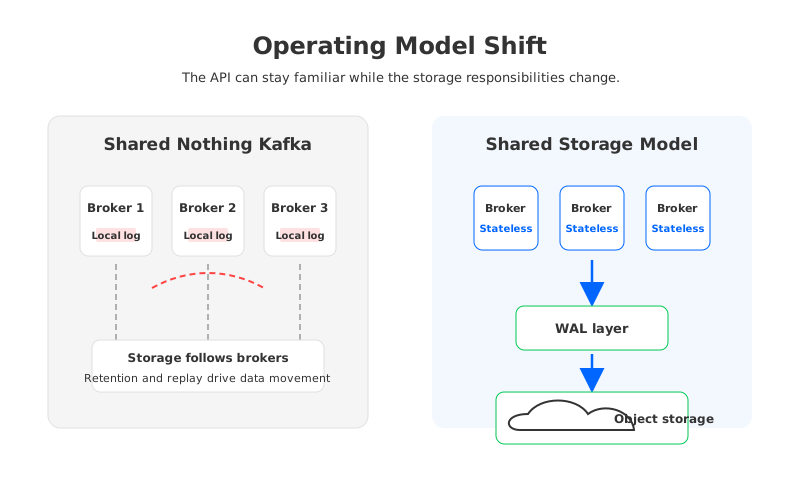
The hard operating constraint is not steady throughput. Many activation topics have modest write volume compared with clickstream or telemetry pipelines. The hard constraint is bursty replay combined with long-lived accountability. A downstream outage, a bad profile model, a schema rollback, or an identity-merge correction can create a large catch-up read long after the original events were written. If that history lives mainly on broker disks, the platform has to provision for the storage and movement profile even when the normal day looks calm.
3Failure handling, schema, and replay trade-offs
The safest activation loops are designed backward from failure. Start with the question a customer-facing incident will ask: which version of the customer fact did this system act on, and can we replay or undo the affected path? If the platform cannot answer that, low latency becomes a liability.
Schema strategy is the first control point. A warehouse table is not a stable activation contract. Tables often reflect analytical convenience: joins, slowly changing dimensions, nullable fields, and model-specific naming. Kafka topics used for CDP activation should publish facts with stable keys, explicit timestamps, versioned schemas, and semantics consumers can test. Kafka Connect can help standardize source and sink integration, but it does not remove the need to decide whether the topic carries a table change, a domain fact, or a command.
Replay strategy is the second control point. Consumer groups and offsets are powerful because they make recovery explicit, but they also make mistakes repeatable. Resetting a connector to an earlier offset can repair a missed window, duplicate target writes, or reapply a command that is not idempotent. Transactions and idempotent producers help with exactly-once style processing inside well-defined Kafka workflows, yet target systems outside Kafka may still expose weaker write semantics. The loop should treat replay as an operational procedure.
Governance strategy is the third control point. CDPs carry personal data, consent state, regional constraints, and business-sensitive segmentation rules. A Kafka topic with long retention can help audit and recovery, but it also extends the period during which sensitive data must be protected. Platform teams should align topic naming, ACLs, encryption, retention, deletion workflows, and observability before activation expands beyond one domain. Governance debt becomes visible when teams need to prove which systems consumed which customer fact.
The trade-off is straightforward: a loop with no replay cannot be trusted, and a loop with unconstrained replay can become dangerous. The design needs enough history to recover and investigate, enough contract discipline to avoid replaying ambiguous records, and enough operational friction to keep high-risk resets under review.
4Evaluation checklist for platform teams
The right architecture does not come from the connector catalog. It comes from the shape of the loop: how facts are produced, how many systems consume them, how long history must remain available, and who can change the contract. A useful evaluation keeps product names out of the first pass and scores the platform against production behaviors.
| Evaluation area | Question to ask | Why it matters |
|---|---|---|
| Kafka compatibility | Can existing clients, Connect workers, ACL patterns, and observability tools work with minimal changes? | CDP teams usually cannot rewrite every producer and consumer during an activation redesign. |
| Event contracts | Are topics modeled as raw events, profile facts, commands, or governance signals? | Contract confusion is the root cause of unsafe target writes and ambiguous replay. |
| Retention and replay | Can the platform support audit windows and bursty catch-up reads without turning broker disks into the planning center? | Activation incidents often require replay after the system has returned to normal traffic. |
| Cost model | How do storage, replication, cross-zone traffic, connector compute, and private networking scale with fanout? | A quiet activation layer can still become expensive when many consumers replay the same history. |
| Recovery controls | Can teams reset offsets, quarantine poison records, roll back schema changes, and isolate target failures? | The loop needs operational procedures that match customer-facing risk. |
| Governance boundary | Can the deployment match data residency, account isolation, network, and access-control requirements? | CDP data often sits inside the most sensitive part of the data estate. |
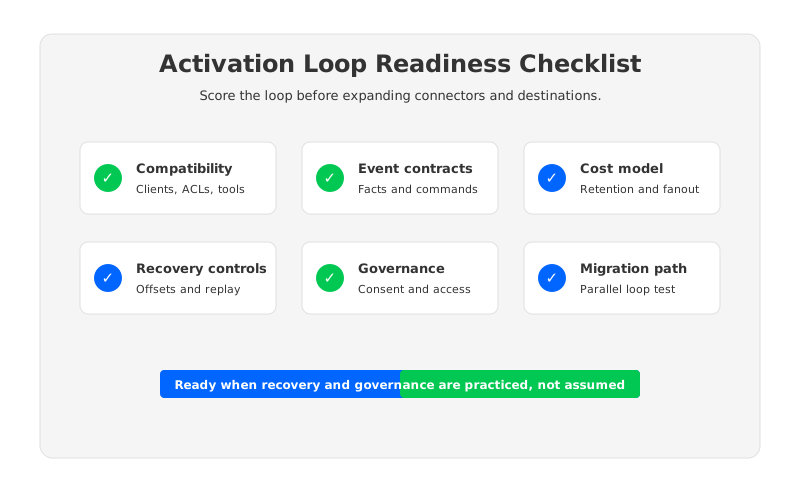
This checklist separates two questions that are often blended together. Kafka compatibility answers whether the application surface is familiar. Operating model answers whether infrastructure can absorb the workload shape without constant storage, movement, and recovery work. A platform can pass the first test and still struggle with the second.
5How AutoMQ changes the operating model
When the evaluation points toward Kafka compatibility plus elastic storage economics, shared-storage Kafka-compatible systems deserve a serious look. AutoMQ fits into that category: it keeps the Apache Kafka protocol and semantics compatible while changing the storage architecture underneath. Instead of making broker-local disks the long-term center of durability, AutoMQ uses a Shared Storage architecture with stateless brokers, S3Stream, object storage, and a write-ahead log layer.
That distinction matters for CDP activation loops because the loop's worst moments are often storage-shaped. A consent repair, target outage, or model rollback can force consumers to read older data at higher speed than usual. With a broker-local model, those reads compete with the storage and placement decisions already embedded in the cluster. With a shared-storage model, compute and storage can be reasoned about more independently. The operational goal is not magic performance; it is reducing the amount of broker data movement that every retention, replay, or scale decision creates.
AutoMQ's stateless broker model also changes scaling and failure recovery. If brokers are less tied to durable local partition ownership, adding or replacing compute is not the same kind of storage migration event. That is useful for activation platforms where workload shape changes during campaigns, backfills, incident recovery, and downstream maintenance windows. It also gives platform teams a cleaner way to evaluate cost: keep enough compute for active produce and consume traffic, use object storage for durable history, and avoid treating every additional retention window as broker disk growth.
Network boundaries still need careful design. CDP data is sensitive, and many enterprises prefer customer-controlled deployment boundaries rather than sending activation data through a vendor-owned plane. AutoMQ Cloud BYOC and software deployment options let teams evaluate Kafka-compatible streaming while keeping cloud accounts, VPCs, object storage, and access controls aligned with internal requirements. AutoMQ documentation also describes approaches for reducing inter-zone traffic in Kafka-compatible deployments, which matters when multi-AZ placement and consumer fanout interact with cloud networking charges.
AutoMQ should not be treated as a shortcut around event-contract work. Teams still need schema discipline, idempotent target writes, offset procedures, connector observability, and governance policy. The architectural benefit is narrower and more concrete: when the activation loop needs Kafka compatibility plus long-lived replay, elastic scaling, and cloud-native storage behavior, the shared-storage model can reduce the operational burden that traditional broker-local storage places on the platform team.
6Migration and readiness scorecard
A pragmatic migration starts beside the existing path. Pick one activation domain where the current batch or connector workflow is important enough to warrant rigor but contained enough to avoid a company-wide cutover. Good candidates are customer entitlement changes, support-priority updates, lifecycle suppression, or a profile fact consumed by two independent systems. The goal is to test the loop, not to move every CDP destination at once.
Use a simple readiness score before expanding:
| Gate | Ready signal | Stop signal |
|---|---|---|
| Contract | Topic key, schema owner, event semantics, and compatibility policy are documented. | Consumers read raw warehouse table shapes as business contracts. |
| Target writes | Sink behavior is idempotent or has a clear deduplication key. | Replay can create duplicate CRM updates, tickets, campaigns, or feature writes. |
| Recovery | Offset reset, poison-record handling, rollback, and replay approval are practiced. | Recovery exists only as tribal knowledge inside one engineer's terminal history. |
| Observability | Lag, connector task health, failed records, schema errors, and target write outcomes are visible. | The team sees Kafka health but not activation correctness. |
| Platform fit | Retention, fanout, cross-zone traffic, and catch-up reads have been modeled. | The architecture is chosen from average write throughput alone. |
The original search phrase, reverse etl event loop kafka, points to a production decision rather than a feature checklist. A CDP activation loop should make customer facts useful while they are still actionable, but it must also preserve evidence and control when those facts are wrong. Kafka gives the loop a durable backbone. The platform choice decides whether retention, replay, governance, and elasticity become routine operations or recurring incidents. If your team is evaluating a Kafka-compatible shared-storage model for that path, start with the AutoMQ demo environment and test one activation loop against your own schemas, connectors, replay windows, and network boundaries.
7References
- Apache Kafka Documentation
- Apache Kafka Connect
- Apache Kafka Message Delivery Semantics
- Apache Kafka KRaft
- Apache Kafka Producer Configurations
- Apache Kafka Consumer Configurations
- AutoMQ Shared Storage Architecture
- AutoMQ Native Compatibility with Apache Kafka
- AutoMQ WAL Storage
- AutoMQ Cloud BYOC Overview
- AWS Amazon S3 Pricing
- AWS VPC Pricing
8FAQ
8.1Is Kafka required for every reverse ETL workflow?
No. Scheduled reverse ETL is still a good fit for low-risk enrichment, periodic SaaS field updates, and workflows where freshness is not tied to user-visible behavior. Kafka becomes more compelling when many systems need independent consumption, replay, ordering, backpressure, and recovery control around the same customer facts.
8.2What makes a CDP activation loop different from a normal data pipeline?
A normal pipeline often moves data from source to destination. An activation loop changes downstream behavior and feeds the result back into customer state. That feedback path raises the standard for schema contracts, offset management, idempotent target writes, consent handling, and incident recovery.
8.3How should teams model topics for activation?
Avoid publishing raw analytical tables as the default contract. Model separate topics for raw events, governed profile facts, activation commands, and governance signals when their ownership and replay behavior differ. Stable keys, explicit timestamps, schema compatibility, and target write semantics matter more than mirroring the warehouse shape.
8.4Where does AutoMQ fit in this architecture?
AutoMQ fits when a team wants Kafka compatibility but expects pressure around long retention, replay, broker-local storage, elastic scaling, cross-zone traffic, or customer-controlled deployment boundaries. Evaluate it with a real activation loop rather than a connector-only benchmark.


