
Table of Contents
Table of Contents
Someone searching active active kafka architecture is usually carrying a real production problem, not a diagram exercise. The application may serve users in multiple regions. A single regional outage may be unacceptable. A platform team may be under pressure to reduce failover time without asking every application owner to rewrite event flows. Active-active sounds attractive because it promises a clean answer: keep more than one Kafka environment serving traffic at the same time.
The difficult part is that Kafka is not a stateless API tier. Topics have partitions and ordered offsets, consumers commit progress, and downstream systems often treat stream order as business truth. When more than one site can write to the same logical stream, the architecture has to answer questions that ordinary high availability does not ask: who owns each key, what happens when both sides accept conflicting events, how are offsets represented across clusters, and how does a failed region rejoin cleanly?
Active-active Kafka can be the right pattern. It can also be an expensive way to hide unresolved ownership rules. The useful starting point is not whether active-active is impressive. The useful starting point is whether the workload is genuinely multi-writer, or whether it needs faster regional failover, lower read latency, or safer migration.
1Why active active kafka architecture matters now
Kafka deployments used to be reviewed mainly as clusters: broker count, replication factor, disk, network, retention, and client throughput. Multi-region requirements force a different review. The unit of design becomes the business stream across failure domains. A payments authorization stream and an observability stream may both use Kafka-compatible APIs, but they do not have the same tolerance for duplicate records, regional split-brain, or delayed conflict repair.
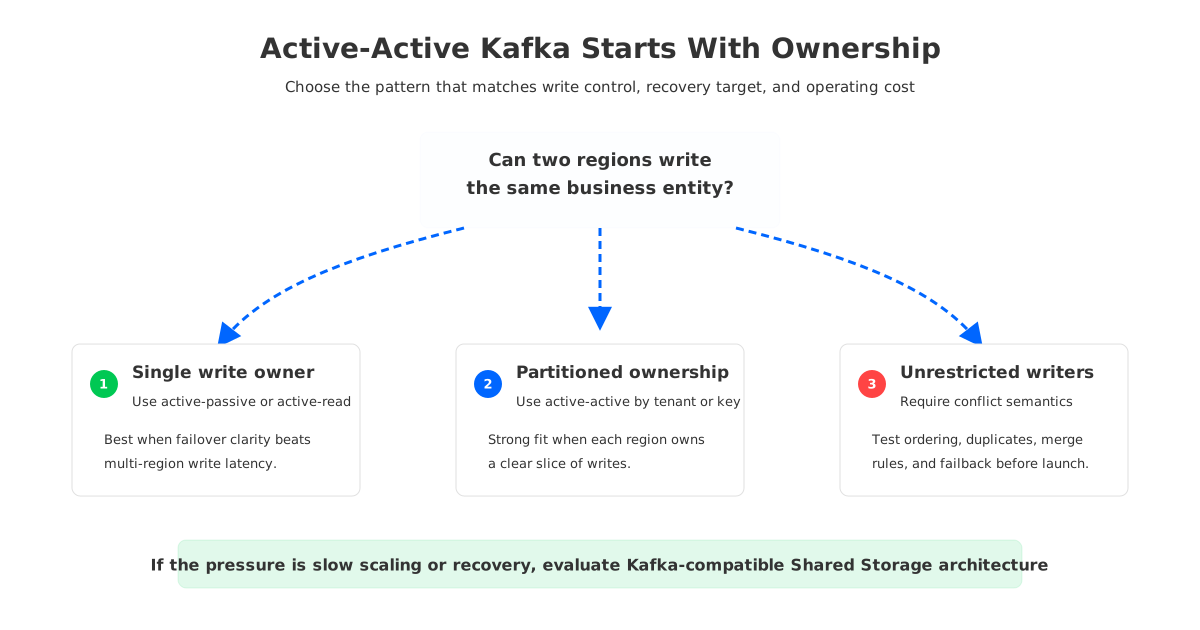
The phrase active-active is also overloaded. Some teams mean two clusters that accept writes for different tenants or geographies. Others mean two clusters that both accept writes to the same topic namespace, or active consumers in multiple regions reading replicated data. These are different systems, even if every diagram has two boxes with arrows between them.
Four questions separate them:
- Write ownership: Can more than one region write the same business entity, key, or topic at the same time?
- Ordering requirement: Does the application need total order, per-key order, per-partition order, or eventual convergence?
- Recovery target: Is the goal low Recovery Time Objective (RTO), low Recovery Point Objective (RPO), regional latency, or migration safety?
- Operating boundary: Who owns networking, storage, access control, audit logs, and the runbook when one side is unhealthy?
Those questions matter because active-active is not a single Kafka feature. It is a system property created by replication, routing, application ownership, storage architecture, observability, and operational discipline. No platform choice removes the need to define write ownership.
2The storage model behind the pain
Traditional Kafka uses a Shared Nothing architecture. Each broker owns local log segments, and durability is achieved by replicating partitions across brokers through ISR (In-Sync Replicas). Inside one region, that model is familiar and battle-tested. Across regions, it becomes more complicated because the platform is now coordinating state that was designed around a cluster-local replication domain.
Geo-replication tools can move records between clusters, but they do not turn two independent clusters into one linear log. If Region A and Region B both accept writes for the same logical stream, the system needs rules for merge order, duplicate handling, conflict resolution, offset mapping, and failback. Kafka offsets are local to partitions in a cluster, so offset continuity across clusters requires an explicit migration or synchronization strategy.
That is where many active-active designs become more fragile than expected. The first version focuses on the happy path: records flow in both directions, dashboards show lag, and both regions look alive. The hard cases arrive later: delayed replication, retries against both regions, or offset translation that does not match the application's idempotency model. The architecture was active-active, but the ownership model was active-confused.
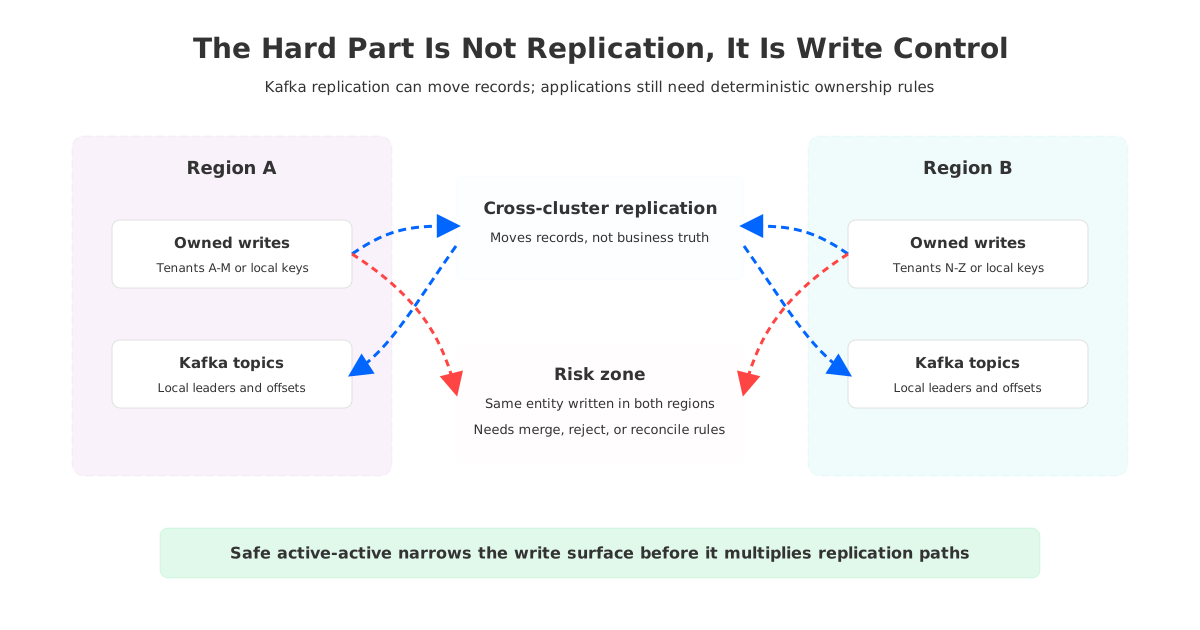
The point is not that multi-region Kafka is unsafe. The point is that active-active pushes application semantics into the platform review. Append-only telemetry may tolerate duplicates and late arrival. Account balance events may require strict key ownership and deterministic reconciliation. Search indexing may accept eventual convergence. Shipment triggers probably cannot.
3When active-active helps
Active-active is strongest when the workload naturally partitions ownership. If users, tenants, devices, or business entities can be assigned to a home region, each region can accept local writes for its owned slice while replication serves remote reads, analytics, or disaster recovery. The platform avoids unrestricted multi-writer conflict while still keeping more than one region active.
It also helps when regional read locality is as important as write availability. A global application may need consumers close to users, AI inference services, or fraud engines. Replicating event streams to multiple regions can reduce read latency and isolate downstream processing from a single regional control point. The write path may remain partitioned by ownership while consumers run actively in several places.
Active-active can be useful during migration as well, although the word can mislead teams. A migration phase may run source and target clusters side by side, synchronize messages, verify consumer progress, and switch traffic gradually. That is not the same as a permanent multi-writer architecture.
The pattern is worth serious consideration when several conditions hold at the same time:
- The business can define ownership by region, tenant, key range, or topic family.
- Producers can route writes according to that ownership rule and fail over deliberately.
- Consumers can tolerate replay, duplicates, or offset translation according to a documented contract.
- Replication lag is observable at the topic, partition, and business-workflow level.
- Failback has a runbook, not a hope that both sides will converge by themselves.
Teams that succeed with active-active rarely allow every service to write everywhere. They narrow the write surface, make ownership visible, and test failure modes before an outage decides for them.
4When active-active hurts
Active-active hurts when it is used as a shortcut around application ownership. If two regions can update the same entity at the same time, the platform has to choose between rejecting a write, accepting both writes and resolving later, or letting downstream systems handle inconsistency. Kafka gives you an ordered log per partition. It does not automatically provide global conflict resolution for arbitrary business state spread across regions.
It also hurts when the cost model is ignored. Multi-region replication adds network transfer, storage, compute, monitoring, and operational overhead. Multi-directional replication can multiply those costs because each region may store, process, and serve records that originated elsewhere. The exact bill depends on cloud provider, region, private connectivity, replication volume, and object storage usage, so production evaluations should use current provider pricing pages rather than borrowed benchmark numbers.
The failure model can become harder too. Active-passive designs have a clear promotion event. Active-active designs have more possible partial states: Region A accepts writes but cannot replicate; Region B serves stale reads; replication resumes out of order from an application perspective. A system can be more available at the cluster layer while being less predictable at the business layer.
The table below is a practical way to keep the debate grounded.
| Requirement | Active-active fit | Hidden risk to test |
|---|---|---|
| Regional write latency for owned tenants | Strong fit when ownership is explicit | Incorrect routing during failover can create conflicts |
| Low RTO for all applications | Possible, but not automatic | Client bootstrap, DNS, secrets, quotas, and dependencies may still block recovery |
| Zero data loss during region failure | Depends on synchronous or near-synchronous design | Long-distance latency and partial partitions can challenge the promise |
| Global ordering across regions | Weak fit for Kafka-style partitioned logs | Requires external sequencing or application-level reconciliation |
| Migration with rollback | Strong fit as a temporary dual-run pattern | Offset mapping and producer cutover must be controlled |
| Lower operating cost | Usually not the main reason | Extra replication, storage, and staffing can outweigh availability gains |
The uncomfortable conclusion is that active-active is not a maturity badge. A simpler active-passive or partitioned-active design may be more reliable if the team cannot prove conflict handling, failback, and observability under stress.
5A vendor-neutral evaluation framework
Start by naming the architecture precisely. "Active-active" is too broad for an engineering review. Use language such as active-active by tenant ownership, active-passive with automated promotion, active-read with single-write, dual-run migration, or multi-region replicated analytics. The label should tell application teams what they are allowed to do.
Then design around the write contract. For each topic family, define the owner, allowed failover path, duplicate policy, ordering expectation, and rollback procedure. If the team cannot describe one representative topic during a regional network partition, the architecture is not ready.
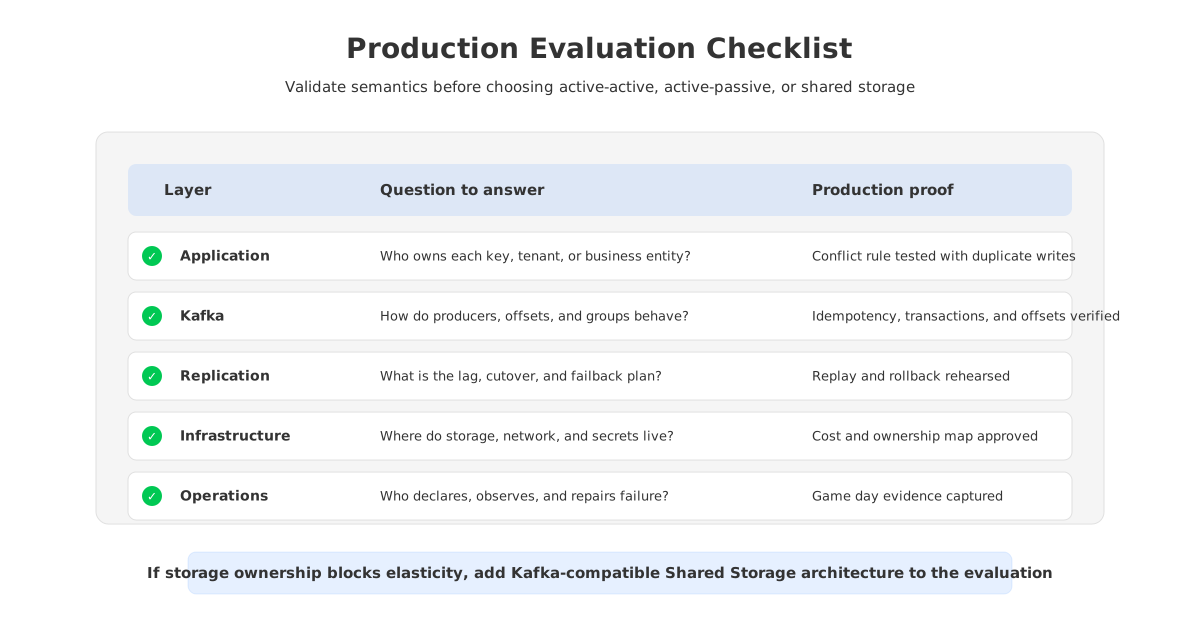
The evaluation should cover five layers:
- Application semantics: ownership, idempotency, conflict handling, and ordering.
- Kafka behavior: producer acks, idempotent producers, transactions, consumer groups, offsets, and topic configuration.
- Replication and migration: direction, lag, offset mapping, cutover, failback, and replay boundaries.
- Infrastructure: network paths, storage ownership, object storage, private connectivity, DNS, secrets, and quotas.
- Operations: SLOs, alerts, game days, audit trails, access control, and support boundaries.
This structure prevents a common mistake: evaluating a multi-region product feature while ignoring the application contract that makes the feature safe. It also makes platform choices easier to compare. Traditional Kafka with MirrorMaker2, managed Kafka services, Kubernetes-based Kafka, and Kafka-compatible Shared Storage architecture can all be reviewed against the same workload.
6Where AutoMQ fits after the neutral evaluation
Once the team separates write ownership from storage ownership, AutoMQ becomes relevant as a Kafka-compatible cloud-native streaming platform built around Shared Storage architecture. AutoMQ keeps the Kafka protocol and ecosystem surface while replacing broker-local log storage with S3Stream, a storage layer that uses WAL (Write-Ahead Log) storage and S3-compatible object storage. AutoMQ brokers are stateless, so durable stream data is not permanently tied to broker-local disks.
That distinction does not solve multi-region conflict semantics by itself. No storage architecture can make two conflicting business writes magically correct. What AutoMQ changes is the operating model around Kafka-compatible clusters: retained data lives in shared object storage, broker replacement is less coupled to local log ownership, and partition reassignment can be treated more like metadata and traffic movement than bulk data copying in typical production scenarios.
AutoMQ is especially relevant when active-active pressure is really a symptom of elasticity pressure. Some teams ask for active-active because broker recovery is slow, scaling requires disruptive data movement, or the cluster is expensive to over-provision for standby capacity. In those cases, the better question may be whether the Kafka foundation needs stateless brokers and shared storage before it needs unrestricted multi-writer operation.
AutoMQ also has a migration angle. AutoMQ commercial editions include AutoMQ Linking for Kafka, a zero-downtime migration tool designed for byte-level message synchronization with offset consistency. That is useful when the project needs controlled dual operation during a migration, but it should still be reviewed separately from a permanent active-active business design.
7Decision guide
If the team needs regional availability, begin with the least complex design that meets the business target. Active-passive with automated promotion may be enough when writes can pause briefly and failover is well tested. Active-read with single-write can work when consumers need regional locality but producers do not. Partitioned-active can work when ownership is cleanly divided by tenant, geography, or key range.
Use this decision guide before committing to a platform pattern:
| If your real problem is... | Prefer this pattern first | Why |
|---|---|---|
| Faster disaster recovery | Active-passive with tested promotion | Clearer ownership and simpler failback |
| Regional consumer latency | Active-read with replicated streams | Keeps writes controlled while reads are local |
| Tenant or geography ownership | Partitioned-active | Multi-region writes without unrestricted conflicts |
| Platform migration | Temporary dual-run migration | Focuses on cutover, offsets, and rollback |
| Broker-local storage operations | Kafka-compatible Shared Storage architecture | Changes scaling and recovery mechanics |
| Global concurrent writes to the same entity | Multi-writer active-active with conflict rules | Requires application-level reconciliation |
The right architecture may combine several rows. A global SaaS platform might use partitioned-active writes by region, replicated reads for analytics, and a shared-storage Kafka-compatible foundation for elasticity.
Active-active Kafka architecture helps when it matches how the business owns data. It hurts when it hides an ownership problem behind replication arrows. Before choosing the pattern, write down the entity ownership rules, offset strategy, failback plan, and cost model for one critical stream. If the design still holds, test it with failure injection. If the deeper issue is broker-local storage and operational elasticity, evaluate Shared Storage architecture as part of the foundation.
To explore the shared-storage path with Kafka-compatible APIs, contact AutoMQ with one representative multi-region workload and its ownership rules.
8References
- Apache Kafka Documentation
- Apache Kafka Operations: Geo-Replication and Cross-Cluster Data Mirroring
- Apache Kafka Documentation: Idempotent Producer
- Apache Kafka Documentation: Transactions
- AutoMQ Documentation: Architecture Overview
- AutoMQ Documentation: S3Stream Shared Streaming Storage
- AutoMQ Documentation: Migrating from Apache Kafka to AutoMQ
9FAQ
9.1Is active-active Kafka always better than active-passive?
No. Active-active can reduce regional dependency and improve local write or read behavior, but it adds ownership, replication, cost, and failback complexity. Active-passive is often more predictable when the business can tolerate tested promotion and wants a clearer write owner.
9.2Can Kafka provide global ordering across active-active regions?
Kafka provides ordered records within a partition in a cluster. Global ordering across independent regions requires extra design, such as external sequencing, strict key ownership, or application-level reconciliation. Most practical active-active Kafka designs avoid unrestricted global ordering requirements.
9.3What is the safest active-active pattern for Kafka?
Partitioned-active is usually safer than unrestricted multi-writer active-active. Each region owns a defined subset of tenants, keys, or topics, while replication supports remote reads and recovery. This preserves regional activity without allowing every region to update the same entity at the same time.
9.4How is active-active different from a migration dual-run?
A migration dual-run is temporary. It keeps source and target clusters operating while data synchronization, consumer progress, cutover, and rollback are validated. Permanent active-active is a steady-state architecture with ongoing multi-region write or read behavior. Mixing the two concepts leads to unnecessary complexity.
9.5Where does AutoMQ fit in active-active Kafka evaluation?
AutoMQ fits when the evaluation shows that broker-local storage, slow scaling, recovery data movement, or customer-controlled cloud deployment boundaries are part of the problem. It preserves Kafka-compatible APIs while using Shared Storage architecture and stateless brokers. Teams still need explicit write ownership and conflict rules for any multi-region design.


