
Table of Contents
Table of Contents
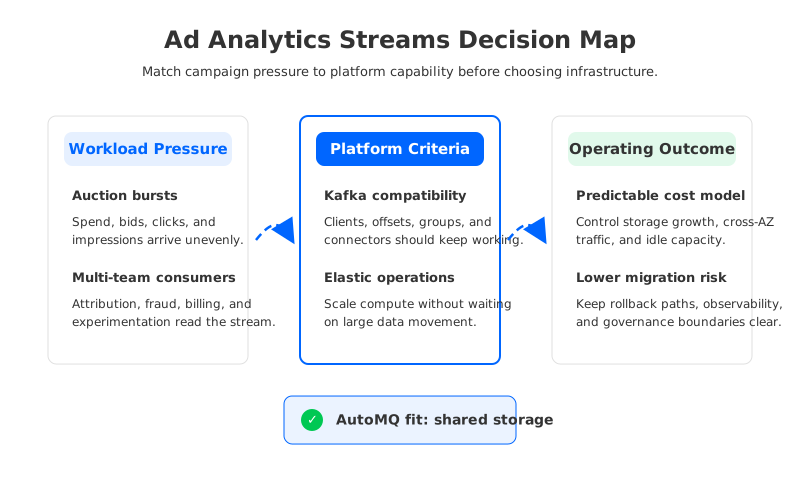
Teams searching for ad analytics streams kafka are usually past the proof-of-concept stage. The question is no longer whether Kafka can move click, impression, bid, conversion, and spend events. Kafka has been doing that for years. The harder question is whether the streaming layer can keep campaign optimization reliable when traffic spikes during auctions, attribution joins arrive late, fraud signals need immediate routing, and finance wants a clean cost model for every region and business unit.
Ad analytics streams sit in an awkward part of the data platform. They are operational enough to affect budget pacing and bidding decisions, but analytical enough to feed warehouses, feature stores, experiments, and customer-facing reporting. That means a platform team cannot evaluate the pipeline only by peak throughput. It has to evaluate latency under burst, consumer lag during replay, failure recovery, schema and access boundaries, connector reliability, and the cost of keeping enough capacity online for the next unpredictable campaign.
The search term usually hides a production decision: should the organization keep operating traditional Apache Kafka, move to a managed Kafka service, adopt a Kafka-compatible cloud-native system, or split the workload across multiple services? The right answer depends less on a benchmark headline and more on the operating model. Ad analytics punishes architectures that make compute, storage, networking, and data movement inseparable.
1Why teams search for ad analytics streams kafka
The simple version of the architecture is familiar. Producers publish ad events into Kafka topics. Stream processors enrich those events with campaign, creative, placement, user, and consent context. Consumers feed real-time dashboards, budget pacing logic, fraud systems, lakehouse tables, billing jobs, and offline model training. The data path looks clean on a whiteboard because Kafka gives every team the same abstraction: an ordered log with offsets.
Production makes that abstraction more expensive. A campaign launch does not increase all topics uniformly. One partner may create a short spike in impression events while conversion events arrive minutes or hours later. A fraud investigation may replay a narrow topic range at high speed. A machine learning team may add another consumer group that doubles read pressure on hot partitions. A finance pipeline may require exactly the records that product analytics considers disposable.
That mix creates requirements that are easy to underestimate:
- Burst absorption without permanent overprovisioning. Ad auctions can produce sharp write peaks, but keeping the whole cluster sized for the worst hour of the quarter wastes compute most of the time.
- Consumer isolation. Attribution, fraud, billing, and experimentation teams read the same event streams with different lag tolerance and replay behavior.
- Replay economics. Historical reads are not rare edge cases. They happen during model backfills, late attribution windows, incident recovery, and audit requests.
- Governance continuity. Campaign data often includes identifiers, consent state, customer segmentation, and financial records. Topic-level access, retention, encryption, and audit controls have to survive migration and scaling events.
- Connector discipline. Kafka Connect pipelines into warehouses, lakehouses, search systems, and object storage become part of the production blast radius, not a side utility.
The platform decision should start from those pressures. A cluster that passes a write benchmark can still be a poor fit if every scaling event triggers partition reassignment work, every replay competes with hot consumers, or every multi-AZ design multiplies network cost.
2The production constraint behind the problem
Traditional Apache Kafka uses a shared-nothing storage model. Each broker owns local log segments for its partitions, and replication across brokers provides durability and availability. This model is coherent and battle-tested. It also means that partition data is tied to broker-local storage, so operations that change the compute layout often become storage operations too.
In ad analytics, that coupling shows up in mundane but costly ways. When traffic grows, adding brokers is not the end of the work; partitions must be reassigned, replicas must catch up, and operators need to watch disk, network, controller load, and consumer lag. When traffic shrinks, the cluster still carries local storage and replica layout decisions made for a larger workload. When a broker fails, recovery interacts with both leadership and data locality. When a team asks for longer retention, the storage bill grows inside the same operational envelope as the serving cluster.
Cloud deployment adds another layer. Multi-AZ replication improves availability, but it can also generate cross-zone traffic. Broker-local disks or block volumes provide predictable local persistence, but they make capacity planning more rigid. Tiered storage can move older data to object storage, but the hot log still depends on broker storage and replica management. None of these are bad design choices in isolation. They become constraints when campaign traffic changes faster than the cluster can be safely reshaped.
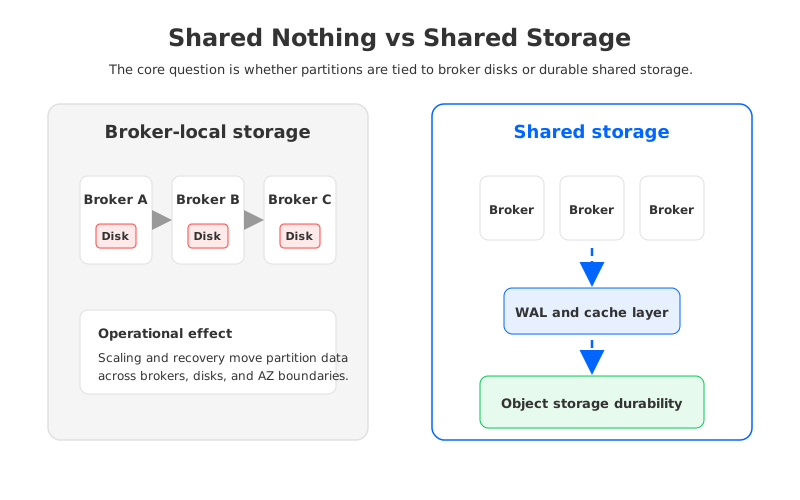
The practical issue is not that Kafka cannot run ad analytics. It can. The issue is that the operating team must budget for the coupling:
| Constraint | What it means for ad analytics | What to evaluate |
|---|---|---|
| Broker-local data | Partitions and disks shape scaling work. | Time and risk of reassignment, rebalance, and recovery. |
| Replication traffic | Multi-AZ durability may create network charges. | Cross-AZ topology, client routing, and replica placement. |
| Replay pressure | Backfills can compete with hot campaign consumers. | Cache behavior, historical read isolation, and throttling. |
| Connector load | Sink failures create lag and duplicated downstream work. | Connect isolation, retries, idempotence, and dead-letter policy. |
| Governance drift | Migrations and topic copies can weaken controls. | ACL parity, encryption, audit logs, and retention policy mapping. |
This is why the infrastructure choice has to be evaluated as an operating model, not only as a Kafka endpoint.
3Architecture options and trade-offs
There are four common ways to build an ad analytics streaming layer. The first is self-managed Apache Kafka on virtual machines or Kubernetes. This gives the platform team maximum control over broker configuration, storage, networking, version upgrades, and ecosystem integration. It also leaves the same team responsible for capacity planning, partition strategy, incident response, and cost attribution. For organizations with deep Kafka operations experience, that control may be worth the work.
The second option is managed Kafka. It reduces operational surface area around provisioning, patching, and some failure handling, but it does not automatically remove the architectural implications of a shared-nothing Kafka model. Buyers still need to understand broker sizing, storage retention, client networking, connector placement, cross-AZ traffic, and version compatibility. Managed service convenience is valuable, but it should not be confused with elastic stream storage by default.
The third option is a Kafka-compatible system with a different storage architecture. This is where the evaluation becomes more interesting. If the system preserves Kafka protocol behavior for producers, consumers, offsets, transactions, and connectors, then the application migration surface can stay small. If it also separates compute from durable storage, the platform team can change the scaling and recovery model. The trade-off is that the team must inspect compatibility details carefully, because “Kafka-compatible” is not a single binary property.
The fourth option is to split the workload. Some teams keep Kafka for operational streams, push raw events into object storage, and serve analytics from a lakehouse or OLAP engine. That can work when the real-time control loop is narrow, but it adds duplication: two retention systems, two access models, two replay paths, and more places for late or corrected events to diverge.
The decision is rarely ideological. A practical architecture might use Kafka-compatible streams for hot event movement, a lakehouse table for broad analytical access, and a warehouse for governed reporting. The streaming platform still matters because it is the first durable boundary after event production. If it drops governance context, hides cost, or makes replay painful, downstream systems inherit the problem.
4Evaluation checklist for platform teams
The most useful platform review starts with questions that force hidden costs into the open. Ask them before the vendor shortlist is fixed, because they change the shortlist.
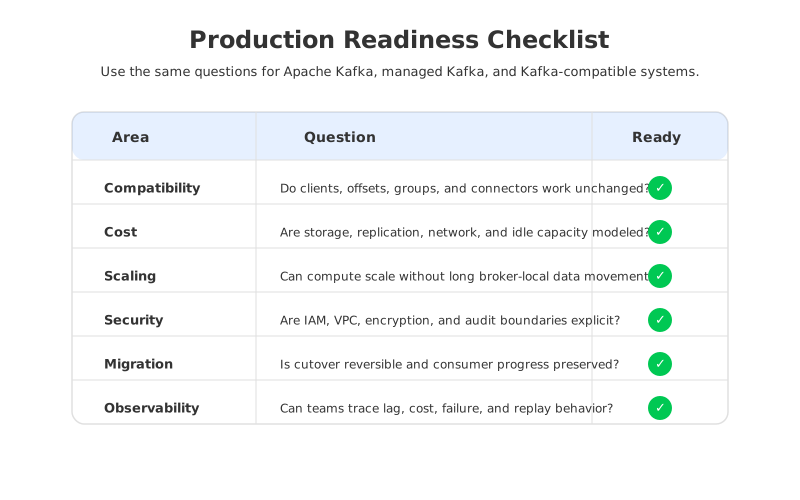
| Evaluation area | Questions to ask | Why it matters |
|---|---|---|
| Kafka compatibility | Which client versions, APIs, consumer group behavior, transactions, and connector patterns are supported? | Ad pipelines usually contain older clients and multiple frameworks. |
| Cost model | How are compute, storage, cross-AZ traffic, egress, connector runtime, and replay reads billed or allocated? | Campaign profitability depends on predictable infrastructure cost. |
| Elasticity | What happens when brokers are added or removed during a traffic spike? | Scaling should not become a large data movement project. |
| Failure recovery | How does the platform recover broker, AZ, storage, controller, and connector failures? | Campaign systems need graceful degradation and bounded lag. |
| Governance | Can ACLs, encryption, network boundaries, retention, and audit logs map cleanly to existing controls? | Ad data often carries privacy and financial obligations. |
| Migration | Can topics, offsets, consumer progress, and rollback paths be preserved? | Downtime and offset drift create business-visible risk. |
| Observability | Can teams trace lag, replay, throttling, broker load, storage behavior, and cost drivers? | SREs need root-cause signals, not only cluster health summaries. |
One useful test is to model a real incident. Suppose a major campaign creates a write spike, a downstream attribution job falls behind, and a broker in one AZ becomes unhealthy. What does the platform do first: move leadership, move data, throttle consumers, expand compute, fail over connectors, or ask operators to rebalance partitions manually? A second test is a quiet month: can the platform release compute capacity, grow retention, and support replay without risky storage work? The answers reveal more than a polished architecture diagram.
5How AutoMQ changes the operating model
Once the evaluation is framed this way, AutoMQ fits into a specific architectural category: a Kafka-compatible cloud-native streaming platform that moves durable stream storage from broker-local disks to shared object storage. Producers and consumers keep using Kafka protocol concepts such as topics, partitions, offsets, and consumer groups, while the storage layer changes underneath.
AutoMQ's Shared Storage architecture separates broker compute from persistent stream data. Brokers handle Kafka protocol processing, leadership, caching, and request routing, while durable data is written through the S3Stream layer into WAL storage and S3-compatible object storage. The WAL absorbs low-latency writes and supports recovery; object storage becomes the long-term durable layer. That distinction matters because it changes what scaling means. Adding or replacing brokers no longer has to imply copying large local logs from one machine to another.
For ad analytics streams, this addresses several of the constraints from the checklist. Compute can be scaled closer to campaign demand because persistent data is not anchored to a broker disk. Storage can grow with retention and replay needs through object storage economics. Self-balancing and faster partition reassignment become easier because the system is changing ownership and traffic placement more than moving large data sets. Multi-AZ traffic can also be reduced when producers, brokers, and consumers are placed with AZ-aware routing and the platform avoids server-side replica replication across zones.
This does not remove the need for engineering judgment. Platform teams still need to validate client compatibility, latency targets, WAL type, cloud permissions, network topology, connector behavior, and ownership. The value of the shared-storage model is that compute, storage, retention, replay, and network placement can be reasoned about separately.
Migration is also part of the operating model. AutoMQ provides Kafka Linking for migrations from Apache Kafka and other Kafka-compatible distributions, including topic replication and consumer progress handling. That is relevant for ad analytics because cutovers often have to happen while producers keep writing and consumers keep reading. The migration plan should still include a traffic shadow period, lag thresholds, rollback criteria, connector parity checks, and a business sign-off point for billing or attribution streams.
The same architecture can support adjacent analytical patterns. For example, Table Topic exposes Kafka topic data in a table-oriented way for analytics workflows, while Kafka Connect support keeps common source and sink integrations in the platform boundary. Those features belong in the data product roadmap, but the core question remains: can the platform carry real-time campaign events with predictable cost, clear governance, and a recovery model the SRE team can operate at 3 a.m.?
If your current ad analytics Kafka estate is reaching the point where scaling, retention, replay, and cross-AZ cost are all tangled together, review AutoMQ's architecture and deployment model with the same checklist above. The next useful step is to compare your busiest campaign stream against a Kafka-compatible shared-storage design, using your own retention, replay, and network assumptions. You can start that conversation through AutoMQ's technical contact page.
6References
- Apache Kafka Documentation
- Apache Kafka Consumer Configuration
- Apache Kafka Producer Configuration
- Apache Kafka Connect Documentation
- AutoMQ Architecture Overview
- AutoMQ Compatibility with Apache Kafka
- AutoMQ S3Stream Shared Streaming Storage
- AutoMQ Continuous Self-Balancing
- AutoMQ Eliminate Inter-Zone Traffic
- AutoMQ Kafka Linking Migration Overview
- AutoMQ Table Topic Overview
- AWS Data Transfer Pricing
- AWS S3 Storage Classes
- AWS PrivateLink Pricing
7FAQ
7.1Is Kafka still a good fit for ad analytics streams?
Yes, Kafka remains a strong fit when teams need durable event streams, independent consumer groups, replayable topics, and broad ecosystem support. The real decision is not Kafka versus no Kafka. It is whether the chosen Kafka or Kafka-compatible platform can handle bursty campaign traffic, replay, governance, and cloud cost without creating excessive operational work.
7.2What is the biggest architecture risk in ad analytics streams?
The biggest risk is coupling too many concerns to broker-local capacity. When compute scaling, persistent storage, multi-AZ replication, replay traffic, and connector recovery all depend on the same broker layout, normal campaign changes become infrastructure projects. A good platform review separates these concerns and tests how the system behaves during both spikes and quiet periods.
7.3How should teams evaluate Kafka compatibility?
Start with the actual estate: client versions, producer settings, consumer group behavior, transactions, connectors, stream processing frameworks, ACLs, and monitoring tools. Then test representative workloads instead of relying only on a compatibility statement. For ad analytics, offset continuity and consumer progress are especially important because attribution, billing, and replay jobs often depend on precise positions.
7.4Where does AutoMQ fit in this architecture?
AutoMQ is relevant when a team wants Kafka compatibility but needs a cloud-native operating model based on shared storage and stateless brokers. It is not a reason to skip workload testing. It is a different architecture to evaluate when broker-local storage, cross-AZ traffic, scaling delay, and replay cost have become limiting factors for campaign analytics.


