
Table of Contents
Table of Contents
advertised.listeners looks like a small Kafka broker setting until the first production client fails after a network change. The bootstrap address works, the port is open, and a quick TCP check looks fine. Then the client receives broker metadata and tries to connect to an address it cannot route to, a DNS name that only exists inside the cluster, or a hostname that does not match the TLS certificate. That is why advertised listener problems are frustrating: the failure happens after the first connection succeeds.
The root cause is a split between discovery and reachability. Kafka clients do not keep talking only to the bootstrap server. They ask for metadata, learn the brokers and partitions they need, and then connect directly to those advertised broker endpoints. That model is efficient, but it makes the advertised address part of the application contract. In cloud and Kubernetes deployments, that contract crosses VPCs, availability zones, load balancers, service discovery, certificates, and private networks.
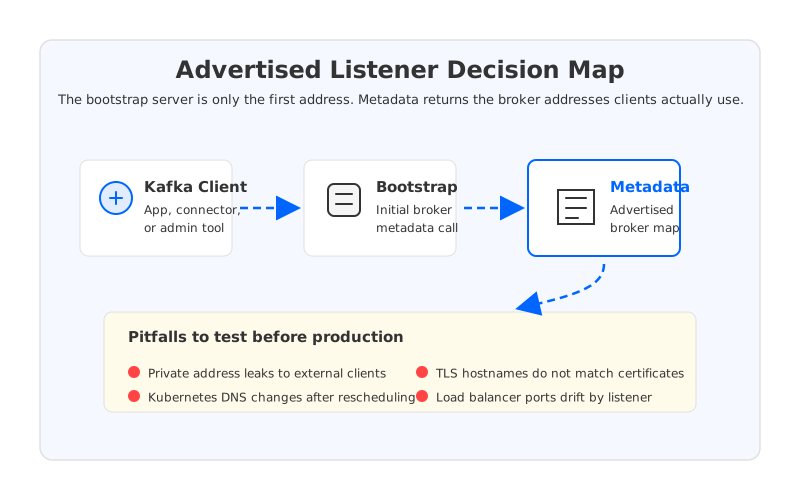
The operational mistake is treating advertised listeners as a syntax problem. The syntax matters, but the harder question is whether every client population can resolve, route, authenticate, and reconnect to every broker address returned in metadata. A platform team may need one listener for in-cluster workloads, another for VPC-internal services, and another for external clients. Each listener must advertise an address that is meaningful to the client that receives it.
1Why advertised listeners fail after deployment
Kafka’s own documentation describes advertised.listeners as the addresses brokers publish to clients, distinct from the interfaces on which brokers listen. That distinction is not academic. A broker can bind to 0.0.0.0 and still advertise an address that is useless to a client outside the pod network. A broker can be reachable through a cloud load balancer and still advertise a private StatefulSet DNS name. The server is running; the metadata is wrong for the client’s network.
The most common failure patterns are familiar to anyone who has operated Kafka across more than one boundary:
- Private address leakage. External clients bootstrap through a public endpoint but receive private broker hostnames in metadata. The first request succeeds, then partition-specific requests fail.
- Kubernetes DNS scope mismatch. In-cluster clients can resolve headless Service names, while clients outside the cluster cannot. Exposing the same metadata to both groups breaks one of them.
- TLS identity drift. The address advertised to clients must line up with certificate names. A load balancer hostname, broker DNS name, and certificate SAN set need to be planned together.
- Port and protocol confusion. Multi-listener setups require listener names, ports, and
listener.security.protocol.mapto stay consistent. A typo can turn a networking issue into an authentication failure. - Scaling surprises. Broker replacement, StatefulSet changes, node rescheduling, and load balancer recreation can alter the addresses that clients depend on.
These are not rare edge cases. They appear because Kafka’s metadata model exposes broker topology directly to clients. That is useful when the network is simple and stable. It becomes a burden when the same cluster serves workloads from pods, VMs, private subnets, cross-region services, and developer laptops.
2The production constraint behind the problem
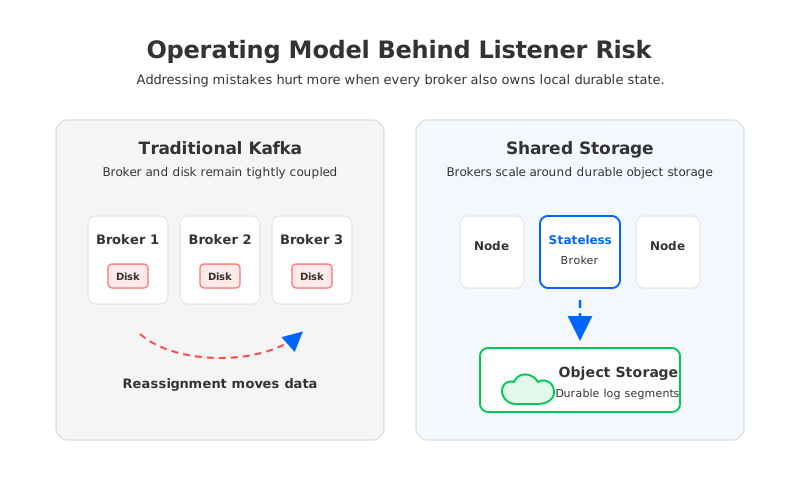
The listener issue is usually a symptom of a broader operating model. Traditional Kafka brokers combine compute, protocol handling, and durable local storage. When a broker’s network identity changes, that broker may also own partition replicas, local log segments, leadership, follower traffic, and disk capacity. The platform team has to reason about routing and state placement at the same time.
This coupling is why a small advertised address mistake can turn into a larger production event. If clients cannot reach a broker, they cannot reach the partitions led by that broker. If the fix requires broker replacement or network restructuring, the team may trigger partition reassignment, replication catch-up, consumer disruption, or capacity pressure. The listener problem started as a metadata bug, but the recovery path touches storage locality and cluster balance.
Cloud infrastructure adds another layer of pressure. Availability zones are separate failure domains, but they are also network and cost boundaries. Load balancers, private access patterns, NAT gateways, firewall rules, DNS records, and certificates all need to agree with the metadata clients receive. Kubernetes adds stable naming through StatefulSets and Services, but those names are scoped to the cluster unless deliberately exposed. The advertised listener must describe the client’s real path, not the broker’s internal view of itself.
That is why “best practice” cannot be a single sample configuration. The correct listener design depends on who the clients are and how they reach the cluster. A connector inside Kubernetes, a Flink job in another VPC, a payment service in a private subnet, and an administrator using a bastion host may all need different advertised endpoints. Reusing one listener for all of them hides incompatible assumptions.
3A practical evaluation framework
The cleanest way to debug advertised listener pitfalls is to stop asking whether the broker is reachable and start asking whether the metadata contract is correct. Bootstrap reachability proves only that one address works. Production readiness requires a path test from each client population to each broker endpoint returned by metadata.
Use the following framework before an initial Kafka-compatible deployment, and again before any network, certificate, or scaling change:
| Evaluation area | Question to answer | What good evidence looks like |
|---|---|---|
| Client population | Which clients receive this listener? | A named group such as in-cluster apps, private VPC services, or external partners. |
| Resolution | Can that group resolve every advertised broker name? | DNS checks from the same network namespace or subnet as the client. |
| Routing | Can the group open a connection to every advertised host and port? | Broker-by-broker connection tests, not only bootstrap checks. |
| Security | Do TLS names and security protocols match the listener? | Certificate SAN validation and protocol mapping review. |
| Scaling | Will broker replacement preserve endpoint identity? | A tested runbook for broker add, remove, and replacement paths. |
| Failure recovery | What happens when a zone, load balancer, or DNS dependency fails? | A drill that observes client reconnect behavior and metadata refresh. |
The table is intentionally operational. Configuration snippets are straightforward to copy; evidence is harder to fake. A listener design is ready when the team can prove how clients behave during metadata refresh, broker failover, and endpoint rotation.
One useful test is to run a metadata inspection tool from each client network and record the returned broker addresses. If an external client sees pod DNS names, the design is wrong. If an in-cluster client is forced through an external load balancer, the design may work but can add latency, network dependencies, and cost. If a TLS-enabled listener returns names absent from the certificate, a successful plaintext network check is irrelevant.
4Kubernetes-specific traps
Kubernetes gives Kafka operators stable primitives, but it does not remove the need to design client-facing identity. A StatefulSet can provide predictable pod names. A headless Service can expose per-pod DNS records. A LoadBalancer Service can expose traffic outside the cluster. These are building blocks, not a listener policy.
The first trap is assuming Kubernetes DNS names are universal. A name such as broker-0.kafka-headless.namespace.svc.cluster.local is useful inside the cluster. It is not a valid address for a VM in another VPC unless DNS forwarding and routing are configured. When that name appears in metadata returned to an external client, the client is doing what Kafka told it to do, and the platform is the part that lied.
The second trap is hiding every broker behind one generic load balancer without considering Kafka’s broker-specific metadata. Kafka clients need to reach the broker that leads the partition they are using. Per-broker external exposure can work, but the advertised address must map cleanly to broker identity. A bootstrap load balancer alone does not solve broker reachability.
The third trap is ignoring certificate planning until late in the rollout. Listener names, DNS names, load balancer names, and certificates are linked. If the public listener advertises kafka-1.example.com, the client expects the certificate to be valid for that name. If the private listener advertises a different internal name, the certificate strategy must account for that too.
5Cloud networking makes the blast radius larger
Cloud deployments stretch the listener contract across more infrastructure than a datacenter rack ever did. A broker endpoint may depend on DNS records, load balancer health checks, security groups, subnet routing, NAT behavior, and zone placement. Each dependency is manageable alone. Kafka clients experience them as one metadata contract.
This matters most during change. An added VPC peering path may route bootstrap traffic but not broker-specific traffic. A certificate rotation may update the public name while the private listener still advertises the old one. A zone failover drill may prove that brokers stay up while clients remain pinned to stale endpoints. These are not Kafka protocol failures; they are mismatches between Kafka metadata and the surrounding network.
There is also a cost dimension. If clients inside one zone are forced through an endpoint in another zone, or if internal workloads hairpin through public-facing infrastructure, the listener design can create unnecessary data transfer. Exact cost depends on provider, region, and traffic path, so verify it against current pricing before procurement decisions. The stable point is that listener design influences availability and traffic flow.
6How architecture changes the operating model
A neutral platform evaluation should separate two questions. The first is listener correctness: can clients reach the broker addresses returned in metadata? The second is operational recovery: how hard is it to change the cluster when listener design, network topology, or client population changes? Traditional Kafka can be operated well, but broker-local storage raises the cost of topology changes because data placement and broker identity are tightly connected.
This is where Kafka-compatible systems with shared storage change the discussion. AutoMQ is one example of this architectural category: it keeps Kafka protocol compatibility while moving durable stream storage to object storage and making brokers closer to stateless compute nodes. The listener contract still matters. Clients still need correct advertised endpoints. But when brokers are less tied to local durable data, scaling and replacement are less entangled with large data movement.
The practical benefit is not that advertised listeners disappear. They do not. The benefit is that the platform has more room to correct infrastructure around the listener contract. If a broker must be replaced, compute capacity can be adjusted without treating local disk as the center of the recovery plan. If traffic grows unevenly, compute and storage scaling can be considered independently.
AutoMQ’s shared storage architecture also fits the governance boundary many cloud teams prefer: Kafka-compatible access for applications, with deployment patterns that can remain under the customer’s cloud account and network controls. That matters because advertised addresses are part of governance. Platform teams need to know where traffic goes, which identity it uses, how certificates are issued, and who can change endpoint exposure.
7Readiness checklist before you ship
The fastest way to avoid listener incidents is to make the listener contract observable before production traffic depends on it. A runbook should capture the client class, bootstrap endpoint, returned metadata, broker-by-broker resolution, protocol, certificate identity, and expected failover behavior. It should also define rollback, because listener changes can strand clients while brokers are healthy.
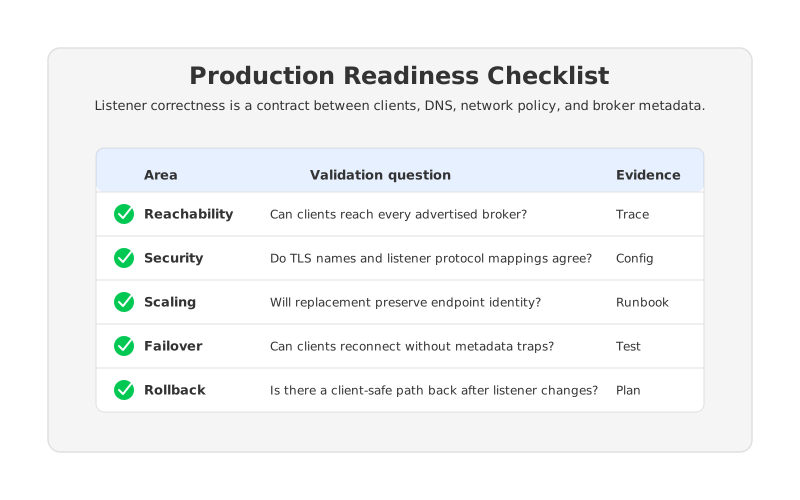
For a production rollout, the checklist should include at least these actions:
- Run metadata inspection from every client network, including pods, VMs, private subnets, and external access paths.
- Test every advertised broker address, not only the bootstrap endpoint.
- Validate TLS hostname coverage for each advertised DNS name.
- Exercise broker replacement or rescheduling and confirm that endpoint identity remains stable.
- Trigger a controlled failover or endpoint rotation and observe client reconnect behavior.
- Record the rollback path, including DNS TTLs, certificate dependencies, and client configuration changes.
The important discipline is to test from the client’s point of view. A broker-side review can miss DNS scope. A Kubernetes manifest review can miss VPC routing. A cloud console review can miss Kafka metadata. The client sees the combination, so the client-side test is the one that counts.
8Closing the loop
Advertised listener incidents feel mysterious because they sit between Kafka, Kubernetes, and cloud networking. Once you trace the metadata path, they become concrete. The broker can listen on one address, advertise another, and return that advertised address to clients in a different network context. Production design starts when the team treats that returned address as a contract.
For teams evaluating Kafka-compatible infrastructure, listener correctness should sit beside storage architecture, scaling model, security, and recovery planning. A cluster that is straightforward to bootstrap but hard to modify is still operationally fragile. Shared storage does not remove the need for careful listener design, but it can reduce the amount of stateful recovery work attached to infrastructure changes.
If you are designing a cloud-native Kafka platform and want to compare broker-local and shared-storage operating models, review AutoMQ’s BYOC streaming architecture and deployment model: Explore AutoMQ for cloud-native Kafka.
9References
- Apache Kafka documentation: Broker configuration for advertised listeners
- Apache Kafka documentation: Listener configuration
- Kubernetes documentation: Headless Services
- Kubernetes documentation: StatefulSet basics
- AutoMQ documentation: AutoMQ technical advantage overview
10FAQ
10.1What does advertised.listeners do in Kafka?
advertised.listeners controls the broker addresses Kafka returns to clients in metadata. Clients use those addresses for broker-specific communication after bootstrap, so the advertised names must be reachable from the client’s network.
10.2Why does bootstrap work while produce or consume fails?
Bootstrap proves that the client can reach the initial endpoint. Produce and consume requests may fail later because the client receives different broker addresses in metadata and then tries to connect directly to those addresses.
10.3Are Kubernetes headless Services enough for Kafka?
Headless Services are useful for stable broker DNS inside a Kubernetes cluster. They are not enough for clients outside the cluster unless DNS, routing, security, and advertised listeners are designed for that external access path.
10.4Should each client group use a separate listener?
Often, yes. In-cluster clients, private VPC clients, and external clients may need different advertised addresses and security settings. The right test is whether each client group can resolve, route to, and authenticate every broker returned in metadata.
10.5Does shared storage eliminate advertised listener pitfalls?
No. Shared storage changes the operating model around broker replacement, scaling, and data movement, but clients still need correct broker addresses. Listener design remains a network and security contract.


