
Table of Contents
Table of Contents
An AI agent does not fail like a normal backend service. A normal service gives you an error code and a request ID. An agent can call a tool with stale context, retrieve the wrong document, skip a guardrail, overwrite a field, retry a workflow, and still return a confident answer. When that action changes customer data, modifies infrastructure, or feeds another model, "we logged the prompt" is not an audit trail.
That is why teams search for agent audit trail kafka once agentic systems move past demos. They need AI actions to be durable, ordered, replayable for investigations, and available downstream without coupling every agent runtime to every consumer. Kafka is a natural candidate because it already gives platform teams producers, topics, partitions, consumer groups, offsets, retention, and connectors.
1Why Agent Audit Trails Become Event Streams
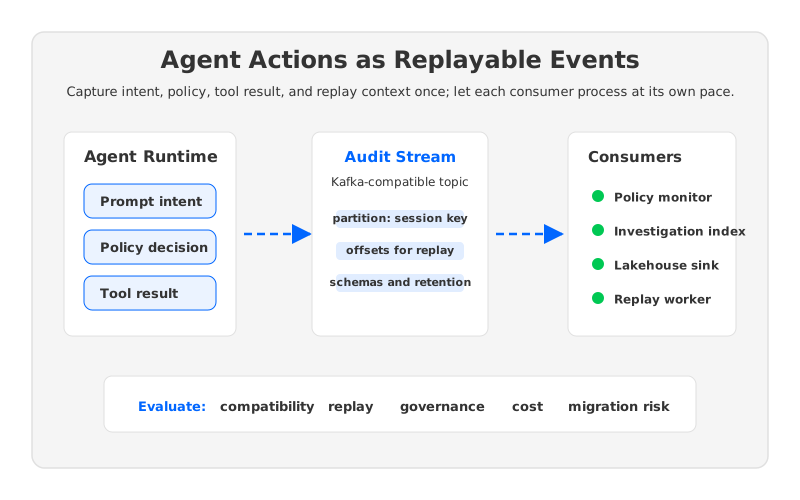
The first design mistake is treating an audit trail as a static append-only log file. A file can prove that something happened, but it rarely gives multiple teams the same live operational view. Security wants suspicious tool calls. Compliance wants immutable evidence. SREs want failure correlation. Model teams want retrieval quality and tool-use feedback. If every team scrapes the agent runtime independently, the audit plane becomes a side effect of application code rather than part of the platform.
An event stream changes the contract. Each action becomes a record with a key, timestamp, schema, identity context, input references, output references, policy decision, and result. Downstream systems subscribe at their own pace. Kafka's consumer group and offset model matters here because replay is not a special recovery mode; it is a normal read pattern.
A useful agent audit event is usually more structured than a text log:
- It identifies the actor, session, tenant, model, tool, policy version, and trace context.
- It separates sensitive payloads from references, hashes, or redacted summaries so the audit stream can be broadly consumable without leaking secrets.
- It records both intent and outcome: the requested tool call, the authorization decision, the external side effect, and the final status.
- It keeps ordering boundaries explicit. A partition key such as
tenant_id + agent_session_idcan preserve session order while still allowing parallelism across tenants or workflows.
This structure is not bureaucracy. It lets a platform team answer a concrete question after an incident: "Which agent action created this state, what context did it use, which policy allowed it, and can we replay the sequence without re-running the side effect?"
2The Freshness and Governance Problem
Agent audit trails sit between observability, data engineering, and compliance. Observability systems are excellent for debugging live services, but they often sample, aggregate, or expire data according to operational needs. Data lakes are strong for analysis, but they are not always the right path for low-latency policy monitoring. Compliance archives can retain records, but they rarely serve real-time consumers.
Freshness is the first pressure point. If a policy monitor learns about a risky tool call minutes later, it may be too late to stop the next action in the chain. If the stream cannot absorb bursts from retries, evaluations, or tool fan-out, producers start dropping details exactly when evidence is most valuable.
Governance is the second pressure point. The audit trail will include user identifiers, retrieved document references, tool inputs, authorization decisions, and operational metadata. A reasonable design separates event classes, applies schemas, redacts payloads at the edge, and routes high-sensitivity material to controlled stores.
The third pressure is replay. Audit replay is not the same as "read old logs." A replayable stream must preserve enough ordering, metadata, schema history, and retention to reconstruct a decision path. It also needs idempotent downstream processing because replaying an audit event should not call the external tool again.
3Architecture Options for Durable AI Context
The simplest option is application logging plus a centralized log pipeline. It is fast to start, but it usually breaks down when consumers need independent replay, schema evolution, or clear ownership. Agent audit trails need machine-readable contracts.
A second option is writing agent actions directly into a database. That can work for a single investigation application. The trade-off appears when the same event must feed alerting, analytics, compliance export, model evaluation, and rollback tooling. Each additional consumer either polls the database or asks the application team for another integration.
Kafka-compatible streaming is the third option. It fits when multiple consumers need durable, ordered, replayable records. Producers write once, consumers track their own offsets, and retention defines how far back online replay can go. Kafka Connect or equivalent connector frameworks can bridge the stream into long-term stores.
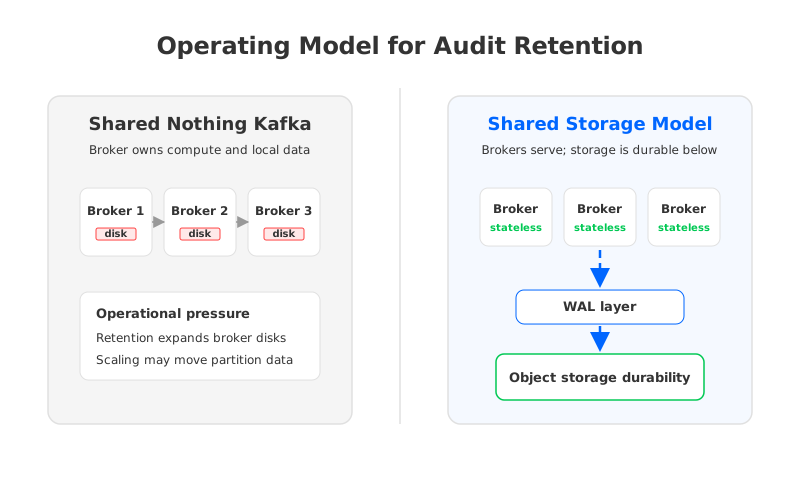
The platform decision does not stop at "use Kafka." Traditional Kafka clusters were built around broker-local storage. Data lives on disks attached to brokers, and replication across brokers provides durability and availability. AI audit trails amplify the operational costs: long retention expands broker storage, rebalancing moves data when capacity changes, and multi-AZ deployments can turn replication into a networking cost problem.
Cloud teams often respond by tiering older data to object storage. Tiered storage can reduce pressure on broker disks for historical data, but it does not make brokers stateless. The cluster still has local storage responsibilities, hot data placement concerns, and coupling between compute and storage.
4Evaluation Checklist for Platform Teams
A neutral evaluation starts with the audit contract, not with a vendor shortlist. These questions usually decide whether an architecture will age well once agents move from pilots to production operations.
| Evaluation area | What to verify | Why it matters |
|---|---|---|
| Compatibility | Can Kafka clients, serializers, stream processors, and connectors work with minimal change? | Audit infrastructure should not force every agent team to learn another event API. |
| Replay semantics | Are retention, partition keys, offsets, schemas, and idempotent consumers designed together? | Replay must reconstruct evidence without repeating external side effects. |
| Cost model | How do storage growth, replication, cross-AZ traffic, connector egress, and long retention affect the bill? | Audit streams are often high-volume and kept longer than operational logs. |
| Elasticity | Can the platform absorb bursts from retries, evaluations, and tool fan-out without manual data movement? | Agent traffic can spike around incidents, batch evaluations, or workflow retries. |
| Governance | Can topics, ACLs, encryption, redaction, schemas, and retention policies map to data sensitivity? | Audit data is evidence, but it can also contain secrets and regulated identifiers. |
| Recovery | Can brokers fail, consumers fall behind, and regions degrade without losing the audit sequence? | The audit plane is least optional when the application is already in trouble. |
| Migration | Can teams move from existing Kafka or log pipelines with staged cutover and rollback? | Audit trails need trust. A risky migration undermines the purpose of the system. |
The table is deliberately operational. An agent audit trail is a streaming workload with production failure modes. If the platform cannot scale retention independently from compute, or if adding capacity triggers heavy data movement, the audit trail will inherit the fragility of the systems it is supposed to explain.
5How AutoMQ Changes the Operating Model
Once the evaluation reaches that point, AutoMQ becomes relevant as a Kafka-compatible streaming system built around shared storage rather than broker-owned local disks. The architectural shift is the point: keep Kafka protocol compatibility for producers and consumers, but move durable stream storage to cloud object storage and make brokers largely stateless.
That shift changes the operating model for agent audit trails. In a traditional shared-nothing cluster, longer retention usually means more broker storage planning. More partitions, more data, or more brokers can mean more data movement. In a shared-storage model, storage durability is anchored in object storage, while brokers focus on serving reads and writes. Compute and storage can scale more independently.
AutoMQ's documentation describes this as a shared-storage architecture with stateless brokers and a write-ahead log layer in front of object storage. For audit workloads, the platform can keep Kafka-compatible application contracts while reducing the operational penalty of retaining and replaying large event histories. That does not remove the need for schema discipline, access control, or careful partition design. It makes the storage and scaling problem less tied to individual broker disks.
This also matters in multi-AZ deployments. Audit trails often need high availability because the organization still needs evidence when a zone or broker fails. Traditional replication can create extra network movement between zones depending on placement and client traffic. AutoMQ's architecture is designed to reduce cross-AZ data movement by using shared cloud storage and stateless compute placement. Platform teams should still validate their own traffic path and cloud bill.
The trade-off is that teams must understand the storage layer as part of the streaming platform. Object storage durability, WAL choice, network path, region design, and customer-controlled deployment boundaries become architectural inputs. For AI audit systems, those inputs are already part of the compliance conversation.
6A Reference Design for Agent Audit Streams
A practical design starts with a small number of event classes. For example, agent.intent, agent.retrieval, agent.tool_request, agent.policy_decision, agent.tool_result, and agent.final_response can capture the decision path without forcing every event into one schema. The key should reflect the ordering boundary: session-level keys favor investigations, while tenant-level or workflow-level keys may fit systems where cross-session ordering matters more.
The stream should keep payload strategy separate from audit semantics. Some events can include structured payloads. Others should include references to encrypted objects, hashes, redacted summaries, or document IDs. That keeps the audit topic useful while the most sensitive material stays in systems with tighter access controls.
Consumers should be designed as first-class audit participants:
- A policy monitor reads fresh events and raises alerts for denied, escalated, or anomalous actions.
- A search/indexing consumer builds investigation views across sessions, tenants, tools, and policy versions.
- A lakehouse sink preserves selected records for analytics, evaluation, and compliance reporting.
- A replay worker reconstructs a sequence into a sandbox or case file without re-invoking external tools.
- A lineage consumer connects agent actions to downstream data changes, tickets, commits, or infrastructure operations.
This is where Kafka's offset model becomes more than a messaging feature. Each consumer can lag, replay, or be rebuilt without asking the agent runtime to re-emit history.
7Production Readiness Scorecard
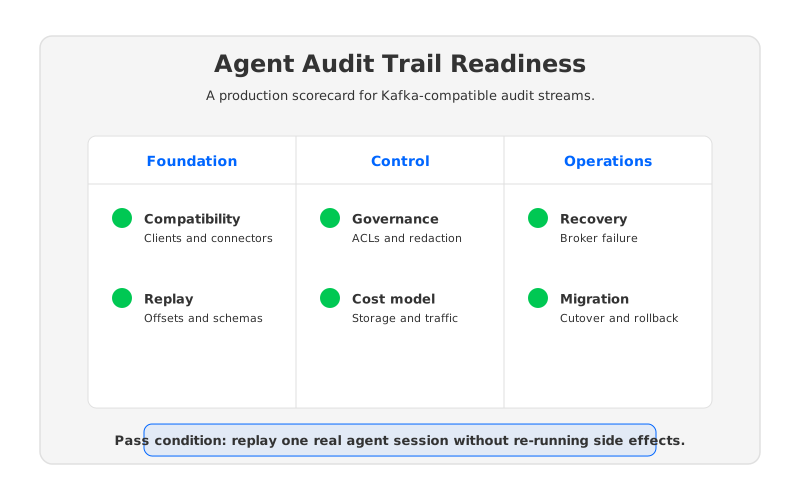
Before promoting an agent audit trail to a shared platform service, use a scorecard that brings architecture, security, and operations into the same room.
| Readiness question | Green signal | Warning signal |
|---|---|---|
| Can you replay one agent session end to end? | A replay worker can rebuild the action path from events and referenced payloads. | Investigation requires stitching logs, database rows, and dashboards by hand. |
| Can consumers fail independently? | Offsets, idempotent sinks, and dead-letter handling are tested. | One slow consumer backpressures the agent runtime or drops audit detail. |
| Can retention grow without emergency resizing? | Storage, compute, and replay demand have separate capacity plans. | Longer retention means urgent broker disk expansion or partition migration. |
| Can sensitive data be isolated? | Topic design, redaction, encryption, ACLs, and payload references are part of the schema contract. | Sensitive prompts and tool payloads are copied into every downstream store. |
| Can teams migrate safely? | Dual-write, mirror, or connector-based cutover has clear rollback criteria. | The first production migration is also the first end-to-end replay test. |
The point of the scorecard is not to make the architecture heavier. It prevents teams from shipping an audit trail that only works when nothing controversial happens. Agent systems are probabilistic at the decision layer, but the evidence layer should be boring: durable records, clear ordering, controlled access, independent consumers, and repeatable replay.
For teams already operating Kafka, the fastest path may be to start with the current event platform, define agent audit schemas, and run a replay drill before adding more infrastructure. For teams planning an audit backbone, compare shared-nothing Kafka, managed Kafka, tiered storage, and shared-storage Kafka-compatible systems against the same checklist. AutoMQ belongs in that comparison when Kafka compatibility, object-storage-backed durability, elastic scaling, and customer-controlled cloud boundaries are important requirements.
If your next design review asks "Can we reconstruct what the agent did without trusting the agent to explain itself?", the answer should be visible in the event stream. To evaluate how a Kafka-compatible shared-storage architecture fits that requirement, review the AutoMQ architecture docs: AutoMQ overview.
8References
- Apache Kafka Documentation: https://kafka.apache.org/documentation/
- Apache Kafka Documentation - Kafka Connect: https://kafka.apache.org/documentation/#connect
- Apache Kafka Documentation - Semantics and transactions: https://kafka.apache.org/documentation/#semantics
- AutoMQ Documentation - Overview: https://docs.automq.com/automq/what-is-automq/overview
- AutoMQ Documentation - Stateless Broker: https://docs.automq.com/automq/architecture/technical-advantage/stateless-broker
- AutoMQ Documentation - WAL Storage: https://docs.automq.com/automq/architecture/s3stream-shared-streaming-storage/wal-storage
- AWS S3 Storage Classes: https://aws.amazon.com/s3/storage-classes/
- AWS Data Transfer Pricing: https://aws.amazon.com/ec2/pricing/on-demand/#Data_Transfer
9FAQ
9.1Is Kafka required for agent audit trails?
No. Kafka is a strong fit when multiple systems need durable, ordered, replayable events with independent consumers. A database or log pipeline can be enough for a narrow audit application. Kafka becomes more attractive when replay, fan-out, schema governance, and long-running consumers matter.
9.2What should be included in an agent audit event?
At minimum, capture actor identity, session or workflow ID, tenant, model, tool, policy version, input references, output references, authorization decision, result, timestamp, and trace context. Store sensitive payloads directly only when the access model and retention policy support it.
9.3How long should agent audit events be retained?
Retention depends on incident response, compliance, model evaluation, and customer support requirements. Many teams separate online replay retention from archive retention: Kafka-compatible streams keep current history available for replay, while selected records move to a controlled lakehouse or archive.
9.4How does a shared-storage Kafka-compatible architecture help?
It decouples durable storage from broker-local disks. For audit workloads, that can reduce the operational friction of long retention, replay bursts, and elastic scaling. It does not replace schema governance, access control, or partition design.
9.5How should teams test an agent audit trail?
Run a replay drill. Pick one real workflow, reconstruct every agent action from the stream, verify policy decisions and tool results, rebuild downstream views from offsets, and confirm that replay does not repeat external side effects. The drill will expose missing fields, weak keys, unsafe payload handling, and consumer assumptions.


