
Table of Contents
Table of Contents
The first serious agent feedback pipeline rarely starts as infrastructure. It starts with a product question: why did the agent give that answer, choose that tool, ignore that policy, or fail to escalate? The prototype stores a rating, a prompt, a response, and maybe a trace in an application database. Then evaluation, policy, safety, analytics, and support teams ask for the same data with different latency and replay requirements.
That is where teams searching for agent feedback events kafka usually are. They are not trying to learn what Kafka is. They are trying to decide whether agent feedback should remain a nightly ETL job, move into a real-time stream, or become a governed platform surface shared by AI engineers, data engineers, SREs, and risk teams.
Nightly ETL is attractive because it is familiar. It lets the application write operational state, then lets the data team clean things up later. The problem is that agent feedback is not only analytical data. It is also a control signal. A thumbs-down rating can trigger evaluation, a tool failure can update routing, a human correction can change retrieval quality, and a policy violation can block an automation path while the workflow is still active.
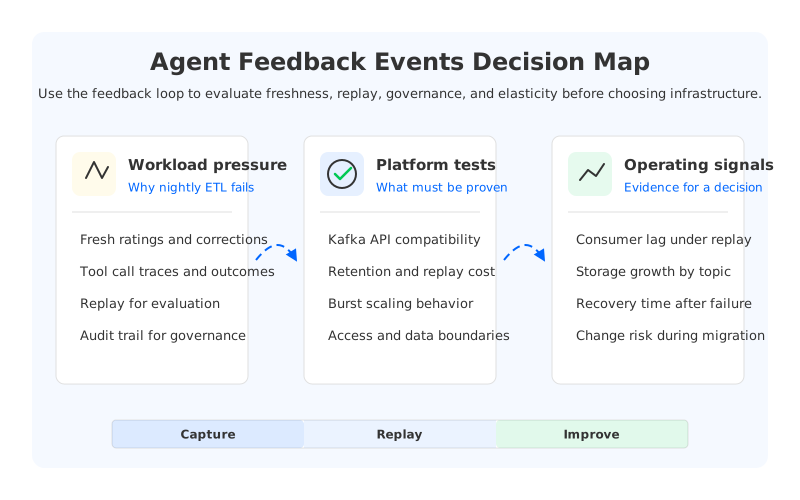
The architecture has to close the loop while the loop still matters. That does not mean every feedback event needs millisecond processing or every organization needs the same retention policy. It means the event backbone must preserve enough order, durability, replay, and access control that feedback can be used for both online improvement and offline accountability.
1Why Agent Feedback Events Become Streaming Data
Feedback looks small when it is treated as a row in a table: user ID, session ID, rating, timestamp, and comment. Production agent systems add more context. They emit prompt versions, retrieval hits, tool calls, tool responses, policy checks, model choices, guardrail outcomes, human overrides, evaluation labels, and downstream business events. The feedback record becomes a join point between what the agent saw, what it did, and what humans or automated evaluators later said about the result.
Batch systems can still analyze this data. The issue is not whether a warehouse can produce a daily report. The issue is whether a stale report is good enough when the same signal should affect prompt evaluation, retrieval tuning, tool availability, abuse detection, customer support, and rollback decisions. The more feedback becomes part of the serving and governance path, the less comfortable it is to leave it trapped behind scheduled ingestion.
Kafka is a natural fit when teams need a durable, replayable stream with multiple consumers. Producers can append feedback and trace events once. Evaluation jobs, feature pipelines, policy services, data lake sinks, and observability systems can consume the same stream at their own pace. Consumer groups make fan-out operationally tractable, offsets make progress explicit, and the log gives teams a way to replay events after they change an evaluator or fix a downstream processor.
That does not make Kafka a magic answer. It moves the hard questions from "how do we export yesterday's rows?" to "how do we operate a shared event backbone that AI, data, and platform teams can trust?" That is a better question, but it is still an infrastructure question.
2The Freshness and Governance Problem Behind AI Event Streams
Agent feedback has two personalities. One personality is operational: what changed, what failed, what should the next run do differently? The other is evidentiary: what happened, who approved it, what data did the agent use, and can we reconstruct the decision path? A useful design has to serve both without pretending they are the same workload.
Operational feedback needs freshness. If a payment-support agent keeps calling a degraded tool, a feedback stream that reaches the policy service tomorrow is not much of a control plane. If a retrieval pipeline keeps surfacing outdated documents, delayed negative feedback can keep bad context in circulation. Freshness is not about vanity latency metrics; it is about shortening the time between an observed failure and a safer next action.
Evidentiary feedback needs durability and governance. Some events may contain prompts, user text, internal policy results, or tool outputs that carry sensitive business context. Those records need clear ownership, retention, access control, encryption boundaries, and deletion or masking rules where required. The streaming platform should not become an ungoverned side channel because the application team wanted faster feedback.
The tension shows up in the topic model. A single agent_feedback topic can work for a prototype, but production teams usually need a sharper taxonomy: raw interaction events, normalized feedback labels, tool telemetry, evaluator outputs, policy events, and sink topics for lakehouse or warehouse consumers. Each class has different retention, partitioning, schema, privacy, and replay needs. Treating them as one stream makes the first demo faster and the production review harder.
The platform review should expose the real constraints:
- What must be fresh? Online policy updates, routing decisions, and safety interventions need tighter lag targets than weekly quality analysis.
- What must be replayable? Model evaluation, prompt regression testing, and incident reconstruction need durable history and stable event semantics.
- What must be governed? Prompts, customer content, tool responses, and human corrections may need stricter access boundaries than aggregate metrics.
- What must be portable? Existing Kafka clients, stream processors, lakehouse sinks, and observability tools should not be replaced casually during an agent platform rollout.
These questions keep the design grounded. They also reveal why the storage and operating model behind the Kafka-compatible surface matters.
3Architecture Options for Durable, Replayable AI Context
The simplest architecture writes feedback to the application database and exports it later. That works when feedback is only used for periodic analytics and the volume is modest. It becomes brittle when multiple teams need independent consumption, replay, and recovery. The database becomes both the serving store and the event distribution system, and the export job becomes the hidden dependency in every AI quality workflow.
A more robust pattern writes feedback and trace events to Kafka, then lets downstream systems consume them in real time or near real time. This pattern fits agent workloads because it separates event capture from event interpretation. The application does not need to know which evaluator, lakehouse table, feature pipeline, or alerting rule will use an event later. It emits the event with stable keys and schemas; consumers evolve around the log.
The operating challenge is that traditional Kafka couples broker compute with broker-local durable storage. That shared-nothing model has served many production systems well, but it turns retention, replay, and burst scaling into capacity-planning problems. If agent feedback grows from a single product surface into a platform-wide trace and evaluation backbone, more retention means more broker disk. More partitions or throughput may mean more careful rebalancing. Backfills and replay can compete with live consumers for broker resources.
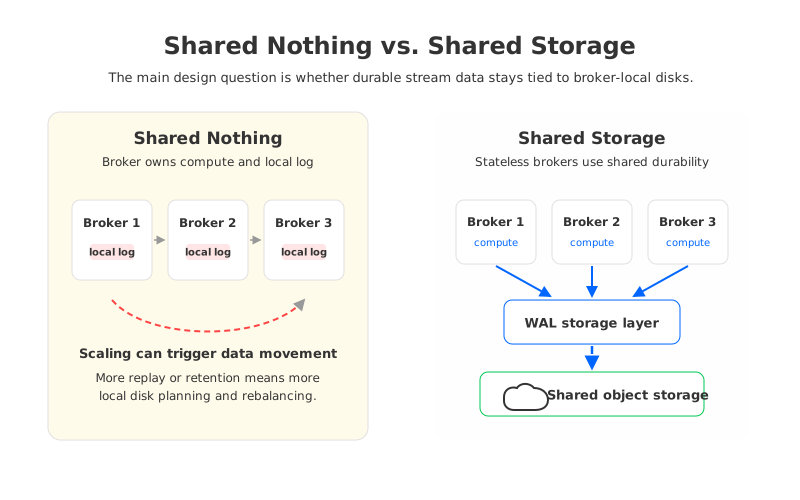
Apache Kafka's ecosystem recognizes some of these pressures. Kafka Connect exists because moving data between Kafka and external systems is a first-class operational need. Tiered Storage exists because keeping all log data on broker-local storage is not always the right cost or capacity model. KRaft removed the ZooKeeper dependency from Kafka metadata management. These are important evolutions, and platform teams should understand them before making any vendor decision.
For agent feedback events, the important distinction is not "Kafka or not Kafka." It is which Kafka-compatible operating model matches the workload. A team can run self-managed Apache Kafka, use a managed Kafka service, adopt Kafka-compatible cloud-native streaming, or split the workload across a database, queue, stream, and lakehouse. Each option can be valid if the team is honest about the trade-offs.
4Evaluation Checklist for Platform Teams
The practical evaluation starts with compatibility because migration risk is usually more expensive than the first cluster bill. If producers, consumers, serializers, ACL patterns, stream processors, and connectors already speak Kafka, the platform should preserve that contract. Compatibility is not only an API checkbox. It includes delivery semantics, offset behavior, consumer group behavior, transactions where used, monitoring expectations, and operational tooling.
Cost comes next, but not as a single monthly number. Agent feedback streams have a cost shape: hot writes, fan-out reads, long retention for audit or evaluation, periodic replay, and bursts during experiments or incidents. A platform that is cost-effective for steady telemetry may behave differently under replay-heavy evaluation workloads. The useful test is to model retention, read fan-out, backfill, cross-zone networking, object storage requests, connector capacity, and operational labor together.
Governance should be evaluated before the first production topic is created. Agent feedback data can contain user content, internal reasoning traces, tool payloads, and human annotations. Topic design, schema contracts, encryption, network boundaries, private connectivity, access control, and sink policies need to be part of the architecture, not an afterthought once the lakehouse table already exists.
The last part of the checklist is recovery. A feedback stream is only useful if the team can trust it after something goes wrong. Test what happens when a consumer falls behind, an evaluator emits bad labels, a connector is misconfigured, a broker fails, or a migration needs rollback. Offsets, replay windows, idempotent writes, dead-letter handling, and schema evolution rules are not paperwork; they decide whether the feedback loop can recover without corrupting future decisions.
| Evaluation area | What to test | Why it matters |
|---|---|---|
| Compatibility | Existing producers, consumers, serializers, Connect sinks, and stream processors | Reduces migration risk and avoids rewriting the AI data path |
| Freshness | End-to-end lag during normal traffic, burst traffic, and replay | Keeps feedback useful for online policy and evaluation loops |
| Retention | Hot and historical reads across the required replay window | Supports audits, prompt regression tests, and incident reconstruction |
| Governance | Topic boundaries, schemas, encryption, ACLs, private networking, and sink controls | Prevents feedback streams from becoming unmanaged sensitive data |
| Recovery | Consumer lag, bad-label rollback, connector failure, broker failure, and migration rollback | Proves that the loop can be repaired after production faults |
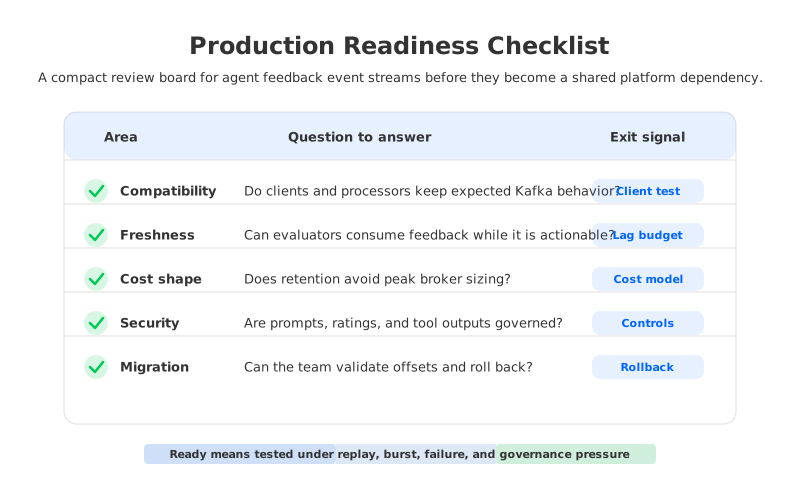
This matrix is vendor-neutral. It gives architects a way to compare self-managed Kafka, managed Kafka, Kafka-compatible alternatives, and shared-storage designs without reducing the decision to a feature list.
5How AutoMQ Changes the Operating Model
Once the evaluation reaches retention, replay, burst scaling, and cloud cost, a Kafka-compatible Shared Storage architecture becomes worth testing. AutoMQ is a cloud-native streaming platform that keeps the Kafka-facing API while separating broker compute from durable stream storage. Brokers become closer to stateless compute, while stream data is persisted through an object-storage-backed architecture with a WAL storage layer for writes.
That changes the operating model for agent feedback events in a few concrete ways. First, scaling broker compute does not have to imply moving the durable log between broker-local disks. That matters when an evaluation replay, product launch, or incident investigation temporarily increases read pressure. Second, long retention can be planned around shared object storage instead of sizing every broker for peak historical data. That matters when feedback events must be kept for model evaluation, governance, and audit. Third, customer-controlled deployment boundaries can fit organizations that need Kafka-compatible streaming while keeping data plane ownership close to their cloud account and security model.
There is still work to do in validation. A shared-storage design should prove write latency, failure recovery, object storage behavior, metadata reliability, connector compatibility, and cost under the actual feedback workload. It should also be tested with the same migration and rollback discipline as any other critical data platform. The useful point is narrower: if broker-local storage and data movement are becoming the bottleneck in an agent feedback event platform, AutoMQ gives teams a different Kafka-compatible architecture to evaluate.
A reasonable next step is a workload-specific proof of concept, not a platform rewrite. Pick one feedback domain, define event schemas, run producers and consumers with realistic replay, connect the sink path, and measure lag, recovery, and operational work. To test that pattern on a Kafka-compatible shared-storage architecture, you can contact AutoMQ for a technical walkthrough and bring your Kafka client assumptions.
6Migration and Readiness Scorecard
Most teams do not design agent feedback infrastructure from a blank page. They already have application logs, warehouse tables, model evaluation notebooks, alerting systems, and Kafka clusters. A good first phase mirrors feedback into Kafka while the batch pipeline continues to run. The team then compares outputs, validates schemas, measures lag, and rehearses rollback before making the stream primary for time-sensitive workflows.
The readiness score is not a generic maturity model. It should answer whether this workload can survive production pressure:
- Green: existing Kafka clients work, consumers keep up during replay, sensitive fields are governed, sinks are tested, and rollback has been rehearsed.
- Yellow: the event model is clear, but cost under retention, consumer lag, or connector operations still needs proof.
- Red: feedback remains coupled to a serving database, replay depends on manual exports, sensitive payloads lack topic boundaries, or the team cannot reconstruct an agent decision after a failure.
The uncomfortable part of this scorecard is useful. It prevents an AI platform from treating feedback as analytics exhaust while depending on it as a control signal. Once feedback influences what the next agent does, the stream becomes production infrastructure.
7References
- Apache Kafka documentation
- Apache Kafka message delivery semantics
- Apache Kafka Connect overview
- Apache Kafka KRaft operations
- Apache Kafka Tiered Storage operations
- AutoMQ architecture overview
- AutoMQ S3Stream shared streaming storage
- AutoMQ WAL storage
- AWS PrivateLink documentation
- Amazon S3 user guide
8FAQ
8.1Do agent feedback events always need Kafka?
No. A small application can store feedback in a database and run batch analysis without introducing Kafka. Kafka becomes attractive when multiple teams need durable event capture, independent consumers, replay, offset tracking, and real-time or near-real-time feedback loops.
8.2What should be included in an agent feedback event?
Include stable identifiers, timestamps, agent or workflow version, prompt references, tool-call references, feedback label, reviewer metadata, and governance fields such as tenant or data classification. Avoid dumping every raw payload into every topic. Sensitive prompt text and tool output may need separate topic boundaries or masking.
8.3How should teams choose retention for feedback topics?
Retention should follow the longest legitimate replay and audit requirement, not the default broker disk size. Online control topics may need shorter retention, while evaluation and audit topics may need longer history. The key is to model retention with replay cost, governance requirements, and storage architecture together.
8.4Where does AutoMQ fit in this architecture?
AutoMQ fits when the team wants Kafka-compatible streaming but needs a cloud-native operating model for elasticity, retention, replay, and customer-controlled deployment boundaries. It should be evaluated with real producers, consumers, connectors, failure tests, and migration rollback checks rather than accepted without workload validation.


