
Table of Contents
Table of Contents
Teams search for agent memory streams kafka when a prototype has crossed the line from clever demo to production dependency. The agent is no longer answering from a static prompt. It is watching orders, tickets, incidents, payments, approvals, deployments, tool calls, and evaluation feedback. At that point, "memory" stops being a prompt-engineering feature and starts behaving like a data infrastructure problem.
The uncomfortable part is not that agents need context. Every serious AI platform team already knows that. The harder question is which parts of that context must be durable, replayable, governed, and shared across systems. A vector database can help retrieve semantically similar content. A feature store can hold point-in-time attributes. A database can expose current state. But an autonomous or semi-autonomous workflow also needs a timeline: what changed, which tool was called, what the agent saw, what it recommended, who approved it, and what happened afterward.
That timeline is where Kafka-compatible streaming becomes relevant. Apache Kafka's core model of producers, topics, consumers, consumer groups, offsets, and replay fits the shape of agent memory because memory is not one object. It is a set of event streams with different freshness, retention, privacy, and recovery requirements. The architectural decision is whether the Kafka-compatible backbone can carry agent memory without turning storage, governance, and operations into the next bottleneck.
1Why teams search for agent memory streams kafka
Agent memory sounds personal, but production memory is organizational. A support agent may need the last customer conversation, the latest billing state, and the outcome of a refund tool call. An SRE agent may need deployment events, alert transitions, log summaries, and remediation attempts. A fraud agent may need account changes, velocity windows, policy decisions, and human overrides. These are not isolated memories inside one model session. They are event records that many systems need to read and verify.
This distinction matters because agent state has at least three forms. Short-term conversational context belongs close to the agent runtime. Long-term semantic memory often belongs in a retrieval system. Operational memory belongs in durable streams, because it represents facts, decisions, and actions that other systems must replay. Confusing these forms leads to prompts filled with raw logs, vector indexes asked to serve as audit records, or databases polled continuously for fresh state.
Kafka-compatible streams solve a narrower but more durable problem. They provide a shared log that preserves event order within partitions, lets independent consumers track offsets, and gives platform teams a place to enforce topic design, access control, retention, and observability. For agent memory, that makes the stream a coordination layer between deterministic services and probabilistic reasoning. The agent can consume derived context, publish decisions, and leave a trail without owning the full integration graph.
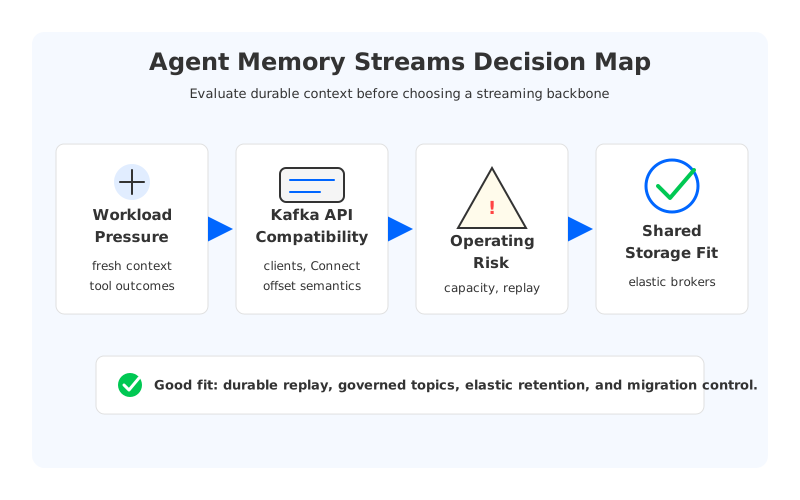
The first design move is to classify memory by operational consequence. A user preference update is different from a tool execution result. A policy denial is different from an embedding refresh. Once the streams are classified, the platform team can decide which records need low-latency delivery, long retention, strict access boundaries, or compaction.
2The freshness and governance problem behind AI event streams
Freshness is the obvious requirement, but governance decides whether the system survives production review. Agents that act on stale context create bad outcomes. Agents that act on ungoverned context create outcomes no one can explain. The backbone needs to support both live delivery and later reconstruction, because debugging an agent decision often starts with one question: what did the system know at that moment?
Kafka's offset model is useful here because consumers can make progress explicit. A stream processor can consume customer events and publish a compact risk signal. An agent runtime can consume that signal and publish a proposed action. A policy service can publish an approval or rejection. Each component has a position in the log, and that position becomes part of the audit story.
The governance surface is broader than access control. Platform teams need to answer practical questions before agent memory streams become a shared substrate:
- Who can publish memory events? Tool results, human approvals, generated outputs, and policy decisions should not all come from the same identity or trust level.
- Which records can be replayed? Replay is valuable for evaluation and recovery, but sensitive topics may need stricter access, shorter retention, or masked payloads.
- How are schemas enforced? An agent action record without stable fields for actor, tool, input reference, output reference, policy state, and correlation ID is hard to audit.
- Where does derived context live? Raw events, summarized state, embeddings, and agent-readable context should be separated so the model is not asked to infer structure from noise.
- What happens after a bad decision? The system needs rollback and compensation records, not only successful action records.
The important point is that governance cannot be bolted onto the agent alone. The agent is one consumer and producer in a larger system. Kafka-compatible infrastructure gives teams a place to manage topics, offsets, retention, connectors, and monitoring with patterns they already understand. That familiarity reduces migration risk, but it does not remove the need to design memory streams deliberately.
3Architecture options for durable, replayable AI context
There are several ways to build durable agent memory. A database-first design works when the agent mostly reads current state and publishes a small number of actions. A retrieval-first design works when the problem is semantic lookup across documents or conversations. A workflow-engine-first design works when the agent follows explicit state transitions. A stream-first design becomes attractive when many services produce context, many consumers need it, and replay is part of testing, audit, or recovery.
The trade-off is that stream-first memory puts pressure on the streaming layer. Agent workloads increase fanout because the same topic may feed stream processors, vector indexers, policy services, dashboards, and multiple agent runtimes. They increase retention because teams want decision history for replay and audit. They also increase burst pressure because evaluation jobs and investigations can read historical context while production agents consume live events.
Traditional Kafka was designed around broker-owned local storage. That model is proven and familiar, but it couples compute placement, durable log storage, and broker capacity. In a high-retention memory-stream workload, this can turn the infrastructure decision into a broker disk decision: how much local storage to provision, how much replication traffic to tolerate, and how much headroom to keep for bursts. Agent systems make these issues more visible because memory is part of the product behavior.
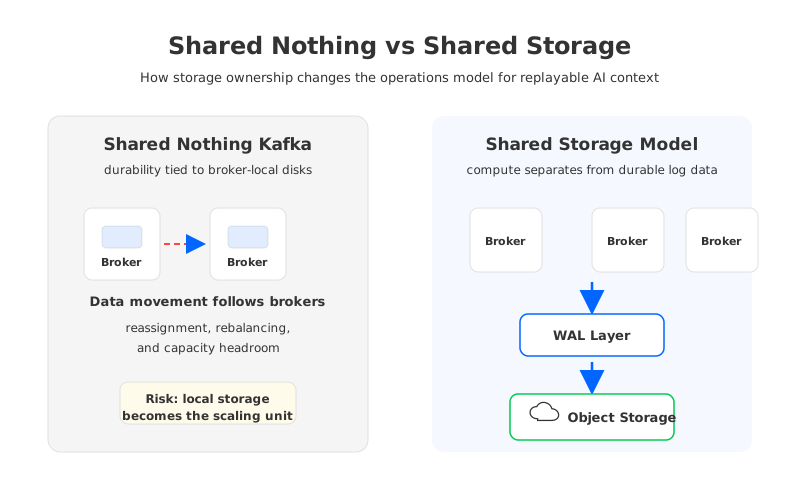
Shared storage changes the operating model. Instead of treating broker-local disks as the long-term home of the log, the architecture separates the Kafka-compatible compute path from the durable storage layer. Object storage becomes the long-lived repository, while a write-ahead log path absorbs hot-path write requirements. The result is a different scaling boundary: compute can scale with brokers, storage can scale with retained data, and capacity planning no longer starts from local disks.
4Evaluation checklist for platform teams
The strongest architecture review starts from workload classes, not vendor names. For agent memory streams, the platform team should place each topic into a matrix that captures freshness, retention, fanout, sensitivity, replay frequency, and ownership. A tool-result stream with compliance impact deserves a different design from a low-risk context-enrichment stream.
Use the following decision matrix as a starting point:
| Evaluation area | What to verify | Why it matters for agent memory |
|---|---|---|
| Kafka compatibility | Producers, consumers, Kafka Connect, offset behavior, security integrations | Teams can reuse existing pipelines and operating patterns instead of rewriting the backbone around the agent |
| Cost model | Storage growth, read fanout, cross-zone traffic, request volume, retained history | Memory streams can grow faster than the original AI budget if replay and retention are ignored |
| Elasticity | Burst ingestion, replay jobs, partition growth, broker scale-out and scale-in | Evaluation and incident workflows can create traffic spikes separate from live agent traffic |
| Governance | Topic ownership, schemas, ACLs, encryption, audit records, retention policy | Agent decisions need a reconstructable control trail |
| Failure recovery | Consumer lag handling, replay range, restore points, rollback topics | Bad prompts, faulty tools, and unsafe actions require investigation and compensation |
| Migration risk | Client compatibility, dual writes, cutover plan, rollback path | The first production agent should not force a risky streaming-platform replacement |
| Team boundary | Who owns topics, connectors, stream processors, and agent outputs | AI platform, data platform, and SRE responsibilities must be explicit |
This matrix often exposes a useful split. Latency-critical control loops may stay close to existing infrastructure after benchmarking. High-volume context, telemetry, tool-result, and audit streams may be better candidates for a shared-storage Kafka-compatible backbone. The decision is a fit assessment based on how each stream behaves under retention, replay, and governance pressure.
5How AutoMQ changes the operating model
Once the evaluation points to Kafka compatibility plus elastic retained history, AutoMQ becomes relevant as a cloud-native, Kafka-compatible streaming platform built around shared storage. Its architecture keeps the Kafka protocol surface familiar while moving durable stream storage away from broker-local disks and into object storage, with a WAL layer for the write path. For agent memory streams, the long-lived record is no longer bound to the same unit that serves client requests.
In operational terms, this changes what the platform team plans for. Brokers can behave more like stateless compute nodes. Retained history can grow in object storage. Scaling decisions can focus on live workload rather than treating every broker as both serving capacity and storage capacity. For teams already standardizing on Kafka clients, Kafka Connect, and Kafka operations, the appeal is not that agent memory gets a special protocol. The appeal is that the familiar protocol can run on an architecture better aligned with cloud storage economics and elastic workloads.
AutoMQ's public architecture documentation also highlights deployment boundaries that matter to AI teams, including customer-controlled environments and features such as zero cross-AZ traffic in AutoMQ Cloud materials. Those details should be evaluated against region, network, security, and compliance requirements. The right question is whether the architecture reduces a concrete memory-stream risk: uncontrolled data movement, hard-to-predict storage growth, slow reassignment, or unclear ownership of retained agent history.
There are still constraints to respect. Object storage and local disks have different latency profiles. WAL design, workload mix, client behavior, and region topology all matter. A good pilot uses real schemas, real retention assumptions, realistic consumer fanout, and a failure exercise that proves replay and rollback paths.
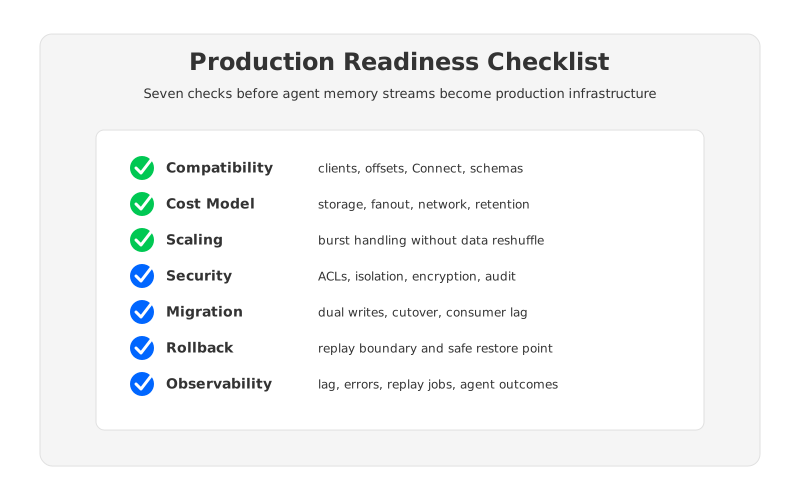
The readiness checklist should be run before the first broad rollout, not after the first incident. Compatibility must be proven with existing clients and connectors. Cost should include retained history and read fanout. Security needs topic-level access boundaries and audit-friendly schemas. Migration needs a dual-run period. Observability needs to include consumer lag, producer errors, WAL and storage behavior, replay jobs, and agent action outcomes in the same view.
6A practical rollout pattern
The safest starting point is not the most dramatic agent workflow. Start with memory streams that are valuable, high-volume, and recoverable: tool-call outcomes, evaluation traces, incident summaries, enrichment outputs, and policy decisions. These streams let the team test schema discipline, retention policy, replay, and ownership without moving a latency-critical control path first.
From there, add stream processing before adding more autonomy. A Flink job, Kafka Streams application, or service-level consumer can transform raw events into compact context that the agent can use. This keeps deterministic calculations outside the model and makes evaluation easier. If the agent receives a risk score, incident summary, or policy state, the team can inspect how that signal was produced.
The final step is to publish agent decisions back into streams with enough structure to support audits. Every tool call should have a correlation ID. Every recommendation should reference the context version or offset range used to produce it. Every approval, denial, override, and compensation should be an event. That gives the organization a memory larger than the model session.
If your team is evaluating whether shared-storage Kafka fits this workload class, read the AutoMQ architecture overview and compare it against your own retention, replay, fanout, and governance matrix. The useful outcome is a clear answer for which memory streams should remain where they are, which should move, and which should be redesigned before any agent consumes them.
7References
- Apache Kafka documentation
- Apache Kafka documentation: consumers and consumer groups
- Apache Kafka documentation: delivery semantics and transactions
- Apache Kafka documentation: Kafka Connect
- Apache Kafka documentation: KRaft
- AutoMQ documentation: What is AutoMQ
- AutoMQ documentation: Architecture overview
- AutoMQ documentation: S3Stream shared streaming storage
- AutoMQ documentation: WAL storage
- AutoMQ Cloud documentation: eliminate inter-zone traffic
- AWS PrivateLink pricing
- Amazon S3 FAQs
8FAQ
8.1Are agent memory streams the same as vector memory?
No. Vector memory is useful for semantic retrieval, while memory streams capture durable changes, decisions, tool results, approvals, and replayable operational context. Many production systems need both: streams preserve the timeline, and retrieval systems help the agent find relevant content inside that timeline or related knowledge.
8.2Why use Kafka-compatible infrastructure for agent memory?
Kafka-compatible infrastructure gives teams a durable log, independent consumers, offset tracking, replay, and a mature ecosystem of clients and connectors. Those properties are useful when agent context is produced by many systems and consumed by agents, stream processors, dashboards, policy services, and audit workflows.
8.3Does every AI agent need Kafka?
No. A small agent that answers from a narrow database or document set may not need a streaming backbone. Kafka-compatible memory streams become more relevant when the agent depends on fresh operational events, tool-call records, multi-team consumers, long retention, replay, or governed audit trails.
8.4Where does AutoMQ fit?
AutoMQ fits when the team wants Kafka compatibility but needs a cloud-native operating model for high-volume, replayable, retained streams. Its shared storage architecture is most relevant for memory streams where elasticity, object-storage-backed durability, and customer-controlled deployment boundaries are part of the evaluation.
8.5What should teams benchmark before adopting shared-storage Kafka?
Benchmark representative topics with real payload sizes, partition counts, retention windows, producer rates, consumer fanout, replay jobs, and failure scenarios. Include migration behavior and rollback testing, because agent memory streams are valuable only when the team can trust both live delivery and later reconstruction.


