
Table of Contents
Table of Contents
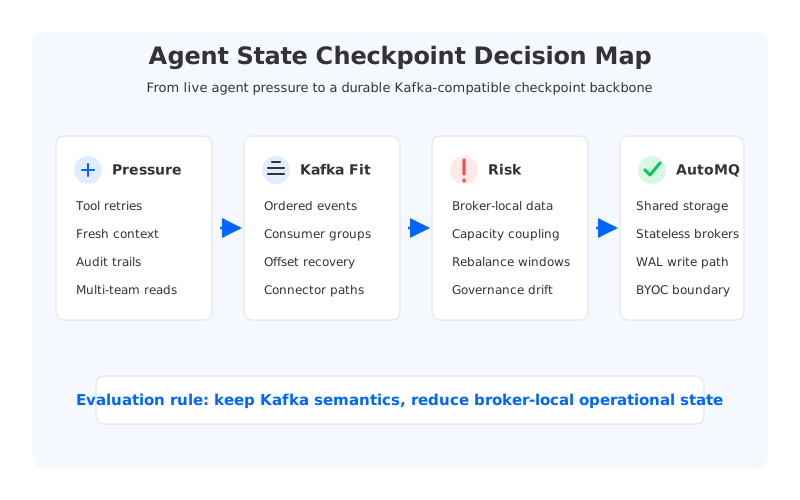
AI platform teams rarely search for agent state checkpoint kafka because they want another storage product. They search for it because an agentic application has started to behave like a distributed system: context changes quickly, retries must resume from a known point, and downstream teams want the same transitions for observability, evaluation, and governance. A batch store can persist the final state, but it does not preserve operational history with the freshness that production agents need.
The pressure usually appears after the first few agent workflows reach production. A prompt, retrieved context, tool decision, human approval, and final output are no longer one opaque blob. They become state transitions that different systems need to consume at different speeds. Analytics wants sessions, security wants tool usage, data science wants traces, and the serving path wants resumable checkpoints when a worker fails.
That is why Kafka enters the conversation. Kafka gives teams a durable, replayable event log, consumer groups for independent readers, offset tracking for restart boundaries, and ecosystem integrations through clients and Kafka Connect. Those properties line up well with agent state checkpoints, but the harder question is what operating model will carry those checkpoints without turning every AI team into a Kafka operations team.
1Why teams search for agent state checkpoint kafka
Agent state is not one thing. It is a stream of observations, decisions, intermediate artifacts, external calls, guardrail results, and user-visible outputs. Some events are small and frequent, such as token usage or tool routing decisions. Others are larger and less frequent, such as retrieved document summaries, execution plans, or state snapshots. Treating all of that as a single database row creates a misleading sense of simplicity. It persists state, but it hides the sequence that explains how the state was reached.
Kafka-compatible streaming is attractive because it separates the writers of state transitions from the readers that interpret them. An agent runtime can append events to a topic while evaluators, billing systems, data quality monitors, and replay workers consume independently. Kafka consumer groups make that fan-out operationally sane because each consumer group maintains its own progress. Offsets provide a concrete restart point when a processor crashes or a replay job needs to resume.
The checkpoint design still has to answer several uncomfortable questions. Is the checkpoint an event, a compacted latest-state topic, a snapshot stored elsewhere with a pointer in Kafka, or a combination? What happens when a tool call succeeds but the checkpoint write is retried? Can a downstream evaluator replay the exact sequence that led to a harmful response? Can sensitive context be masked without breaking auditability? These are architecture questions, not syntax questions.
A useful pattern is to separate the event log from the materialized state. Kafka holds the ordered transitions and restart boundaries. A serving database, vector store, object store, or lakehouse table may hold derived views and larger artifacts. The event log says what happened, in what order, and which durable object belongs to that point in the workflow.
2The freshness and governance problem behind AI event streams
Batch stores are good at accumulation. Agent systems need accumulation plus freshness. When an agent is calling tools, waiting on external systems, or handing work to another model, the state checkpoint is useful only if it arrives before the next operational decision. A delayed checkpoint can make a retry repeat an external action. A missing checkpoint can make the platform lose the difference between a model error, a tool error, and a policy stop.
Governance makes the problem sharper. AI teams often start by logging prompts and responses, then discover that the useful evidence lives between them. The decision to call a search tool, the retrieved context, the policy score, and the human override are separate facts. They need retention rules, access controls, lineage, and replay boundaries. If those facts are stored only in a batch analytics system, operational teams can inspect them after the fact but cannot use them as live control signals.
The core design tension looks like this:
| Requirement | Batch-first state store | Kafka-compatible checkpoint stream |
|---|---|---|
| Fresh restart boundary | Often derived after ingestion or compaction | Natural fit through committed offsets and replayable events |
| Independent consumers | Requires extra export or polling paths | Consumer groups can read the same checkpoint stream independently |
| Audit sequence | Final state may hide intermediate steps | Ordered records preserve state transitions |
| Large artifacts | Strong fit for object stores and lakehouse tables | Better handled by pointers plus metadata in the event stream |
| Governance | Strong for cataloged tables | Strong when combined with schemas, ACLs, retention, and downstream catalogs |
The table points to a practical conclusion: teams should not choose between streaming and batch. They should choose where each responsibility belongs. Kafka is a strong fit for the ordered checkpoint ledger. Batch stores, object stores, and lakehouse tables remain useful for derived state, large artifacts, analytics, and long-range reporting. Lock-in happens when the batch store becomes the primary place where transitions are visible.
3Architecture options for durable, replayable AI context
A production checkpoint architecture usually has four layers. The agent runtime writes state transition events. Kafka-compatible infrastructure persists and orders those events. Stream processors and consumers materialize views, enforce policy, or run evaluations. Batch and object stores hold bulky artifacts and query-optimized state. The clean version of this architecture keeps the streaming layer as the live source of sequence, while allowing other stores to do what they are good at.
There are several workable checkpoint shapes. A pure event topic works when consumers can rebuild state from the beginning or from a known snapshot. A compacted topic works when the latest state per session or task needs to be queryable through Kafka semantics. A hybrid design stores snapshots in object storage and emits checkpoint events with object references, hashes, schema versions, and policy tags. That hybrid pattern is often the most practical for agent systems because some state is too large or too sensitive to treat as a normal Kafka record.
Traditional Kafka can support these patterns, but its Shared Nothing architecture turns checkpoint growth into an operations problem. Each broker owns local log segments. Replication, partition reassignment, disk sizing, and broker replacement all involve data locality. As checkpoint volume grows, storage and compute move together: more retained state often means more broker disk, more provisioned capacity, and more work during rebalancing. That becomes painful when agent traffic has sharp peaks and retention requirements change as governance matures.
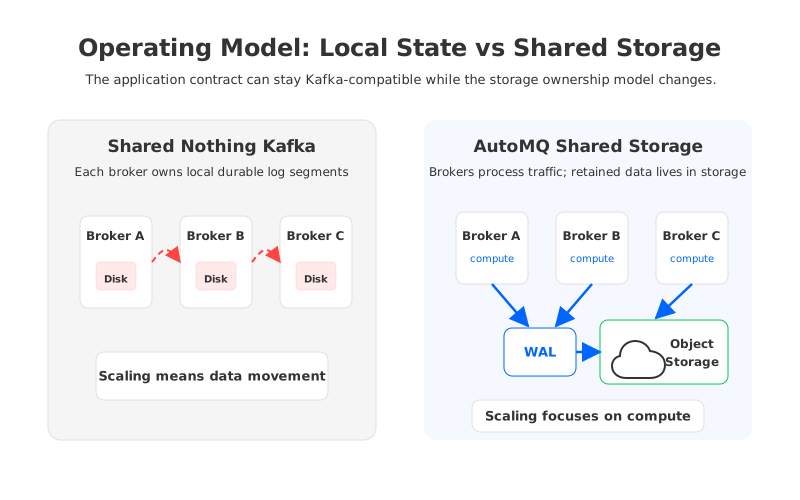
The architecture decision is therefore less about whether Kafka semantics are useful. They are. The decision is whether the platform can keep Kafka-facing behavior while reducing the operational state attached to every broker. Agent checkpoints are a good stress test because they combine bursty writes, many consumers, long audit horizons, and changing governance rules.
4Evaluation checklist for platform teams
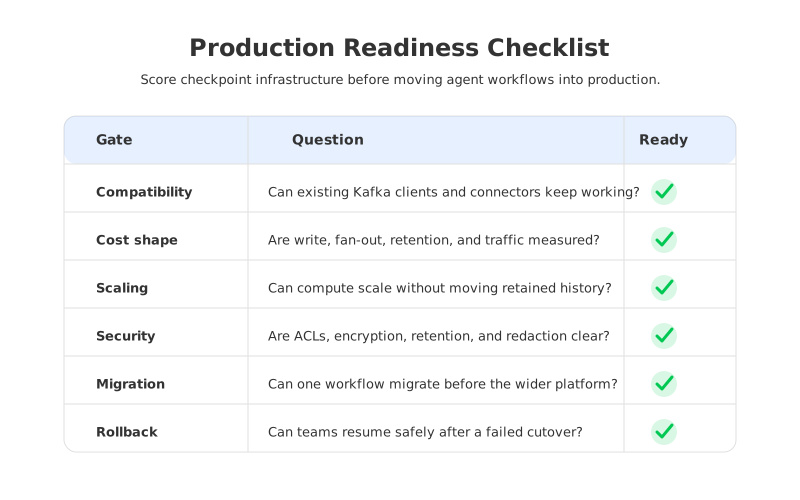
Before introducing any vendor or managed service into the discussion, write down the evaluation gates. A checkpoint platform that passes a throughput benchmark but fails rollback planning is not ready for production agents. A platform that stores everything durably but forces consumers through one batch export path will slow down the teams that need live signals.
Use this checklist as a starting point:
- Compatibility: Producers, consumers, stream processors, Schema Registry integrations, and Kafka Connect pipelines should work with minimal client changes. Agent teams should not rewrite application logic to adopt a checkpoint backbone.
- Ordering and idempotency: The design must define ordering scope, deduplication keys, and retry behavior for tool calls. Idempotent producers and transactional patterns may matter when state transitions are tied to external side effects.
- Cost shape: Separate write throughput, read fan-out, retention, cross-zone traffic, object storage, broker compute, and operations labor. A checkpoint stream can look small at launch and become a shared platform bill later.
- Elasticity: Bursty agent workloads should not force permanent overprovisioning. Scaling compute should not trigger large broker-local data movement for retained checkpoint history.
- Governance: Schemas, ACLs, encryption, retention, redaction strategy, and audit exports should be part of the first design. Waiting until the first policy review creates harder migration work.
- Failure recovery: Define recovery point, replay scope, consumer offset handling, and rollback mechanics. The test is not whether the happy path writes events; it is whether teams can recover a half-finished workflow without guessing.
- Team boundaries: AI application teams, data platform teams, SREs, and security reviewers need different controls. The platform should expose stable contracts without making every team own broker internals.
This checklist also prevents a common mistake: treating agent checkpoints as a storage-only problem. The value of the checkpoint stream comes from its role as a shared operational ledger. If replay, fan-out, and governance stay hard, the checkpoint data will exist but the organization will avoid using it.
5How AutoMQ changes the operating model
Once the neutral checklist is clear, AutoMQ becomes relevant as a Kafka-compatible streaming platform that changes the storage architecture under the Kafka API. AutoMQ keeps Kafka protocol compatibility and ecosystem expectations while moving durable stream storage away from broker-local disks. Its Shared Storage architecture uses S3Stream, WAL storage, and S3-compatible object storage so brokers can act more like stateless compute nodes than long-lived owners of local partition data.
That shift matters for agent checkpoint workloads because the hard part is not only accepting writes. It is keeping the platform elastic while state history grows. In a broker-local model, retained checkpoint data lives on specific brokers and becomes part of scaling, replacement, and balancing work. In a shared-storage model, durable data is no longer trapped on one broker’s local disk. Broker changes can focus on compute capacity and traffic distribution, while object storage carries retained log data.
AutoMQ’s WAL layer is also important to understand. Object storage is the primary durable repository, but writes still need a low-latency and recoverable path before larger objects are committed. WAL storage provides that write path. Different deployments can choose storage media according to latency and cost requirements, while retained data stays in shared object storage. For agent checkpoints, teams can evaluate the same Kafka-compatible surface across workloads from evaluation traces to user-facing recovery.
The cloud-cost angle is an operating model question. Agent traffic can create high read fan-out because observability, evaluation, billing, policy, and data science systems may all consume the same stream. It can also create long retention because audit and model improvement workflows need history. A platform that separates compute scaling from retained storage gives architects more room to tune each dimension.
AutoMQ also fits the team-boundary requirement in regulated or infrastructure-sensitive environments. BYOC-style deployment lets organizations evaluate a Kafka-compatible data plane while keeping cloud resources and data boundaries under customer control. For checkpoint streams that may include prompts, retrieved context, policy decisions, and tool outputs, that boundary is often the difference between a shared platform and isolated silos.
6A migration path that avoids checkpoint lock-in
The safest migration plan starts with one checkpoint domain, not the whole AI platform. Choose a workflow where replay is valuable, governance is visible, and the current batch-first state path is causing friction. Define the event schema, checkpoint keys, retention expectations, artifact-pointer strategy, and consumer groups before moving traffic. Then run the stream beside the existing state path until teams trust replay and rollback behavior.
The readiness scorecard should include both platform and application work:
| Gate | What to prove before widening rollout |
|---|---|
| Schema stability | Events carry task ID, step ID, checkpoint type, schema version, artifact references, and policy tags |
| Replay safety | Consumers can rebuild state from a snapshot plus event sequence without repeating external side effects |
| Offset handling | Each consumer group has clear ownership, lag alerts, and restart procedures |
| Governance | Sensitive fields are classified, access is enforced, retention is documented, and exports are auditable |
| Rollback | A failed cutover can return to the prior state path without losing checkpoint sequence |
| Cost review | Write volume, read fan-out, retention, and cloud traffic are measured under production-like load |
This is where Kafka compatibility pays off. Teams can use familiar producers, consumers, offsets, and connectors while changing the infrastructure behind them. The migration does not have to begin as a platform-wide rewrite. It can begin as a controlled ledger for one workflow, then expand as the operational contract proves itself.
The original search for agent state checkpoint kafka is really a search for a better boundary. Batch stores should keep doing batch-store work: large artifacts, analytics, derived tables, and long-horizon reporting. The checkpoint stream should carry the ordered, replayable facts that production agents need while they are live. If your team is evaluating that boundary with Kafka-compatible shared storage, start with the checklist above and test one real agent workflow through the AutoMQ Cloud Console.
7References
- Apache Kafka documentation
- Apache Kafka consumer configuration
- Apache Kafka producer configuration
- Apache Kafka transactions
- Apache Kafka Connect documentation
- AutoMQ compatibility with Apache Kafka
- AutoMQ architecture overview
- AutoMQ WAL storage documentation
- AutoMQ stateless broker documentation
- AWS S3 performance guidelines
8FAQ
8.1Is Kafka a state store for AI agents?
Kafka is better treated as the ordered checkpoint ledger, not the sole state store. It records state transitions, restart boundaries, and replayable events. Serving databases, object stores, vector stores, and lakehouse tables can hold materialized state or large artifacts derived from that ledger.
8.2Should agent checkpoints use compacted topics?
Compacted topics are useful when teams need the latest checkpoint per task, session, or agent run. They are not a full replacement for an event-history topic when audit and replay matter. Many production designs use both: an append-only transition topic for sequence and a compacted topic or external store for the latest view.
8.3How do offsets relate to agent checkpoint recovery?
Offsets tell each consumer group how far it has processed a topic partition. For checkpoint recovery, offsets are useful because they give processors a concrete restart boundary. They do not replace application-level idempotency, especially when a checkpoint event corresponds to an external tool call or side effect.
8.4Where does AutoMQ fit if my application already uses Kafka clients?
AutoMQ is relevant when the Kafka-facing contract is valuable but broker-local storage has become the operational constraint. It keeps Kafka compatibility while using Shared Storage architecture, WAL storage, and S3-compatible object storage to reduce the amount of durable state tied to individual brokers.
8.5Can agent checkpoint streams coexist with batch analytics stores?
Yes. The stronger design is usually streaming plus batch, not streaming instead of batch. Kafka-compatible streams preserve live sequence and replay. Batch stores and lakehouse tables support large-scale analytics, long-term queries, and derived views.


