
Table of Contents
Table of Contents
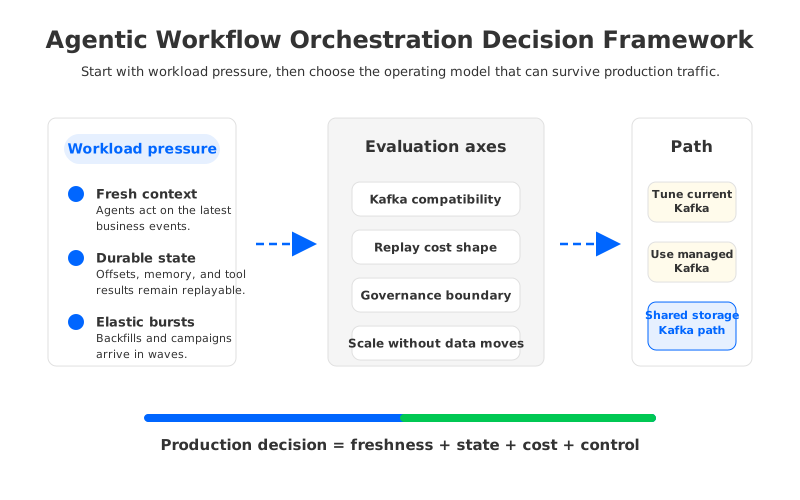
The production pressure behind agentic workflow orchestration is not that agents need another task queue. A customer-support agent, fraud investigation assistant, cloud operations copilot, or procurement workflow can already call tools, receive prompts, and produce actions. The harder problem is that every action depends on state that changes while the workflow is running. Customer context shifts, tool results arrive out of order, policies are updated, and a human escalation may need to replay the full decision path.
That is why teams searching for agentic workflow orchestration often end up evaluating event streams and stateful processing. The architecture has to coordinate long-running work without pretending that the world is static between steps. It needs a durable record of business events, agent decisions, tool calls, state transitions, and compensating actions. It also needs enough operational discipline that a burst of agent traffic does not turn into a Kafka sizing crisis.
1Why Agentic Workflow Orchestration Matters Now
Agentic systems change the shape of workflow orchestration because the workflow is no longer a fixed sequence of steps. A conventional workflow engine can move a ticket from state A to state B after a deterministic rule fires. An agentic workflow may inspect context, choose a tool, wait for a result, branch into a different action, ask for human approval, and resume after another event changes the situation. The control flow is dynamic, but the infrastructure requirements are not vague: the platform still has to preserve ordering where it matters, track progress, recover from failures, and explain what happened.
Kafka is attractive in this setting because it gives teams a durable event log with mature producer and consumer semantics. Apache Kafka's core model of topics, partitions, producers, consumers, offsets, and consumer groups maps naturally to workflow state: each step can publish facts, downstream processors can consume at their own pace, and failed processors can resume from a known offset. Stateful stream processing extends that model by maintaining intermediate state while events keep arriving.
The catch is that agentic workflows make replay and freshness part of the serving path. A recommendation agent might need the current inventory update and the earlier conversation history. An operations agent may need to correlate a telemetry event, a deployment event, and a policy decision. If the event backbone is slow to scale, costly to retain, or weakly governed, the agent layer inherits those constraints.
2The Production Constraints Behind the Search
The usual diagram for agentic workflow orchestration shows agents, tools, memory, and a stream processor connected by arrows. That diagram is useful for a design review, but it hides the platform constraints that decide whether the system survives production traffic.
- Freshness pressure. Agents can make poor decisions when they reason over stale events. The platform must protect tail latency and consumer catch-up at the same time.
- State pressure. Agent memory, tool results, approvals, retries, and compensating actions need a durable trail. Losing state is not a minor inconvenience when the workflow touches customer-facing or regulated operations.
- Elasticity pressure. Agent traffic often arrives in bursts: a product launch, incident, fraud campaign, support spike, or backfill can create sudden event volume.
- Governance pressure. Agentic workflows expand access to sensitive context. Platform teams need clear ownership of payloads, metadata, audit logs, IAM roles, and support access.
- Migration pressure. Most enterprises already have Kafka clients, stream processors, warehouses, lakehouses, workflow tools, and operational systems. The agentic layer has to integrate with that estate rather than ask for a blank page.
These constraints reinforce each other. A backfill can increase consumer lag, which can make an agent reason over stale context. A retention increase can add broker-local storage pressure, which can make scaling slower. A governance gap can force teams to isolate workloads, which can fragment topics and make replay harder. The architecture conversation starts with agents, but the operating model decides whether agents remain dependable.
3Where Traditional Kafka Architecture Gets Stressed
Traditional Apache Kafka is a shared-nothing system. Brokers own local log segments, partitions have leaders and replicas, and durability is achieved by replicating data across brokers. This design has served many high-throughput workloads well because the broker, log, and replication model are explicit and mature. It also gives operators strong control over topic configuration, partitioning, retention, and client behavior.
The trade-off appears when durable data is tightly coupled to the broker fleet. Adding compute capacity can involve partition reassignment. Replacing a broker can involve replica catch-up and disk pressure. Increasing retention can expand the local or attached storage footprint that brokers must carry. Kafka tiered storage, introduced through KIP-405, improves the economics of retaining older log segments by moving them to remote storage, but the hot path and operational model still depend on broker placement, partition leadership, and local resources.
Agentic workflows expose this coupling because they combine long-lived state with bursty access. One processor may tail fresh events while another replays a prior conversation window. A tool telemetry pipeline may spike during an incident while an audit job scans historical actions. The cluster must serve current decisions and historical reconstruction at the same time.
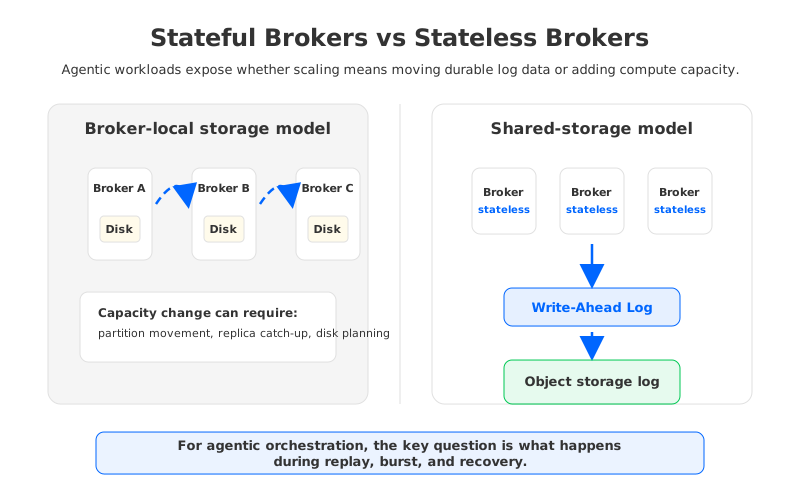
This does not mean traditional Kafka is wrong for agentic orchestration. It means the platform team has to be honest about the operating cost of state. If the workflow requires long retention, frequent replay, multi-team fan-out, and burst scaling, broker-local storage can become a design constraint rather than a background implementation detail.
4Architecture Patterns Teams Usually Compare
The practical decision is not "Kafka or no Kafka." Most teams compare several patterns that preserve some event-driven behavior while changing where state, compute, and control live.
| Pattern | Where it fits | Main risk |
|---|---|---|
| Workflow engine plus database state | Deterministic business processes with limited streaming fan-out | Event history can become fragmented across tables, logs, and tool-specific state |
| Traditional Kafka plus stream processing | Teams with mature Kafka operations and strong client compatibility needs | Retention, replay, scaling, and recovery can become broker-storage problems |
| Managed Kafka service | Teams that want Kafka APIs with less infrastructure ownership | Data-plane boundary, pricing dimensions, feature limits, and exit path need review |
| Kafka-compatible Shared Storage architecture | Teams that want Kafka semantics while separating compute from durable stream storage | WAL design, object-store behavior, metadata path, and compatibility must be validated |
The workflow-engine pattern can be effective when the process is mostly deterministic. It gives business teams a visible state machine and a clear place to model approvals. The weakness appears when agent decisions, external events, and stream processing become central. At that point, the workflow database and the event log can diverge unless the team invests heavily in event sourcing and replay discipline.
The traditional Kafka pattern is familiar and powerful. Producers publish state transitions, processors maintain workflow state, consumer groups track progress, and downstream systems replay from offsets when they need to rebuild. Its risk is operational coupling: the more the workflow relies on retention and replay, the more broker-local storage becomes part of the workflow's cost and recovery model.
The managed-service pattern reduces some operational burden, but it does not remove architecture questions. Platform teams still need to understand where data resides, how pricing works across storage and network dimensions, what client behaviors are supported, and how a migration or rollback would happen.
The Shared Storage architecture pattern changes the infrastructure contract. It keeps the Kafka-compatible surface while moving durable stream data into shared object storage and making brokers closer to stateless compute. This can be valuable when agentic workflows need elastic capacity, long retention, and replay without turning every capacity change into a data movement project.
5Evaluation Checklist for Platform Teams
A useful agentic workflow orchestration review should test the workload shape, not a vendor feature list. The platform has to work when agents act on fresh events, when processors fall behind, when state must be reconstructed, and when a governance team asks where the sensitive data lives.
Use this checklist before treating an architecture as production-ready:
- Compatibility. Validate producer idempotence, transactions if used, consumer group behavior, offset commits, compaction, ACLs, quotas, Kafka Streams, Connect, and observability agents. Compatibility is not a badge; it is a set of client behaviors your estate already depends on.
- Freshness and replay. Measure produce latency, end-to-end lag, tail reads, and catch-up reads under concurrent backfill. Agentic workflows need current facts and a durable path to reconstruct earlier decisions.
- State ownership. Decide which state belongs in the event log, which state belongs in a stream processor, which state belongs in a database, and which state belongs in agent memory. Blurry state boundaries become incident boundaries.
- Elastic scaling. Test scale-out, scale-in, node replacement, and partition movement. The key question is whether capacity can change without moving large amounts of durable data through the cluster.
- Cost shape. Model compute, storage, replication, object-store requests, network transfer, private connectivity, observability, and migration overlap. A workflow that is affordable at tail traffic can become expensive during replay.
- Governance boundary. Map payloads, schemas, metadata, audit logs, metrics, keys, IAM roles, and support access. Agentic workflows often touch sensitive context, so architecture diagrams should become security review artifacts.
- Migration and rollback. Prove dual running, event validation, consumer cutover, offset handling, and rollback rehearsal. A platform that cannot be exited safely should not become the state backbone for autonomous workflows.
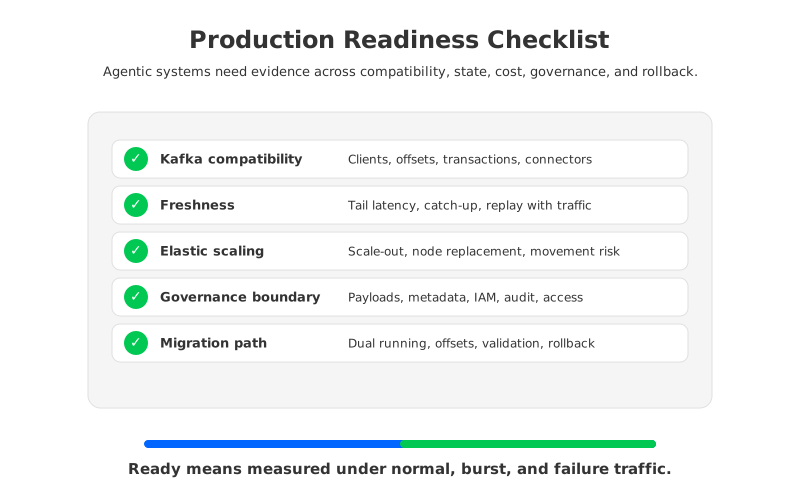
The important detail is that these checks should run together. A replay test without normal traffic hides contention. A compatibility test without failure recovery hides operational risk. A cost model without migration overlap hides the period when two platforms run in parallel.
6Where AutoMQ Changes the Operating Model
Once the evaluation reaches replay, elasticity, and cost shape, AutoMQ becomes relevant as a Kafka-compatible, cloud-native streaming platform that separates Kafka compute from durable stream storage. It keeps the Kafka-facing API familiar while replacing broker-local durable storage with an object-storage-backed Shared Storage architecture. Brokers become closer to stateless compute, durable data lives in shared object storage, and WAL (Write-Ahead Log) storage absorbs low-latency writes before data is uploaded.
For agentic workflow orchestration, this changes three operating assumptions. First, scaling compute does not have to imply moving the durable log between brokers. That matters when agent traffic spikes or stream processors need temporary capacity for backfill. Second, long retention can be modeled around object storage rather than broker-local disks alone. That matters when workflows need a durable audit trail and replayable state. Third, teams can keep Kafka-compatible client behavior while evaluating a different data-plane boundary, including customer-controlled deployment options.
This is not a reason to skip validation. Shared Storage architecture must still prove write latency, read behavior, failure recovery, object-store request economics, metadata reliability, and client compatibility. The point is narrower and more useful: if the bottleneck in your agentic workflow architecture is the coupling between broker compute and durable stream storage, the shared-storage category gives platform teams a different operating model to evaluate.
7Decision Table: How to Choose the Next Step
The right next step depends on the shape of the workflow. Teams with modest freshness needs and stable traffic may get more value from improving their current Kafka governance than from changing platforms. Teams with high replay volume, burst traffic, and long audit retention should evaluate whether the storage model is becoming the limiting factor.
| If your main constraint is... | Start with... | Escalate when... |
|---|---|---|
| Inconsistent event contracts | Schema governance, topic ownership, and state boundary design | Agents make decisions from conflicting or incomplete context |
| Consumer lag during agent bursts | Processor tuning, partition review, and capacity testing | Scaling requires large partition movement or persistent overprovisioning |
| Long audit and replay windows | Retention policy and cost modeling | Broker-local storage dominates cost or recovery time |
| Sensitive agent context | IAM, encryption, audit logging, and support-access review | Governance requires customer-controlled data-plane boundaries |
| Migration risk | Dual running and offset validation | Existing platform cannot support rollback without data loss or long downtime |
The closing question for architects is not whether agentic workflows are exciting. They are. The question is whether the event backbone can preserve state, freshness, governance, and cost control after the prototype becomes a production system. If your review shows that broker-local storage and data movement are becoming the limiting factors, evaluate a Kafka-compatible Shared Storage architecture with real workload tests. AutoMQ's documentation on architecture and differences from Apache Kafka is a practical place to begin that assessment.
8References
- Apache Kafka Documentation
- Apache Kafka Design Documentation
- KIP-405: Kafka Tiered Storage
- AutoMQ Architecture Overview
- AutoMQ Difference with Apache Kafka
- AutoMQ WAL Storage
9FAQ
9.1Is Kafka required for agentic workflow orchestration?
Kafka is not required for every agentic workflow, but it is a strong fit when workflows depend on durable events, consumer groups, replay, and multiple downstream processors. A small deterministic workflow may work well with a workflow engine and database state. A production agentic system that coordinates tool telemetry, business events, audit trails, and stateful processors usually benefits from a durable event backbone.
9.2What is the difference between workflow state and event state?
Workflow state describes the current progress of a process: pending approval, tool call completed, rollback requested, or escalation opened. Event state is the historical record of facts that led to that progress. Production architectures usually need both. The workflow state helps the system act, while the event log helps teams replay, audit, debug, and rebuild.
9.3Why does Shared Storage architecture matter for agentic workflows?
Shared Storage architecture matters when retained event data, replay, and burst scaling become operational constraints. In a broker-local model, durable data is tied closely to the broker fleet. In a Shared Storage architecture, durable stream data can live in object storage while brokers focus more on compute. That separation can reduce the amount of data movement required during scaling or recovery, but it should be validated with the team's actual workload.
9.4How should teams test an agentic workflow platform?
Test normal traffic, burst traffic, backfill, failure recovery, and migration together. Measure end-to-end lag, replay behavior, state reconstruction, compatibility with existing clients, governance controls, and cost dimensions. A platform that passes a happy-path producer and consumer test has not yet been tested against production agentic orchestration.


