
Table of Contents
Table of Contents
Teams searching for ai agent event memory kafka are usually past the prototype stage. A single agent can keep short context in a vector database, a cache, or an application table. A production agent system has a harder problem: every prompt, tool call, policy decision, user correction, retrieval result, and model response becomes part of a shared operational memory that other systems need to read while it is still fresh.
That is why Kafka enters the discussion. It gives platform teams a durable event log, ordering within partitions, consumer groups for parallel processing, offset tracking for replay, and a large ecosystem around connectors and stream processing. Those properties fit agent memory better than a request-response database alone because agent behavior is not one record. It is a sequence of facts, decisions, and side effects that must remain auditable after the session ends.
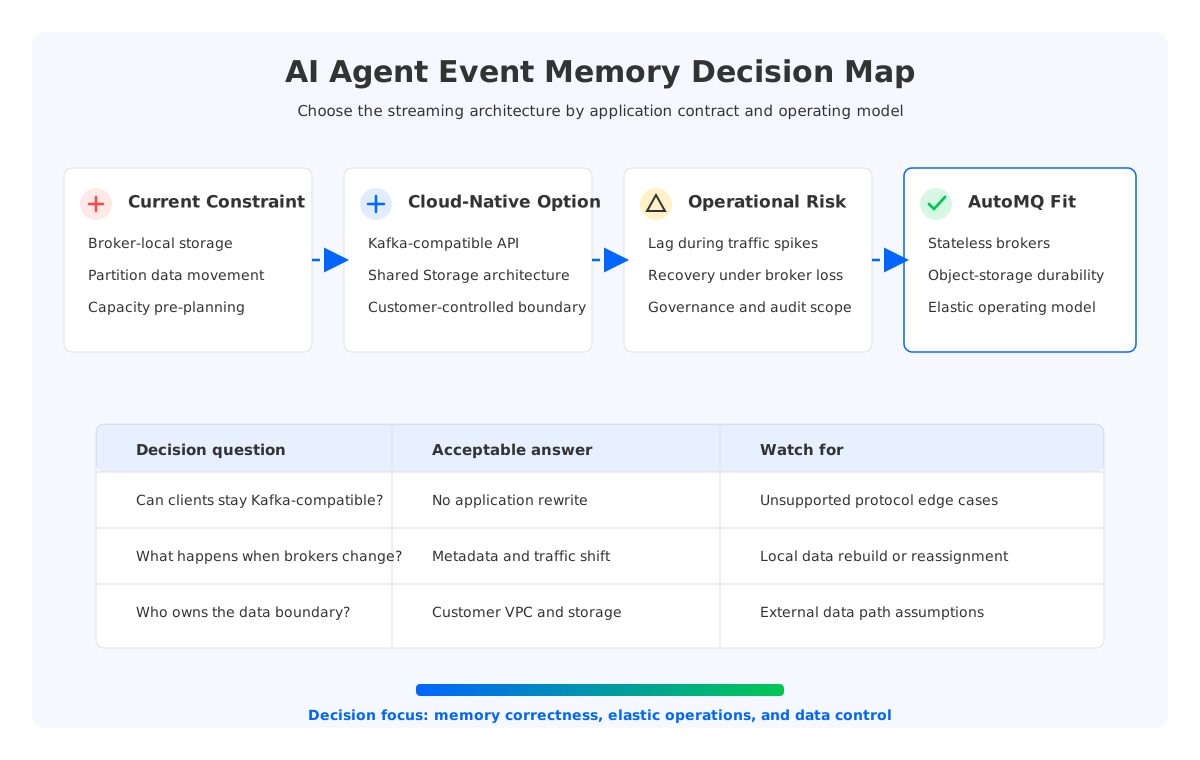
The architecture question is not whether Kafka can move events. It can. The real question is whether the Kafka operating model you choose can absorb AI workload volatility without turning memory into another fragile platform dependency. Agent traffic can spike when a workflow fans out across tools, when a batch of documents is reprocessed, or when a customer-facing assistant enters a high-volume support window. If the streaming layer needs careful broker sizing, partition movement, storage preallocation, and cross-zone traffic tuning every time the workload shape changes, event memory becomes expensive to trust.
1Why teams search for ai agent event memory kafka
Agent memory has a misleading name. It sounds like a model feature, but production teams quickly discover that it is a data infrastructure problem. Short-term context may live in the agent runtime. Semantic recall may live in a vector index. The durable trail of what happened belongs in an event system because multiple downstream consumers need different views of the same activity.
In a typical AI platform, one stream may feed a context builder, another may update a feature store, a third may write audit records, and a fourth may trigger human review. Kafka's consumer group model lets these consumers progress independently without forcing every application to share one database cursor. Offsets also matter: when a prompt template changes or an embedding job is fixed, teams can replay from a known point instead of inventing a custom backfill path.
The workload is more than high-throughput logging. It has sharp requirements that often conflict:
- Freshness: Context builders need recent events quickly enough to influence the next action, not only tomorrow's analytics table.
- Replayability: Platform teams need to rebuild state after schema changes, model upgrades, or data quality fixes.
- Governance: Security teams need a durable trail for prompts, tool calls, policy checks, and access decisions.
- Isolation: AI product teams need to experiment without disturbing operational consumers that depend on the same event stream.
- Elasticity: Traffic can jump when agents decompose one user request into many tool invocations.
These requirements explain the search query better than a generic "Kafka for AI" framing. The team is not asking for another pipeline diagram. It is asking whether Kafka can become the memory substrate for agent behavior while staying manageable for the people on call.
2The production constraint behind the problem
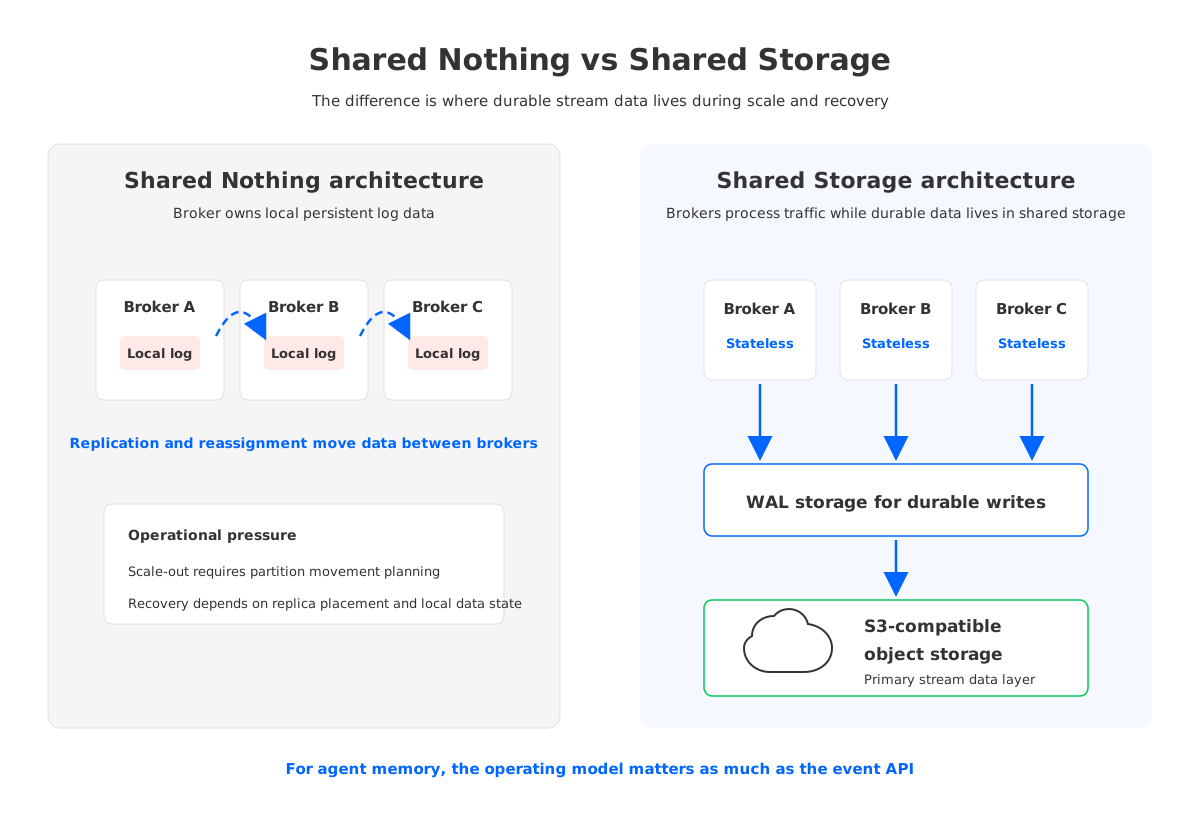
Traditional Kafka was designed as a Shared Nothing architecture. Each broker owns local storage, and durability is achieved by replicating partition data across brokers. That design is proven and widely deployed, but it couples three things AI platform teams would rather scale separately: compute, durable storage, and data movement.
The coupling shows up first in capacity planning. If an agent memory topic needs longer retention for audit or replay, local broker storage has to grow with it. If traffic spikes, teams add brokers, rebalance partitions, and move data until the cluster reaches a workable shape. If the cluster spans Availability Zones for resilience, replica traffic also becomes part of the operating model. None of this is unusual for Kafka operators, but AI workloads make the trade-off harder because the memory layer is both hot path and system of record.
Tiered Storage helps with one part of the pressure. Apache Kafka's Tiered Storage moves older log segments to remote storage while retaining recent data locally. That can reduce the local disk burden for long retention, and it is a useful option for teams that want to keep the traditional broker model. It does not make brokers stateless, though. Recent data, leader placement, local disks, replication, and recovery behavior still remain central to operations.
For agent memory, the distinction matters. A platform team can tolerate a slower offline analytics rebuild. It has less room for surprises in the stream that records tool decisions, user-visible actions, or policy outcomes. When broker storage and ownership are tightly linked, operational changes tend to carry data movement risk. When event memory becomes a shared dependency for many AI applications, that risk has a wider blast radius.
3Architecture options and trade-offs
The clean way to evaluate ai agent event memory kafka architecture is to separate the application contract from the infrastructure model. At the application layer, you usually want Kafka-compatible semantics: producers, consumers, topics, partitions, offsets, transactions where needed, Kafka Connect integration, and compatibility with existing observability and security practices. At the infrastructure layer, you need to decide how much broker-local state you are willing to operate.
Three options show up often in platform discussions:
| Option | Good fit | Main trade-off |
|---|---|---|
| Traditional Kafka on local or cloud block storage | Teams with mature Kafka operations and predictable capacity growth | Broker-local storage keeps scaling, reassignment, and recovery tied to data movement |
| Kafka with Tiered Storage | Long retention where older data can move to object storage | Hot data and broker ownership still require careful local storage operations |
| Kafka-compatible Shared Storage architecture | Cloud-native teams that want durable event logs with more elastic broker operations | Requires validating compatibility, latency profile, deployment boundary, and migration plan |
This table is not a ranking. Traditional Kafka remains a strong choice when the team already has deep operational muscle and the workload shape is stable. Tiered Storage is attractive when retention is the main pressure. Shared Storage becomes interesting when the operational problem is not only retention, but the repeated need to add, remove, replace, or rebalance brokers without treating data movement as the center of every change.
The evaluation should also include data governance. Agent memory can contain user context, derived model signals, tool outputs, and sensitive audit metadata. A managed service may reduce operations, but it may not fit data residency or network boundary requirements. A self-managed cluster gives control, but it also gives the team every upgrade, rebalance, and failure scenario. A customer-controlled deployment model can be the middle path if it preserves ownership of the data path while reducing the mechanics of operating the streaming layer.
4Evaluation checklist for platform teams
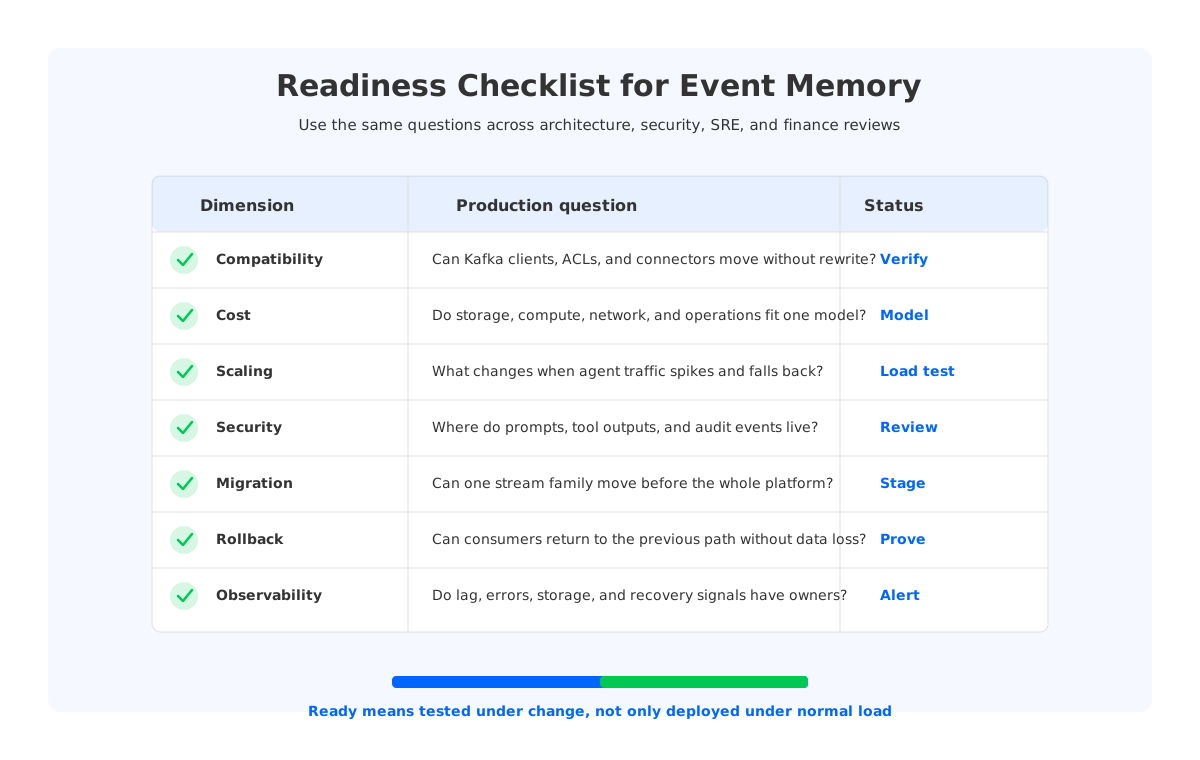
Before picking an event memory backbone, platform teams should turn the architecture debate into a checklist. The useful questions are concrete enough that engineering, security, finance, and SRE can all answer them without guessing what "production-ready" means.
Start with the application contract. Which producers write memory events? Which consumers build context, update vector indexes, trigger evaluations, and write audit trails? Which topics need compaction, long retention, or transaction boundaries? Kafka's model is powerful because it gives each consumer a replayable position, but that power only helps if topic design and schema ownership are explicit.
Then test the operating model against failure and change:
- Compatibility: Can existing Kafka clients, serializers, connectors, ACL patterns, and monitoring tools work with minimal change?
- Cost: Does the cost model include compute, storage, cross-zone traffic, object storage requests, observability, and operational time?
- Scaling: What happens when agent traffic doubles for a few hours and then falls back?
- Recovery: Can the team replace a broker, rebuild a consumer, or roll back a bad deployment without manual data surgery?
- Governance: Where does customer data live, who can access it, and how are audit events retained?
- Migration: Can producers and consumers move gradually, and is there a rollback path if the new cluster does not meet latency or compatibility expectations?
The most revealing question is often the simplest one: what work must happen when a broker disappears? If the answer is mostly leader election, metadata updates, cache warmup, and traffic redistribution, the platform has one kind of recovery profile. If the answer includes large local data reconstruction or partition movement, the platform has another. Both can be engineered, but they have different on-call costs.
5How AutoMQ changes the operating model
Once the evaluation framework is clear, AutoMQ enters as a Kafka-compatible streaming platform built around Shared Storage architecture. It keeps the Kafka protocol and ecosystem contract while changing the storage layer: durable data is stored in S3-compatible object storage through S3Stream, and AutoMQ Brokers are designed as stateless brokers rather than owners of broker-local persistent data.
That change is important for AI agent event memory because the hard part is not only ingesting events. The hard part is keeping the memory substrate elastic and recoverable as the number of agents, tools, tenants, and downstream consumers changes. In AutoMQ's model, brokers mainly handle Kafka protocol processing, partition leadership, caching, and scheduling. WAL (Write-Ahead Log) storage provides the durable write path, while S3 storage becomes the primary storage layer for stream data.
The result is a different operational shape. Scaling brokers does not have to mean moving large volumes of partition data between local disks. Replacing a broker does not require treating its local log as the source of truth. Long retention is aligned with object storage instead of broker disk sizing. Cross-zone architecture can also be designed around the fact that durable data is not bound to a local replica set in the same way as traditional Kafka.
This is not a reason to skip validation. AI platform teams should still test client behavior, produce latency, consumer lag, connector compatibility, schema evolution, authorization, observability, and rollback procedures under their own workload. The point is narrower and more useful: Shared Storage architecture changes what the team spends time operating. Instead of making broker-local data placement the recurring center of capacity and recovery work, the platform can focus on traffic, metadata, cache behavior, and application-level correctness.
AutoMQ BYOC is also relevant when data boundary control matters. In BYOC deployment, the control plane and data plane run in the customer's cloud account or VPC, and business data remains in customer-owned infrastructure. For agent memory, that boundary can be as important as throughput because the event log may contain sensitive user interactions, tool outputs, and policy decisions.
6A migration path that does not bet the platform
The safest migration plan for agent memory starts with one stream family, not the entire AI platform. Pick a topic group that is important enough to expose real constraints but contained enough to roll back. Good candidates include tool invocation logs, context update events, evaluation results, or retrieval feedback signals. Avoid starting with the most latency-sensitive user path unless the team already has a measured baseline and a rollback design.
A practical migration sequence looks like this:
- Mirror or dual-write a narrow event set while keeping the existing consumer path intact.
- Validate schema compatibility, ordering assumptions, authorization, and observability.
- Move one downstream consumer to the new cluster and compare lag, replay behavior, and failure handling.
- Expand to more consumers only after rollback, alerting, and operational runbooks are proven.
- Retire the old path after retention and audit requirements are satisfied.
This is also where teams should resist vanity benchmarks. A synthetic throughput number is useful only if it resembles the agent memory workload: event size distribution, partition key strategy, consumer fan-out, retention, replay rate, and failure mode. The goal is not to prove that one cluster can publish an impressive number. The goal is to prove that the memory layer behaves predictably when an AI application is noisy, stateful, and under active development.
If your AI platform is treating event memory as a side table, the next incident will probably prove that it is part of the control surface. Use the checklist above to evaluate your Kafka-compatible options, then test a contained workload with AutoMQ in your own environment.
7FAQ
7.1Is Kafka a good fit for AI agent event memory?
Kafka is a strong fit when agent memory needs durable ordering, replay, independent consumers, and integration with existing data systems. It is less useful if the requirement is short-lived prompt context inside one application process.
7.2Does agent memory replace a vector database?
No. The event log and the vector database solve different problems. Kafka records what happened and lets systems replay or subscribe to those events. A vector database supports semantic retrieval over selected representations derived from those events.
7.3Should every prompt and model response go into Kafka?
Not automatically. Teams should classify events by operational value, privacy risk, retention need, and replay usefulness. Some payloads should be redacted, tokenized, summarized, or excluded before they enter a durable stream.
7.4When should a team evaluate Shared Storage architecture?
Evaluate it when broker-local storage, partition reassignment, cross-zone replication traffic, or long-retention planning are becoming recurring operational concerns. The point is not novelty; it is whether the storage model reduces the work required to keep Kafka-compatible memory reliable.
7.5How should teams start with AutoMQ?
Start with a contained event memory workload, keep the existing path available during validation, and test compatibility, latency, consumer lag, recovery, observability, and rollback. For a customer-controlled deployment, review AutoMQ BYOC boundaries before production planning.
8References
- Apache Kafka documentation
- Apache Kafka Consumer Design
- Apache Kafka Transactions and Semantics
- Apache Kafka Connect
- Apache Kafka KRaft
- Apache Kafka Tiered Storage
- AutoMQ Kafka Compatibility
- AutoMQ Architecture Overview
- AutoMQ S3Stream Shared Streaming Storage
- AutoMQ Migration Overview
- AutoMQ zero cross-AZ traffic overview


