
Table of Contents
Table of Contents
Teams usually type ai data freshness budget kafka after a model has already made the wrong decision with stale context. A support agent missed the latest entitlement change. A recommendation service ranked an item that had already gone out of stock. A fraud workflow scored the transaction but ignored the device signal that arrived a few seconds later. The Kafka cluster may still show healthy broker latency, yet the AI system is already behind where the business decision happens.
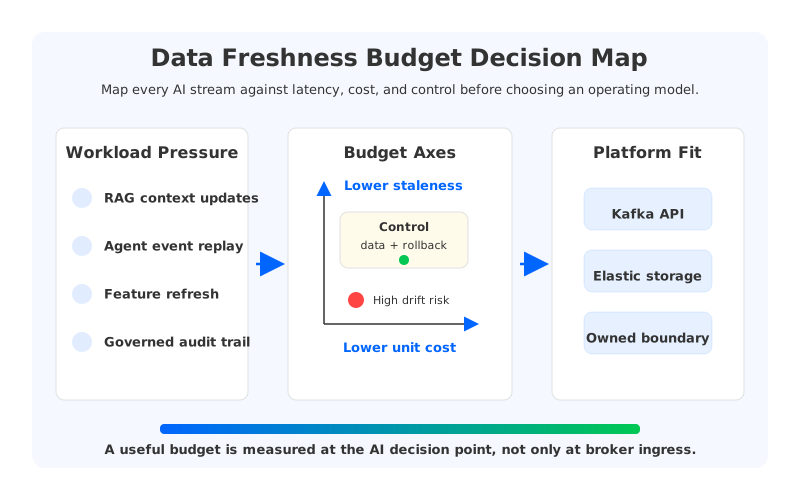
That gap is the reason a freshness budget is more useful than a generic "real-time" requirement. For AI workloads, the budget should measure the time from source event to usable context, not only the time from producer to broker. It includes capture, produce behavior, broker durability, stream processing, enrichment, embedding, index refresh, consumer progress, and any serving cache between the data platform and the model. A team that only monitors broker ingress can meet the wrong SLO perfectly.
The harder part is that freshness is not free. Lower staleness often increases network traffic, storage pressure, replay load, connector activity, and governance work. The platform decision is therefore not "Kafka or not Kafka." The better question is whether the Kafka-compatible infrastructure can keep the freshness budget under pressure without making cost and control unpredictable.
1Why AI Teams Need a Freshness Budget
AI applications turn data delay into product behavior. In analytics, a late event may change a dashboard after the fact. In an AI workflow, the same late event can shape a response, trigger an action, update a feature vector, or change the retrieval context for the next user interaction. The system needs a budget that reflects that action path.
A practical budget has three parts. The latency target defines how fresh the decision input must be. The replay target defines how quickly the platform can rebuild or reprocess context after a model, parser, schema, prompt, or feature transformation changes. The control target defines who can prove where the data moved, which policies applied, and how the team can roll back if the pipeline starts producing bad context.
These targets vary by workload:
- Interactive agent context usually cares about low end-to-end staleness and strong control over user, tenant, and authorization events. A technically fast pipeline is unsafe if it can serve context that violates access rules.
- RAG ingestion cares about freshness and rebuild speed. The team may need to re-embed a corpus or replay document changes when chunking logic changes, so retained event history and consumer catch-up behavior matter.
- Model feedback loops care about auditability and rollback. A poisoned signal can influence later behavior, so the platform must keep enough lineage to explain and reverse the path.
- Feature refresh pipelines care about sustained throughput and burst recovery. A sudden source backlog should not force the team to overprovision brokers for the next quarter.
Kafka is often a good foundation for these requirements because it provides a durable, replayable log with a mature client and connector ecosystem. Kafka consumer groups, offsets, transactions, and Kafka Connect are built around the idea that data movement and processing progress need explicit coordination. The challenge is not the API. The challenge is the operating model behind that API when AI workloads push retention, replay, and elasticity at the same time.
2Where Traditional Kafka Operating Models Get Tight
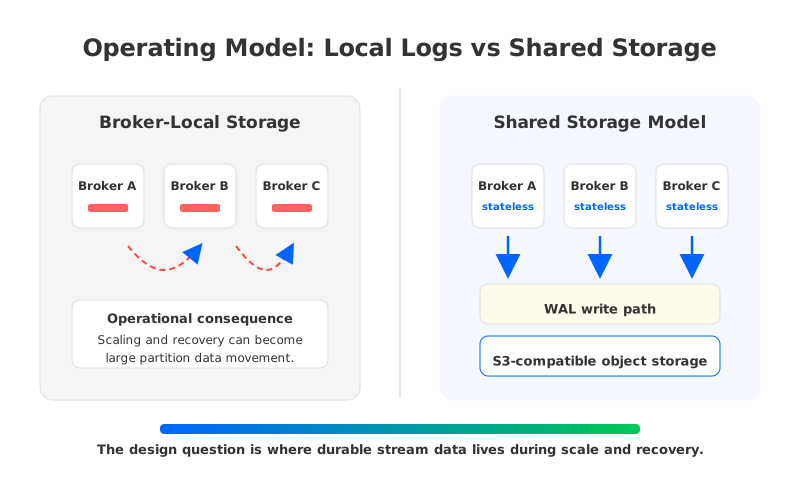
Traditional Kafka was designed around broker-local log storage. Each broker owns local partition data, replication protects durability, and partition leadership ties request handling to the brokers that carry the relevant log segments. This model is familiar, proven, and still appropriate for many workloads. It also means that capacity, recovery, and scaling decisions are often constrained by where the bytes currently live.
That constraint becomes visible in freshness budgets because AI workloads are rarely smooth. Rebuilds create read bursts. New agents or product launches create write bursts. Long retention keeps more history available for replay, but it also increases the storage footprint that operators must plan around. When durable data is tightly coupled to brokers, a scale-out or replacement event can involve partition reassignment, replica catch-up, local disk planning, and network movement before the platform reaches the new steady state.
The cost pressure is not only storage. Multi-AZ durability and client placement can make network paths part of the architecture review. Cloud providers document separate pricing models for network services and data transfer, which means platform teams need to understand where replication, consumer reads, private connectivity, and cross-zone traffic occur. A freshness target that ignores network topology can become expensive in a way the AI team did not anticipate.
Connectors add another layer. Kafka Connect helps move data between Kafka and external systems, but connector tasks also need capacity, offsets, retries, credentials, schema handling, and operational ownership. In AI pipelines, those connectors often sit beside vector databases, data lakes, object stores, transactional systems, and feature stores. A slow connector can consume the freshness budget even when the broker is healthy.
The most dangerous failure mode is organizational, not mechanical. The AI platform team owns model behavior, the data platform team owns streams, the security team owns policy, and the SRE team owns incident response. If the freshness budget is not explicit, each team can optimize its own dashboard while the application still serves stale or unauthorized context.
3Architecture Options for Durable, Replayable AI Context
Before choosing a platform, separate the workload requirements from the implementation preference. Kafka-compatible streaming can be delivered through several operating models, and each model changes the trade-off between latency, cost, and control.
| Architecture option | What it optimizes | Where to test carefully |
|---|---|---|
| Self-managed Kafka with local disks | Full operational control and familiar Kafka behavior | Reassignment time, disk growth, recovery drills, and cross-AZ traffic |
| Managed Kafka service | Reduced broker operations and provider integration | Service limits, networking model, migration path, and cost visibility |
| Kafka with tiered storage | Longer retention with remote storage for older segments | Hot-path broker state, replay behavior, and operational complexity |
| Kafka-compatible shared storage | Separation of broker compute from durable stream storage | Compatibility, write path, object storage behavior, and governance boundary |
Tiered storage deserves special attention because it is often confused with a fully shared-storage architecture. Kafka tiered storage moves older log segments to remote storage, which can reduce pressure from long retention. It does not make brokers stateless for the hot path, and it does not remove the need to reason about broker-local state, leadership, and recovery. It can be valuable, but it should be evaluated for what it changes and what it leaves in place.
For AI data freshness, the strongest architecture review starts with tests rather than labels. Pick one stream that represents a real decision path. Measure source-to-context freshness under normal load, then under replay, connector retry, broker maintenance, consumer group rebalance, and downstream index rebuild. The platform that looks elegant on a diagram may still fail the budget if it cannot recover from the maintenance and rebuild paths that production will actually run.
4A Neutral Evaluation Checklist
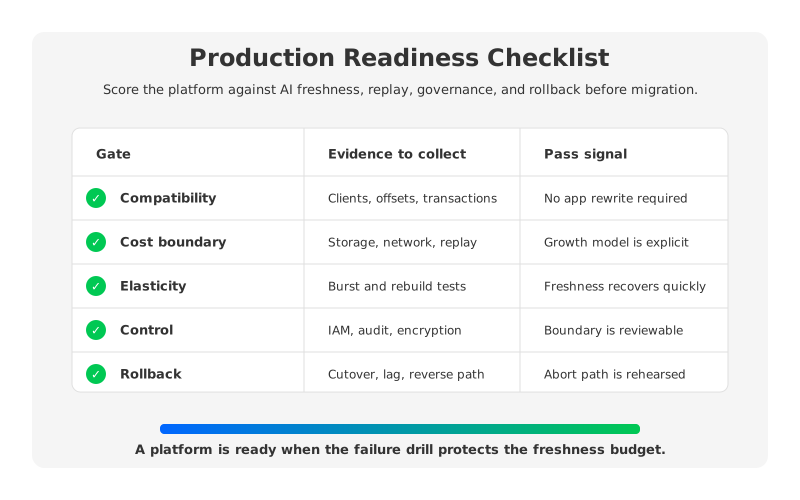
A good AI data freshness budget is a contract between application behavior and infrastructure reality. It should be specific enough for SREs to test, for architects to compare, and for governance teams to review. The following checklist keeps the conversation grounded.
Compatibility. Validate producer and consumer clients, protocol behavior, offset management, transactions if used, authentication, authorization, schema workflows, stream processors, and operational tools. Kafka compatibility should be tested with the versions and libraries the organization actually runs, not assumed from a compatibility statement.
Freshness path. Measure event time to model-usable context. Include broker write, consumer lag, processing time, connector time, embedding or enrichment time, index update, and serving cache refresh. A budget that stops at Kafka append latency will miss the delays that users experience.
Replay and rebuild. Test how quickly the platform can replay retained history into a new processor, index, feature store, or lakehouse table while live traffic continues. AI teams change prompts, parsers, feature logic, and embedding models; the platform should treat rebuilds as normal operations.
Cost boundary. Map storage growth, compute growth, inter-zone traffic, private connectivity, connector capacity, and replay bursts. Avoid precise savings claims until the team has its own workload model, but do require every major cost path to be visible before production.
Governance and control. Confirm where data is stored, which account or project owns the data plane, how encryption and identity are managed, how audit logs are collected, and how tenant boundaries are enforced. AI context often includes sensitive source data and derived signals; derived data still needs policy.
Failure recovery. Run drills for broker loss, connector failure, consumer group lag, downstream index failure, bad transformation rollout, and rollback. A platform is not ready because the happy path is fast. It is ready when the failure drill protects the freshness budget.
5How AutoMQ Changes the Operating Model
The checklist often turns a vague freshness complaint into a storage ownership question. If the Kafka API is still the right application contract but broker-local durable data is what slows rebuilds, recovery, or scale-out, the next architecture to examine is a shared-storage Kafka-compatible model. AutoMQ fits that category as a Kafka-compatible cloud-native streaming platform built around Shared Storage architecture.
AutoMQ keeps the Kafka protocol and ecosystem model while changing the storage layer underneath. Brokers handle Kafka-facing compute, partition leadership, request processing, caching, and scheduling. Durable data is stored through S3Stream, with a WAL write path and S3-compatible object storage behind it. The practical effect is that scaling and recovery can be evaluated less as "move broker-local data to the right machines" and more as "add or replace compute around shared durable storage."
For AI freshness budgets, that distinction matters in three ways. First, compute and storage can be reasoned about more independently, which helps when a workload has bursty processing or replay pressure but long-lived retained history. Second, object-storage-backed durability aligns the log history with cloud storage controls that many governance teams already understand. Third, deployment models such as AutoMQ BYOC and AutoMQ Software can keep the data plane within customer-controlled boundaries, which is often important for AI context, regulated data, and private network design.
This does not remove the need for testing. A platform team should still validate Kafka client behavior, topic configuration, consumer groups, transactions if used, connector paths, authentication, IAM, object storage behavior, WAL choice, observability, and migration mechanics. AutoMQ is most relevant when the evaluation shows that broker-local storage is the limiting factor for elasticity, recovery, retention, cross-AZ traffic, or governance boundary control.
AutoMQ also has adjacent capabilities that can matter after the core architecture decision is made. Kafka Linking can be relevant when migration risk sits in message synchronization and consumption progress. Self-Balancing can reduce day-two placement work. Zero cross-AZ traffic is relevant when cloud network topology is part of the cost model. Table Topic can matter when streaming data needs to land directly into Apache Iceberg tables for lakehouse consumption. These are not substitutes for the freshness budget; they are mechanisms to test against it.
6Migration and Rollback Planning
The migration plan should be written from the AI decision backward. Start with the topics and consumer groups that feed one production context path. Identify which producers can be paused, which consumers must keep offsets, which downstream stores can be rebuilt, and which serving layer can tolerate dual reads during validation. The safest migration is usually not the one with the fewest moving parts; it is the one where every moving part has a measured rollback path.
For Kafka-compatible migrations, the rehearsal should include source and target topic configuration, partition counts, ACLs, client authentication, schema registry behavior, connector configuration, consumer offsets, lag alarms, and replay speed. If the AI workload includes vector indexes or feature stores, include them in the rehearsal. A stream cutover that preserves offsets but leaves the index stale has not preserved the user-facing freshness budget.
The rollback plan deserves the same specificity. Define what condition triggers rollback, how producers are redirected, how consumer progress is reconciled, how downstream writes are paused or reverted, and how the team proves that the source of truth remains valid. This is where freshness and control meet: a fast platform that cannot support a clean abort path is not ready for critical AI context.
If your team is evaluating Kafka-compatible infrastructure for AI freshness, use one real workload as the test case. Define the freshness budget, replay target, governance boundary, and rollback drill before comparing products. When broker-local storage is the constraint you need to remove, you can start a focused evaluation through AutoMQ Cloud and test the shared-storage model against that workload.
7References
- Apache Kafka documentation
- Apache Kafka documentation: Kafka Connect
- Apache Kafka KIP-405: Kafka Tiered Storage
- AutoMQ architecture overview
- AutoMQ compatibility with Apache Kafka
- AutoMQ S3Stream shared streaming storage overview
- AutoMQ WAL storage
- AutoMQ zero cross-AZ traffic overview
- Amazon S3 User Guide
- AWS VPC pricing
- Google Cloud Storage documentation
8FAQ
8.1What is an AI data freshness budget?
An AI data freshness budget is the maximum allowed delay between a source event and the point where that event becomes usable by an AI decision path. It should include the full pipeline: capture, Kafka produce and consume behavior, processing, enrichment, embedding, index updates, serving caches, and rollback needs.
8.2Is Kafka enough for AI data freshness?
Kafka provides a strong durable log and replay model, but the full freshness budget depends on the operating model around Kafka. Teams should test broker recovery, consumer lag, connector behavior, replay speed, storage growth, and downstream index refresh rather than judging freshness from broker latency alone.
8.3How is tiered storage different from shared storage?
Tiered storage moves older log segments to remote storage, usually to reduce local disk pressure from long retention. A shared-storage architecture changes the ownership model more deeply by reducing the broker's role as the long-term home of durable stream data. The operational difference shows up during scaling, recovery, and replay tests.
8.4When should AutoMQ be evaluated?
Evaluate AutoMQ when the team wants Kafka compatibility but broker-local storage is making elasticity, long retention, recovery, cross-AZ traffic, or governance boundaries hard to manage. It should be tested with real clients, consumer groups, connectors, security settings, migration paths, and AI freshness drills.
8.5What should be measured before migration?
Measure event-to-context freshness, consumer lag under replay, connector retry behavior, downstream rebuild time, storage growth, network paths, compatibility gaps, observability coverage, and rollback timing. A migration is ready when the team can prove both the cutover path and the abort path.


