
Table of Contents
Table of Contents
An AI data freshness SLA starts to matter when stale context becomes a production incident, not a dashboard inconvenience. A fraud model that sees account activity 20 minutes late, a support agent that answers from yesterday's entitlement state, or a forecast that misses inventory may look healthy from the model-server view. The serving tier is up, but the streaming backbone did not deliver data within the freshness envelope the business assumed.
That is why teams searching for ai data freshness sla are usually not asking for a prettier metric name. They are trying to convert a vague promise such as "real time" into an architecture that can survive bursty writes, long replays, consumer lag, cloud network placement, retention growth, and governance reviews. Freshness is an end-to-end property: producer acknowledgments, consumer offsets, stream processor checkpoints, vector index updates, and application reads all contribute to the same user-visible outcome.
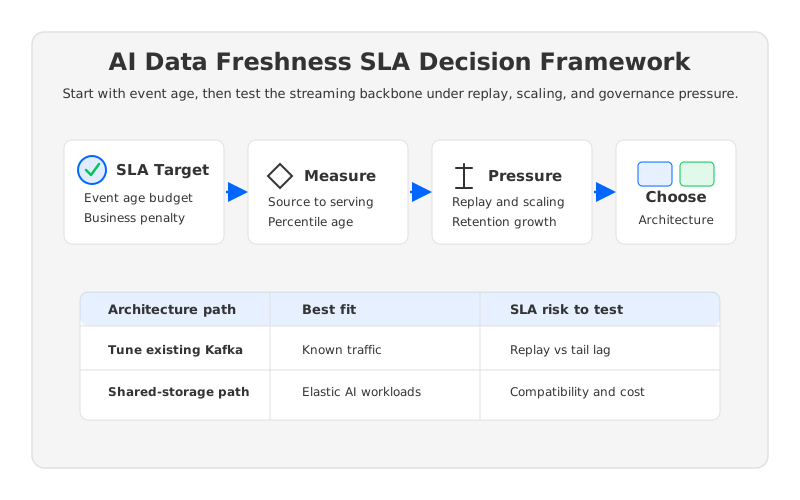
The useful question is not whether Kafka can move records fast. Apache Kafka is already the default event log for many low-latency pipelines, with mature primitives around producers, consumers, consumer groups, offsets, transactions, and broker configuration. The sharper question is whether the backbone can keep freshness predictable while the AI workload stops behaving like a neat ingestion benchmark. Production AI systems replay history, fan out events, rebuild features, and absorb sudden demand when an agent workflow becomes popular.
1What an AI Data Freshness SLA Actually Measures
A freshness SLA should describe the maximum acceptable age of the data used by an AI decision. For transaction risk, the clock may start when the business event is committed and stop when the feature is queryable. For retrieval, it may start when a document changes and stop when the embedding, metadata filter, and search index reflect that change. For an operations copilot, it may start when a metric or log event is emitted and stop when the agent can reason over it.
Those paths have different mechanics, but the SLA usually decomposes into five budgets:
- Capture latency: time from source commit to event publication. This includes CDC connector behavior, source throttling, batching, and retry policy.
- Stream durability latency: time for the streaming platform to acknowledge and make the event durable under the configured semantics.
- Processing latency: time spent in stream processors, enrichment jobs, joins, feature computation, or embedding generation.
- Serving freshness latency: time until the destination feature store, index, cache, warehouse table, or operational API exposes the update.
- Recovery latency: time required to catch up after a consumer outage, broker incident, schema rollback, or replay.
The last budget is the one many teams omit. A pipeline can meet a 30-second freshness target on a quiet day and still fail during recovery because replay competes with tail traffic. AI systems make that omission expensive: they need the latest events and repeated historical reads for new features, offline evaluation, incident reconstruction, and governance evidence. Freshness is a promise about how the platform behaves when normal and corrective work happen at the same time.
2Why Traditional Kafka Operations Can Amplify Freshness Risk
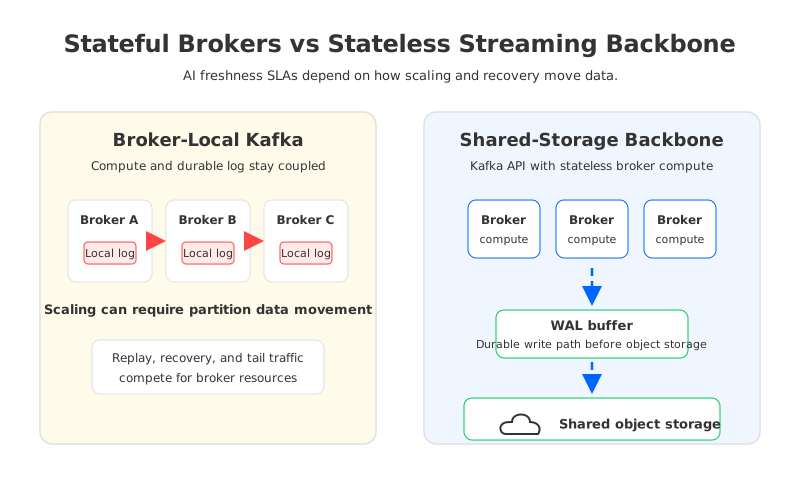
Traditional Kafka is a shared-nothing system: brokers own local partitions, store logs on attached disks, replicate data across brokers, and serve reads from the broker layer. That design is tested. It also means several operational actions move or re-read large amounts of data through the same broker resources that must protect tail latency.
When a platform team expands a cluster, reassigns partitions, replaces disks, changes retention, or recovers a failed broker, data locality becomes a practical constraint. Replicas must catch up, consumers may shift, and storage hot spots can last longer than the application team expects. The event log is still correct, but the freshness SLA feels fragile because the operating model is tied to broker-local state.
That tension shows up in four places:
| Pressure point | Why it matters for AI freshness | What to inspect |
|---|---|---|
| Replay and backfill | Feature changes may reread large history windows. | Whether replay steals disk, network, or broker CPU from tail traffic. |
| Elasticity | AI traffic can be bursty across ingestion, embedding, and serving. | Whether scaling requires moving large partition data sets. |
| Retention | AI teams keep history for audit and recomputation. | Whether retention growth forces local disk expansion. |
| Multi-AZ design | Freshness SLAs usually imply high availability, not single-zone optimism. | Whether replication and client placement create avoidable cross-AZ data movement. |
Many teams can meet freshness targets by tuning producers, consumers, partitioning, quotas, and processing jobs. But if the SLA depends on fast recovery, elastic capacity, long retention, and high replay throughput at the same time, storage architecture becomes part of the freshness design.
3Design Patterns Teams Usually Compare
The first architecture option is to optimize the current Kafka estate. This can be right when workload shape is known, the platform team has strong operating discipline, and the freshness target is moderate. Improvements often include better partition keys, producer batching rules, consumer parallelism, autoscaling based on lag and throughput, stricter quotas, and better observability around event age. This path preserves known semantics and avoids migration risk, but it may leave the team managing local-disk capacity under peak stress.
The second option is managed Kafka. A managed service can reduce broker lifecycle work, which matters when the team is small or the business wants less infrastructure ownership. The evaluation should still go beyond the service label. Teams need to model storage, networking, retention, private connectivity, observability export, migration mechanics, and high-volume replay behavior.
The third option is a cloud-native Kafka-compatible architecture that separates compute from durable stream storage. In this model, the API and ecosystem compatibility remain Kafka-oriented, while broker compute becomes less tied to local persistent data. Durable bytes live in shared object storage or cloud storage, and brokers focus more on serving protocol, coordination, caching, and traffic. This changes the elasticity and recovery discussion because capacity can be adjusted with less partition data movement.
That is the natural point to evaluate AutoMQ. AutoMQ is a Kafka-compatible streaming platform that redesigns Kafka storage around shared object storage and stateless brokers while preserving Kafka protocol and ecosystem expectations. In BYOC-style deployment boundaries, infrastructure resources and data-plane placement can remain under the customer's cloud account or private network assumptions. For an AI freshness SLA, the important part is the operating model: fewer durable bytes pinned to broker-local disks, faster capacity changes, and clearer separation between compute scaling and retention growth.
4A Practical Evaluation Checklist
The architecture decision should start from the SLA, not from a vendor feature table. Define the freshness target by workload class first: seconds for operational decisions, minutes for analytical enrichment, or longer windows for offline evaluation. Then describe the penalty of missing the target. A stale recommendation and a stale payment-risk signal do not deserve the same platform budget.
Once the business envelope is clear, evaluate the streaming backbone against six checks:
- End-to-end age metric: Can the team measure event age from source commit to AI consumption, not only broker lag?
- Replay isolation: Can backfills, feature rebuilds, and incident reprocessing run without breaking tail freshness?
- Elastic scaling path: Can capacity change quickly without large partition data movement or long rebalance windows?
- Retention economics: Can the platform keep enough history for AI governance and recomputation without over-provisioning hot broker disks?
- Compatibility surface: Do existing clients, connectors, stream processors, security policies, and transaction assumptions continue to work?
- Rollback path: Can the team pause, mirror, compare, and roll back during migration without losing offset visibility?
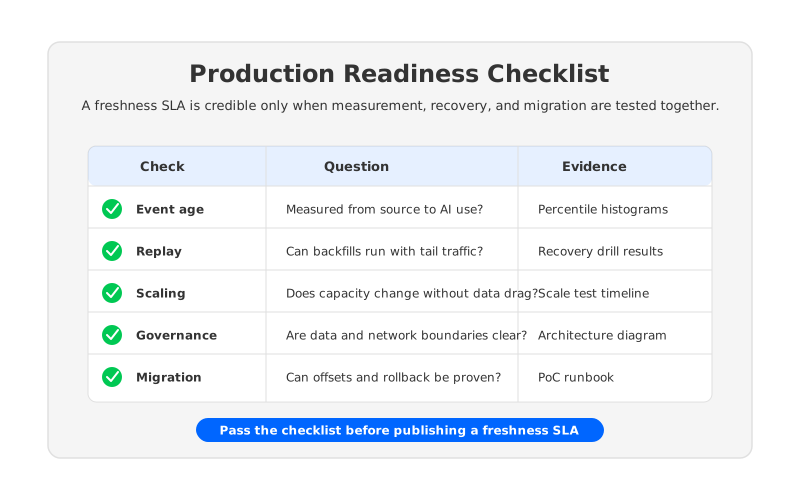
This checklist is deliberately uncomfortable. It forces teams to test the boring parts that keep production systems alive: catch-up reads, data age under failure, cross-zone paths, object storage requests, and the labor required to explain the bill.
5Measurement: The SLA Needs Its Own Control Loop
Freshness cannot be governed from a single Kafka metric. Consumer lag is useful, but it measures distance from the log head, not necessarily business event age. A slow source connector can publish old events with low Kafka lag. A downstream feature job can keep up with Kafka and still leave the model serving stale data because the feature store write path is throttled. A vector index can accept updates and still expose older embeddings until compaction or refresh completes.
Platform teams should build a freshness control loop:
- Add event-time and source-commit timestamps where the source system can provide them reliably.
- Track broker append time separately so late-arriving data is visible.
- Export per-stage age histograms for connectors, Kafka topics, processors, feature stores, indexes, and AI-serving APIs.
- Alert on percentile age for business-critical paths, not only average lag.
- Run replay drills that measure catch-up time while normal tail traffic continues.
This is where Kafka-compatible semantics matter. Consumer groups, offsets, idempotent writes, transactions where used, and stream processor checkpoints all become part of the evidence chain. If a platform replacement claims compatibility, turn that claim into tests: client versions, offset continuity, transactional behavior, ACLs, connector behavior, observability naming, and failure recovery. The SLA is only credible when the migration test proves that the measurement model still works.
6Cost and Governance Are Part of Freshness
Freshness targets tend to become expensive in quiet ways. Shorter freshness windows increase pressure on always-on capacity. Longer retention increases storage footprint. Multi-AZ availability introduces network placement decisions. More consumers increase fan-out. More AI use cases increase replay and recomputation. None of those pressures is surprising by itself; the surprise comes when the architecture couples them together.
In a broker-local storage model, keeping more history often means planning more broker disk, more replication traffic, or more careful partition placement. In a shared-storage model, retention can shift toward object storage economics, but the design still has costs: object storage capacity, requests, cache behavior, compute, observability, and network paths. AWS S3 pricing, for example, separates storage, requests, retrieval, transfer acceleration, and data transfer dimensions; other clouds expose similar categories. A serious freshness SLA budget needs a workload model, not a single unit price.
Governance adds another reason to prefer explicit architecture over vague "real time" claims. AI teams need to answer where data lives, who can read it, how replay is audited, and whether private connectivity or customer-cloud ownership is required. AutoMQ's BYOC-oriented options are relevant when the data-plane boundary matters as much as the streaming API. The same logic applies to any candidate: place the data, control plane, encryption boundary, network path, and observability exports on the diagram before making the platform decision.
7Decision Table: Optimize, Manage, or Redesign
No single architecture wins every AI data freshness SLA. Stable pipelines may be better served by tuning existing Kafka clusters. Teams expecting workload growth, long retention, high replay volume, and strict data-control boundaries should test a cloud-native Kafka-compatible architecture such as AutoMQ beside the current baseline.
| If this is true | Likely first move | Why |
|---|---|---|
| Freshness misses come from consumer code, partition keys, or slow sinks. | Optimize the existing pipeline. | Changing the broker architecture will not fix bad downstream parallelism. |
| Broker operations consume the team, but workload shape is moderate. | Evaluate managed Kafka. | Operational delegation may matter more than storage redesign. |
| Scaling and recovery require heavy partition data movement. | Test shared-storage Kafka-compatible designs. | Stateless brokers can reduce the operational coupling between compute and durable data. |
| Retention and replay are growing because AI teams need recomputation. | Model object-storage-backed architectures. | Durable history and hot broker capacity should not always scale together. |
| Data residency, VPC placement, or cloud-account ownership is mandatory. | Include BYOC-style candidates. | Governance requirements can eliminate otherwise attractive SaaS options. |
The most useful proof of concept is small but adversarial. Mirror a representative topic, run the same producers and consumers, trigger a backfill, simulate a broker or node failure, scale capacity, and measure end-to-end event age throughout the test. Then compare cost using the same workload: write rate, read fan-out, retention, replay volume, availability-zone placement, object storage assumptions, and operations overhead. The winner is the architecture whose freshness behavior remains explainable when the system is under correction, not only when it is under load.
If your AI platform is moving from "real-time pipeline" language to explicit freshness SLAs, the next step is to make the SLA testable. Start with the event-age budget, add recovery drills, and evaluate whether your current Kafka backbone can keep the promise without over-provisioning. When the bottleneck is the coupling of broker compute and durable storage, AutoMQ is worth including in the same PoC as a Kafka-compatible, shared-storage option rather than treating it as a separate migration category.
8References
- Apache Kafka Documentation
- Apache Kafka Documentation: Message Delivery Semantics
- Apache Kafka Documentation: Tiered Storage
- AutoMQ Documentation: Compatibility with Apache Kafka
- AutoMQ Documentation: Architecture Overview
- AutoMQ Documentation: Stateless Broker
- AutoMQ Documentation: Eliminate Inter-Zone Traffic
- AWS S3 Pricing
9FAQ
9.1What is an AI data freshness SLA?
An AI data freshness SLA defines the maximum acceptable age of data used by an AI system at decision time. It should cover the full path from source commit through streaming, processing, serving, and recovery, not only Kafka consumer lag.
9.2Is Kafka enough for real-time AI data pipelines?
Kafka is often a strong foundation for real-time AI data pipelines because it provides durable logs, consumer groups, offsets, and mature ecosystem support. The architecture still needs testing under replay, retention growth, scaling, and failure recovery to prove a specific freshness SLA.
9.3How should teams measure freshness?
Measure event age at every stage: source event time, broker append time, processor output time, feature or index update time, and model consumption time. Alert on percentile age for important business paths, and run replay drills while normal traffic continues.
9.4When should a team consider a shared-storage Kafka-compatible architecture?
Consider shared-storage Kafka-compatible designs when freshness risk is driven by broker-local data movement, long retention, high replay volume, slow scaling, or costly multi-AZ replication patterns. The decision should be made through a PoC using the same clients, topics, workloads, and failure drills as the current platform.
9.5Where does AutoMQ fit in an AI data freshness SLA architecture?
AutoMQ fits when the team wants Kafka compatibility but needs a cloud-native operating model with shared object storage, stateless brokers, and deployment boundaries that can align with customer-cloud or private-network requirements. It should be evaluated after the SLA, measurement plan, cost model, and migration tests are defined.


