
Table of Contents
Table of Contents
Teams usually search for ai governance logs kafka after the first uncomfortable production question lands. A model made a decision, an agent called a tool, a retrieval step pulled the wrong context, or a human approved an action that now needs reconstruction. The question is no longer whether the AI application emitted logs. The question is whether those logs can be replayed, joined, governed, retained, and trusted as part of the platform.
That is a different problem from application observability. A dashboard can tell an SRE that latency changed. A governance log stream has to tell a reviewer why an AI workflow behaved the way it did, which inputs were visible, which policies were active, which tool calls were attempted, and which downstream systems accepted the result. The data is operational, evidentiary, and product-facing at the same time.
Kafka is a natural fit because AI governance events need ordering, replay, consumer groups, durable offsets, and a connector ecosystem. But the word "Kafka" does not settle the architecture. A platform team still has to decide whether the stream is a side channel attached to the AI app, an audit database populated after the fact, or a first-class streaming data product with its own SLOs and ownership boundaries.
1Why Teams Search For ai governance logs kafka
The search phrase is awkward, but the intent is precise. Buyers are trying to connect AI governance requirements with infrastructure that already works for high-volume event streams. They want Kafka-compatible clients and tooling because the surrounding stack already speaks Kafka: producers, consumers, Kafka Connect, stream processors, schema tooling, monitoring systems, and platform runbooks.
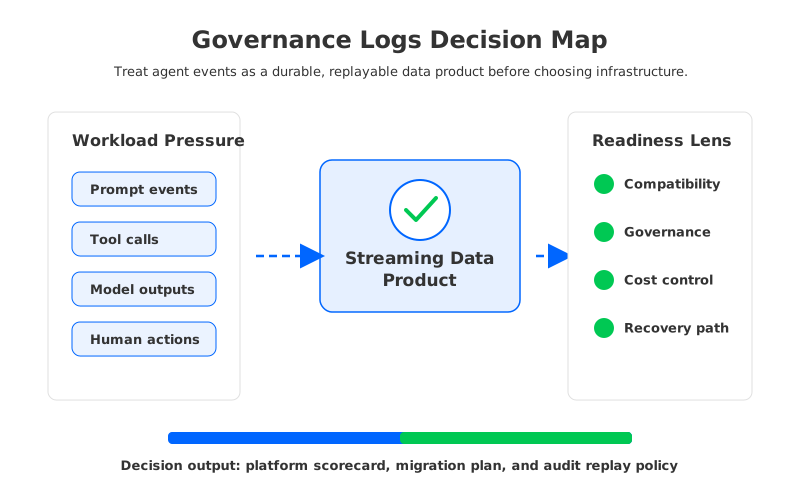
The pressure comes from event categories that do not fit cleanly into ordinary logs. Prompt and response events describe what the model saw and returned. Retrieval events describe which documents or profile records influenced the output. Tool-call events describe what the agent attempted outside the model. Policy and human-action events close the loop when a reviewer, operator, or support agent accepts or changes the outcome.
Those categories create a data product because different consumers need different slices of the same stream. Security teams need suspicious tool-call patterns. Compliance teams need evidence chains. AI platform teams need model behavior over time. Data engineering teams need governed lakehouse ingestion. If each group builds its own logging path, the organization gets duplicated pipelines and inconsistent evidence.
Kafka's mechanics help because a governance event stream can be consumed independently by multiple teams without forcing every consumer into the writer's release cycle. Consumer groups and offsets allow processors to track their own progress. Transactions and idempotent producer patterns can help with stronger write guarantees where workflows need them. Kafka Connect can move records into downstream stores, although connector operations become part of the production system rather than an afterthought.
2The Freshness And Governance Problem Behind AI Event Streams
AI governance logs are not valuable only at audit time. They are useful while the system is still acting. A fraud agent may need fresh policy-denial events to avoid repeating a blocked path. A customer support assistant may need the latest human correction before generating the next answer. A platform risk model may need near-real-time tool-call anomalies instead of a batch summary that arrives after the incident window has closed.
Freshness changes the storage question. A slow archive can preserve evidence, but it cannot feed live guardrails. A fast in-memory buffer can feed guardrails, but it cannot preserve evidence. The platform needs a stream that can serve both hot consumers and later replay, while keeping enough metadata to answer who produced the event, which tenant or workload it belongs to, which policy version applied, and whether the record is still within its retention window.
The governance side is equally demanding. An AI event can contain personal data, confidential prompts, tool arguments, model outputs, and system policy decisions in one envelope. That means retention, encryption, access control, masking, deletion workflows, and schema evolution all have to be designed before the first production incident. A stream that begins as "debug logs for agents" can become a liability if it lacks ownership and retention boundaries.
A useful event contract normally includes these fields:
- Identity context: tenant, application, workflow, agent, model, user, and service account identifiers.
- Decision context: prompt reference, retrieval references, policy version, tool name, approval state, and output classification.
- Operational context: event time, trace identifier, offset position, producer version, schema version, and sensitivity tags.
- Lifecycle context: retention class, deletion eligibility, legal hold state, replay permission, and downstream sink status.
The contract matters because infrastructure cannot rescue an incoherent event model. Kafka can carry the records, but it cannot decide which fields are safe to expose to an analyst or how long tool arguments should remain searchable. Governance starts with the data product definition, then infrastructure enforces the parts that are enforceable.
3Architecture Options For Durable, Replayable AI Context
The simplest architecture is to write governance events into the same application log pipeline used by the rest of the service. That is tempting because the pipeline already exists. It breaks down quickly because observability logs are usually optimized for search, sampling, and incident triage, while governance streams need ordered replay, consumer isolation, and lifecycle control. Sampling a model-decision event may be acceptable for latency debugging, but it is hard to defend during an audit.
The next option is a dedicated Kafka or Kafka-compatible cluster. This gives the platform a familiar data plane for event production and consumption. It also exposes the classic Kafka operating model: brokers own local log storage, scaling is tied to partition and replica movement, retention increases broker storage pressure, and multi-AZ replication can turn governance traffic into a network and capacity planning problem. For AI platforms with high fan-out, long retention, and bursty agent behavior, the coupling becomes visible.
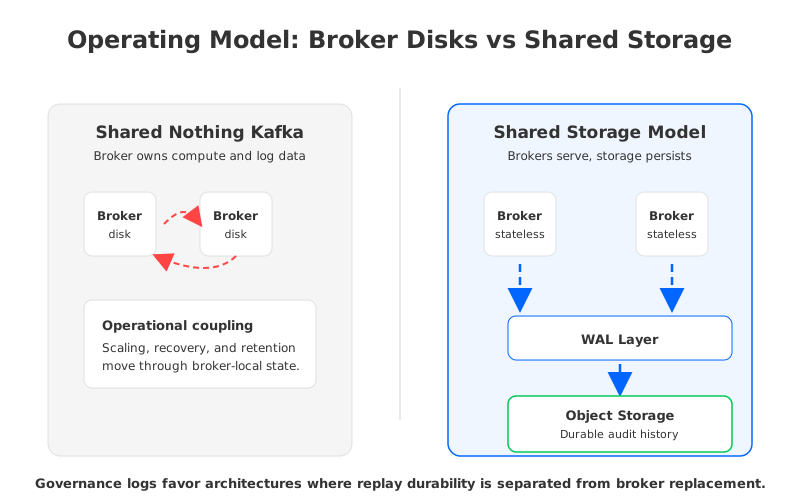
Tiered storage helps by moving older log segments to remote storage. It can reduce pressure from long retention, but it does not fully remove the broker's role as the owner of active log data. The hot path still has local or attached storage assumptions, and operational work still centers on protecting, replacing, and rebalancing stateful brokers.
Shared storage changes the boundary. Durable log data is placed on object storage or another shared durable layer, while brokers become closer to serving nodes. That distinction matters because the hardest requirement is often not peak ingest alone. It is the combination of long retention, replay, read fan-out, security review, and the ability to replace compute without turning every broker event into a data movement project.
4Evaluation Checklist For Platform Teams
The right platform decision should start with a neutral checklist, not a vendor name. AI governance logs sit between application teams, AI platform teams, SRE, security, legal, and data engineering. Each group will judge the same stream by a different failure mode. A system that is strong on retention but weak on deletion workflow may fail security review. A system that is easy to launch but expensive to scale may fail FinOps review.
| Evaluation area | What to test | Why it matters |
|---|---|---|
| Kafka compatibility | Producers, consumers, Admin APIs, offsets, transactions, client libraries, and connector behavior | Migration risk hides in client semantics, not only in the protocol label |
| Cost model | Broker compute, storage, replication traffic, cross-zone traffic, connector runtime, private networking, and object-store requests | Governance data grows quietly because retention and replay are product requirements |
| Elasticity | Burst ingest, read fan-out, partition growth, broker replacement, and recovery time | AI agents can create uneven traffic when workflows fan out through tools |
| Governance | Identity, encryption, retention, masking, schema evolution, deletion, and replay authorization | Audit evidence must remain useful without overexposing sensitive context |
| Operations | Observability, lag control, connector health, rollback, disaster recovery, and on-call runbooks | A governance stream becomes a control plane dependency once AI workflows rely on it |
These tests should be run with representative events, not synthetic strings. A ten-line JSON record does not expose the same problems as a real tool-call event with nested arguments, sensitivity tags, schema evolution, and multiple downstream consumers. The same applies to retention. Testing seven days of data does not prove the cost or replay behavior for a year-long audit horizon.
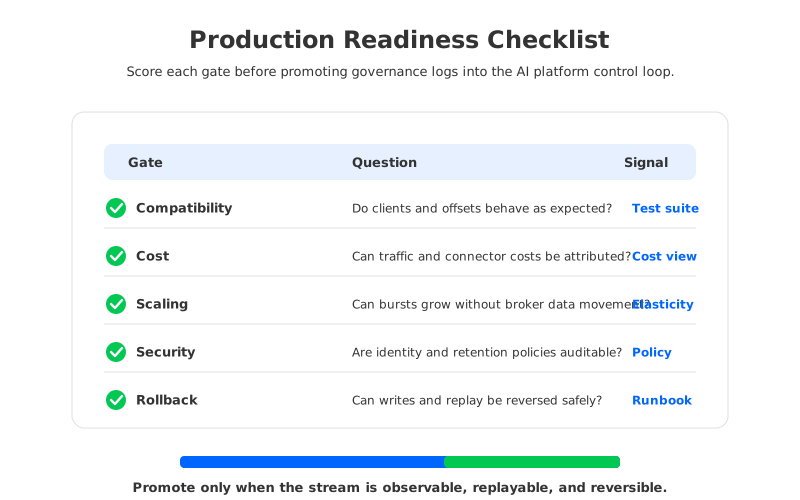
The migration path deserves its own gate. If the team already has AI logs in a database, object store, warehouse, or observability platform, the target stream has to coexist before it replaces anything. Producers need a dual-write or forwarding strategy. Consumers need a cutover plan. Security teams need proof that the stream does not widen access to sensitive prompts. SREs need rollback criteria that are more specific than "turn it off."
5How AutoMQ Changes The Operating Model
Once the checklist points toward Kafka-compatible streaming plus lower stateful-broker burden, AutoMQ becomes relevant as an architecture option rather than a slogan. AutoMQ is a Kafka-compatible, cloud-native streaming system that redesigns the storage layer around shared storage and stateless brokers. The value for AI governance logs is that the operating model matches the shape of the workload.
In traditional Kafka, the broker is both the serving process and the owner of local durable log segments. That design has served the industry well, but it means scaling and recovery often involve state movement. For governance logs, state movement is exactly where pressure accumulates: long retention, replay-heavy consumers, uneven agent bursts, and data products that keep adding downstream readers.
AutoMQ separates the concerns. Brokers can be treated as stateless serving nodes, while durable data is backed by object storage through AutoMQ's shared storage architecture and WAL layer. Compute and storage can be scaled more independently, and broker replacement no longer implies the same kind of broker-local log migration. For teams operating in cloud environments, that also makes it easier to reason about storage durability, capacity growth, and deployment boundaries.
The deployment boundary matters for governance. AutoMQ's BYOC-oriented materials describe ways to run within the customer's cloud and network environment, which is often important when prompts, model outputs, and tool arguments are sensitive. The platform still needs encryption, identity, and retention policy design, but the residency conversation becomes concrete: where records are stored, which network paths are used, and who can operate the environment.
There is also a practical migration angle. Keeping Kafka compatibility lets teams evaluate existing producers, consumers, connectors, and operational expectations instead of rewriting the AI event architecture around a different messaging model. Compatibility still has to be tested. A serious proof of concept should include offset behavior, consumer group recovery, connector tasks, schema changes, large records if applicable, transactional workloads if used, and failure drills.
For teams trying to reduce multi-AZ traffic exposure, AutoMQ's zero cross-AZ traffic guidance is worth evaluating against the actual client and broker placement model. Governance streams often have many readers, and fan-out can become more expensive than the write path. The key is to model traffic from the whole data product: producers, storage writes, stream processors, lakehouse sinks, observability consumers, and replay jobs.
6A Practical Readiness Scorecard
Before promoting AI governance logs into a production control loop, score the stream as a product. The scorecard should be boring enough to run every quarter and strict enough to block a launch. A governance stream that cannot be replayed safely should not feed policy automation. A stream that cannot be cost-attributed should not become the default sink for every agent event.
Use this compact scorecard as a starting point:
- Green: representative clients pass compatibility tests, sensitive fields are classified, retention policies are approved, cost allocation is visible, replay is authorized, and rollback has been exercised.
- Yellow: core writes and reads work, but some consumers still rely on manual access grants, connector recovery is not rehearsed, or retention costs are not yet tied to owners.
- Red: event contracts are unstable, sensitive prompts are stored without lifecycle policy, replay depends on one team's manual script, or broker scaling requires risky data movement during peak AI traffic.
The score is not a maturity badge. It is a way to keep the platform honest. AI governance logs tend to grow because every team has a legitimate reason to ask for more context. Treating the stream as a data product gives those requests a place to land without turning infrastructure into an unbounded logging sink.
If your team is evaluating Kafka-compatible infrastructure for AI governance logs, compare your workload against AutoMQ's shared-storage architecture and Kafka compatibility documentation. The next useful step is a workload-specific review, not a generic demo: validate your event contract, client behavior, retention horizon, replay plan, cloud boundary, and cost model. You can start from the verified AutoMQ docs at AutoMQ Architecture or contact the team through AutoMQ Contact.
7References
- Apache Kafka Documentation: https://kafka.apache.org/documentation/
- Apache Kafka Connect Documentation: https://kafka.apache.org/documentation/#connect
- Apache Kafka Consumer Configuration: https://kafka.apache.org/documentation/#consumerconfigs
- AutoMQ Architecture Overview: https://docs.automq.com/automq/architecture/overview
- AutoMQ Kafka Compatibility: https://docs.automq.com/automq/what-is-automq/compatibility-with-apache-kafka
- AutoMQ BYOC Experience Guide: https://docs.automq.com/automq-cloud/getting-started/experience-automq
- AutoMQ Cross-AZ Traffic Guidance: https://docs.automq.com/automq/eliminate-inter-zone-traffics/overview
- AWS S3 FAQs: https://aws.amazon.com/s3/faqs/
- AWS PrivateLink Pricing: https://aws.amazon.com/privatelink/pricing/
8FAQ
8.1Are AI governance logs the same as observability logs?
No. Observability logs help engineers debug systems. AI governance logs preserve decision context: prompts, retrieval references, tool calls, policy decisions, approvals, and downstream effects. Some data may overlap, but the ownership, retention, replay, and access-control requirements are stricter.
8.2Why use Kafka for AI governance logs?
Kafka is useful when governance events need durable ordering, replay, independent consumers, offsets, and a broad connector ecosystem. It is especially relevant when multiple teams need to consume the same evidence stream without coupling their release schedules to the AI application team.
8.3What should be tested before migrating AI audit events to a Kafka-compatible platform?
Test client compatibility, offset behavior, consumer group recovery, schema evolution, connector health, large or sensitive event handling, retention policy, replay authorization, rollback, and cloud cost attribution. The test data should look like real AI workflow events, not placeholder messages.
8.4Where does AutoMQ fit in this architecture?
AutoMQ fits when the team wants Kafka-compatible streaming but wants to reduce the operational coupling created by broker-local storage. Its shared-storage architecture and stateless broker model are most relevant for workloads with long retention, replay, bursty traffic, and cloud deployment boundaries.
8.5Should governance logs go directly into a lakehouse instead?
A lakehouse is often the right analytical destination, but it is not always the right first hop. A streaming layer can preserve fresh events, isolate consumers, feed policy systems, and move governed records into the lakehouse through controlled sinks. Many teams need both.


