
Table of Contents
Table of Contents
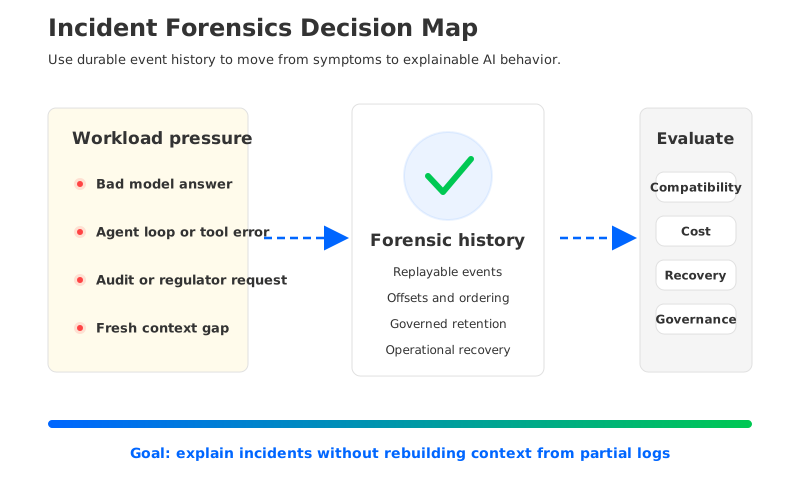
An AI incident rarely begins with a clean error message. A customer receives a harmful answer, an agent calls the wrong tool, or retrieval returns stale context. By the time the platform team is pulled in, the question is no longer "did the system fail?" The question is "what exactly did the system know, decide, emit, and persist?"
That question is why teams search for ai incident forensics kafka. Kafka already sits in the path of many AI systems: prompt events, tool calls, feature updates, retrieval context, moderation outcomes, model responses, audit signals, and downstream business actions. If those streams are durable and replayable, investigators can reconstruct the chain. If they are fragmented across short-lived logs, local broker disks, connector side effects, and partially retained observability data, the review turns into archaeology.
Durable event history is not the same as "more logging." Logs help operators see symptoms. Event history lets engineers replay the context that produced the symptom. The difference matters because model input is assembled from user state, policy state, retrieval results, prompt templates, tool outputs, and prior agent steps. Missing one event can turn a forensic review into probability instead of fact.
1Why AI Incident Forensics Needs Kafka Discipline
Kafka is useful for AI incident forensics because it gives teams properties that ordinary application logs do not provide by default. Topics preserve event streams. Partitions preserve order within a key. Consumer groups track progress through offsets. Producers and consumers expose controls around delivery, batching, idempotence, and retries. Kafka Connect can move data between operational and analytical systems without every team building its own ingestion path.
Those primitives are familiar, but forensic workloads stress them in a specific way. An AI platform may need to replay the exact context window that fed a model, correlate it with tool calls, compare it with moderation decisions, and preserve enough history for governance review. The workload is read-heavy during an incident, write-heavy during normal operation, and storage-heavy over time. It also crosses team boundaries: AI platform engineers, data engineers, SREs, security teams, and compliance owners all touch the evidence path.
A workable forensic pipeline usually needs five event categories:
- Input context events. These include prompts, retrieval IDs, feature values, policy versions, and user or tenant metadata needed to understand what the model saw.
- Decision and execution events. Agent steps, tool invocations, model outputs, function-call arguments, and guardrail outcomes belong here.
- State transition events. Any durable state written after an AI decision needs an event trail, including ticket changes, account actions, workflow transitions, and database updates.
- Control-plane events. Prompt-template versions, model deployment versions, routing rules, connector changes, and access-control changes explain why the same request may behave differently across time.
- Investigation events. Replays, manual labels, incident notes, and remediation actions should be written back into an auditable stream rather than kept in a side document.
The first trap is treating these categories as separate logging problems. The value comes from joining them by time, key, offset, version, and tenant. Kafka gives teams a common substrate for that join, but the infrastructure underneath Kafka determines how long the evidence stays available and how expensive it becomes to keep it.
2The Freshness, Retention, and Governance Problem
AI systems need fresh context, but incident forensics needs old context. That tension shows up in architecture reviews. Product teams want low latency and fast iteration. Compliance teams want retention and auditability. SREs want predictable capacity. FinOps teams want to know why a system that looks like "messages in, messages out" is accumulating storage and network cost.
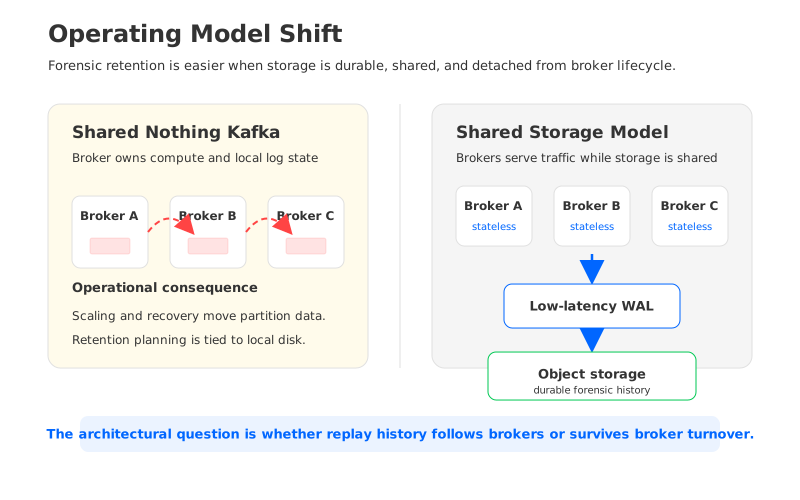
Traditional Kafka deployments are often built around a shared-nothing architecture. Each broker owns local compute and local log segments. Replication keeps copies of partitions on multiple brokers so the cluster can survive broker failures. That design has served Kafka well, especially where disks, machines, and network cost were planned as one infrastructure envelope.
Cloud deployments change the cost and operating model. Broker-local storage means retention is tied to provisioned disks. Scaling compute can force data movement because partitions live on brokers. Rebalancing can consume network and operational attention during the same period when the team is trying to stabilize the platform. When forensic history grows from days to weeks or months, the storage plan becomes a product decision, not a background broker setting.
The governance story also gets harder when evidence is scattered. Kafka offsets can tell a consumer where it was in a topic, but the incident review may also need topic retention policy, ACL history, connector configuration, lifecycle policy, replay job records, and proof that deletion rules were applied consistently. The platform has to make those controls visible before the incident.
3Architecture Options for Durable, Replayable AI Context
A practical evaluation starts with a neutral question: where does the forensic record live, and what has to move when the system changes shape? That question separates several architecture patterns that look similar at the API layer.
In a classic self-managed Kafka cluster, the forensic record lives in replicated log segments on broker-local storage. This can be acceptable for stable workloads with predictable retention and a team comfortable operating brokers, disks, partitions, reassignments, and upgrades. Its weakness appears when compute elasticity and long retention pull in opposite directions: more history needs more disk, while more throughput needs more brokers.
Managed Kafka services can reduce operational burden, but the architecture question still matters. A managed control plane can simplify provisioning, upgrades, monitoring integration, and support boundaries. It does not automatically remove storage-compute coupling inside the data plane. Teams still need to inspect how retention, replication, cross-zone traffic, broker sizing, tiering, and client compatibility behave under their forensic workload.
Tiered storage changes part of the equation by moving older log segments to remote storage while keeping brokers in the serving path for hot data. This can help long-retention workloads. It is still worth asking how tiering affects replay latency, recovery behavior, operational complexity, and the path between producers, brokers, consumers, and remote storage.
A shared storage model goes further: brokers serve Kafka-compatible traffic while durable data is persisted outside broker-local disks. Broker replacement and compute scaling do not require the same kind of partition-data movement, because the durable record is not owned by a specific broker instance. The platform still needs a low-latency write path, metadata correctness, and careful failure handling. Shared storage is a different answer to the question of where the evidence lives.
4Evaluation Checklist for Platform Teams
The evaluation should not start with product names. It should start with the incident you do not want to mishandle: a wrong high-impact answer, an autonomous workflow that modified production data, a policy bypass, or a hallucinated recommendation that reached a customer. Then ask what evidence would be required to explain it and what the streaming platform must preserve.
| Evaluation area | What to verify | Why it matters for AI incident forensics |
|---|---|---|
| Kafka compatibility | Client APIs, consumer groups, offsets, transactions, and connector behavior | Investigation pipelines should not require rewriting every producer and consumer. |
| Retention economics | Storage growth, replication overhead, tiering behavior, and object storage policy | Forensic windows tend to expand after the first serious incident. |
| Elasticity | Whether compute can scale without large data movement | Incident replay can spike read demand while production traffic continues. |
| Recovery model | Broker failure, zone failure, metadata recovery, and replay availability | The evidence system should not become unavailable during the incident it is meant to explain. |
| Governance | ACLs, tenant boundaries, deletion policy, lineage, and audit logs | AI evidence may contain sensitive prompts, user context, or regulated data. |
| Migration risk | Cutover, rollback, connector compatibility, and offset continuity | Forensic infrastructure often touches many teams, so migration must be reversible. |
| Observability | Lag, throughput, storage growth, replay jobs, and connector health | Investigators need to know whether missing evidence is a system fact or an observability blind spot. |
This table is intentionally operational. AI incident forensics fails in small gaps: a connector was not retaining source offsets, a topic had the wrong retention policy, a replay consumer changed group IDs without a record, or a broker rebalance stretched into the incident window. The architecture review should expose those gaps before the platform becomes part of a postmortem.
The test is simple: can a new investigator reconstruct the event chain from durable records without asking five teams to export private logs from five different tools?
That test also helps separate "Kafka-compatible" from "forensics-ready." Compatibility tells you whether applications can speak the protocol and preserve core semantics. Forensics readiness tells you whether the platform can keep the evidence durable, governed, queryable, and affordable for the time horizon your business needs.
5How AutoMQ Changes the Operating Model
Once the requirements are clear, AutoMQ becomes relevant as an architecture category rather than as a shortcut around evaluation. AutoMQ is a Kafka-compatible cloud-native streaming system that separates broker compute from durable shared storage. The intent is to preserve Kafka protocol familiarity while changing the operational model that comes from binding partitions to broker-local disks.
For AI incident forensics, that separation matters in three places. First, durable history is backed by object storage rather than treated as an extension of local broker capacity. Object stores such as Amazon S3 are designed for high durability, and cloud teams already have mature controls around lifecycle policy, access boundaries, encryption, and audit. Second, brokers can be treated more like stateless serving capacity, so replay demand and long-term retention can be planned separately. Third, cross-zone traffic and placement become explicit design concerns rather than side effects hidden inside a broker replication plan.
AutoMQ still has to satisfy the same checklist as any other platform. Client compatibility has to be tested with existing producers, consumers, transactions, and connectors. Governance has to match the organization's data classification rules. Observability has to expose the signals investigators need. Migration has to include cutover and rollback plans. The architectural advantage is that the forensic record is not trapped inside the lifecycle of broker-local disks.
This is especially relevant for agentic AI systems. Agent traces are not only high volume; they are also semantically dense. A single user-visible action may depend on plan generation, tool selection, retrieval, policy checks, retries, output validation, and external side effects. Keeping those events in a Kafka-compatible stream gives teams replay discipline. Keeping them on shared durable storage gives teams more room to retain evidence without expanding broker disks as the primary lever.
AutoMQ's documentation also describes deployment patterns where customers keep infrastructure boundaries under their own cloud account, including BYOC-style installation paths and Kafka client guidance. That boundary can matter when AI evidence contains prompts, user data, tool payloads, or regulated context.
6A Readiness Scorecard Before the First Incident
The strongest incident programs design evidence paths before the first investigation. For AI systems, that means treating event history as a production dependency. The streaming platform should have retention targets, topic naming rules, schema strategy, replay procedures, connector ownership, access controls, and cost visibility before the model or agent is rolled out.
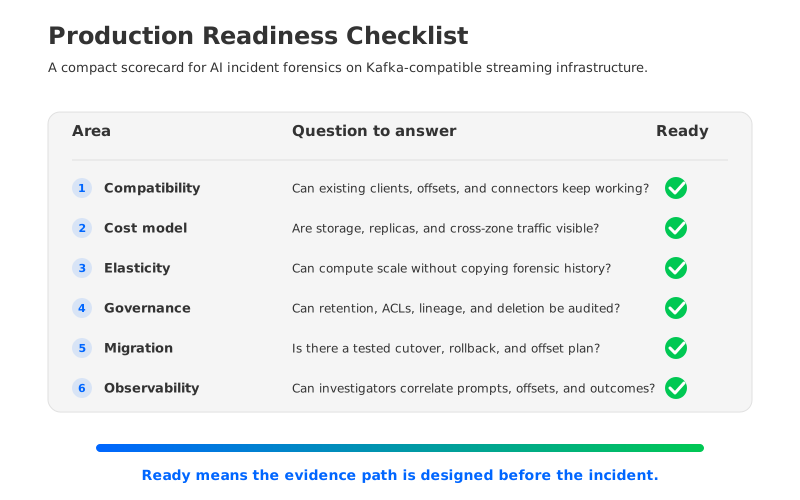
Use the following scorecard in architecture review. A "no" answer is not a failure; it is a work item that should be visible before the incident.
- Can investigators map a customer-facing AI action to prompts, retrieval context, model output, tool calls, guardrail decisions, and downstream state changes?
- Can replay jobs consume historical context without interfering with production consumer groups or hiding offset changes?
- Can the platform retain evidence for the required investigation window without binding every retention decision to broker disk expansion?
- Can security teams enforce tenant boundaries, ACLs, deletion policy, and audit logging across event streams and storage?
- Can SREs recover from broker or zone failures while preserving replay availability for the incident window?
- Can data engineers trace connector state and source offsets when evidence moves into a lakehouse, warehouse, or search index?
- Can finance teams explain storage and network cost under normal traffic and investigation replay traffic?
When teams answer these questions early, Kafka becomes more than a transport layer for AI events. It becomes the system of record for how AI behavior happened. That does not replace model evaluation, tracing, or observability. It gives those tools a durable timeline to stand on.
If your team is designing Kafka-compatible infrastructure for AI event history and wants to evaluate shared storage, stateless brokers, and customer-controlled deployment boundaries, review the AutoMQ documentation or start a technical conversation through AutoMQ. The useful question is not whether every AI event belongs in Kafka. The useful question is which events you will need when a serious incident asks for proof.
7References
- Apache Kafka Documentation - Kafka concepts, client configuration, consumer groups, offsets, transactions, Kafka Connect, KRaft, and tiered storage.
- AutoMQ Cloud Getting Started Overview - AutoMQ Cloud onboarding and deployment context.
- AutoMQ Kafka Client SDK Guide - Kafka client compatibility and connection guidance.
- AutoMQ Kafka Connect Overview - Connector management context for Kafka-compatible pipelines.
- AutoMQ Inter-Zone Traffic Overview - Guidance on reducing inter-zone traffic in AutoMQ deployments.
- AWS S3 Data Durability - Official durability model for Amazon S3 storage classes.
- AWS EC2 On-Demand Pricing: Data Transfer - Official reference for cloud data transfer pricing considerations.
8FAQ
8.1Is Kafka required for AI incident forensics?
No. Kafka is not required as the event backbone. It is often practical because many data platforms already use Kafka-compatible APIs, consumer groups, offsets, and connectors. The core requirement is durable, replayable, governed event history.
8.2Which AI events should be retained?
Start with events needed to reconstruct causality: prompts, retrieval references, model outputs, tool calls, guardrail decisions, state transitions, deployment versions, and connector movements. Avoid storing sensitive payloads without a governance plan.
8.3How long should forensic event history be kept?
Retention depends on business risk, regulation, customer commitments, and investigation practice. The key architectural point is that the window tends to grow after teams experience a serious incident. Choose infrastructure that can extend retention without turning every policy change into a broker disk expansion project.
8.4Does shared storage remove the need for Kafka operations?
No. Shared storage changes the operating model, but teams still need capacity planning, observability, security controls, schema governance, client testing, and incident procedures. The benefit is that durable history is less tied to individual broker lifecycle.
8.5How should teams migrate forensic streams to a new Kafka-compatible platform?
Treat migration as an incident-readiness project. Test producer and consumer compatibility, mirror or dual-write critical topics when appropriate, preserve offset strategy, validate connector behavior, and define rollback before cutover. The first success criterion is continuity: applications should keep their Kafka expectations while the platform changes underneath.


