
Table of Contents
Table of Contents
Teams searching for ai observability event streams kafka are usually past the dashboard phase. They already collect metrics, traces, logs, prompts, model outputs, retrieval events, tool calls, and user feedback. The harder question is whether those signals arrive while an AI system can still act on them. A fraud agent that learns about an anomaly five minutes after the transaction is not observing the system in an operational sense; it is reading history.
That pressure changes the shape of the data platform. AI observability is not only about plotting token latency or error rates. It is about feeding fresh operational context into guardrails, routing decisions, evaluation loops, incident response, and human review. Kafka is a natural fit because it gives platform teams ordered event streams, Consumer group parallelism, Offset-based replay, Kafka Connect integration, and a broad client ecosystem. The trap is assuming that the same Kafka operating model used for application logs will keep up with AI workloads that are bursty, stateful, and sensitive to stale context.
The real architecture question is narrower and more useful: can your streaming layer keep AI context fresh without turning every scale event, retention change, and migration plan into a storage operation?
1Why teams search for ai observability event streams kafka
AI observability creates a different relationship between telemetry and action. In a traditional monitoring workflow, a delayed metric might still be useful for a dashboard, a weekly reliability review, or a cost allocation report. In an AI workflow, the same delay can change the decision itself. A retrieval-augmented generation system may need the latest policy update before answering a customer. An agentic workflow may need to suppress a tool call because a downstream system is degraded. A model evaluation service may need prompt and response events while the experiment is still running, not after an overnight batch job.
Kafka helps because the core abstractions match the problem. A Topic gives teams a durable stream for each signal type. A Partition gives ordering where ordering matters. Offsets let consumers replay context without asking producers to resend data. Consumer groups let scoring jobs, alerting services, feature builders, and audit sinks consume the same events independently. Kafka Connect is often the bridge into warehouses, search systems, object storage, and operational databases.
The part that deserves more scrutiny is the infrastructure underneath those abstractions. AI observability streams often combine high-cardinality metadata, spiky write rates, fan-out reads, and long replay windows. Those properties are manageable when they are designed into the platform. They become expensive when they are absorbed through overprovisioned brokers, local disk buffers, manual Partition reassignment, and a habit of treating batch pipelines as the safety net.
2The production constraint behind the problem
The first constraint is freshness. A batch context pipeline can produce correct data and still be operationally wrong because the answer arrives after the AI system has moved on. Teams often notice this when an incident review shows that the required signal existed somewhere in logs, but it was not in the stream that the policy engine, agent router, or evaluation service used at decision time.
The second constraint is elasticity. AI workloads are uneven by design. A product launch, incident, synthetic evaluation run, or abuse spike can multiply telemetry volume without warning. Traditional Kafka can scale, but the operational cost of scaling depends on how much durable data is tied to broker-local storage. If adding capacity means rebalancing partitions and moving retained log segments between brokers, the platform team has to choose between overprovisioning and delayed response.
The third constraint is governance. Observability events for AI can include prompts, retrieval snippets, user identifiers, security decisions, tool outputs, and model responses. That data often needs stronger residency, access-control, retention, and audit boundaries than generic service metrics. The streaming platform must fit those boundaries rather than asking teams to copy sensitive context through an external control plane or into a vendor-managed data path they cannot fully inspect.
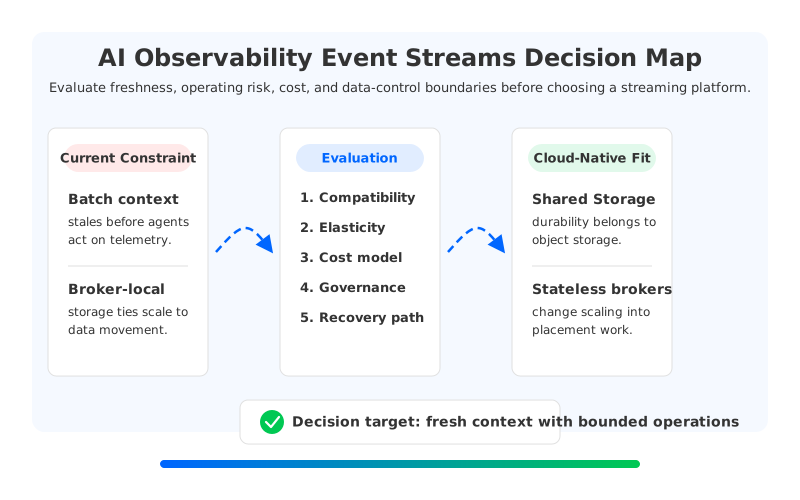
These constraints are connected. Freshness pushes teams toward event streaming. Elasticity determines whether the streaming layer can keep up during bursts. Governance determines where the platform can run and who controls the data. A useful architecture review keeps all three in the same conversation.
3Architecture options and trade-offs
The baseline option is self-managed Apache Kafka. It gives teams maximum control and the broadest ecosystem compatibility, and the official Apache Kafka documentation remains the right source for core semantics such as consumers, offsets, transactions, Kafka Connect, KRaft, and Tiered Storage. The trade-off is operational ownership. Platform teams own broker sizing, storage provisioning, network topology, upgrades, Partition reassignment, and failure drills. For teams with deep Kafka operations experience, that control can be valuable. For teams building AI platforms under time pressure, the hidden cost is often the specialist capacity required to keep the cluster responsive.
Managed Kafka services reduce some of that operational burden. They can be a good fit when the primary goal is standard Kafka usage with a managed control surface. The question is where the service boundary sits. If the service still exposes the same broker-local storage model underneath, elasticity and long-retention economics may still depend on capacity planning and data movement. If data governance requires customer-owned network, encryption, IAM, and storage boundaries, the managed model also needs a careful security review.
The architecture pattern to examine is the difference between Shared Nothing architecture and Shared Storage architecture. In the traditional model, each broker manages local durable data and coordinates replication with other brokers. In a shared-storage model, durable data is placed in shared object storage, and brokers become mostly compute nodes responsible for protocol handling, caching, leadership, and scheduling. That distinction matters because a broker scale event stops being a durable-data relocation problem and becomes more like a traffic placement problem.
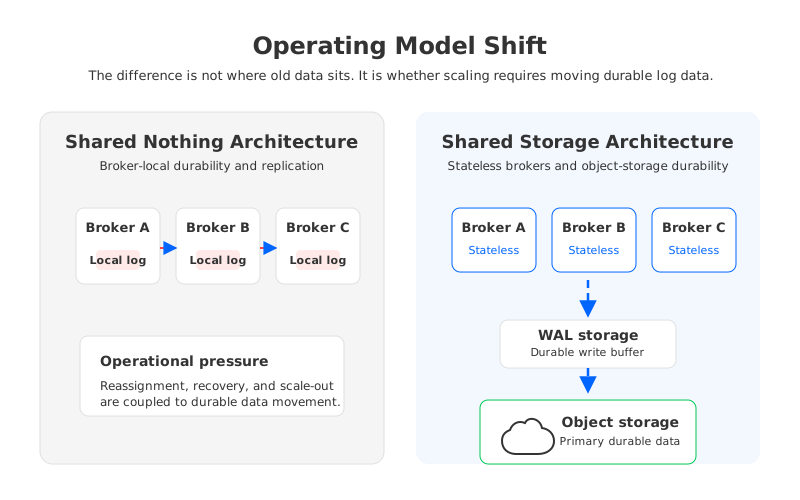
No architecture removes trade-offs. Shared Storage architecture still needs a write path that can acknowledge data durably without waiting on slow object-storage operations for every record. It also needs caching and read-path design for hot tail reads and historical catch-up reads. The evaluation should focus on how those mechanisms behave under the workload you actually have: high-cardinality telemetry, bursty producers, fan-out consumers, strict retention controls, and replay-heavy debugging.
4Evaluation checklist for platform teams
The most useful platform review starts with failure modes rather than feature names. Ask what happens when the AI system receives a sudden evaluation burst, when a consumer falls behind, when a broker fails, when a security team asks for a data residency proof, and when a migration has to roll back. If the answers depend on manual data movement, long maintenance windows, or a separate batch copy that lags the stream, the architecture is carrying risk that will surface during production pressure.
Use the following decision matrix to keep the review grounded:
| Evaluation area | What to verify | Why it matters for AI observability |
|---|---|---|
| Kafka compatibility | Producer, Consumer, Admin, Connect, schema, auth, and client behavior | Existing applications and tools should move without a rewrite. |
| Freshness and replay | End-to-end lag, replay window, offset handling, and Consumer group behavior | AI guardrails and evaluators need current context plus auditable history. |
| Elasticity | Broker scale-out, scale-in, Partition reassignment, and rebalance behavior | Bursty telemetry should not require overprovisioning as the default answer. |
| Cost model | Compute, storage, inter-AZ traffic, object storage API calls, and retained data | Observability data grows quickly, and retention costs become a platform tax. |
| Governance | VPC, IAM, encryption, audit logs, data residency, and customer data path | AI telemetry can contain sensitive business and user context. |
| Migration and rollback | Offset consistency, dual running, cutover criteria, and rollback steps | A streaming migration should not break downstream AI decisions. |
The matrix also prevents a common mistake: evaluating Kafka platforms by API compatibility alone. API compatibility is necessary, but it is not sufficient. A platform can accept Kafka clients and still impose an operating model that does not fit AI observability. The proof is in the runbook: how many steps are required to add brokers, recover a failed node, isolate hot partitions, retain more history, and replay a month of events into a new evaluator?
5How AutoMQ changes the operating model
After the neutral checklist, the architectural requirement becomes clearer. The platform needs Kafka-compatible semantics, but it should decouple durable storage from broker lifecycle so freshness and elasticity do not fight each other. AutoMQ is a Kafka-compatible, cloud-native streaming platform built around that idea: it keeps Kafka protocol compatibility while replacing broker-local log storage with S3Stream, WAL storage, and S3-compatible object storage.
In AutoMQ's Shared Storage architecture, AutoMQ Brokers are stateless for durable data. Writes are first persisted through WAL (Write-Ahead Log) storage and then uploaded to object storage in near real time. Object storage becomes the primary durable data layer, while WAL storage acts as a write buffer and recovery layer. This changes the platform team's operating model. Scaling a broker fleet no longer implies copying retained log data from one broker's disk to another broker's disk. Partition movement becomes metadata, leadership, and traffic scheduling work rather than a long storage relocation task.
For AI observability event streams, that shift shows up in four places. First, elastic capacity is easier to align with bursty telemetry because brokers are not the long-term data containers. Second, long retention is anchored in object storage rather than broker disk sizing. Third, customer-controlled deployment models such as AutoMQ BYOC and AutoMQ Software let teams keep control plane, data plane, network, and storage boundaries inside their own cloud account or private environment. Fourth, Kafka-compatible APIs preserve the client and ecosystem path that made Kafka attractive in the first place.
There are still design choices to make. AutoMQ Open Source uses S3 WAL and is suitable for teams that want a minimal object-storage-backed deployment path. AutoMQ commercial editions support additional WAL storage options for workloads that need lower write latency or specific cloud durability characteristics. Migration also deserves its own plan. Open-source Kafka migrations can use tools such as MirrorMaker2, while AutoMQ commercial editions provide Kafka Linking for byte-to-byte synchronization and offset-consistent cutover paths. The right path depends on your workload, tolerance for dual running, and rollback requirements.
6A readiness checklist before you commit
An AI observability streaming platform is ready when the team can explain both the data path and the operational path. The data path covers producers, topics, partitions, offsets, consumers, retention, schemas, and sinks. The operational path covers scale events, failures, upgrades, security reviews, migration, and rollback. Weakness in either path eventually becomes stale context.
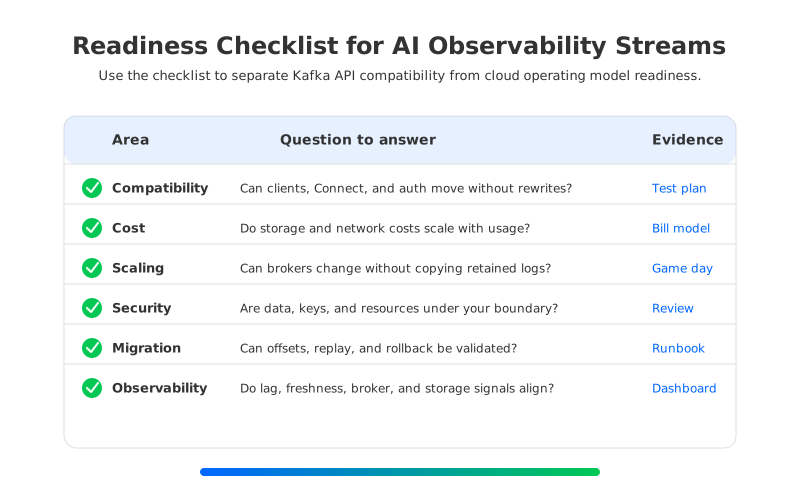
Before committing to a platform, run a small production-shaped exercise rather than a synthetic hello-world test. Produce real telemetry shapes, including large headers, prompt metadata, error payloads, retrieval IDs, and tool-call events. Run multiple consumer groups: one for alerting, one for evaluation, one for audit storage, and one for replay into a development environment. Then force the boring events that decide whether the architecture works: add brokers, remove brokers, throttle a consumer, extend retention, rotate credentials, and cut over a downstream sink.
The outcome should be a scorecard, not a single pass/fail label:
- Green: Kafka clients work as expected, lag stays within the service objective, replay is predictable, and scale operations do not require large durable-data movement.
- Yellow: API compatibility is strong, but one or two operational paths need runbook work before production.
- Red: Freshness depends on batch repair jobs, migration lacks offset validation, or governance requires data movement outside the approved boundary.
That scorecard gives platform teams a practical way to compare self-managed Kafka, managed Kafka, Tiered Storage, and Shared Storage architecture without turning the decision into a vendor checklist.
7FAQ
7.1Is Kafka a good fit for AI observability event streams?
Kafka is a strong fit when AI observability requires ordered events, replay, multiple independent consumers, and integration with existing data systems. The platform decision should include both API semantics and the operating model underneath the brokers.
7.2Does Tiered Storage solve stale AI context?
Tiered Storage can help with historical data retention and replay economics, but it does not automatically make brokers stateless or remove hot-path operational constraints. It should be evaluated as one part of the storage strategy, not as a complete answer to freshness and elasticity.
7.3What should teams test first?
Start with client compatibility, Consumer group behavior, lag under bursty writes, replay from stored offsets, broker scale operations, and migration rollback. Those tests reveal whether the architecture can support real-time AI context instead of only storing events correctly.
7.4Where does AutoMQ fit in the decision?
AutoMQ fits when teams want Kafka-compatible APIs with a cloud-native Shared Storage architecture, stateless brokers, object-storage-backed durability, and deployment boundaries that can stay inside the customer's cloud account or private environment.
8Closing the loop
The search for ai observability event streams kafka starts with a freshness problem, but it usually ends with an operating model decision. Batch context is not wrong; it is wrong for the moment when an AI system must act. If your team is evaluating a Kafka-compatible platform for fresh AI observability streams, review the AutoMQ Cloud Console deployment path and test the scorecard against your own telemetry shape.
9References
- Apache Kafka documentation
- Apache Kafka documentation: Kafka Connect
- Apache Kafka documentation: KRaft
- Apache Kafka documentation: Tiered Storage
- Apache Kafka documentation: Message delivery semantics
- AutoMQ documentation: Compatibility with Apache Kafka
- AutoMQ documentation: S3Stream Shared Streaming Storage
- AutoMQ documentation: Migration overview
- AutoMQ documentation: Table Topic overview
- AutoMQ documentation: Eliminating inter-zone traffic


