
Table of Contents
Table of Contents
The pressure behind an AI-ready Kafka architecture is not that another application wants to consume events. Kafka teams have handled high-throughput producers, consumer groups, offset management, and replay for years. The pressure is that AI systems turn freshness into a product requirement. A support agent that reasons over a ticket without the latest billing event can make the wrong recommendation. A fraud workflow that waits for a batch feature refresh can miss the short window where intervention matters. A retrieval pipeline that indexes stale product, inventory, or account events will make the model sound confident for the wrong reason.
This changes how architects should evaluate Kafka-compatible streaming platforms. The question is no longer only whether the platform can ingest a peak number of records per second. The harder question is whether the event log can keep agents, feature pipelines, retrieval systems, and operational controls synchronized while the platform remains affordable and governable. That pulls familiar Kafka concerns into a different order: data freshness, elastic capacity, replay cost, placement control, and safe migration become first-class design constraints.
1Why AI-Ready Kafka Architecture Matters Now
AI applications are often described as if the model is the system. In production, the model is only one participant in a larger data loop. Agents need instructions, tool results, customer context, policy changes, conversation history, feature updates, and operational feedback. Some of that data sits in databases and object stores, but the events that explain what changed usually move through a streaming backbone.
Kafka is a natural fit for this role because its core contract is already useful for AI infrastructure: append events, preserve ordering within partitions, let consumers track offsets, and replay history when downstream systems need to rebuild state. Apache Kafka's documentation describes the producer, broker, topic, partition, consumer group, offset, and transaction concepts that make this contract practical at scale. Those primitives are still relevant when the consumer is a feature service, vector indexer, agent memory service, or real-time risk workflow.
The twist is that AI workloads punish slow operational loops. A human-facing dashboard can sometimes tolerate a delayed aggregate. An autonomous workflow may act on whatever state it sees. If the event backbone is brittle during scale-out, expensive during replay, or difficult to isolate by team and environment, the AI layer inherits those weaknesses. The architecture has to make fresh data normal, not heroic.
2The Production Constraints Behind The Search
Teams searching for ai ready kafka architecture are not asking for a generic streaming definition; they already know Kafka matters. They are trying to decide whether their current operating model can survive the next workload shape.
- Freshness pressure. Agents and retrieval systems need recent business events, not yesterday's warehouse snapshot. The platform has to protect producer latency, consumer catch-up, and replay performance at the same time.
- Elasticity pressure. AI workloads can be bursty because indexing jobs, backfills, experiments, and traffic spikes arrive in waves. A platform that scales only through careful broker sizing and partition movement becomes a scheduling constraint.
- Governance pressure. AI systems expand the blast radius of bad data access. The streaming layer has to support clear ownership of payloads, metadata, network paths, audit logs, and operational access.
- Cost pressure. Retention and replay are valuable for AI, but they can make broker-local storage, replica capacity, and cross-zone movement expensive. Cost modeling has to include the steady state and the recovery path.
Those pressures are connected. If a vector indexer falls behind, the team may increase broker and consumer capacity. If the cluster is tied to local disks, capacity changes can trigger rebalancing and data movement. If rebalancing is slow or risky, the team overprovisions. Overprovisioning hides the operational problem until retention, replay, or regional expansion makes the bill visible. The architecture starts as a performance discussion and becomes a platform economics discussion.
3Where Traditional Kafka Architecture Gets Stressed
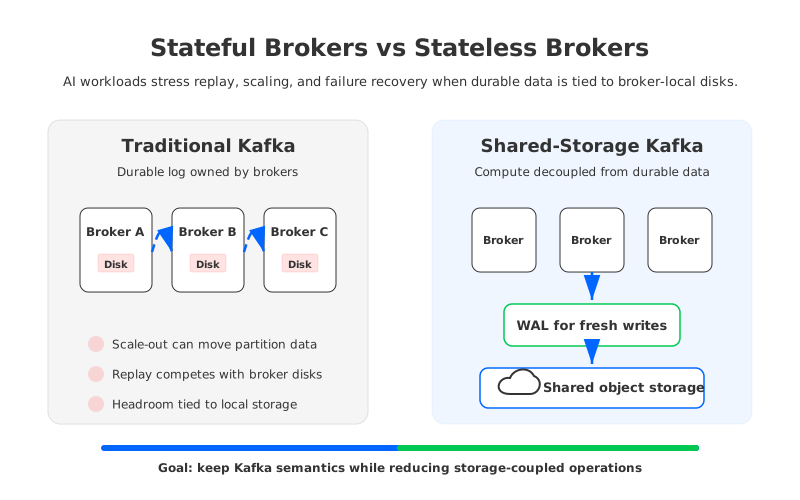
Traditional Apache Kafka is a shared-nothing architecture. Brokers own local log segments, partitions are assigned to brokers, and durability is achieved through replication across brokers. This design was reasonable for a data center world and remains powerful for many workloads. It keeps the hot write path close to broker storage, exposes mature client semantics, and gives operators direct control over topic-level behavior.
The trade-off appears when the durable log is tightly coupled to the broker fleet. Adding capacity is not only adding compute; it can also mean moving partition data. Replacing a broker is not only replacing a process; it can involve replica catch-up, leader movement, and disk pressure. Expanding retention is not only a policy change; it increases the amount of broker-attached storage and replicated data the fleet must carry. Kafka tiered storage can help offload older segments to remote storage, but the primary operational model still depends on how hot data, partition leadership, and local broker resources are managed.
For AI workloads, this coupling matters because replay and freshness often happen together. A feature pipeline may need low-latency tail reads while another job backfills weeks of history. The cluster has to serve current state and historical reconstruction without turning every replay into a broker sizing event.
4Architecture Patterns Teams Usually Compare
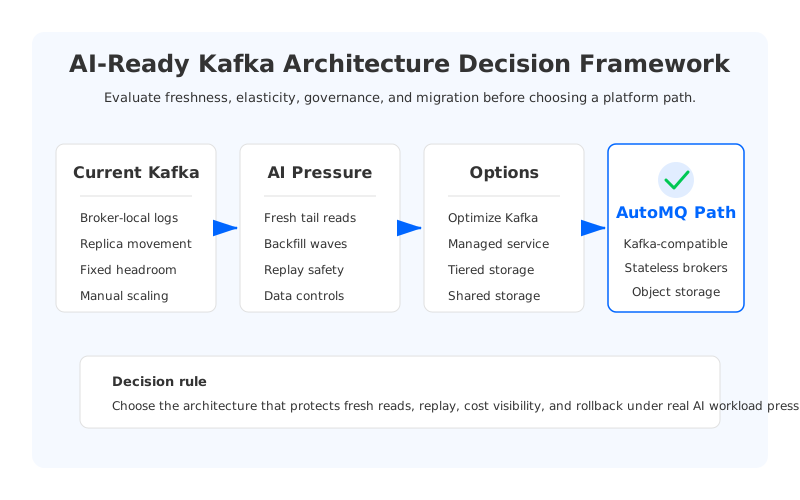
The practical evaluation is not "Kafka or not Kafka." Most serious teams compare several Kafka-shaped options that preserve some part of the Kafka operating contract while changing the storage, control, or service boundary.
| Pattern | What stays familiar | What changes | Watch closely |
|---|---|---|---|
| Self-managed Kafka | Apache Kafka broker model, client behavior, operational control | Your team owns scaling, upgrades, storage, and incidents | Broker-local storage, partition movement, inter-zone replication, upgrade discipline |
| Managed Kafka service | Kafka API surface with vendor-managed operations | Control plane and infrastructure ownership move toward the provider | Data-plane boundary, feature limits, pricing dimensions, migration exit path |
| Kafka with tiered storage | Kafka brokers plus remote storage for older log segments | Retention economics improve for colder data | Hot path still depends on brokers, local disks, and replica behavior |
| Kafka-compatible shared storage | Kafka-compatible API with durable data moved to shared object storage | Brokers or compute nodes become more stateless | WAL design, object-store behavior, compatibility, metadata path, failure recovery |
That last category is where architecture decisions become interesting for AI. Object storage gives teams elastic, durable, and widely understood infrastructure for retained data. It also has different latency and request-cost behavior than local disks. A production design therefore needs a write path that absorbs low-latency writes, a read path that handles both tailing and catch-up consumers, and a failure model that does not move the complexity into an invisible metadata dependency.
5Evaluation Checklist For Platform Teams
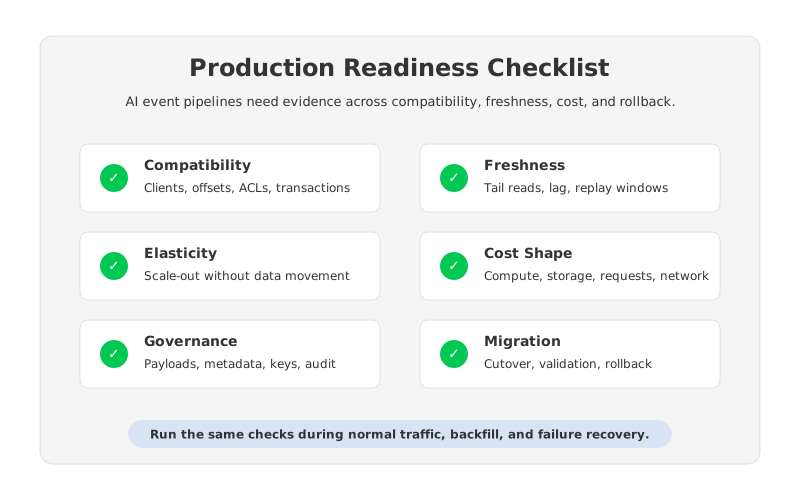
An AI-ready event platform should be evaluated with workload evidence, not a feature checklist copied from a vendor page. The most useful tests combine normal traffic, burst traffic, failure recovery, and governance review. If the platform only looks good when the workload is a single producer and a single consumer, it has not been tested against the problem AI teams actually have.
Use the checklist below as a design review baseline:
- Compatibility. Validate producer idempotence, transactions if used, consumer group behavior, offset commits, compaction, ACLs, quotas, Kafka Streams, Connect, and observability agents. Compatibility is not a logo; it is the disciplined work of running the client behavior your estate already depends on.
- Freshness. Measure produce latency, end-to-end consumer lag, tail-read performance, and catch-up behavior under concurrent backfill. AI pipelines care about the current event and the replay window.
- Elasticity. Test scale-out, scale-in, broker or node replacement, and partition reassignment behavior. The key question is whether capacity changes require moving large amounts of durable data.
- Cost shape. Model compute, storage, replication, object-store requests, network transfer, private connectivity, observability, and migration overlap. The smallest visible line item may not be the lowest total cost.
- Governance boundary. Map where payloads, metadata, logs, metrics, keys, IAM roles, and support access live. AI expands data exposure risk, so architecture diagrams need to become security review artifacts.
- Migration and rollback. Prove dual-write or replication strategy, consumer cutover, offset handling, validation, and rollback before treating the platform as production-ready.
6Where AutoMQ Changes The Operating Model
Once the evaluation reaches this point, AutoMQ is relevant as a Kafka-compatible, cloud-native streaming platform that separates Kafka compute from durable stream storage. It keeps the Kafka-facing contract familiar while replacing broker-local storage with an object-storage-backed shared storage architecture. In that model, brokers become more stateless, durable data lives in shared object storage, and a write-ahead log absorbs low-latency writes before data is uploaded.
Shared storage does not remove every trade-off. It changes which trade-offs the platform team has to manage. Traditional Kafka asks operators to plan around broker disks, local replicas, partition movement, and fleet headroom. AutoMQ's architecture asks teams to validate WAL choice, object-storage behavior, cache behavior, metadata flow, and deployment boundary. That can be a better fit when AI workloads need retained event history, elastic compute, and predictable scaling.
AutoMQ's Kafka compatibility documentation is especially relevant for migration planning because client compatibility is the first gate. If applications must be rewritten, the project stops being a Kafka architecture decision and becomes an application modernization program. AutoMQ's docs position the system as Kafka-compatible while using S3Stream shared storage and WAL storage underneath the Kafka log abstraction. That combination lets architects evaluate a third path between classic broker-local Kafka and a fully different streaming abstraction.
The BYOC angle also matters for AI governance. In regulated or security-sensitive environments, the platform team often needs data to remain inside the customer's cloud account or controlled network boundary. AutoMQ BYOC and software deployment options are designed for teams that want explicit control over infrastructure, object storage, networking, and operational access. For AI systems that combine business events with customer context, that boundary is part of the architecture.
7A Practical Decision Table
The decision is easier when the team names the primary constraint instead of asking for a universal winner. A payment risk pipeline, observability lake, customer support agent, and recommendation feature store may all use Kafka, but they stress different parts of the platform.
| If your main constraint is... | Prefer this direction | Why |
|---|---|---|
| Stable workloads with strong internal Kafka SRE capability | Optimize the current Kafka estate first | You may get enough value from better partition strategy, retention policy, capacity planning, and upgrade discipline. |
| Operations offload over architecture change | Evaluate managed Kafka services | Managed services reduce direct operational work, but review data-plane control and pricing dimensions carefully. |
| Long retention, replay, bursty AI pipelines, and storage-driven cost | Evaluate shared-storage Kafka-compatible architecture | Decoupling durable data from broker-local disks can reduce data movement and make compute elasticity more practical. |
| Strict data boundary, private networking, and internal platform ownership | Evaluate BYOC or self-controlled deployment | AI workloads often need clear evidence for where payloads, metadata, keys, and support access reside. |
| Low migration tolerance | Prioritize Kafka compatibility and rollback design | The architecture is only useful if existing clients, offsets, tools, and runbooks survive the move. |
For many teams, the right sequence is not a single jump. Start by measuring freshness and replay pain in the current Kafka estate. Then model whether the problem is operational discipline, managed-service ownership, or storage architecture. AutoMQ belongs in the shortlist when the evidence points to Kafka compatibility plus shared-storage economics as the architectural lever.
8References
- Apache Kafka Documentation
- AutoMQ Documentation: What is AutoMQ?
- AutoMQ: Built on Kafka
- AWS Documentation: Amazon S3 Data Durability
- AWS Architecture Center: Event-Driven Architecture
9FAQ
9.1What makes Kafka architecture AI-ready?
An AI-ready Kafka architecture protects freshness, replay, governance, and elasticity at the same time. It should support low-latency tail reads, controlled backfills, durable event history, clear ownership boundaries, and migration paths that preserve existing Kafka clients and operational tools.
9.2Is traditional Kafka unsuitable for AI workloads?
No. Traditional Kafka remains a strong event backbone when the team has the SRE capacity, storage model, and cost profile to support the workload. The stress appears when AI pipelines need frequent replay, bursty indexing, long retention, and fast scaling while the cluster remains tied to broker-local storage and partition movement.
9.3How is shared-storage Kafka different from Kafka tiered storage?
Tiered storage usually offloads older log segments to remote storage while brokers still own the primary hot path and local log behavior. Shared-storage Kafka-compatible architecture moves the durable storage foundation toward shared object storage and makes brokers more stateless, which changes scaling, recovery, and cost behavior more deeply.
9.4Where should AutoMQ enter an AI platform evaluation?
AutoMQ should enter after the team has identified storage-coupled scaling, replay cost, broker-local disk operations, or BYOC governance as real constraints. It is most relevant when the team wants Kafka compatibility, shared object-storage-backed persistence, stateless broker operations, and a deployment model that can keep infrastructure under customer control.
9.5What should a proof of concept measure?
Measure produce latency, consumer lag, replay throughput, catch-up behavior during live traffic, scale-out and node replacement time, object-storage request patterns, cache behavior, ACL and transaction compatibility, observability integration, and rollback procedures. The test should look like your AI workload, not a generic demo topic.


