
Table of Contents
Table of Contents
The first production incident in an agentic AI system rarely looks like a science-fiction failure. It looks like a familiar operations problem: a tool call fired with stale context, a policy service returned a verdict too late, or a downstream system consumed the right event in the wrong order. The search query ai risk signals kafka appears when teams realize that agent safety is not only a model problem. It is a data infrastructure problem.
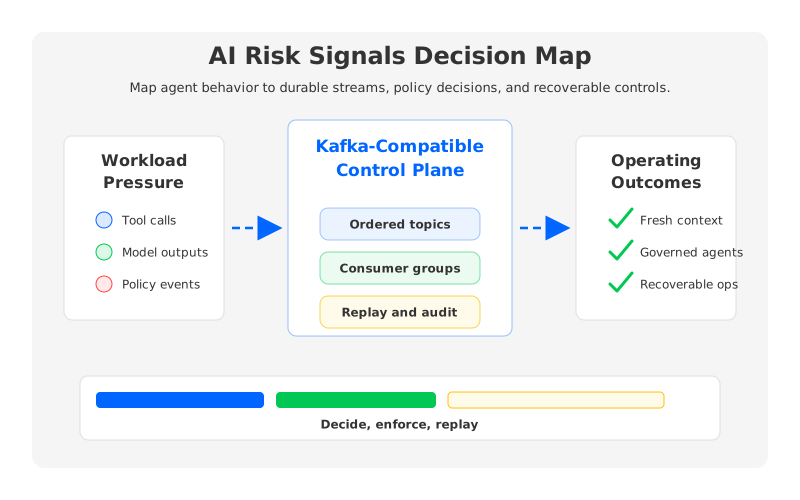
Agentic systems create risk signals continuously. Prompt inputs, retrieved documents, tool-call requests, model outputs, policy decisions, approval events, and remediation actions all become evidence that someone will need during live control, audit, debugging, or rollback. These events need low latency, but low latency alone is not enough. They also need ordering, replay, retention, fan-out, and a way to separate control decisions from the agent runtime that generated them.
Kafka is a natural candidate because it gives platform teams durable topics, partitioned ordering, consumer groups, offsets, and a mature integration ecosystem. The hard question is whether the Kafka-compatible platform you choose can keep those signals fresh, governable, cost-aware, and recoverable while agent traffic changes faster than a traditional batch pipeline.
1Why Teams Search for ai risk signals kafka
Most AI teams start with logs. Logs are useful for after-the-fact diagnosis, but risk controls need something stronger than a passive record. A risk signal is an event that other systems may act on: a fraud score update, a tool-use denial, a retrieval freshness warning, a privilege escalation request, a prompt-injection classifier result, or a human override. Once those events influence live behavior, they become part of the control plane.
That control plane has several properties that ordinary application logging does not guarantee:
- Consumers must be independent. Security analytics, observability, compliance review, and agent orchestration should consume the same signal stream without blocking each other.
- Replay must be deliberate. Investigators need to rebuild the sequence of decisions around an incident, while operators may need to replay corrected events into a downstream policy engine.
- Freshness must be visible. A policy decision based on a signal from seconds ago may be acceptable; the same decision based on minutes-old context may be unsafe.
- Backpressure must be explicit. When a classifier, approval queue, or external tool slows down, the platform should expose lag rather than hiding it inside a request path.
Kafka's core mechanics matter here. Consumer groups make independent processing paths possible. Offsets give teams a durable notion of progress. Retention lets a topic act as both live transport and historical record. Kafka Connect extends the stream into databases, object stores, and search systems. These primitives are old in the useful sense: they are boring enough to be trusted, yet flexible enough for agent workloads.
AI risk signals make those primitives more demanding. Agent traffic is bursty because user behavior, tool availability, and model routing can change quickly. The data is often sensitive because it may include prompts, retrieved context, user identifiers, or business decisions. That combination turns a streaming platform into a production control surface.
2The Freshness and Governance Problem Behind AI Event Streams
An agentic system can be wrong in several ways at once. The model may produce a risky plan, the retrieval layer may return outdated context, the tool layer may expose more capability than the agent should have, or the approval workflow may respond after the action is no longer relevant. The risk signal stream is the place where these concerns meet. If the stream is late, incomplete, or impossible to replay, the organization loses the ability to explain and correct behavior.
Freshness is more subtle than end-to-end latency. A producer can publish quickly while a consumer group falls behind. A topic can retain events while downstream systems silently skip failed records. A policy engine can process every event while using an outdated enrichment table. Good platform design treats freshness as a measurable property at each stage: producer timestamp, broker append time, consumer lag, processing time, and action time.
Governance adds a second dimension. The same signal may be useful to an SRE, a security analyst, a compliance reviewer, and an AI platform engineer, but each role should not see the same fields or take the same actions. Topic design, access controls, encryption, schema discipline, and audit trails become part of the agent safety model.
The practical pattern is to separate signal categories before they become tangled.
| Signal category | Typical producer | Operational control |
|---|---|---|
| Agent intent | Agent runtime or planner | Detect unsafe plans before execution |
| Tool request | Tool gateway or MCP server | Enforce policy and privilege boundaries |
| Retrieval context | RAG pipeline or vector system | Track freshness and source provenance |
| Policy verdict | Guardrail service | Explain allow, deny, or escalate decisions |
| Human action | Approval workflow | Preserve accountability and rollback context |
This categorization is not a taxonomy exercise. It determines topic naming, partition keys, retention, access policy, schema evolution, and alerting. An approval event may need longer retention than a transient classifier score, while a tool request may need partitioning by tenant or session to preserve order.
3Architecture Options for Durable, Replayable AI Context
The default Kafka architecture is shared nothing: brokers own both compute and local storage. This design is battle-tested and still works well for many workloads, but it creates operational coupling. When you add brokers, replace disks, rebalance partitions, or change capacity, data movement is part of the operation.
Shared-nothing storage also affects cost visibility. Durable Kafka deployments replicate data across brokers, and in cloud environments that can translate into storage, instance, and network costs. Tiered storage can reduce pressure on local disks by moving older segments to object storage, but the hot write path and broker-local responsibilities still shape day-to-day operations. The platform team should be precise about which problem tiered storage solves and which problems remain.
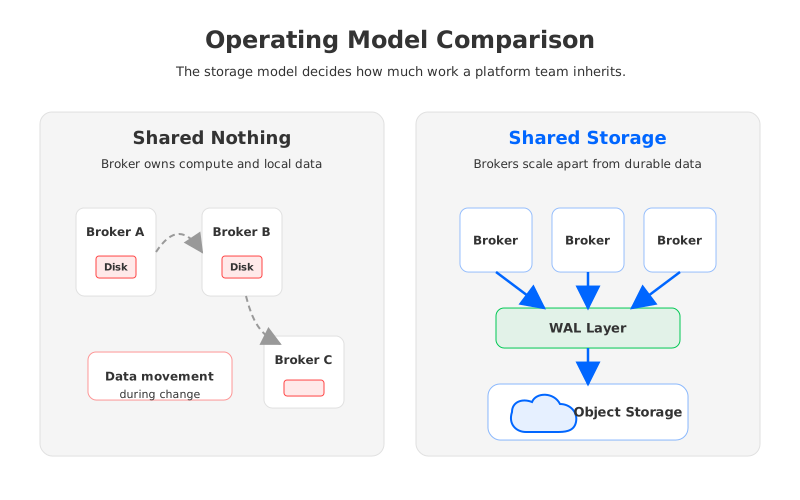
A neutral evaluation starts with the operating model, not a vendor name. Ask what happens when risk-signal volume doubles, when retention requirements change, when a consumer group falls behind, and when a team needs to migrate without breaking existing clients. The answers expose the real architecture.
The decision framework looks like this:
| Evaluation area | What to test | Why it matters for agentic systems |
|---|---|---|
| Kafka compatibility | Existing clients, producers, consumers, Connect jobs, transactions, and offset behavior | Agent platforms should not require a rewrite of the data plane before controls can launch |
| Elasticity | Add and remove broker capacity under bursty traffic | Risk-signal streams may grow faster than forecasted capacity |
| Cost shape | Storage, compute, replication, cross-zone traffic, and standby capacity | Governance streams often need retention even when average throughput is modest |
| Recovery model | Broker failure, zone impairment, replay, and rollback | Controls must keep working during the incidents they help investigate |
| Governance | Access boundaries, encryption, schema discipline, and auditability | Risk events can contain sensitive prompts, context, and decisions |
| Migration risk | Mirroring, cutover, offset preservation, and rollback | Existing Kafka estates usually cannot pause while AI teams replatform |
This table prevents a common mistake: evaluating streaming platforms as if they only move bytes. AI risk-signal infrastructure is judged by the decisions it makes possible. A platform that ingests quickly but makes replay expensive, scaling slow, or governance unclear is not a control plane. It is another dependency to supervise.
4How AutoMQ Changes the Operating Model
If the problem is broker-local coupling, the architectural answer is to separate the responsibilities that traditional Kafka combines. AutoMQ is a Kafka-compatible, cloud-native streaming platform that uses a shared storage architecture: brokers handle compute and protocol work, while durable log data is backed by object storage with a write-ahead log layer. The goal is not to change the Kafka application model. The goal is to change the operating model underneath it.
That distinction matters for teams building AI controls. Kafka compatibility lets existing producers, consumers, and ecosystem tools remain the starting point. Shared storage reduces the amount of broker-local data movement tied to scaling and recovery. Stateless brokers make capacity changes closer to an infrastructure operation than a data relocation project. Object-storage-backed durability aligns long-retention audit streams with cloud storage economics and customer-controlled deployment boundaries.
For ai risk signals kafka workloads, the most interesting consequence is independent scaling. A team may need more compute during a burst of agent activity but may not need to duplicate the same storage footprint across every broker. Another team may need longer retention for audit topics without keeping all historical data hot on broker disks. A third team may need to isolate deployment boundaries for regulated data while still using a Kafka-compatible API.
AutoMQ's cloud-native model also addresses cross-zone traffic, a concern that often appears late in architecture reviews. In traditional replicated Kafka, traffic patterns can include replication, client access, and rebalance movement across availability zones. AutoMQ documents a zero cross-AZ traffic design for supported deployments, which is relevant when teams evaluate cloud network cost and fault-domain design.
The trade-off is that platform teams must understand the storage path. A shared storage architecture depends on the WAL design, object storage behavior, metadata management, and deployment boundaries. Due diligence should include compatibility testing, failure drills, observability review, and migration rehearsal.
5Evaluation Checklist for Platform Teams
The safest way to evaluate infrastructure for AI risk signals is to turn architecture claims into operational tests. Start with a thin but realistic stream: one topic for agent intent, one for tool requests, one for policy verdicts, and one for human approval events. Run the clients you already use, add one slow consumer group on purpose, increase retention on the audit topic, and trigger a broker capacity change. Then ask whether the system behaved in a way your SREs can explain.
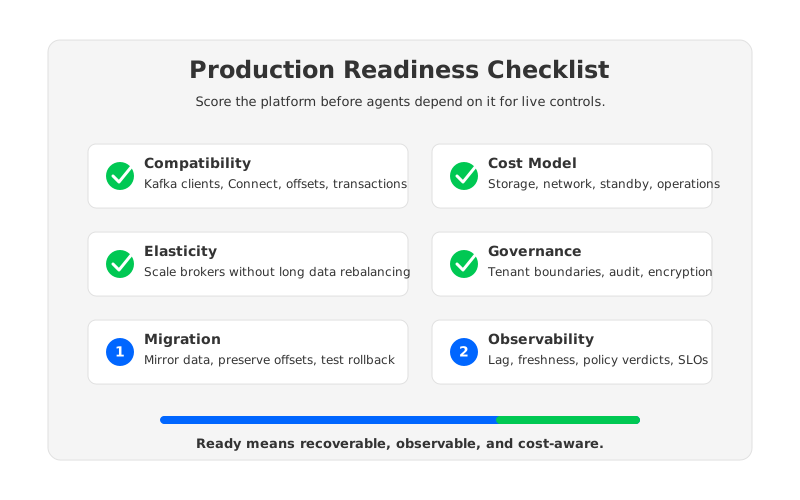
A readiness scorecard should include at least these checks:
- Compatibility: Producers and consumers should keep their expected Kafka behavior, including offset commits, group rebalances, idempotent writes where used, and connector compatibility.
- Cost model: The evaluation should include compute, storage, data transfer, retention, standby capacity, and operational labor. A narrow price comparison misses the costs that show up during scale and recovery.
- Governance: Sensitive fields should have clear access boundaries. Topic-level permissions, encryption, schema rules, and audit trails should be reviewed before production traffic begins.
- Recovery: The team should test broker failure, delayed consumers, replay from a known offset, bad-event quarantine, and rollback after a migration step.
- Observability: Dashboards should show producer rate, broker health, consumer lag, end-to-end freshness, policy-verdict distribution, and rejected or quarantined events.
- Migration: Existing Kafka estates need a migration plan that covers mirroring, validation, cutover, offset handling, and rollback. A strong architecture still fails if the move into it is improvised.
The scorecard should be owned by the platform team, not only by the AI team. Agent developers can define what a risky event means, but SREs and architects own stream behavior under failure, overload, and change. That division keeps model experimentation from quietly becoming infrastructure risk and forces deployment boundaries into the conversation: prompt data, retrieved context, policy verdicts, and human approvals may carry regulated or commercially sensitive information.
6Turning Signals into Real-Time Controls
The end state is not a prettier event pipeline. It is an agentic system where risk signals can change behavior while still leaving an evidence trail. A tool gateway can deny a request because a policy topic delivered a relevant verdict. A post-incident review can replay the exact sequence of intent, context, decision, and action.
That level of control requires a disciplined topic model. Partition keys should preserve the order that matters, such as tenant, session, workflow, or agent execution ID. Retention should reflect the investigation window for each signal class. Consumer groups should separate live enforcement from analytics and audit. Schema evolution should be treated as a compatibility contract.
It also requires humility about failure. A risk-control stream can fail open, fail closed, or degrade into a manual path. Each choice has consequences. For a low-risk recommendation agent, delayed signals may only reduce quality. For an agent that can trigger payments, infrastructure changes, or customer-facing actions, delayed or missing signals may become a business incident. The platform should make those states visible before they become surprises.
The original search was about ai risk signals kafka, but the deeper decision is about accountability. If agents are going to act with more autonomy, the organization needs a real-time substrate that can observe, govern, and replay those actions. Kafka-compatible streaming gives teams the right primitives. A cloud-native shared storage architecture can make those primitives easier to scale and operate in production.
For teams evaluating that path, AutoMQ's documentation is a useful next stop for understanding how Kafka compatibility, shared storage, and cloud deployment boundaries come together: Explore the AutoMQ docs.
7References
- Apache Kafka Documentation: https://kafka.apache.org/documentation/
- Apache Kafka Consumer configuration: https://kafka.apache.org/documentation/#consumerconfigs
- Apache Kafka Connect documentation: https://kafka.apache.org/documentation/#connect
- Apache Kafka transactions design notes: https://kafka.apache.org/documentation/#semantics
- Apache Kafka KRaft documentation: https://kafka.apache.org/documentation/#kraft
- AutoMQ Documentation: https://www.automq.com/docs
- AutoMQ inter-zone traffic documentation: https://docs.automq.com/automq/eliminate-inter-zone-traffics/overview
- AWS Amazon S3 User Guide: https://docs.aws.amazon.com/AmazonS3/latest/userguide/Welcome.html
- AWS Architecture Blog on data transfer costs: https://aws.amazon.com/blogs/architecture/overview-of-data-transfer-costs-for-common-architectures/
- Google Cloud Cloud Storage documentation: https://cloud.google.com/storage/docs
8FAQ
8.1Is Kafka a good fit for AI risk signals?
Kafka is a strong fit when risk signals need durable ordering, replay, retention, and independent consumers. It is less useful if the workload only needs best-effort logs or synchronous request checks with no downstream audit requirement.
8.2What is the difference between AI risk signals and ordinary logs?
Logs usually explain what happened. Risk signals may influence what happens next. A policy verdict, tool-use denial, approval event, or freshness warning can become part of a live control loop, so the infrastructure needs stronger guarantees around ordering, delivery, access, and replay.
8.3Why does shared storage matter for agentic systems?
Shared storage separates durable log data from broker-local disks. For bursty AI workloads, this can reduce the operational burden of scaling brokers, retaining audit streams, and recovering from infrastructure changes. The benefit should be validated with compatibility tests and failure drills.
8.4Where does AutoMQ fit in this architecture?
AutoMQ fits when teams want Kafka-compatible APIs with a cloud-native shared storage operating model. It is most relevant for workloads that need elastic scaling, object-storage-backed durability, reduced broker-local data movement, and customer-controlled deployment boundaries.


