
Table of Contents
Table of Contents
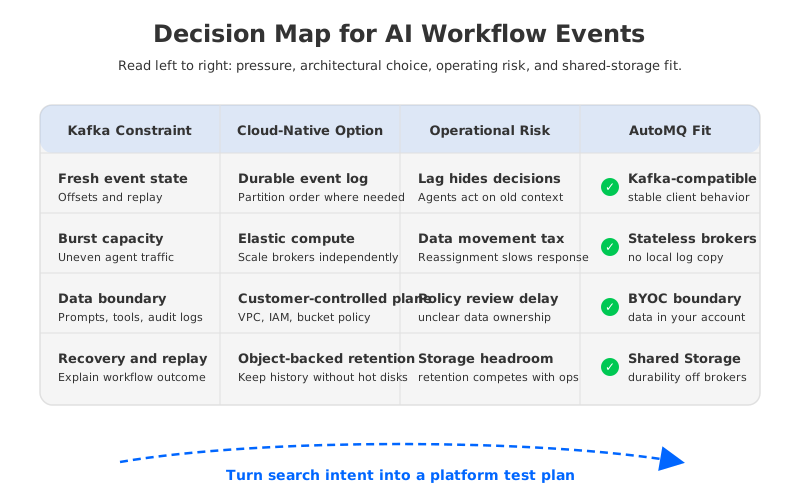
Teams searching for ai workflow orchestration events kafka are usually past the prototype stage. The demo already has agents, tools, prompts, vector retrieval, and a workflow engine that can move a task from intake to action. Production asks a colder question: when the workflow makes a decision, can the platform prove which event, context snapshot, tool result, policy version, and human override led to that decision?
That question is why Apache Kafka shows up in AI workflow architecture discussions. A workflow database can store current state, but AI orchestration needs a durable sequence of state changes. It needs to replay a failed branch, rebuild context after a model or tool bug, fan out the same event to audit and monitoring systems, and keep consumers from racing ahead with stale context. The core thesis is simple: AI workflow events should be treated as a production event stream, and the hard decision is not whether Kafka can carry events. It is whether the Kafka operating model can keep up with the volatility of AI workloads.
1Why Teams Search for ai workflow orchestration events kafka
AI workflow orchestration changes the shape of event streaming because the workflow is no longer a fixed pipeline. A fraud investigation assistant may wait for a third-party risk score, call a retrieval system, request human approval, branch into a different tool, and resume after a policy update. Each step creates events that matter for correctness: task created, context loaded, tool called, result received, decision proposed, action approved, action executed, and compensation triggered.
The natural first instinct is to wire these events through the workflow engine itself. That works while the system has one team, one queue, and a small number of consumers. It starts to break when the same event stream becomes useful to model evaluation, compliance review, observability, feature generation, and incident response. At that point, orchestration events are no longer internal implementation details. They become a shared data product with ordering, retention, replay, schema, and access-control requirements.
There are four event categories worth separating before you pick infrastructure:
- Control events describe workflow state transitions such as
task.started,approval.requested, andtool.retry_scheduled. These usually need strict ordering per workflow instance. - Context events record what the agent saw, including retrieval references, policy versions, feature snapshots, and selected prompts. These drive audit and reproducibility, so retention matters.
- Tool events capture calls to external systems, tool responses, error classes, and retry outcomes. These often have bursty traffic patterns because one workflow step can fan out into many tool calls.
- Decision events summarize proposed and executed actions. These require careful access control because they are the events most likely to enter compliance, customer-support, or financial records.
The separation is not bureaucracy. It prevents one topic from carrying incompatible expectations. A low-latency control topic, a long-retention context topic, and a restricted decision topic may all be part of one AI workflow, but they should not inherit the same retention, partitioning, and access model by accident.
2The Production Constraint Behind the Problem
The first production constraint is freshness. If a Consumer group falls behind, an agent may act on context that was true seconds or minutes earlier. That sounds like a model-quality problem, but the root cause can be mundane: partitions are under-provisioned, consumers are rebalancing, retention is too short for replay, or brokers are overloaded by a traffic burst that came from tool fan-out rather than user requests.
The second constraint is explainability. When a user asks why an automated action happened, the answer cannot depend on a loose bundle of application logs. Kafka offsets give teams a concrete way to point to the records that fed a decision, and transactions can help applications coordinate writes across partitions when the processing design requires atomicity. These are not AI-specific features. They are older distributed-systems tools that become more valuable when AI workflows start making decisions that other teams must trust.
The third constraint is operational elasticity. AI traffic is uneven by nature. A product launch, a backfill job, an incident triage burst, or a model evaluation run can multiply orchestration events for a short window. Traditional Kafka can handle high throughput, but capacity changes are entangled with broker-local storage. Adding brokers is not the same as immediately having balanced partitions, local disk headroom, and predictable recovery behavior.
3Architecture Options and Trade-Offs
The familiar Kafka deployment model is Shared Nothing architecture. Each broker owns local storage for the partitions it serves, and durability is achieved through replication across brokers. The model is battle-tested, but it makes storage placement an operational concern. Broker replacement, partition reassignment, disk sizing, and multi-AZ traffic all become part of the AI platform team's capacity plan.
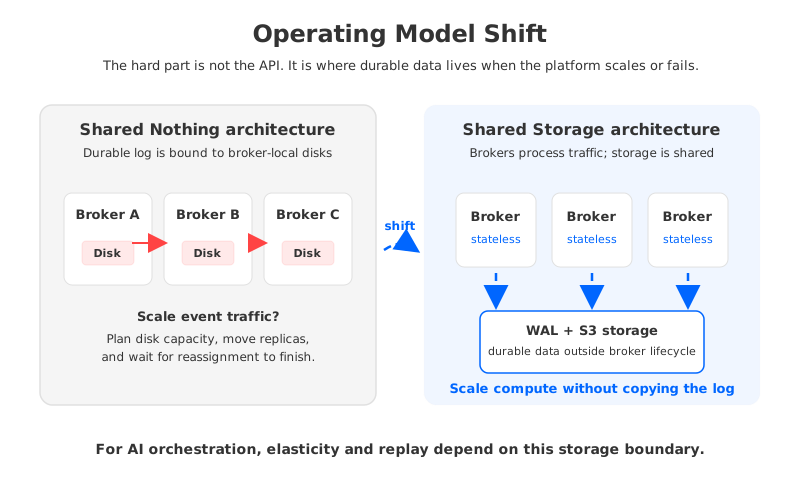
Tiered Storage changes part of this equation by moving older log segments to remote storage while keeping recent data on local broker disks. That can help retention-heavy workloads, especially when historical replay is the main pressure. It does not make brokers stateless, and it does not remove the need to manage the hot local tier. For AI orchestration events, the question is therefore not "local disk or object storage?" but "which data must remain tied to broker lifecycle, and which data can live behind a shared storage boundary?"
Managed Kafka services reduce operational work around provisioning, upgrades, and monitoring. They are attractive when the team wants standard Kafka behavior with less direct cluster administration. The trade-off is that the operating model is still shaped by the provider's service boundaries, pricing meters, network topology, and scaling semantics. For AI workflows that carry sensitive context or customer actions, governance and data residency may matter as much as convenience.
A Kafka-compatible Shared Storage architecture takes a different path. It keeps the Kafka client and protocol surface while moving durable data out of broker-local disks and into shared object storage, with a WAL (Write-Ahead Log) layer in the write path. In that model, brokers become primarily compute nodes for request handling, caching, leadership, and coordination. The operational promise is not magic latency or infinite throughput. The promise is a cleaner separation between compute elasticity and durable log placement.
A neutral evaluation should compare options across workload behavior, not vendor labels:
| Decision area | What to test | Why it matters for AI workflows |
|---|---|---|
| Compatibility | Producer, Consumer, transactions, offset management, Connect, stream processors, and admin tooling | The workflow platform should not force every application team to rewrite clients. |
| Freshness | Consumer lag under tool fan-out, backfill, and model-evaluation bursts | Stale context can produce wrong decisions even when the model is behaving as designed. |
| Retention and replay | Context-event retention, replay speed, and audit reconstruction | AI incidents often require rebuilding the exact event path behind a decision. |
| Elasticity | Broker add/remove behavior, partition balancing, and recovery after node loss | Bursty orchestration traffic should not turn into a long storage-migration exercise. |
| Governance | VPC boundary, IAM, encryption, schema controls, and access separation | Prompt context, tool results, and decision records can be sensitive. |
| Migration risk | Topic mapping, offset preservation, dual-run plan, and rollback criteria | The platform switch should be tested before orchestration events become hard dependencies. |
This table usually exposes the real bottleneck. Some teams need managed operations more than architectural change. Some need longer retention and can accept the remaining hot-disk model. Some need a data-plane boundary that stays in their cloud account. Some need elastic compute because the storage layer is the part making every traffic spike feel dangerous. The right answer depends on which constraint is already visible in production.
4Evaluation Checklist for Platform Teams
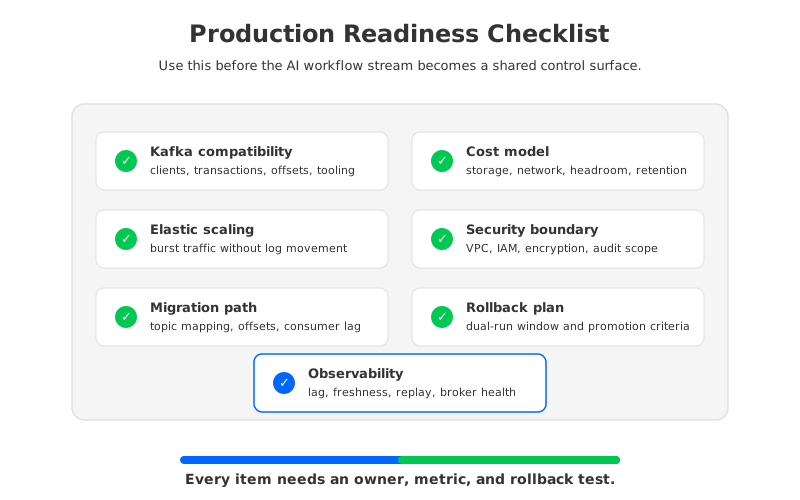
A good checklist starts with ownership. AI workflow events cross application, data, security, and SRE boundaries, so no single team can validate the platform alone. The AI platform team may define event contracts, but the data team owns downstream consumption, the security team owns access review, and SRE owns the failure modes. If those owners are not named, the architecture will look complete on a diagram and remain untested where it counts.
Use the first test workload to answer concrete questions:
- Can one workflow instance be reconstructed from Kafka records without reading application logs from five services?
- Does every event type have a schema owner, retention target, and access policy?
- Can a replay job run beside live traffic without starving workflow consumers?
- What happens to Consumer lag during a burst of tool calls or retrieval updates?
- Can the team migrate a topic and preserve consumer progress, or is the migration plan really a downtime plan?
- Which metrics will page SRE: end-to-end freshness, broker health, consumer lag, object-storage errors, or all of them?
5How AutoMQ Changes the Operating Model
If the evaluation points to broker-local storage as the constraint, AutoMQ is one Kafka-compatible Shared Storage architecture to test. AutoMQ is designed to preserve Kafka protocol and API compatibility while replacing broker-local durable storage with S3Stream, WAL storage, data caching, and S3-compatible object storage. That matters for AI workflow orchestration because the platform can keep the Kafka ecosystem while changing the part of the system that usually makes scaling and recovery operationally heavy.
The most important change is that AutoMQ Brokers are stateless brokers. Durable data is not anchored to the local disk of the broker that happened to lead a partition. When compute and storage are separated, adding or replacing brokers becomes less dependent on copying large partition logs between machines. For AI workflow traffic, that changes the capacity conversation from "how much disk should each broker carry?" to "how much compute and cache do we need for the current freshness target?"
The second change is retention economics and recovery shape. Object-storage-backed durability lets teams model longer-lived context and decision history without assuming every retained byte must sit on hot broker disks. WAL storage still matters because the write path needs a durable buffer before data is uploaded and organized in object storage. The right WAL type depends on deployment form and latency requirements, so production evaluation should test the actual WAL configuration rather than treating all shared-storage designs as identical.
The third change is deployment boundary. AutoMQ BYOC runs the control plane and data plane in the customer's cloud account, and AutoMQ Software is available for private environments. For AI workflow events, that boundary can be decisive because context events may include customer data, tool outputs, prompt references, or decision records. A platform team can evaluate Kafka-compatible operations while keeping infrastructure, buckets, network policy, and access review inside its own governance model.
AutoMQ does not remove the need for event design. You still need keys that preserve per-workflow ordering, schema evolution rules, dead-letter handling, freshness SLOs, and replay procedures. It changes the infrastructure constraints under those decisions. When the pain is broker-local storage, cross-AZ replication traffic, or slow partition movement, a Shared Storage architecture gives the platform team a different operating model to validate.
6Migration and Readiness Scorecard
Treat migration as a rehearsal, not a cutover date. The smallest useful exercise is one representative workflow stream with real schema, real consumers, and a real rollback plan. Mirror the topic, run consumers in observation mode, compare lag and event counts, and decide what "ready to promote" means before any production endpoint changes.
Score each category from 0 to 2:
| Category | 0 | 1 | 2 |
|---|---|---|---|
| Event contract | Events are informal logs | Schemas exist but ownership is partial | Schemas, owners, and compatibility rules are defined |
| Replay | Manual log search | Replay job exists for one path | Replay is tested beside live traffic |
| Freshness | Lag is observed after incidents | Lag dashboards exist | Freshness SLOs page the right owner |
| Scaling | Capacity is manually preallocated | Scale runbook exists | Burst test validates scale and recovery |
| Governance | Access follows service defaults | Sensitive topics are separated | IAM, encryption, audit, and retention are reviewed |
| Migration | Endpoint switch is the plan | Dual-run is documented | Offset, rollback, and promotion are tested |
The search for ai workflow orchestration events kafka starts with a workflow problem, but it ends with a storage, replay, and operations question. If your current Kafka model is making freshness, retention, migration, or governance harder than the AI workload itself, use the checklist above with one real workflow stream. To test a Kafka-compatible Shared Storage architecture in your own environment, start with AutoMQ BYOC.
7FAQ
7.1Is Kafka required for AI workflow orchestration events?
No. A workflow engine, database, or task queue may be enough for small systems. Kafka becomes useful when multiple teams need durable replay, fan-out, Consumer group coordination, Offset tracking, and a shared event contract across workflow, audit, observability, and data pipelines.
7.2How should AI workflow events be partitioned?
Partition by the identifier that needs ordering. For many systems, that is a workflow instance, case ID, account ID, or customer ID. Avoid partitioning only by event type if one workflow's state transitions must be read in order.
7.3What is the biggest Kafka risk for AI workflow traffic?
The biggest risk is treating orchestration events as generic logs. AI workflows need freshness, replayability, governance, and explainability. If those requirements are not designed into topics, schemas, retention, and access controls, Kafka will store events without making the workflow easier to operate.
7.4Where does AutoMQ fit in this architecture?
AutoMQ fits when the team wants Kafka-compatible behavior but needs a different operating model for storage, scaling, and customer-controlled deployment boundaries. It is most relevant when broker-local storage, data movement, cross-AZ traffic, or retention growth is already part of the production problem.
8References
- Apache Kafka 4.3 Documentation: APIs
- Apache Kafka 4.3 Documentation: Design
- Apache Kafka 4.3 Documentation: KRaft
- Apache Kafka 4.3 Documentation: Kafka Connect
- Apache Kafka 4.3 Documentation: Tiered Storage
- AutoMQ Documentation: Architecture Overview
- AutoMQ Documentation: Compatibility with Apache Kafka
- AutoMQ Documentation: Kafka Linking Overview
- AWS Documentation: Amazon S3 Data Consistency


