
Table of Contents
Table of Contents
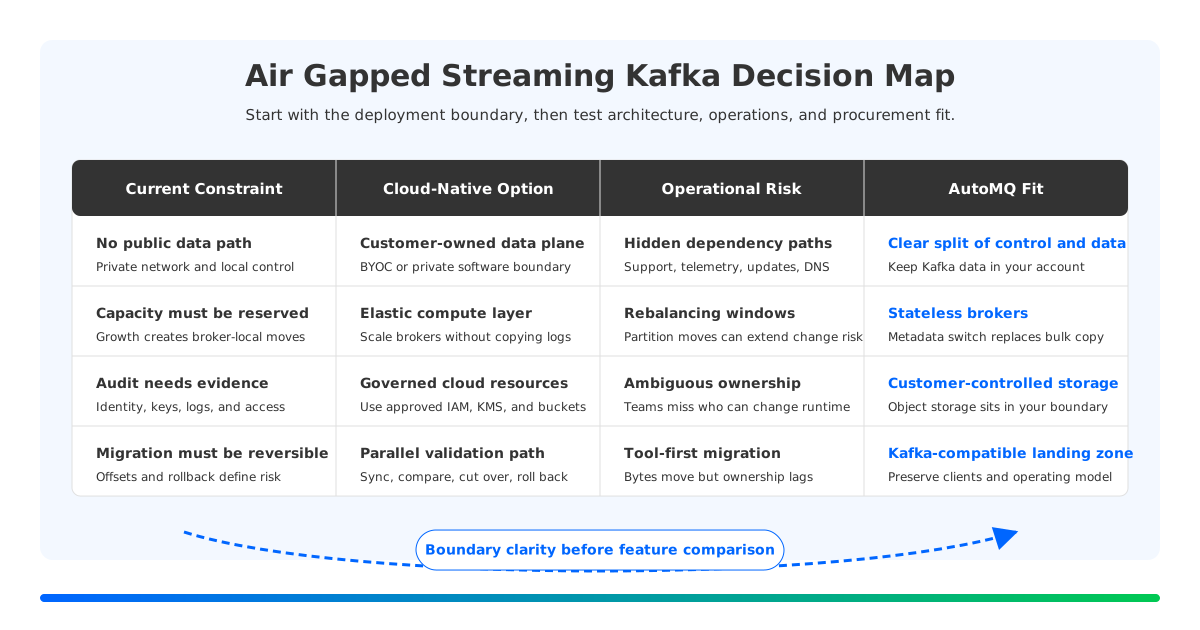
Teams rarely search for air gapped streaming kafka because they want a textbook definition of isolation. They search because a production decision is stuck. A security team may require that event data never leave a controlled network. A platform team may need Kafka-compatible APIs without opening a public data path. A procurement team may be comparing SaaS, BYOC, and self-managed software when each vendor uses "private" differently. The hard part is proving where the boundary actually is.
That boundary matters because Kafka is not a small service sitting behind one endpoint. A production streaming platform includes producers, consumers, brokers, metadata, topic configuration, offsets, transactions, schemas, connectors, storage, logs, metrics, identity systems, network paths, upgrade tooling, and support access. If any piece crosses a boundary the buyer thought was closed, the architecture will fail review even if the broker feature list looks strong.
1Why teams search for air gapped streaming kafka
The phrase "air-gapped" often gets used loosely in cloud architecture. In its strictest form, an air-gapped environment has no network connection to external systems. Many enterprise streaming searches are broader: the team needs a Kafka-compatible deployment where the data plane, storage, keys, network traffic, and operational evidence stay inside a customer-controlled environment. Governed update paths, marketplace procurement, private connectivity, or read-only observability export must be explicit and reviewable.
The first question should be concrete: which data, metadata, and operational paths are allowed to leave the environment? Kafka's API surface makes this bigger than producer and consumer traffic. Consumer group offsets define application progress, transactions affect correctness, Connect workers may carry source-system position, and monitoring may expose topic names, client IDs, tenant labels, or throughput patterns. These are not always business payloads, but security teams still need to know where they go.
For platform buyers, the answer usually falls into three deployment patterns:
- Self-managed Apache Kafka in a private environment. This gives the customer direct control over runtime, disks, network, and upgrades, but it also keeps the full operational burden inside the team.
- BYOC Kafka or Kafka-compatible streaming. The data plane runs in the customer's cloud account or VPC while the provider supplies automation, lifecycle management, support, or a control layer. The exact boundary must be verified, not assumed.
- Private software deployment. The platform runs in a customer data center or isolated private environment, often with stronger requirements around offline installation, internal artifact repositories, and customer-led operations.
Each pattern can be valid. The trap is treating them as feature tiers instead of boundary models. A SaaS-like experience inside a customer's cloud account may still depend on an external control path. A self-managed cluster may still use cloud storage, marketplace licensing, registries, or external observability. Buyers need a map that shows who owns each path before they compare latency, retention, or price.
2The production constraint behind the problem
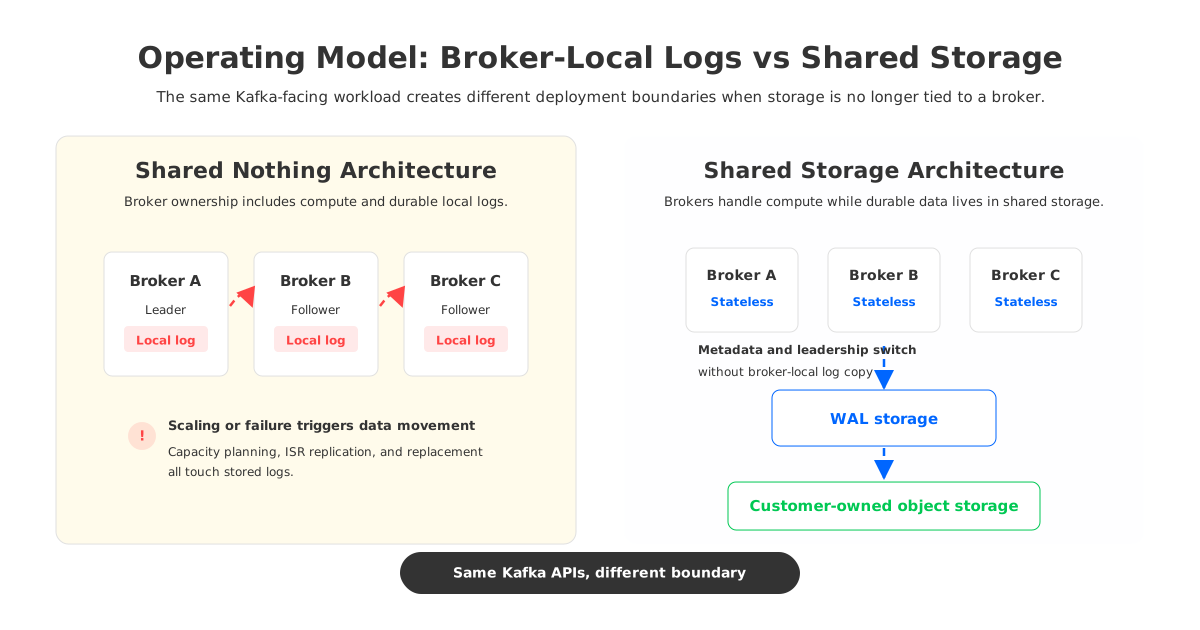
Traditional Kafka was designed around a Shared Nothing architecture: each broker owns local log storage, and durability comes from replication across brokers. In a tightly controlled cloud or private environment, that model turns isolation into a capacity and movement problem. Storage is tied to broker placement, rebalancing can require data movement, longer retention increases disk pressure, and adding brokers can still leave the team waiting for partitions and replicas to settle.
This matters for boundary-sensitive environments because approval does not stop at "Kafka works." Reviewers ask whether the system can grow without emergency firewall changes, whether storage can be encrypted and audited under customer keys, whether cross-zone traffic changes the cost model, whether a failed broker can be replaced without moving large volumes of data, and whether upgrades depend on a public network path.
Tiered Storage changes part of the storage story by moving older log segments to remote storage while keeping recent data on local disks. That can be useful for retention-heavy workloads, and Apache Kafka documents Tiered Storage as part of the broader Kafka feature set. It does not fully remove the broker-local operating model. Hot data, leadership, local disk sizing, and reassignment behavior still matter. For air-gapped platform buyers, the distinction is important: offloading historical data is not the same as making brokers stateless.
The same constraint appears in networking. PrivateLink-style services, private service connectivity, VPC peering, and internal load balancers can keep client traffic off the public internet, but private connectivity does not define the whole boundary. It does not answer who owns storage, which identities can change broker configuration, where logs are exported, how updates arrive, or how support access works.
3Architecture options and trade-offs
A practical architecture review compares deployment models by the questions they force the buyer to answer. The table below is not a vendor scorecard. It is a way to keep security, platform, finance, and procurement teams in the same conversation.
| Evaluation area | Self-managed Kafka | BYOC Kafka-compatible platform | Private software deployment |
|---|---|---|---|
| Data plane location | Customer environment | Customer cloud account or VPC, depending on provider design | Customer data center or private infrastructure |
| Operational ownership | Customer owns most runtime work | Shared responsibility between customer cloud team and provider automation | Customer-led operations with vendor support |
| Storage boundary | Local disks or customer-managed remote storage | Customer-owned cloud resources if designed that way | Customer-owned storage systems |
| Elasticity | Requires Kafka operations planning and reassignment management | Depends on architecture; shared-storage designs reduce broker-local movement | Depends on internal infrastructure capacity |
| Security review | High control, high evidence burden | Strong fit when paths and permissions are explicit | Strong fit for strict isolation, higher operational effort |
| Procurement model | Infrastructure plus support contracts | Cloud marketplace, subscription, or enterprise contract | Software license and support contract |
| Migration risk | Tooling and runbooks owned by customer | May include platform migration tooling; verify offset and rollback behavior | Customer-owned migration, often phased |
The strongest pattern depends on what the buyer is trying to protect. If the requirement is literal disconnection from external networks, private software or self-managed Kafka may be the cleanest fit. If the requirement is customer-owned data plane, customer cloud controls, and reduced day-to-day operations, BYOC can be attractive. If the requirement is fastest onboarding and the workload can run under a provider-managed boundary, a managed SaaS model may still be acceptable even though it is outside the air-gapped category.
Cost needs the same discipline. Buyers may focus on software subscription because it is visible during procurement, while the cloud bill carries architectural consequences. Traditional Kafka cost includes compute, storage, inter-zone replication traffic, load balancers, private endpoints, observability, backup, and operations time. Shared-storage designs shift the bill toward object storage, WAL storage, compute, requests, and network paths. Only a workload-specific model can prove whether that shift helps.
Governance is the second hidden cost. A platform that requires many exceptions may be slower to approve than one with a higher line-item price but cleaner boundaries. Security teams will ask for identity scopes, encryption responsibilities, telemetry content, support workflows, artifact sources, upgrade windows, audit log retention, and incident access. Procurement teams will ask how the platform is licensed, who pays cloud infrastructure charges, and how usage is measured.
4Evaluation checklist for platform teams
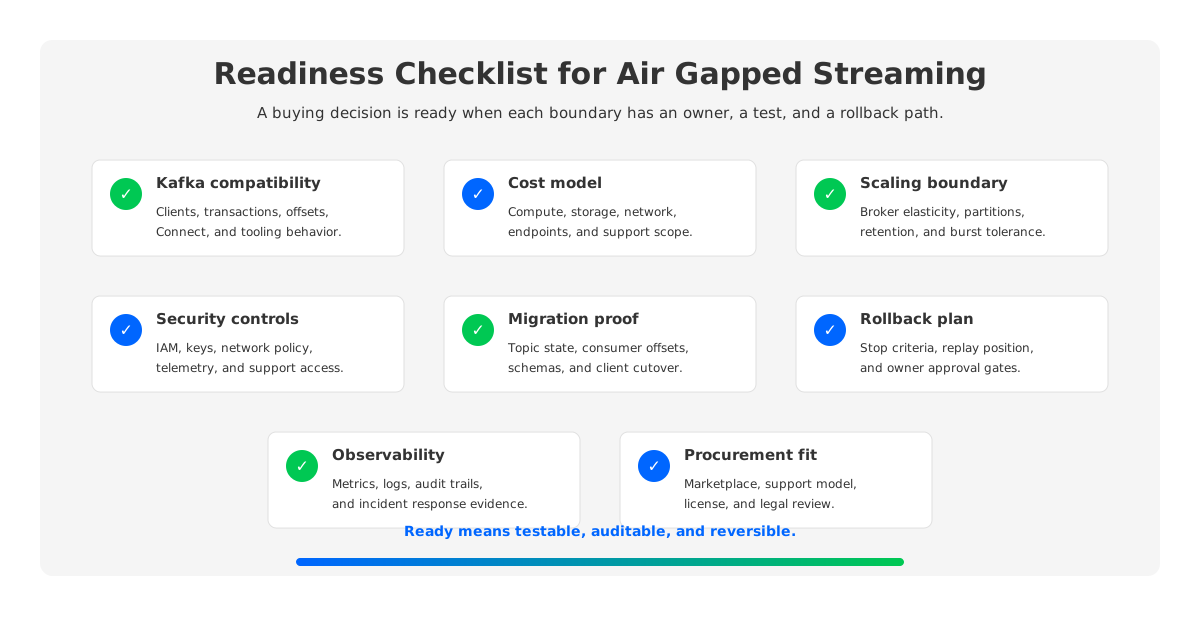
The most useful air-gapped Kafka checklist is not a list of product features. It is a set of review gates. Each gate should produce evidence before production traffic depends on the platform.
- Compatibility gate. Test the actual clients, serializers, transactional producers, consumer groups, admin operations, Kafka Connect jobs, and monitoring tools you run. Kafka-compatible does not only mean that a producer can write records.
- Boundary gate. Draw the data path, control path, telemetry path, update path, and support path. Mark which account, VPC, subnet, bucket, key, identity, and audit trail owns each one.
- Failure gate. Replace a broker, lose a zone, rotate credentials, throttle object storage, and break a network dependency in a controlled environment. The point is not drama; it is finding which recovery step depends on a path you intended to close.
- Migration gate. Validate topic configuration, schemas, offsets, consumer lag, connector state, producer cutover, DNS, and rollback. Moving bytes is only one part of moving a streaming platform.
- Cost gate. Model compute, storage, WAL storage, request volume, private connectivity, inter-zone or inter-region traffic, observability, support, and engineering time under the same workload assumptions.
- Operations gate. Confirm who can upgrade, pause, scale, patch, observe, and troubleshoot the platform. A boundary is only useful when responsibility is as clear as placement.
This checklist prevents a common buying mistake: approving an architecture because it passes a diagram review, then discovering that migration or support does not fit the same boundary. A platform that cannot be tested, audited, and rolled back is not ready for an air-gapped workload.
5How AutoMQ changes the operating model
Once the evaluation framework is clear, a different architectural question becomes possible: what if Kafka-compatible streaming could keep the client ecosystem while removing broker-local durable storage as the center of operations? AutoMQ is a Kafka-compatible cloud-native streaming platform built around Shared Storage architecture. It preserves Kafka protocol and API compatibility while moving durable streaming storage to S3-compatible object storage through S3Stream and WAL storage.
That storage change matters more than it first appears. In a Shared Nothing architecture, the broker is both a compute node and a storage owner. In AutoMQ, brokers are stateless for durable data: they handle Kafka-facing compute, leadership, caching, and request processing, while persistent data is stored in shared object storage. Partition reassignment no longer has to mean copying broker-local logs across machines. Scaling and broker replacement become closer to compute orchestration problems than storage migration projects.
For boundary-sensitive buyers, this gives AutoMQ two relevant deployment models. AutoMQ BYOC is designed for customer cloud accounts and VPCs, with control plane and data plane components deployed in the customer's environment. AutoMQ Software is designed for private data centers or private infrastructure. The buyer can reason about data plane placement, object storage ownership, control plane responsibilities, operational authorization, and support access as separate review items.
Shared Storage architecture also changes cost and governance. Customer-owned object storage can align durable data with cloud controls, bucket policies, encryption, lifecycle management, and audit evidence. Stateless brokers reduce the operational penalty of scaling compute separately from retained data. AutoMQ's zero cross-AZ traffic design is relevant when deployment and storage are designed around that goal. These are architectural levers, not blanket promises.
Migration should be treated with the same care. AutoMQ's Kafka compatibility reduces client-side change for many workloads, but compatibility is not a substitute for a cutover plan. Platform teams should still test offsets, consumer group behavior, transactions, connector state, security configuration, observability, and rollback. AutoMQ Linking can be part of that migration strategy for supported commercial deployments, while open and vendor-neutral Kafka tooling may be appropriate in other cases. The buyer's job is to prove the migration boundary before the production date is fixed.
6A buyer-ready decision framework
An air-gapped streaming decision is ready when the team can answer five questions without relying on vendor shorthand.
- Where does business data live at rest and in motion? Include records, offsets, schemas, connector state, logs, metrics, and backups.
- Which external paths exist by design? Include licensing, support, telemetry, package updates, marketplace activation, and emergency access.
- What changes during failure or scaling? Include broker replacement, zone loss, storage throttling, partition movement, and credential rotation.
- How does migration preserve application correctness? Include producer cutover, consumer progress, transactional behavior, connector state, and rollback.
- Who owns each control? Include cloud IAM, encryption keys, network policy, object storage, cluster configuration, observability, and upgrade approval.
The best platform for one team may be wrong for another because "air-gapped" is not one requirement. It can mean no public data path, no provider-operated runtime, no external control dependency, no telemetry export, or no internet-connected artifact source. Write the definition down before the shortlist begins. Then force every platform, including self-managed Kafka, through the same boundary test.
If your team is evaluating customer-controlled Kafka-compatible streaming for BYOC or private environments, review AutoMQ's deployment and architecture materials, then test the boundary with your own clients and controls. Start with AutoMQ BYOC when you want a managed operating model inside your cloud boundary, or use the open-source path to validate Kafka-compatible behavior before a commercial review.
7FAQ
7.1Is air-gapped streaming Kafka the same as private networking?
No. Private networking controls how clients and services communicate. Air-gapped or boundary-sensitive streaming also asks where data is stored, where operational metadata goes, who can change runtime resources, how updates arrive, and how support access is governed.
7.2Is BYOC Kafka always air-gapped?
No. BYOC means the deployment runs partly or fully in the customer's cloud environment, but each provider defines control paths, telemetry, support access, and update mechanisms differently. A BYOC platform can be a strong fit for customer-owned data plane requirements, but it still needs a boundary review.
7.3When is self-managed Apache Kafka the better choice?
Self-managed Kafka can be the better choice when the environment must be strictly disconnected, when internal teams already have strong Kafka operations capability, or when the organization needs full runtime control over every component. The trade-off is operational burden: scaling, rebalancing, upgrades, failure recovery, and capacity planning remain customer-owned.
7.4What should security teams ask first?
Ask for a data-flow and control-flow diagram that separates producer and consumer traffic, broker runtime, storage, keys, logs, metrics, support access, software updates, and licensing. Then ask which paths can be disabled, restricted, audited, or operated through an internal process.
7.5How does Shared Storage architecture help with air-gapped streaming?
Shared Storage architecture separates durable data from broker-local disks. In AutoMQ, stateless brokers use WAL storage and S3-compatible object storage, which can make scaling, broker replacement, and storage governance easier to reason about. It does not remove the need for security review, but it changes the operating model that review evaluates.
8References
- Apache Kafka Documentation
- Apache Kafka KRaft Documentation
- Apache Kafka Connect Documentation
- AutoMQ Compatibility with Apache Kafka
- AutoMQ Shared Storage Architecture
- AutoMQ BYOC Environment Overview
- AutoMQ Zero Cross-AZ Traffic Overview
- AWS PrivateLink Documentation
- Google Cloud Private Service Connect Documentation


