
Table of Contents
Table of Contents
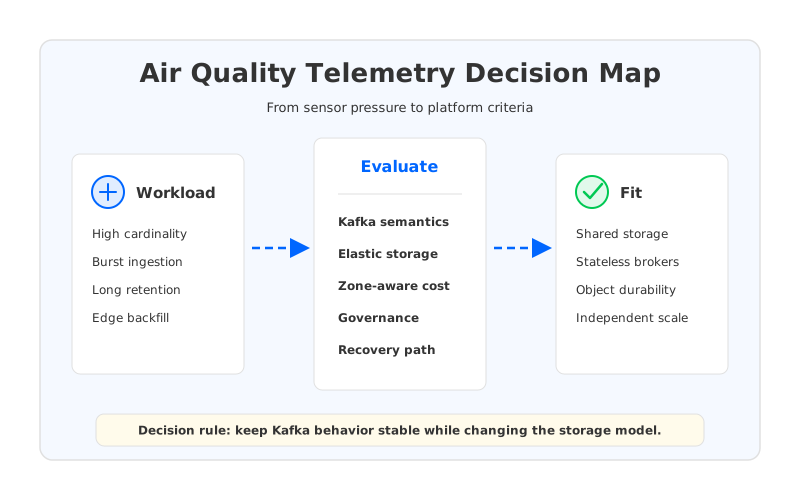
Air quality telemetry looks tidy on a dashboard and messy everywhere else. A city project might start with a few fixed stations, then add rooftop sensors, mobile sensors, indoor devices, industrial monitors, weather feeds, and calibration data from third-party labs. Each device emits small records, but the operational shape is not small: high cardinality, uneven connectivity, retry storms from edge gateways, and retention requirements that outlive the original pilot budget.
That is why teams search for air quality telemetry kafka after the first architecture diagram stops matching production. Kafka is a natural fit for sensor-heavy applications because it gives producers, consumers, replay, ordering within partitions, consumer groups, and a large ecosystem of connectors and stream processors. The harder question is not whether Kafka-shaped streaming helps. The harder question is which Kafka-compatible operating model can absorb sensor growth without turning storage, cross-zone traffic, and rebalancing into the platform team's daily work.
1Why Teams Search for air quality telemetry kafka
Air quality systems have a particular mix of requirements. They ingest readings from particulate matter sensors, gas sensors, weather stations, location sources, and device-health signals. They need near-real-time views for public health alerts, but they also need historical replay for model training, sensor calibration, compliance evidence, and late-arriving corrections. The same stream may feed a public dashboard, an anomaly detector, a lakehouse table, a forecasting model, and an operations console.
Kafka works well when those consumers move at different speeds. A dashboard can read the latest window, a data lake sink can batch writes, and a model pipeline can replay a historical range without asking every producer to resend data. Kafka consumer groups and offsets are especially useful here because each downstream application can track progress independently while sharing the same topic.
The pressure starts when device count, retention, and fan-out grow together. More sensors usually mean more partitions or more throughput per partition. Longer retention means more data sitting in the streaming layer before it is compacted, aggregated, or exported. More downstream consumers mean more read traffic, more lag conditions, and more operational noise when one pipeline falls behind. At that point, the streaming platform is no longer a neutral pipe. It becomes the boundary between field operations, analytics, machine learning, and compliance.
2The Production Constraint Behind the Problem
The uncomfortable part of air quality telemetry is that the workload is bursty in ways that are hard to schedule. Wildfire smoke, dust events, factory incidents, and large public events can all create temporary spikes in readings, alerts, and dashboard traffic. Edge gateways may lose connectivity and reconnect later, pushing buffered records in bursts. Maintenance teams may also replay old data to correct a calibration error or rebuild derived features.
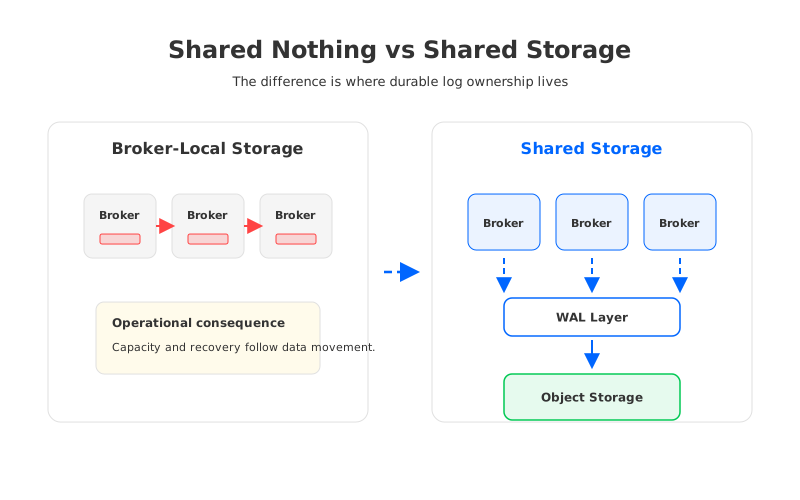
Traditional Kafka can handle large workloads, but its shared-nothing architecture ties durable log storage to broker-local disks. That coupling matters because a capacity change is not only a compute change. Adding brokers can require partition reassignment. Rebalancing moves data. Expanding retention can require more broker-local storage. Replacing failed nodes requires recovery of local state. These are understood Kafka operations, but in telemetry systems they arrive during the same period when the business wants more sensors and more historical data.
The cost model follows the same coupling. Replication protects availability, yet replica traffic often crosses availability-zone boundaries in cloud deployments. Consumers reading from another zone can add more network movement. Long retention increases disk pressure even if most old data is rarely read. A pipeline that looked efficient at a pilot scale can become expensive because the storage model makes every byte participate in broker placement and recovery decisions.
3Architecture Options and Trade-Offs
Most teams evaluate three broad options for air quality telemetry. A self-managed Kafka cluster gives maximum control, but the team owns broker sizing, partition strategy, disk expansion, upgrades, connector operations, and incident response. A managed Kafka service reduces infrastructure work, but the underlying shared-nothing model can still expose the team to partition, broker, and retention planning. A Kafka-compatible cloud-native streaming platform changes the storage and scaling model while keeping Kafka clients and tooling in the picture.
The decision should not start with a vendor comparison. It should start with the failure modes and operating boundaries that the application cannot tolerate.
| Evaluation area | What to test | Why it matters for air quality telemetry |
|---|---|---|
| Kafka compatibility | Producer configs, consumer groups, offsets, transactions, ACLs, and connector behavior | Existing gateways, stream processors, and lake sinks should not need a rewrite. |
| Storage elasticity | Retention growth, catch-up reads, and node replacement | Historical replay and calibration backfills should not force emergency broker storage work. |
| Network cost | Cross-zone replication, consumer locality, and private connectivity | Sensor-heavy workloads create many small records, and fan-out can amplify movement. |
| Governance | Topic naming, schema policy, access control, and audit boundaries | Environmental data often crosses city, industrial, and research teams. |
| Recovery path | Broker failure, zone impairment, replay from offsets, and rollback | Operators need recovery behavior they can rehearse before an incident. |
| Migration risk | Dual running, consumer cutover, offset handling, and validation windows | Field devices are harder to coordinate than backend services. |
This matrix is deliberately plain. A platform that scores well on paper but cannot run the team's existing Kafka clients is a migration project, not a streaming infrastructure decision. A platform that preserves client behavior but keeps the same storage scaling constraints may reduce some operational work while leaving the hardest capacity problems in place. The useful question is where the platform removes work from the steady state, not where it looks clean in a reference diagram.
4Design Patterns for Sensor-Heavy Kafka Pipelines
Topic design should separate physical sensor readings from derived interpretations. Raw readings, device health events, calibration updates, and alert decisions have different retention, ordering, and access-control needs. Combining them into one broad topic makes early development fast, but it forces every downstream consumer to parse data it does not own. Separating them lets platform teams tune partitioning, retention, compaction, and permissions around the actual lifecycle of each data type.
Partitioning deserves the same discipline. Partitioning by device ID preserves order for a device, which is useful for calibration and anomaly detection. Partitioning by region can improve locality for regional consumers, but it may create hot partitions during localized events. Some teams use a composite key such as region plus device ID to balance these concerns. The right answer depends on whether the most important read path is per-device history, regional aggregation, or low-latency alerting.
Downstream pipelines should assume delayed data. Edge devices will reconnect after outages, gateways will retry, and sensors will sometimes be recalibrated after the fact. Kafka offsets give consumers a stable progress model, but application logic still needs event time, ingestion time, idempotent writes, and clear rules for correction records. The streaming layer should make replay possible; it cannot define the scientific meaning of a corrected measurement.
Operationally, the strongest pattern is to keep the ingestion path boring. Use Kafka-compatible producers at gateways or ingestion services, keep records small and schema-governed, avoid synchronous calls from the hot path to external databases, and push enrichment into downstream processors. The ingest topic is the system of record for the telemetry stream. Everything downstream can be rebuilt if that log is durable, readable, and governed.
5Evaluation Checklist for Platform Teams
Before a platform team picks infrastructure, it should run a readiness review that looks more like an operations drill than a product demo. Create a representative workload with realistic device cardinality, message size, burst behavior, consumer fan-out, and retention. Include delayed backfill from edge gateways. Include a catch-up consumer that reads older data. Include a sink connector or lakehouse writer because environmental telemetry rarely stays in Kafka alone.
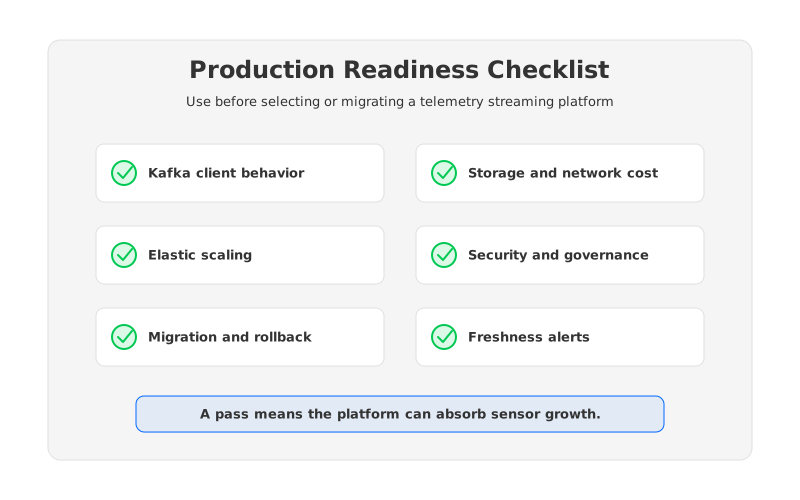
The review should answer these questions in writing:
- Can current Kafka clients connect without code changes beyond bootstrap, authentication, and expected configuration updates?
- What happens to broker, storage, and network utilization when retention doubles?
- How long does capacity expansion take, and does it require moving durable log data between brokers?
- Can consumers read from their own zone or locality boundary where the deployment model supports it?
- How are topics, ACLs, encryption, schemas, and audit trails managed across city, research, and operations teams?
- What is the rollback path if migration validation fails after some consumers have moved?
These questions expose hidden ownership. If the platform team owns all connector failures, schema drift, lag alerts, and replay requests, the chosen architecture must reduce routine work. If field engineering owns device connectivity but not Kafka operations, ingestion buffering and retry behavior need clear limits. If compliance owns retention policy, topic lifecycle and storage cost cannot be treated as an afterthought.
6How AutoMQ Changes the Operating Model
Once the evaluation points to storage coupling as the core constraint, a different architecture becomes relevant. AutoMQ is a Kafka-compatible cloud-native streaming system that keeps Kafka protocol compatibility while moving durable stream storage into a shared-storage architecture. The goal is not to make telemetry teams learn a different messaging model. The goal is to change the operational model underneath Kafka-compatible clients.
In AutoMQ, brokers are designed to be stateless relative to durable log ownership. A write-ahead log layer absorbs low-latency writes, while object storage provides durable, elastic storage for stream data. That separation changes the meaning of scaling. Adding or removing broker compute is less tied to moving large volumes of broker-local log data. Long retention is less likely to become a disk planning exercise on every broker. Recovery focuses on restoring service around shared durable storage rather than rebuilding a broker's local history as the primary path.
For air quality telemetry, the practical effect is straightforward: the platform can scale compute and storage along different curves. Sensor count and dashboard traffic affect compute and network paths. Retention and replay affect storage and read paths. These curves still need engineering work, but they no longer have to be packed into the same broker-local capacity plan. That matters when a public health event creates a short ingestion spike while the compliance team is asking for longer historical retention.
AutoMQ's Kafka compatibility is also important for migration. Teams can keep the Kafka API surface, client libraries, and much of the surrounding ecosystem while evaluating the storage model beneath it. Its documentation describes compatibility with Apache Kafka clients, a shared-storage architecture, WAL storage options, inter-zone traffic reduction, migration from Apache Kafka, and Table Topic for data lake ingestion. Those details matter because telemetry systems are rarely isolated. They sit between devices, dashboards, stream processors, warehouses, and object-storage-backed analytics.
There is still a trade-off to inspect. Shared storage changes broker operations, but it does not remove the need for schema governance, client tuning, observability, or incident drills. Object storage also has its own performance and request-cost model. A serious evaluation should test tail reads, catch-up reads, producer latency, consumer lag, connector throughput, and failure recovery under the team's actual message size and retention profile. Architecture helps most when it removes a structural bottleneck; it does not replace workload testing.
7Migration and Readiness Scorecard
A low-risk migration starts with compatibility rather than bulk data movement. First, inventory producers, consumers, Kafka Connect jobs, stream processors, ACLs, topic configs, and retention rules. Then run a parallel environment that mirrors representative topics and validates consumer behavior. The validation window should include normal ingestion, edge backfill, a delayed consumer, and at least one operational incident drill such as broker replacement or zone impairment.
Use a scorecard that separates "works in a demo" from "ready for production."
| Readiness item | Pass signal |
|---|---|
| Client compatibility | Existing producers and consumers pass functional tests with expected configuration changes. |
| Offset and replay behavior | Consumers can resume, reset, and replay ranges without data loss in validation. |
| Retention economics | Storage and network cost are modeled for the target retention period, not the pilot period. |
| Operational elasticity | Scaling and recovery are measured during bursts and catch-up reads. |
| Governance | Topic ownership, schema evolution, ACLs, and audit procedures have named owners. |
| Rollback | The team can return producers and consumers to the previous cluster during the migration window. |
The right time to introduce a cloud-native Kafka-compatible platform is when the scorecard shows that Kafka semantics are still the right interface, but broker-local storage is the wrong operating boundary. That is a common point in air quality telemetry: the application needs replay, fan-out, and ecosystem compatibility, while the platform team needs retention and elasticity to stop driving broker maintenance.
If your team is evaluating this architecture for sensor-heavy Kafka workloads, AutoMQ's technical team can help review the workload shape and migration path through the verified contact route: talk to AutoMQ.
8References
- Apache Kafka Documentation
- AutoMQ Architecture Overview
- AutoMQ Compatibility with Apache Kafka
- AutoMQ WAL Storage
- AutoMQ Inter-Zone Traffic Overview
- AutoMQ Migration Overview
- AutoMQ Table Topic Overview
- Amazon S3 User Guide
- Amazon S3 Performance Guidelines
- AWS PrivateLink Documentation
9FAQ
9.1Is Kafka a good fit for air quality telemetry?
Kafka is a strong fit when the system needs durable ingestion, replay, multiple downstream consumers, and independent consumer progress. Air quality telemetry often has those requirements because the same readings feed dashboards, alerting, analytics, machine learning, and compliance workflows. The platform choice should still be tested against device cardinality, burst behavior, retention, and recovery requirements.
9.2How should air quality telemetry topics be partitioned?
Many teams start with device ID because it preserves per-device ordering. Regional keys can help aggregation and locality, but they may create hot partitions during localized events. A composite key can balance device ordering and regional distribution. The right choice depends on the most important read path and should be validated with production-like bursts.
9.3What is the main risk in traditional Kafka for this workload?
The main risk is not Kafka semantics. It is the coupling between broker compute and broker-local durable storage. As sensors, retention, and consumer fan-out grow, that coupling can turn scaling, rebalancing, recovery, and cross-zone traffic into recurring operational work.
9.4Where does AutoMQ fit?
AutoMQ fits when a team wants to preserve Kafka-compatible clients and semantics while changing the storage operating model. Its shared-storage architecture and stateless broker design are useful for workloads where retention, elasticity, and recovery should not be governed by broker-local disk ownership.
9.5Should all telemetry data stay in Kafka forever?
Usually no. Kafka or a Kafka-compatible platform should hold the operational stream and the replay window required by downstream systems. Long-term analytics, model training, and regulatory archives often belong in object storage or lakehouse tables. The streaming platform should make that export reliable and replayable.


