
Table of Contents
Table of Contents
If you are searching for "Aiven Inkless Kafka" or "Aiven vs AutoMQ," you are probably past the stage of asking whether Kafka should move away from broker-attached disks. KIP-1150 has made the direction clear: Kafka's storage layer is moving toward object storage. The harder question is which diskless design you can trust with production traffic in 2026.
Aiven Inkless and AutoMQ both attack the same cloud Kafka problem: local disks, broker-to-broker replication, cross-AZ traffic, and slow scaling loops. But they put coordination in different places. That single decision changes availability, Kafka feature coverage, deployment control, and migration risk.
1Same Direction, Different Write Path
The cleanest way to compare diskless Kafka platforms is to ignore the word "diskless" for a moment and trace an acknowledged write. Object storage is durable, elastic, and regionally available, but it does not remove the need for ordering. Kafka still has to decide which offset a record receives, which batch contains it, where the batch is stored, and what happens if a broker fails halfway through the write.
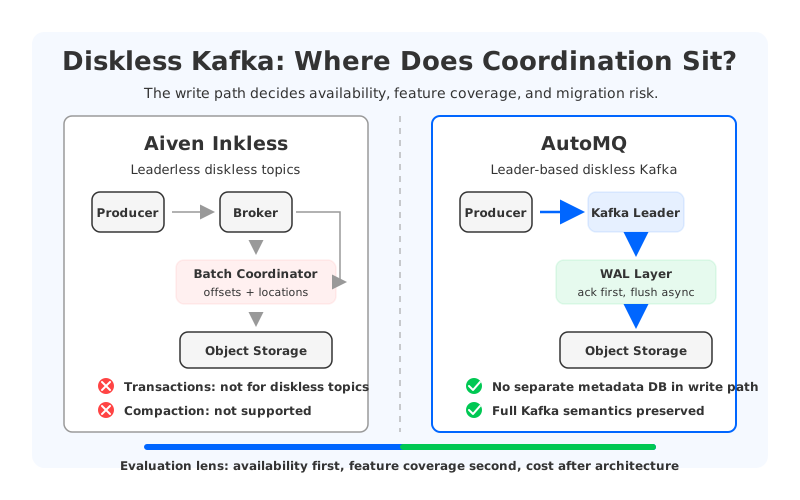
Aiven's diskless topics architecture solves that with a leaderless data layer and a Batch Coordinator. Brokers write messages in batches to object storage, and each batch is registered with the coordinator, which tracks offset ranges and object locations. The upside is flexible broker placement and less inter-broker replication for diskless topic data. The trade-off is that the coordinator becomes part of the successful write path for diskless topics.
AutoMQ takes the opposite route. It is built on the Apache Kafka codebase and keeps Kafka's leader-based write ownership, while replacing the storage layer under the log segment abstraction with a diskless engine. Writes go through the Kafka leader into a WAL layer, then flush to object storage asynchronously. The data path does not depend on a separate metadata database for every produced batch, so the availability model stays closer to the Kafka model that operators already understand.
| Dimension | Aiven Inkless | AutoMQ |
|---|---|---|
| Diskless model | Opt-in diskless topics inside an Aiven Kafka service | Diskless storage architecture for Kafka workloads |
| Write ownership | Leaderless diskless topic data path | Kafka leader-based write path |
| Coordination dependency | Batch Coordinator tracks offsets and object locations | Kafka metadata plus WAL, with no separate metadata DB in the message write path |
| Object storage role | Durable store for diskless topic data | Durable store for retained Kafka data |
| Operational implication | Strong fit for append-heavy topics that can accept diskless topic limits | Strong fit when the goal is diskless economics with Kafka semantics preserved |
This is why "diskless Kafka comparison" is not a storage checklist. A system can remove broker disks and still introduce a coordination dependency that changes its failure model. For platform teams, the relevant question is not whether S3 or object storage appears in the architecture. The question is what has to be alive before a producer gets an acknowledgment.
2Aiven Inkless: KIP-1150 Energy, Explicit Topic Limits
Aiven deserves credit for pushing diskless topics into the Apache Kafka conversation. Inkless is a concrete implementation around the KIP-1150 direction, and Aiven's public docs are unusually clear about how diskless topics differ from classic topics. That clarity is useful because it shows where the design is strong and where buyers need a migration plan.
The leaderless model helps reduce broker-to-broker replication for diskless topic data. A broker can access the shared object-storage layer, and Aiven describes AZ-aware affinity to reduce cross-zone traffic. For high-throughput logging, event collection, analytics buffers, and long-retention append workloads, that is an attractive direction. Many Kafka estates have a large class of topics that behave this way.
The limits matter when your Kafka estate is not a pure append-and-scan system. Aiven's limitations page states that diskless topics do not support transactions, compacted topics, or Kafka Streams state stores, and classic or tiered topics cannot be converted into diskless topics. The same page also describes an internal metadata service; in BYOC deployments, enabling diskless topics creates an Aiven for PostgreSQL service in the project, required for diskless topics to function.
That does not make Inkless a bad architecture. It makes Inkless a specific architecture. If your workload can separate diskless topics from classic topics, the model may fit. If your platform relies on transactional producers, compacted changelog topics, Kafka Streams state stores, or queue-related Kafka feature work, the evaluation has to happen topic by topic rather than cluster by cluster.
3AutoMQ: Diskless Storage Without Giving Up Kafka Semantics
AutoMQ starts from a different premise: Kafka's compute layer is the part teams want to keep. The protocol, consumer groups, transactions, compaction, Connect compatibility, Streams behavior, operational tools, and edge-case semantics represent years of production hardening. The expensive part in the cloud is the storage layer and its replication pattern, so AutoMQ changes that layer instead.
AutoMQ's Kafka compatibility documentation explains the implementation cut point: AutoMQ reuses the Apache Kafka compute layer and replaces the storage layer around log segments with S3Stream and a WAL-based architecture. The docs state that AutoMQ passes 500+ Apache Kafka system test cases in KRaft mode, covering message send/receive, consumer management, topic compaction, partition reassignment, rolling restart, Streams, and Connector testing.
That design choice is the availability argument. AutoMQ does not ask every produced batch to round-trip through a separate metadata service before the write can be accepted. The broker leader owns ordering, the WAL absorbs the write, and object storage becomes the durable retained data layer. Metadata still exists, of course; Kafka cannot operate without metadata. The difference is that normal message writes are not gated by an external ordering database.
The result is less dramatic on a whiteboard and more useful in production. Existing Kafka applications can keep their semantics while the infrastructure team removes broker-local retained storage, shrinks cross-AZ replication traffic, and turns partition reassignment into a metadata operation rather than a data-copying event.
4Feature Coverage Is the Migration Test
Diskless topics are not evaluated by throughput alone. A platform that handles append-only telemetry well can still fail a migration if a handful of compacted or transactional topics sit in the critical path. Kafka teams know this pattern: the average topic is boring, and the dangerous topic is the one that carries identity state, payment events, inventory updates, or stream-processing state.
| Kafka capability | Aiven Inkless diskless topics | AutoMQ |
|---|---|---|
| Transactions | Not supported for diskless produce or consume operations in Aiven docs | Supported through Kafka semantic compatibility |
| Compacted topics | Not supported for diskless topics in Aiven docs | Supported through Kafka semantic compatibility |
| Kafka Streams state stores | Not supported on diskless topics as write targets in Aiven docs | Covered by Kafka compatibility testing |
| Classic-to-diskless conversion | Not supported in Aiven docs | Not a per-topic diskless conversion model |
| Queue-related Kafka feature work | Needs validation against diskless topic limits | Closer to Kafka-native semantics because the compute layer is retained |
The practical reading is straightforward. Aiven Inkless can be a strong fit when diskless topics are selected deliberately for append-heavy data. AutoMQ is the stronger fit when the migration goal is to make Kafka diskless without splitting the estate into "full Kafka topics" and "limited diskless topics."
5Production Maturity: Architecture Has to Survive Real Traffic
KIP-1150 is an important market signal because it shows that Apache Kafka is moving toward diskless topics. But acceptance of a KIP and production maturity are different milestones. KIP-1150 establishes direction; implementation details live in follow-up work such as KIP-1163 and KIP-1164. That means buyers should separate "the community agrees with the direction" from "the implementation is ready for every workload."
AutoMQ reached the market earlier and has had more time under real workloads. Public AutoMQ materials reference production deployments across JD.com, Grab, Tencent Music, LG U+, HubSpot, and other customers. The scale markers are not small: JD.com runs AutoMQ across a real-time data platform serving 1,400+ business lines, with customer materials describing 13 trillion messages per day and peak throughput above 100 GiB/s; Grab's public story describes reducing partition reassignment from 6+ hours to under 1 minute.
Those customer examples matter because diskless Kafka failure modes do not show up in a toy benchmark. They show up during broker replacement, partition reassignment, traffic spikes, cache misses, object storage turbulence, metadata maintenance, and consumer replay. A design that has passed through those operational loops has a different risk profile from a design that is still being mapped from proposal to broader production adoption.
6GitHub Signal: Community Attention and Release Timing
GitHub stars are not a substitute for architecture review, but they are a useful signal when two products both claim an open technical direction. As of May 7, 2026, the GitHub API shows a large difference in community attention and repository age.
| Repository | Created | Stars | Forks | License signal |
|---|---|---|---|---|
| AutoMQ/automq | 2023-08-17 | 9,809 | 699 | Apache-2.0 |
| aiven/inkless | 2024-09-24 | 90 | 10 | Apache-2.0 for original Kafka files; AGPL-3.0 for storage/inkless |
The interpretation should stay measured. Inkless is tied to Aiven's product and KIP-1150 work, so its GitHub star count does not capture every user of Aiven Kafka. Still, for an engineering team evaluating open implementation risk, repository age, license terms, forks, and community attention are fair questions. AutoMQ has been public longer, is Apache-2.0 licensed, and has a much larger visible developer audience.
7Deployment Control: Managed Service or Architecture You Can Run
Aiven Inkless is documented as an Aiven for Apache Kafka service for cloud deployments, available on Aiven Cloud and BYOC. That gives teams a managed service path and a gradual adoption model with classic and diskless topics in the same service. The trade-off is that the diskless capability is consumed through Aiven's service model, including its managed internal metadata behavior.
AutoMQ provides a different control profile. The open-source repository is available under Apache-2.0, and AutoMQ also offers BYOC and software deployment models. For regulated teams, platform teams with strong internal SRE practices, or companies that want source-level control over their Kafka infrastructure, that flexibility changes the exit-risk conversation. You are not evaluating a managed feature in isolation; you are evaluating an architecture you can inspect, deploy, and operate under your own constraints.
This deployment difference becomes more important as Kafka moves deeper into shared platform infrastructure. A logging cluster can tolerate a vendor-specific topic mode more easily than a company-wide event backbone. The broader the workload surface, the more valuable it becomes to keep Kafka semantics and deployment control aligned.
8Cost Follows the Availability Model
Both platforms target the same economic pain: traditional Kafka pays for broker disks, overprovisioned capacity, replica traffic across availability zones, and slow rebalancing. Moving retained data to object storage attacks all of those. But cost savings are not independent from architecture. If the path to lower cross-AZ traffic introduces a metadata service that every diskless write depends on, the bill may improve while the availability model becomes more complex.
AutoMQ's argument is that cost reduction should come from removing broker-local storage, not from moving Kafka semantics into a separate coordination plane. The WAL absorbs writes, object storage holds retained data, and Kafka's leader model keeps ordering where Kafka teams expect it. This is why the comparison cannot stop at "Aiven Kafka pricing" or "managed diskless Kafka." The lower monthly bill matters, but the cost model has to be read beside the failure model.
For buyers, the concrete next step is to price the workload and then replay the failure scenarios. Ask what happens when the coordinator is slow, when object storage latency rises, when a broker dies during a write, when a compacted topic needs migration, and when a Streams application writes state. The architecture that answers those questions with fewer special cases is usually the architecture that costs less to operate after the invoice is paid.
9When to Choose Which
Aiven Inkless is worth evaluating if you already use Aiven, want managed Kafka with opt-in diskless topics, and can clearly separate append-heavy workloads from topics that require transactions, compaction, or Kafka Streams state stores. It is also useful as a live expression of the KIP-1150 direction, especially for teams tracking upstream Apache Kafka design work.
AutoMQ is the better first test when your requirement is broader: diskless Kafka economics, production validation, full Kafka semantics, open-source control, and deployment flexibility. That fit is strongest for large Kafka estates where a topic-by-topic feature audit would slow migration, or where the platform team wants one architecture for log ingestion, transactional events, stateful stream processing, and long retention.
The diskless Kafka debate is no longer about whether object storage belongs in Kafka's future. It does. The deciding question is where you want complexity to live. Aiven Inkless moves diskless topics into a leaderless model with a coordinator. AutoMQ keeps Kafka's leader-based semantics and changes the storage layer underneath. If availability and compatibility are the first filters, that difference is the comparison.


