
Table of Contents
Table of Contents
Searching for Aiven Kafka usually means the team has moved past curiosity. Someone is no longer asking whether Apache Kafka is useful; they are asking which operating model should carry production traffic. Aiven enters that conversation as a managed service provider with Apache Kafka offerings, cloud deployment choices, and an operations model that can reduce the day-to-day burden of running brokers yourself. That is a valid starting point, but it is not yet an architecture decision.
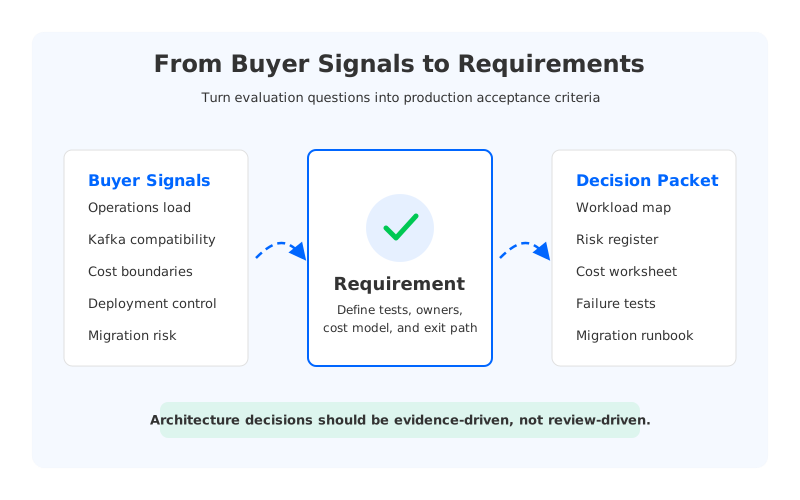
The hard part is translating buyer signals into requirements. A review, pricing page, vendor comparison, or product overview can tell you what people care about: operational effort, support quality, feature coverage, pricing, networking, migration work, and confidence in production behavior. Those signals are useful only when platform teams convert them into testable questions.
1Why Teams Search for Aiven Kafka
Aiven Kafka searches tend to come from three different groups inside the same company. Platform engineers want to know whether the service reduces broker operations without hiding too much of the data plane. SREs want to understand the blast radius of scaling, upgrades, disk pressure, and availability zone events. FinOps and procurement teams want pricing predictability, contract clarity, and a clean answer to who pays for storage, network transfer, support, and cloud resources.
Those groups often use the same keyword but mean different things by it. A platform owner may read "Aiven Kafka comparison" as a question about Kafka compatibility and operational control. A CTO may read it as a question about time-to-market and vendor risk. A FinOps lead may read it as a request to model monthly cost under high retention or high fan-out workloads. Treating all of those as one generic vendor evaluation misses the point.
The strongest evaluation starts with the workload, not the vendor. A fraud pipeline with low tolerance for producer latency has different requirements from observability ingestion, lakehouse ingestion, IoT telemetry, CDC replication, or event-driven microservices. The Kafka API may be common across those workloads, but the operating envelope is not.
2What Aiven Kafka Research Usually Covers
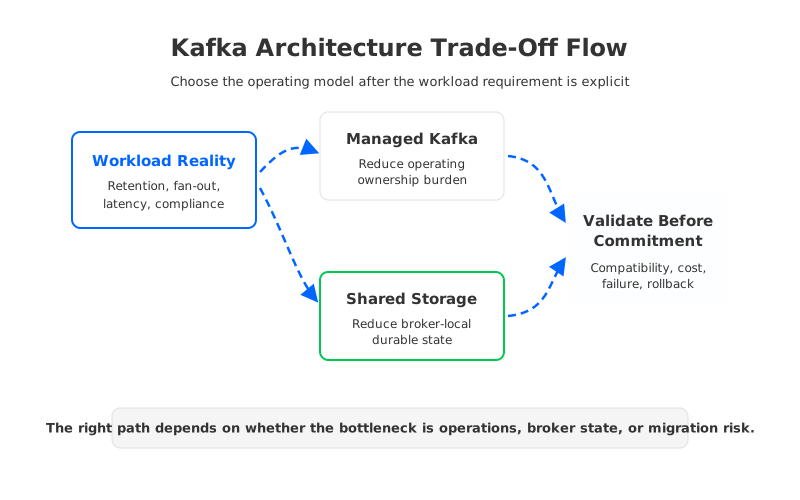
Public material around Aiven for Apache Kafka commonly answers buyer questions about managed operations, supported clouds, service plans, integrations, maintenance, and Kafka feature usage. Aiven documentation also distinguishes traditional Kafka service concepts from its Inkless Kafka direction, which uses object storage to change the storage behavior for supported topic types. That matters because buyers may be evaluating both a managed Kafka operating model and an architecture shift toward object storage-backed streaming.
Those are different decisions. Managed Kafka mainly changes who operates Kafka. Object-storage-backed Kafka changes how durable stream data is placed, recovered, and scaled. A procurement-led evaluation may focus on contract simplicity and support. A platform-led evaluation has to go deeper because storage architecture affects latency behavior, compatibility boundaries, recovery procedures, and the migration plan.
The useful buyer signals usually cluster into five areas:
- Operational load. Teams want fewer broker-level chores: patching, node replacement, disk expansion, partition reassignment, and routine incident handling. The requirement should specify which operational tasks are being delegated and which still remain inside the platform team.
- Kafka compatibility. Producers, consumers, Connectors, Streams applications, transactions, ACLs, compaction, and admin workflows are not optional details. The requirement should state the Kafka features used today and the features planned for the next 12 months.
- Cost boundaries. Kafka cost is not only broker hours. Storage, replication, cross-AZ traffic, private connectivity, observability, support, and migration labor can all move the number.
- Deployment boundary. Some teams care most about a fully managed service. Others need BYOC, private networking, customer-owned storage, or a clear split between control plane and data plane.
- Migration risk. The most expensive failure is not a failed proof of concept. It is a half-migrated estate with duplicated consumption, offset confusion, ACL drift, and no rollback path.
3Production Questions the First Pass Leaves Unanswered
The first pass through Aiven Kafka material can tell you whether the service deserves a deeper look. It cannot tell you whether your most important workload will behave well under failure, scale, or cost pressure. The missing questions are not obscure. They are the questions operators ask after the kickoff call is over.
Start with the write path. Which component acknowledges a produce request? Where is the write durably recorded before it is visible to consumers? How does the system fence stale writers, preserve partition ordering, and recover from a broker or zone failure? If an object-storage-backed path is involved, what sits between producer acknowledgment and final object storage persistence? Kafka teams do not need marketing labels here. They need the actual durability path.
Then move to the read path. Retention-heavy workloads often look inexpensive until consumer fan-out, cache misses, replay jobs, and cross-zone reads enter the model. A Kafka platform that feeds operational services, lakehouse pipelines, and backfills at the same time must be evaluated under mixed access patterns. A steady-state benchmark with hot consumers is not enough because the painful days are usually replay days.
Cost questions also need discipline. A managed Kafka quote may include service fees, but the full platform model may include cloud network transfer, PrivateLink or equivalent private connectivity, storage classes, monitoring export, schema registry, migration tooling, and retained engineering labor. If the workload is multi-AZ, the evaluation should model where bytes cross availability zones and who pays for that movement. AWS publishes Amazon MSK pricing and cloud networking charges separately for a reason: buyers have to assemble the full picture.
Finally, test governance and exit paths. Can the team export configurations, ACLs, topic definitions, and offsets in a form that supports rollback or migration? Can applications use standard Kafka clients without vendor-specific behavior becoming part of the application contract? Managed services often provide strong convenience, and that convenience is valuable. The question is whether the convenience becomes a hard dependency in the wrong layer.
4A Technical Evaluation Framework for Platform Teams
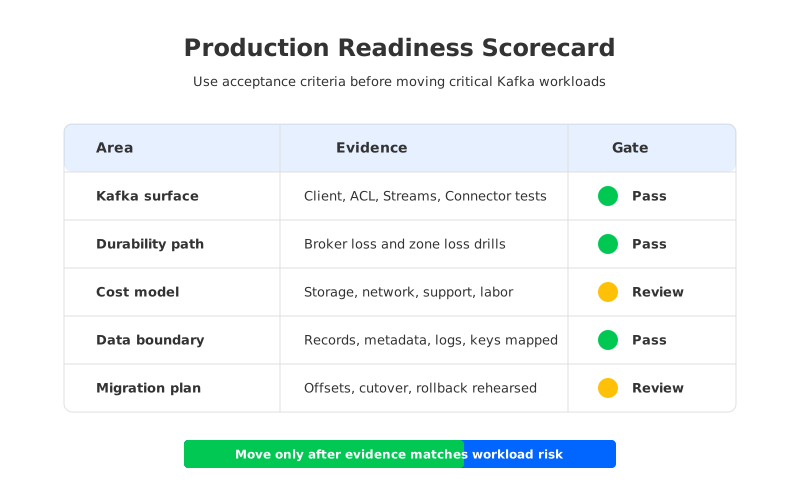
A practical evaluation should turn vague buyer concerns into acceptance criteria. The table below is deliberately vendor-neutral. It works for Aiven Kafka, Amazon MSK, self-managed Kafka, Confluent, Redpanda, AutoMQ, or any Kafka-compatible platform because it starts from production responsibility rather than product packaging.
| Decision area | Architecture requirement | Evidence to request |
|---|---|---|
| Kafka surface | Existing clients, Connectors, Streams jobs, ACLs, compaction, transactions, and admin scripts keep working or have documented exceptions. | Compatibility matrix, integration tests, workload-specific proof of concept. |
| Write durability | Produce acknowledgment, WAL behavior, replication or shared storage, and failure fencing are explicit. | Failure test results for broker loss, zone loss, and stale writer scenarios. |
| Read behavior | Hot reads, cold replay, consumer fan-out, and cache-miss behavior are measured under realistic retention. | Replay benchmark with your partition count, retention, and consumer groups. |
| Cost model | Broker, storage, network, connectivity, support, observability, and migration costs are modeled together. | Bill-of-materials worksheet with assumptions and sensitivity ranges. |
| Operating boundary | Ownership of data, metadata, logs, metrics, encryption keys, and control actions is clear. | Architecture diagram for customer account, provider account, VPC, and storage boundary. |
| Migration safety | Cutover, offset continuity, rollback, ACL parity, and duplicate-consumption prevention are designed before migration starts. | Migration runbook tested on non-critical topics before core workloads. |
The important part is not the table itself. The important part is the sequence. Compatibility comes first because application rewrites change the project from an infrastructure decision into a software migration. Durability and read behavior come next because they define whether the platform can carry the workload. Cost and operating boundary follow because they decide whether the architecture remains acceptable after the first month. Migration safety closes the loop because no target platform is useful if the team cannot reach it cleanly.
For procurement teams, this framework also changes the RFP language. Instead of asking "Do you support Kafka?" ask which Kafka protocol versions, admin APIs, security features, and ecosystem tools are covered. Instead of asking "Is storage lower cost?" ask how retention growth changes broker count, storage spend, network movement, and recovery time. Instead of asking "Do you support BYOC?" ask which components run in the customer account, which provider systems can access metadata, and where business records are stored.
That level of detail may feel demanding, but Kafka is rarely a peripheral system. It is usually the shared fabric between application teams, data teams, and operational systems. Weak requirements turn into weak handoffs between those teams. Strong requirements create a common language: what must stay compatible, what must become easier to operate, and what trade-offs are acceptable.
5Where Shared-Storage Kafka-Compatible Architectures Fit
Once the requirements are written down, a pattern usually appears. Many teams are not only trying to outsource Kafka operations. They are trying to reduce the coupling between broker lifecycle and durable data. Traditional Kafka stores log data on broker-attached disks and uses replication to protect availability. That model is proven, but in cloud environments it can make scale-out, scale-in, recovery, and cross-AZ traffic more expensive and operationally heavy than teams expect.
Shared-storage Kafka-compatible architectures attack that specific coupling. In this model, brokers continue to serve the Kafka protocol and coordinate with metadata, but durable stream data moves into a shared storage layer, often backed by object storage. The design goal is not to make Kafka disappear. The goal is to stop treating every broker replacement or capacity change as a bulk data movement event.
This is where AutoMQ becomes relevant in the evaluation. AutoMQ is a Kafka-compatible streaming platform that keeps the Kafka API and ecosystem surface while replacing broker-local persistent storage with S3Stream, a shared streaming storage layer backed by object storage. Its architecture uses a WAL path for writes and object storage for durable retained data, so the evaluation point is concrete: can a team preserve Kafka compatibility while reducing broker-local state, storage over-provisioning, and data rebalancing work?
That question should still be tested, not assumed. AutoMQ documentation describes Kafka compatibility, S3Stream shared storage, BYOC and software deployment paths, and migration capabilities such as AutoMQ Linking. For an Aiven Kafka evaluation, AutoMQ is not a rhetorical opposite. It is a different architecture category to place beside managed Kafka and other Kafka-compatible options when the main pain is broker statefulness rather than only operations staffing.
The fairest comparison is by workload. A team that mainly wants a managed Kafka service with familiar operations may prioritize service experience, support, and integration breadth. A team whose current Kafka estate is constrained by retention growth, cross-AZ traffic, slow rebalancing, or broker recovery should add shared-storage requirements to the evaluation. Both teams can be serious buyers. They are solving different problems.
6Turning the Evaluation into a Decision Packet
The final output should be a decision packet, not a slide with checkmarks. A good packet contains the current workload inventory, the target operating model, the compatibility matrix, the cost worksheet, the failure-mode test plan, and the migration runbook.
For Aiven Kafka specifically, the packet should separate the service decision from the storage architecture decision. Managed operations, support model, cloud availability, and integration ecosystem belong in one section. Topic type, object storage behavior, compatibility boundaries, and migration constraints belong in another. Mixing those sections creates confusion: a strength in managed operations does not automatically answer a durability-path question, and a storage innovation does not automatically answer a procurement-boundary question.
The cleanest decision packet usually includes four artifacts:
- A workload map showing topic families, producers, consumers, retention, throughput, fan-out, compliance constraints, and owner teams.
- A risk register mapping each major risk to a test, a mitigation, or an accepted trade-off.
- A cost model with low, expected, and high scenarios for retention growth, consumer replay, private connectivity, and multi-AZ operation.
- A migration plan that covers topic creation, ACL parity, producer cutover, consumer group progress, offset verification, rollback, and post-cutover monitoring.
This is more work than reading a product page. It is also less work than discovering architectural mismatch after the platform is already carrying business traffic.
If your team is comparing Aiven Kafka with Kafka-compatible shared-storage alternatives, start with the requirements rather than the vendor names. For workloads where broker-local storage, rebalancing, and cloud traffic dominate the pain, validate AutoMQ as part of that architecture track: explore AutoMQ Cloud with a representative topic set and test compatibility, cost behavior, and rollback before expanding the migration scope.
7References
- Aiven for Apache Kafka documentation
- Aiven Inkless Kafka topic overview
- Aiven for Apache Kafka best practices
- Apache Kafka documentation
- Amazon MSK pricing
- AWS PrivateLink documentation
- AutoMQ Kafka compatibility
- AutoMQ S3Stream shared storage overview
8FAQ
8.1Is Aiven Kafka the same as self-managed Apache Kafka?
No. Aiven for Apache Kafka is a managed service built around Apache Kafka, so the evaluation should include both Kafka feature compatibility and the managed-service operating model. Self-managed Kafka gives the platform team more direct control over brokers and infrastructure, but also leaves more operational work inside the team.
8.2What should teams compare beyond the monthly service price?
Compare broker resources, storage, network transfer, private connectivity, observability export, support, migration tooling, and retained engineering effort. Kafka cost often changes under retention growth, consumer replay, and multi-AZ traffic, so a single steady-state quote can understate the full platform cost.
8.3When does a Kafka-compatible shared-storage architecture deserve evaluation?
Evaluate shared storage when the current pain comes from broker-local data ownership: slow recovery, heavy partition reassignment, storage over-provisioning, difficult scale-in, or high cross-zone replication cost. In that case, the architecture requirement is not only "managed Kafka"; it is "Kafka compatibility with less broker-bound durable state."
8.4How should an Aiven Kafka migration be tested?
Test a representative topic family before moving core workloads. Include producer cutover, consumer offset continuity, ACL parity, schema and Connector behavior, replay, rollback, and monitoring. The goal is to prove the migration workflow, not only the target cluster.
8.5Where does AutoMQ fit in this decision?
AutoMQ fits the shared-storage Kafka-compatible architecture track. It is relevant when teams want to preserve the Kafka API and ecosystem while changing the storage model beneath brokers. It should be evaluated with the same workload-specific compatibility, failure, cost, and migration tests as any other production Kafka platform.


