
Table of Contents
Table of Contents
Teams rarely search for "Aiven Kafka" because they need a definition of Kafka. They already know Kafka is in the critical path of analytics, CDC, fraud detection, observability, or customer-facing event flows. The real question is whether Aiven for Apache Kafka is the right operating model for the next stage of that platform.
Aiven is a credible managed data platform vendor, and its Kafka service gives teams a way to consume Apache Kafka without owning every broker, upgrade, backup, and day-2 operation themselves. That can be exactly the right trade-off. But enterprise Kafka decisions are not made on "managed versus self-managed" alone. The bigger decision is where the cost boundary, control boundary, and recovery boundary sit.
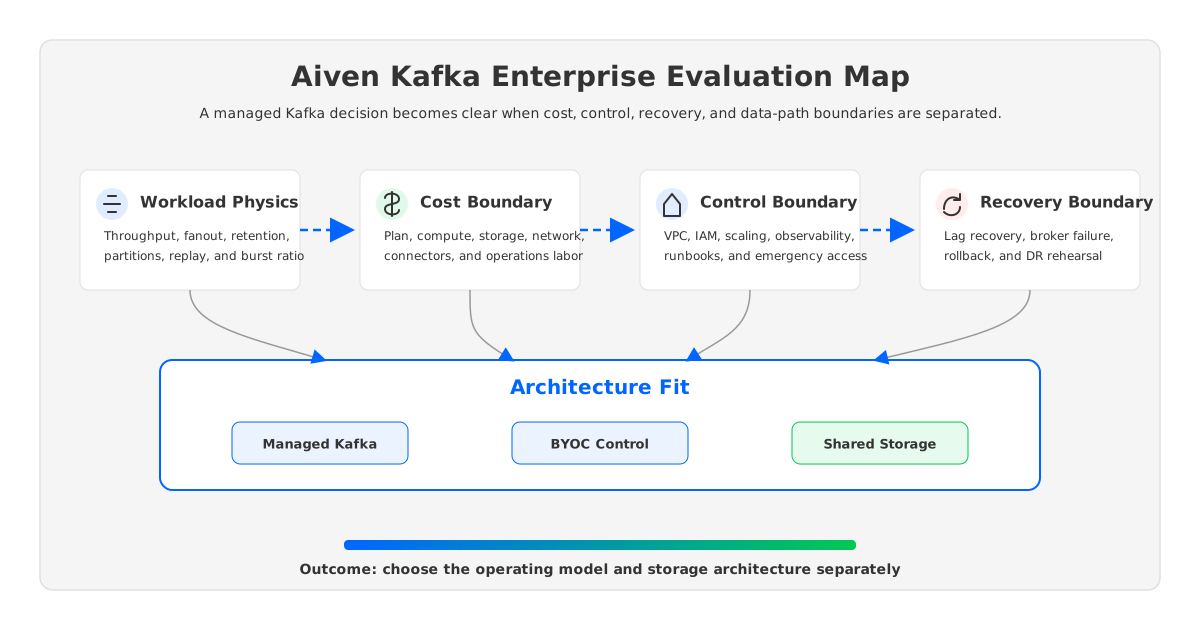
Kafka looks simple in a product plan and complicated in production. A plan tells you cloud, region, tier, storage, and support. Production asks where replicated data moves, who controls the VPC boundary, how scaling works after a traffic spike, what happens during broker replacement, and how much of the bill is compute, storage, network, connector runtime, and support.
1What Aiven Kafka Gives You
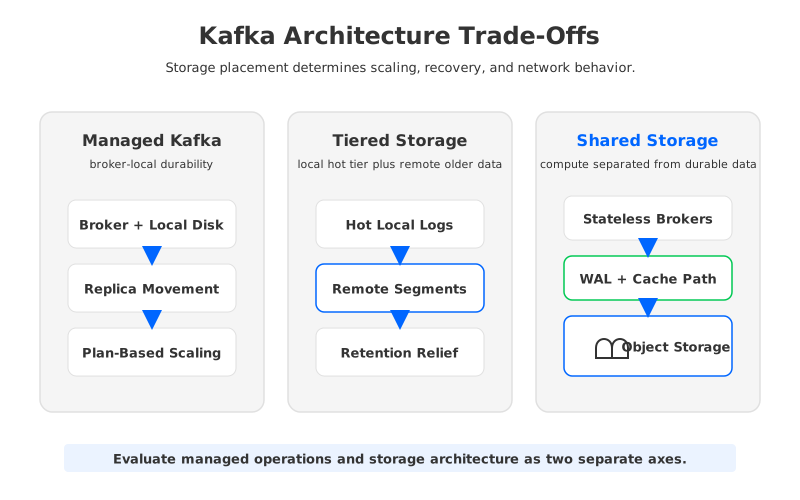
Aiven's public documentation describes Aiven for Apache Kafka as a fully managed Apache Kafka service for event-driven applications, data pipelines, and stream processing systems. Its Kafka documentation describes two cluster types: Inkless Kafka and Classic Kafka. Inkless Kafka supports diskless topics that store topic data in cloud object storage, while Classic Kafka uses fixed plans with local broker storage and can optionally move older data to object storage through tiered storage.
That distinction matters because the Kafka market is moving from one question to another. The old question was, "Who will operate my brokers?" The current question is, "Which storage architecture should my Kafka estate use in the cloud?" A managed service can reduce operational burden, but the storage model still shapes cost, elasticity, recovery speed, and placement control.
For a platform team, Aiven Kafka is attractive when the organization wants:
- A managed Kafka service instead of direct broker operations.
- Multiple cloud and region deployment choices under one provider relationship.
- Integration with managed connectors, monitoring, backups, and service lifecycle tools.
- A path to BYOC-style deployments where available, with feature availability checked against Aiven's current tier and deployment model.
Those are real operational benefits. The mistake is treating them as the whole decision. Kafka is not a stateless API behind a load balancer; it is a replicated log system whose data path can dominate both failure behavior and cloud cost.
2The Cost Boundary Is Not Just the Kafka Plan
The visible line item is the service plan. It is also the easiest line item to understand. The more useful model is to split cost into service subscription, compute, storage, and network movement. Different vendors bundle those layers differently, so a clean comparison needs to normalize what is included and what remains in your cloud bill.
AWS documents that data transfer between Availability Zones in the same Region can appear as regional data transfer usage, and for a given resource AWS may meter both inbound and outbound sides of in-Region data transfer. Exact charges vary by service and Region, so map traffic paths before committing to a target architecture. Kafka makes that important because replication, client reads, MirrorMaker 2, connector traffic, and backfill reads can all move large volumes.
| Cost layer | What to check in an Aiven Kafka evaluation | Why it changes the decision |
|---|---|---|
| Service plan | Cluster type, tier, included features, support, connector billing, storage limits | The plan is the commercial starting point, not the full TCO model. |
| Compute | Broker sizing, headroom, dedicated VMs, scale-up path | Overprovisioning hides risk but turns idle capacity into recurring spend. |
| Storage | Local disk, object storage, retention policy, tiered storage behavior | Retention-heavy workloads punish architectures that bind data growth to broker disks. |
| Network | Cross-AZ, cross-region, connector, replication, and client egress paths | Network can become a material cost when Kafka traffic fans out across zones or clouds. |
| Operations | Upgrade work, incident response, observability, security administration | Managed service value should be measured against the work it actually removes. |
This table is not an argument against Aiven. It is a way to avoid comparing a managed-service invoice with an incomplete self-managed estimate. If Aiven owns more operational work, its plan price should reflect that value. If the architecture still creates large cross-zone or cross-region movement, the platform team needs to account for that separately.
3The Control Boundary Decides Who Can Change What
Control is not the opposite of managed service. It is a set of questions about blast radius and change authority. In Kafka, those questions become concrete fast: who controls broker placement, network routing, IAM integration, VPC connectivity, ACL automation, quota policy, connector runtime, encryption settings, observability export, and incident access?
Aiven's documentation notes that Kafka services can run on Aiven Cloud or Bring Your Own Cloud, with feature availability varying by service type and deployment model. The same vendor can offer different control boundaries depending on deployment. For regulated, data-sensitive, or platform-standardized teams, the difference between provider-hosted and BYOC is not cosmetic. It affects procurement, security review, network design, and incident process.
The control boundary should be written down before a proof of concept. A POC that only tests producer and consumer compatibility can pass while the production design is still unclear. Platform teams should test whether Terraform can create the service, whether security teams can audit identities and network paths, whether metrics can land in the existing observability stack, and whether the service owner can execute emergency runbooks without opening a ticket for every operational move.
There is a procurement angle too. A single managed platform can simplify vendor management, but it can also concentrate operational dependency. That dependency may be acceptable when the vendor's operating model matches the company's risk model. It becomes a problem when the team discovers late that a needed control surface is unavailable in the chosen tier or deployment model.
4Compatibility Is Necessary, Not Sufficient
Kafka compatibility starts with clients. Existing producers, consumers, Kafka Streams applications, Connect pipelines, schema workflows, ACLs, and transaction settings need to keep working with minimal code change. Aiven's service is based on Apache Kafka, so this part of the evaluation is usually more straightforward than with systems that implement a Kafka-compatible protocol from outside the Apache Kafka codebase.
Still, compatibility has layers. Apache Kafka includes APIs, broker behavior, configuration expectations, security mechanisms, metadata operations, and ecosystem tools. Basic producers and consumers have a different risk profile from workloads that depend on transactions, strict ACL automation, custom client configs, MirrorMaker 2 replication, or large-scale partition reassignment procedures.
Tiered storage adds another compatibility question. Apache Kafka documentation describes tiered storage as a two-tier model with local broker storage and remote storage for completed log segments. It also notes that Apache Kafka does not provide an out-of-the-box RemoteStorageManager implementation in the documented setup. Managed providers can package this complexity, but buyers still need to understand where local hot data ends, where remote retained data begins, and how that affects catch-up reads, restores, and cost.
The practical test is not "does the cluster speak Kafka?" It is whether the workload's operational habits survive the move:
- Can consumers recover from lag without surprising storage or network behavior?
- Can producers keep their latency and durability assumptions under the target replication and storage model?
- Can the team run its existing ACL, quota, topic, and secret management automation?
- Can disaster recovery use the same offset, identity, and cutover model the team already rehearses?
- Can the platform owner explain the data path during a broker failure without guessing?
If the answer to those questions is yes, Aiven Kafka may be a strong fit. If the answers are mixed, the team needs a deeper architecture evaluation before negotiating price.
5A Technical Evaluation Framework
The most useful Aiven Kafka comparison is not a vendor scoreboard. It is a decision worksheet that maps workload shape to operating model. A team running a few moderate-throughput topics with short retention has different priorities from a team running multi-TiB daily ingest, long retention, bursty replay, and strict cloud account controls.
Start with workload physics. Write throughput, read fanout, retention, partition count, peak-to-average ratio, backfill frequency, and multi-region requirements all change the right answer. A service that looks expensive for one workload can be cost-effective for another if it removes heavy operational work. A service that looks simple for steady traffic can become awkward when storage growth, replay reads, or cross-zone movement are the real cost drivers.
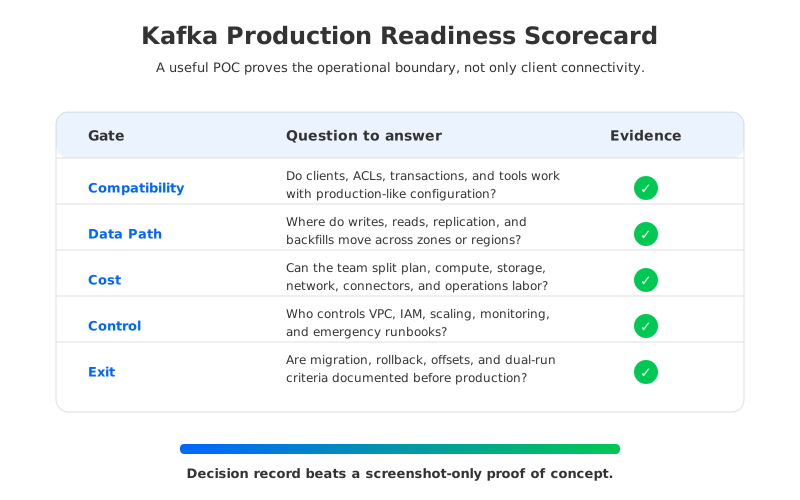
Then map the decision to five gates:
- Compatibility gate: prove clients, security, tooling, and operational procedures against the target service, not a toy cluster.
- Data-path gate: diagram producer writes, replication, object storage movement, consumer reads, connector traffic, and cross-region replication.
- Cost gate: separate vendor bill, cloud bill, network transfer, connector runtime, support, and internal operations labor.
- Control gate: document who can change network, identity, scaling, retention, observability, and emergency access.
- Exit gate: define migration in, migration out, dual-write or MirrorMaker 2 strategy, rollback criteria, and offset validation.
The exit gate is easy to skip and expensive to recreate during an incident. Kafka migrations are rarely blocked by the first message produced to the target cluster. They are blocked by consumer cutover, lag reconciliation, security drift, connector differences, DNS or bootstrap changes, and confidence that a rollback will not duplicate or lose business events.
6Where AutoMQ Fits the Evaluation
Once the evaluation is framed around storage architecture, network movement, and control boundaries, AutoMQ becomes relevant as a different architectural option rather than a generic "alternative." AutoMQ is a Kafka-compatible cloud-native streaming platform that separates compute from storage and uses shared object storage through its S3Stream architecture. The goal is to keep Kafka protocol and ecosystem compatibility while changing the broker storage model that drives much of the cloud cost and elasticity problem.
In a traditional Kafka design, brokers own local persistent data. Scaling and recovery are therefore tied to data movement: partitions must be reassigned, replicas must catch up, and storage capacity follows broker placement. In a shared-storage design, brokers can be more stateless because durable log data is placed in object storage and the write-ahead path is designed for low-latency persistence. That changes the operational question from "how do we move data between brokers safely?" to "how do we route compute to durable shared data safely?"
This distinction matters for teams evaluating Aiven Kafka because Aiven's managed model and AutoMQ's architecture solve different parts of the problem. Aiven can reduce day-2 operations by offering Kafka as a managed service. AutoMQ focuses on changing the Kafka storage architecture so compute and storage can scale independently, broker replacement can be faster, and cross-zone replication traffic can be reduced in supported deployment patterns.
AutoMQ's documentation describes BYOC and software deployment paths, Kafka compatibility, S3-backed shared storage, stateless brokers, and approaches for reducing inter-zone traffic. That makes it a candidate for teams whose evaluation turns on cloud account control, object-storage economics, rapid elasticity, or network-cost reduction rather than outsourcing Kafka operations.
The fair comparison is therefore not "Aiven or AutoMQ" in the abstract. It is:
- If the primary pain is operating Kafka and the current storage and network model is acceptable, a managed Kafka service such as Aiven can be a good fit.
- If the primary pain is cloud cost, storage-bound scaling, cross-zone movement, or control inside the customer's cloud account, a Kafka-compatible shared-storage architecture deserves evaluation.
- If both pains exist, the team should compare managed-service operating model and storage architecture as separate axes instead of collapsing them into one vendor line item.
That separation keeps the decision technical. It also prevents a common procurement failure: choosing a platform because it reduces toil, then discovering that the retained architecture still drives the largest cost and scaling constraints.
7How to Run the POC
A useful POC should look less like a hello-world demo and more like a production rehearsal. Use a representative topic count, retention profile, partition layout, producer batch settings, consumer group behavior, and connector path. Run a lag recovery test, a broker or node failure test if the service model exposes it, a scale event, and a security automation run.
The output should be a short decision record, not a pile of screenshots. Capture the data path, cost assumptions, controls available to the platform team, controls delegated to the vendor, migration steps, rollback plan, and unresolved risks. When pricing changes or another deployment model becomes available, that decision record can be updated without restarting the evaluation from zero.
For enterprise teams comparing Aiven Kafka with Kafka-compatible shared-storage platforms, the strongest signal is whether the architecture lets the team explain cost, control, and recovery before production traffic arrives. If your team is evaluating Kafka-compatible shared storage for that reason, review the AutoMQ architecture docs or talk with the AutoMQ team through the demo page: book an AutoMQ discussion.
8References
- Aiven documentation: Aiven for Apache Kafka
- Aiven pricing overview: Aiven Plans and Pricing
- Apache Kafka documentation: Tiered Storage
- AWS documentation: Understanding data transfer charges
- AWS Architecture Blog: Overview of Data Transfer Costs for Common Architectures
- AutoMQ documentation: Architecture overview
- AutoMQ documentation: S3Stream shared streaming storage
9FAQ
9.1Is Aiven Kafka a managed Apache Kafka service?
Yes. Aiven describes Aiven for Apache Kafka as a fully managed Apache Kafka service for event-driven applications, data pipelines, and stream processing systems. Enterprise teams should still validate the exact cluster type, tier, region, deployment model, and feature availability.
9.2How should teams compare Aiven Kafka cost?
Separate the vendor plan from the full architecture cost. Include service tier, storage, connector runtime, support, cloud network transfer, replication traffic, backfill reads, and internal operations labor. This avoids comparing a complete managed-service bill with an incomplete self-managed estimate.
9.3What is the main architecture trade-off?
The main trade-off is not only managed versus self-managed. It is whether the Kafka platform should keep broker-local storage as the operational center, use tiered storage for older data, or move toward a Kafka-compatible shared-storage architecture where compute and storage scale more independently.
9.4When should AutoMQ be evaluated alongside Aiven Kafka?
Evaluate AutoMQ when the decision depends on Kafka compatibility plus cloud account control, shared object storage, faster elasticity, reduced inter-zone traffic patterns, or storage-heavy retention economics. Evaluate Aiven Kafka when the priority is consuming Kafka as a managed service with an operating model that matches the team's control and procurement requirements.


