
Table of Contents
Table of Contents
When a platform team searches for Aiven Kafka, the question is rarely "what does it cost?" By that point, someone has usually accepted that operating Apache Kafka directly is expensive in engineering time, incident load, or infrastructure coordination. The harder question is whether a managed Kafka service changes the operating model enough to justify a cutover, and whether the team can prove that before production traffic moves.
That distinction matters because a Kafka cutover is not a normal database migration. Producers, consumers, ACLs, schemas, offsets, replication, network routes, observability, and rollback all have to line up at the same time. A pricing page or product overview can tell you what a service offers, but it cannot tell you whether your current Kafka estate is ready to move. Platform owners need a readiness model that connects commercial inputs with technical risk.
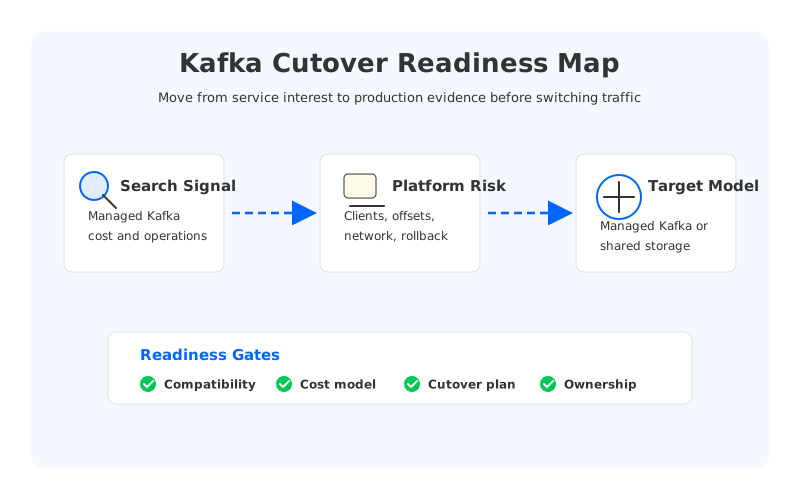
The useful way to evaluate Aiven Kafka is to separate three decisions that often get mixed together. First, do you want a managed Kafka service that keeps the Apache Kafka operational model but delegates provisioning, patching, monitoring, and service management to a provider? Second, do your application teams need strict Kafka protocol and client compatibility, or are they open to a Kafka-compatible architecture that changes the storage layer? Third, does your cost model depend more on broker hours, storage growth, networking boundaries, or the engineering work required to keep the platform healthy?
Those questions are not vendor scorecard trivia. They decide how much of your current architecture survives the move and where the next operational bottleneck will appear.
1What Aiven Kafka Solves, And What It Does Not Decide For You
Aiven positions its Apache Kafka service as managed Kafka across major clouds, with service plans, hourly billing, and operational features exposed through its platform. That is a real value proposition for teams that want Apache Kafka without owning every broker lifecycle task. It also gives procurement and platform teams a concrete place to start: choose the cloud, region, plan, storage, networking, and adjacent managed services that the workload needs.
The trap is treating that first quote as a final architecture decision. A managed Kafka plan can reduce day-to-day operational burden, but the underlying workload still has Kafka-shaped behavior. Partition count still affects broker load. Retention still drives storage. Consumer fan-out still turns reads into network and broker work. Replication still has availability and cost implications. Security, quota, schema, and connector policies still have to be designed around the organization, not around a line item.
This is why cutover readiness should be evaluated in layers:
- Application compatibility. Confirm broker protocol expectations, client versions, authentication, authorization, transactions, idempotent producers, compression, and topic-level configuration behavior.
- Data movement. Decide how topics, offsets, consumer groups, schemas, and historical retention move, and define the exact point where the target cluster becomes the source of truth.
- Network placement. Map producers and consumers to VPCs, regions, availability zones, private connectivity, peering, and egress paths before estimating cost.
- Operational ownership. Decide which tasks become provider responsibilities and which remain with the platform team, including quotas, incident response, capacity planning, and application onboarding.
- Commercial boundaries. Read the provider bill together with cloud networking, storage, support, and migration labor. A service price alone is not total cost of ownership.
This layered view prevents a false binary. Aiven Kafka may be a strong fit for teams that want managed Apache Kafka and a consistent service experience. Another team may decide that its next bottleneck is not broker management but the storage and network economics of Kafka itself. Those are different problems, and they should not be forced into one answer.
2The Cutover Readiness Model
A Kafka cutover becomes manageable when every risk has an owner and a rollback path. The readiness model below treats the move as a production change, not a procurement event. It does not assume that managed Kafka is wrong or right. It asks whether the target platform can carry your specific traffic pattern with fewer surprises than the current one.
| Readiness area | What to verify | Why it matters |
|---|---|---|
| Protocol and client behavior | Supported Kafka APIs, client versions, authentication, ACLs, transactions, idempotence, compression, and admin operations | Compatibility failures often appear in application edge cases, not in a simple produce-consume test |
| Topic and partition design | Topic count, partition count, replication factor, retention, compaction, quotas, and hot partitions | A plan that looks fine by storage size can fail under partition metadata or uneven traffic |
| Migration mechanics | Mirror path, offset translation, schema migration, consumer group restart plan, dual-write policy, and freeze windows | Cutovers fail when data movement is tested but application ownership is not |
| Network and security | Private connectivity, DNS, TLS, IAM or user management, VPC boundaries, and cross-region paths | Kafka is chatty enough that a small network mistake can become a persistent bill or latency problem |
| Operations and observability | Metrics, logs, lag alerts, broker health, quota alerts, runbooks, support path, and incident severity routing | Managed services reduce some toil, but they do not remove application-facing accountability |
| Exit and rollback | Criteria for reverting producers, pausing consumers, preserving offsets, and reconciling duplicate writes | A rollback that is designed during an incident is usually too late |
The table looks obvious until a real migration exposes the gaps. A team may have tested basic Kafka clients but missed transactional producers. It may have mapped producer traffic but not high fan-out consumers. It may have validated private networking but forgotten that disaster recovery traffic crosses a different boundary. The point is not to create a larger checklist; the point is to find the few assumptions that would be expensive to discover after the cutover.
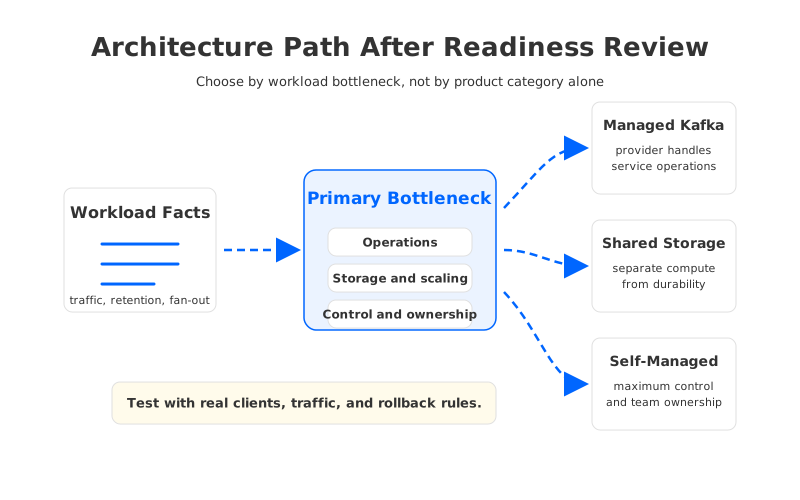
The strongest readiness reviews start with a traffic profile rather than a feature list. Write throughput, read fan-out, retention duration, partition growth, peak-to-average ratio, and regional placement are the inputs that determine platform shape. Once those are clear, the team can ask whether a managed Apache Kafka service, a self-managed Kafka cluster, or a Kafka-compatible cloud-native engine is the right target.
3Cost Modeling Beyond The Service Price
Pricing pages are useful because they make commercial comparison possible. They are also incomplete by design, because every Kafka deployment has workload-specific costs outside the service selector. For a serious Aiven Kafka evaluation, model the bill in four buckets instead of one.
The first bucket is the managed service itself: plan, instance size, storage, region, support assumptions, and any service-specific options. The second is cloud infrastructure around the service: private connectivity, inter-VPC or inter-region paths, load balancers, logging sinks, monitoring pipelines, and data transfer. The third is migration execution: parallel run time, replication tooling, application testing, freeze windows, and rollback rehearsals. The fourth is the residual operating model after onboarding.
For Kafka, network placement deserves special attention. Producer traffic, replication traffic, consumer reads, observability export, and disaster recovery flows can cross different boundaries. AWS publishes separate pricing material for Amazon MSK, S3, and data transfer, and the exact answer depends on region, service, and path. A provider's Kafka price may be easy to read while the surrounding cloud bill remains opaque.
A practical cost model should answer these questions before any executive comparison:
- Are producers and consumers colocated with the target Kafka service, or will the cutover introduce additional egress paths?
- How does the bill change if read fan-out doubles while write throughput stays flat?
- What happens to cost when retention grows from operational replay to audit-style history?
- Which costs disappear from the team budget but reappear as service charges, support contracts, or migration labor?
The answer may still favor Aiven Kafka. It may also reveal that the largest cost driver is not the managed-service premium but the inherited Kafka storage and networking pattern. That is the moment when architecture comparison becomes more useful than vendor comparison.
4Migration Risk Is Mostly About State Ownership
Most Kafka migration plans start with replication. That is understandable: if messages can move from source to target, the project feels real. But state ownership is the harder part. Producers decide where incoming records are written. Consumers decide which offsets are safe. Schema registries decide whether records remain interpretable. Operations teams decide which cluster is authoritative during an incident.
The cleanest cutovers make these ownership changes explicit. A dual-write period may reduce fear, but it also introduces duplicate handling and ordering questions. A mirror-only period may be simpler, but it shifts risk to consumer restart timing and offset translation. A blue-green application deployment may be elegant for stateless services, but Kafka consumers often carry durable expectations about committed offsets and replay windows.
Here is a pragmatic sequence that keeps risk visible:
- Inventory topics by business owner, traffic class, retention, compaction, and consumer criticality.
- Validate client behavior against the target cluster using non-critical workloads before moving shared libraries or frameworks.
- Rehearse replication, offset handling, schema compatibility, and consumer restart with production-like traffic.
- Define a small first production slice with rollback criteria that include data correctness, lag, latency, and application error budgets.
- Move the remaining workloads by dependency group, not by topic name order.
That sequence is slower than "replicate everything and switch DNS." It is also more honest. Kafka is usually shared infrastructure, and shared infrastructure fails at dependency edges. The more teams depend on the cluster, the more important it becomes to know who can stop, restart, replay, or roll back each stream.
5Where AutoMQ Fits The Evaluation
Once the readiness review separates managed operations from storage architecture, another option becomes visible: keep Kafka protocol compatibility while changing how Kafka data is stored and scaled. AutoMQ belongs in that category. It is a Kafka-compatible cloud-native streaming system that uses a shared-storage architecture backed by object storage, with stateless brokers and a storage layer designed for cloud elasticity.
That distinction is important. A managed Apache Kafka service can improve how Kafka is operated, but it does not necessarily change the broker-local storage model that shapes scaling, recovery, and network behavior. AutoMQ approaches the problem from the other side: preserve Kafka-facing application semantics while moving durability and storage growth away from broker-local disks. For teams whose readiness review flags storage expansion, broker rebalancing, cross-zone traffic, or compute-storage coupling as the main issue, that architecture is worth evaluating alongside managed Kafka services.
This does not make AutoMQ the automatic answer for every Aiven Kafka evaluation. If the primary requirement is a managed Apache Kafka service with a familiar provider workflow, Aiven may be the more direct fit. If the primary requirement is to reduce the operational and cost impact of Kafka's traditional storage model, a Kafka-compatible shared-storage system changes a different part of the stack.
The readiness framework makes the comparison concrete:
- If your main pain is broker patching, service provisioning, and basic operational toil, managed Kafka should be evaluated first.
- If your main pain is partition growth, storage elasticity, recovery speed, and network cost under multi-AZ traffic, shared storage deserves a parallel proof of concept.
- If your main pain is governance, data contracts, and application ownership, no platform choice will save the cutover unless the operating model is fixed.
AutoMQ's evaluation should therefore use the same tests as any production candidate: Kafka client behavior, transactional and idempotent producer paths, consumer lag behavior, quota design, recovery behavior, observability integration, security controls, and rollback procedures.
6A Buyer Checklist For The Final Review
The final review should be short enough to use in a decision meeting and specific enough to block a risky migration. A platform owner needs a clear statement of what is known, what remains uncertain, and which uncertainties are acceptable.
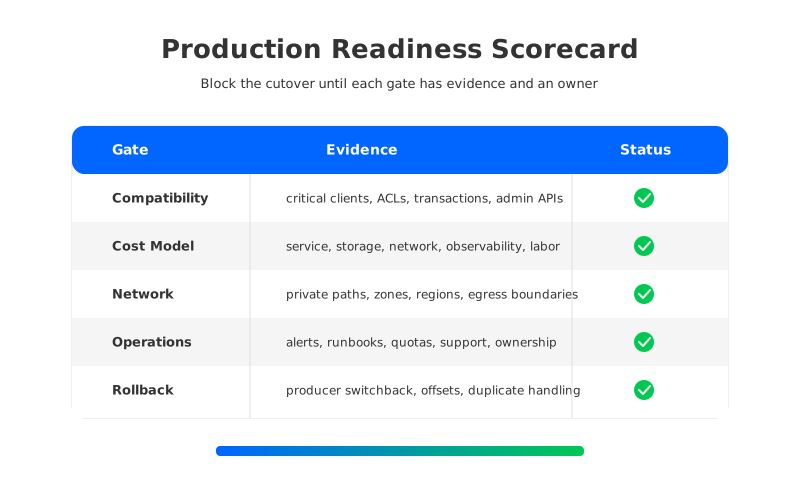
Use these five gates:
- Compatibility gate. Every critical client pattern has been tested on the target, including authentication, authorization, transactions, idempotence, compression, admin operations, schema usage, and consumer restart behavior.
- Cost gate. The estimate includes service charges, cloud networking, storage growth, observability export, parallel-run migration time, and support assumptions.
- Operational gate. Incident routing, alert ownership, quota workflow, capacity review, backup or recovery expectations, and escalation paths are documented.
- Cutover gate. The first production slice has defined entry criteria, success metrics, rollback triggers, and a named owner for producer and consumer actions.
- Architecture gate. The team can explain why the target is a managed Apache Kafka service, a self-managed cluster, or a Kafka-compatible shared-storage platform, based on workload evidence rather than preference.
That last gate is the one that keeps the evaluation honest. "Aiven Kafka" is a search term, but the decision behind it is broader: what kind of Kafka operating model should this organization own for the next several years? If the target only solves today's provisioning pain while preserving tomorrow's storage and network pressure, the cutover may be successful but strategically incomplete.
When you are ready to test a Kafka-compatible shared-storage path beside managed Kafka options, review the AutoMQ architecture and migration material, then talk through your workload shape with the engineering team: start an AutoMQ evaluation. Bring your topic count, throughput profile, retention target, cloud placement, and cutover constraints. Those inputs matter more than a generic feature comparison.
7References
- Aiven pricing
- Aiven for Apache Kafka documentation
- Apache Kafka documentation
- Apache Kafka tiered storage documentation
- Amazon MSK pricing
- Amazon S3 pricing
- AWS guidance on data transfer costs
- AutoMQ compatibility with Apache Kafka
- AutoMQ S3Stream shared storage architecture
8FAQ
8.1Is Aiven Kafka the same as self-managed Apache Kafka?
No. Aiven Kafka is a managed Apache Kafka service, so the provider takes responsibility for many service management tasks that a self-managed team would otherwise own. Your applications still need Kafka-compatible behavior, topic design, networking, security, and operational ownership decisions.
8.2What should I test before moving production traffic to Aiven Kafka?
Test critical client behavior, authentication, ACLs, transactions if used, idempotent producers, compression, schema workflows, consumer restart behavior, offset handling, observability, private networking, and rollback. A simple producer-consumer smoke test is not enough for a shared Kafka platform.
8.3How should I compare Aiven Kafka with AutoMQ?
Compare them by architectural objective. Aiven Kafka is a managed Apache Kafka path. AutoMQ is a Kafka-compatible shared-storage path that changes the storage and scaling model. The right comparison depends on whether your main problem is service operations, storage elasticity, network cost, recovery behavior, or application governance.
8.4Should cost modeling start from broker price?
Broker or service price is only the first input. A Kafka cost model should also include storage growth, read fan-out, private connectivity, cross-boundary data transfer, observability export, support, migration parallel run time, and the internal labor required to operate the platform.


