
Table of Contents
Table of Contents
The search for Aiven Kafka usually starts with a practical question: can a team keep the Kafka API it already depends on while reducing the operational work of running brokers, disks, upgrades, networking, security patches, and monitoring? That is a reasonable place to start. Apache Kafka remains the center of many event-driven architectures, but the work around Kafka is no longer limited to choosing broker instance sizes. The harder decision is where the control boundary should sit: inside a managed service, inside the customer's cloud account, or inside a Kafka-compatible architecture that changes how storage and compute behave.
Aiven for Apache Kafka is commonly evaluated as a managed Apache Kafka option. Its public product positioning emphasizes managed event streaming for microservices, event-driven architecture, and streaming pipelines. Those are useful signals, but they are only the first layer of a production decision. A platform team still has to answer questions about protocol compatibility, data-plane location, cost exposure, network topology, failure recovery, operational access, and migration rollback.
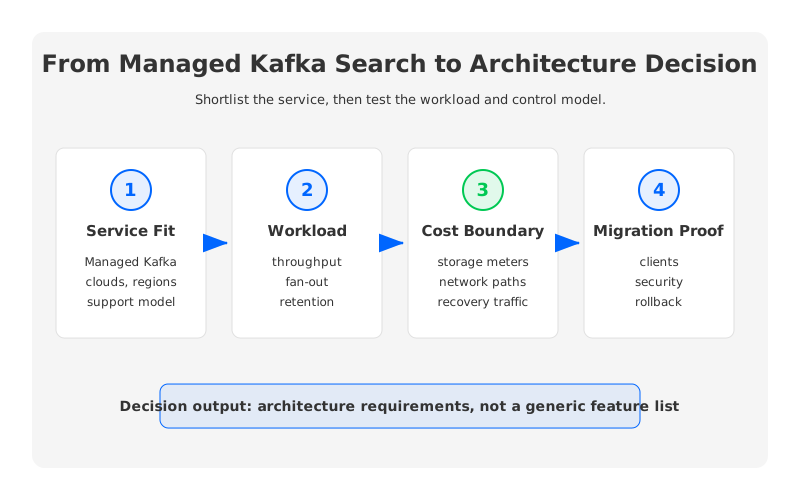
That is where many Kafka evaluations become uncomfortable. The page a buyer finds first can explain what a service does, but it cannot know the team's workload shape, cloud networking constraints, retention policy, audit requirements, or tolerance for replatforming risk. A good evaluation turns the product page into a set of architecture questions before it turns into a purchase order.
1Why Teams Search for Aiven Kafka
Most teams do not search for Aiven Kafka because they want a new message broker category. They search because Kafka is already in the architecture and the current operating model is starting to show strain. The symptoms vary: broker upgrades take too much coordination, storage expansion requires partition movement, cross-zone data transfer appears as a growing line item, or procurement wants a managed contract instead of a long tail of internal toil.
The keyword also carries several different intents at once. An SRE may be checking whether the managed service reduces on-call load. A cloud architect may care more about VPC placement, PrivateLink, peering, encryption, and data residency. A FinOps reviewer may want to understand whether the cost model scales with throughput, retention, partitions, or networking. A platform owner may be trying to protect Kafka client compatibility while changing the infrastructure underneath.
Those intents are related, but they are not interchangeable. A service that is excellent for a small managed Kafka deployment may still need deeper review for a high-throughput platform with strict network boundaries. A service that removes broker patching may still leave the team with throughput, storage, and data-transfer trade-offs. The evaluation has to separate convenience from architecture fit.
2What a Managed Kafka Product Page Can Tell You
A managed Kafka product page is useful because it frames the service category. It should tell buyers whether the service is based on Apache Kafka, which clouds and regions are available, what operational tasks are managed, what security integrations exist, and which surrounding services can be attached. For Aiven Kafka, the official positioning makes it clear that the service is meant for teams that want managed event streaming rather than self-managed Kafka operations.
That public information answers the first buyer question: "Is this worth shortlisting?" It does not answer the final platform question: "Can this become our long-term streaming control plane?" The second question needs a deeper worksheet because Kafka's production behavior is shaped by moving parts that are easy to hide behind the phrase "managed service."
| Evaluation area | What product pages usually clarify | What platform teams still need to test |
|---|---|---|
| Service model | Managed Kafka operations, cloud availability, service integrations | Data-plane location, administrative access, incident boundaries |
| Kafka behavior | Apache Kafka basis and client-facing endpoint model | Exact client versions, protocol features, ACL behavior, transactions, quotas |
| Cost model | Plan, instance, storage, and transfer billing categories | Cost under real fan-out, retention, multi-AZ traffic, and catch-up reads |
| Operations | Backups, upgrades, monitoring, and support promises | Recovery objectives, noisy-neighbor controls, change windows, rollback paths |
The point is not that product pages are incomplete. They are designed to be broad. A Kafka platform decision is narrow and workload-specific, so the missing layer has to come from the buyer's own architecture review.
3Production Questions the Initial Search Does Not Answer
The first production question is compatibility. "Kafka-compatible" can mean several things: wire protocol support, client library support, topic and consumer group semantics, transaction behavior, ACLs, Connect ecosystem compatibility, or operational behavior during leader movement. Apache Kafka's own documentation spans producer, consumer, security, transactions, KRaft, and storage behavior for a reason. A serious evaluation should use those semantics as the checklist, not a generic compatibility label.
The second question is cost exposure. Kafka cost is not only broker compute plus storage. In cloud deployments, data movement can be a material part of the bill. Cross-AZ traffic, inter-region replication, PrivateLink, NAT gateways, and object storage requests can all matter depending on topology. AWS publishes separate pricing pages for MSK, EC2 data transfer, PrivateLink, and S3 because those meters are separate services. Kafka buyers should treat any managed Kafka quote the same way: model workload behavior first, then map it to billing meters.
The third question is failure recovery. Traditional Kafka keeps log data on broker-attached disks and uses replication to preserve durability. That model is well understood, but it couples broker state, storage capacity, and partition placement. When a broker fails, a platform team cares about the work needed to recover leadership, rebalance hot partitions, restore capacity, and avoid a second incident while recovery is still running. A managed service can reduce operational burden, but the underlying recovery mechanics still matter.
The fourth question is control. Some teams want the provider to own as much as possible. Others need the data plane inside their cloud account, integration with existing network controls, or predictable behavior under internal security tooling. Neither preference is universally correct. The right answer depends on who owns the incident, who can access the environment, how audit evidence is collected, and how the service fits the organization's cloud operating model.
4A Technical Evaluation Framework for Platform Teams
A useful Aiven Kafka evaluation starts by writing down the workload shape before comparing providers. The same Kafka service can feel uneventful at modest throughput and painful at high fan-out with long retention. The important inputs are write throughput, read amplification, retention period, partition count, consumer lag patterns, peak-to-average ratio, cross-zone topology, and recovery objectives. If those inputs are vague, the evaluation will drift toward generic feature comparison.
After workload shape, the next layer is the control boundary. Ask where brokers run, where durable data lives, how clients connect, how administrative actions are performed, and what happens when the provider and customer both need to act during an incident. This is not procurement paperwork. It determines whether the platform team can debug latency, enforce network rules, and satisfy audit requests without waiting for a support escalation.
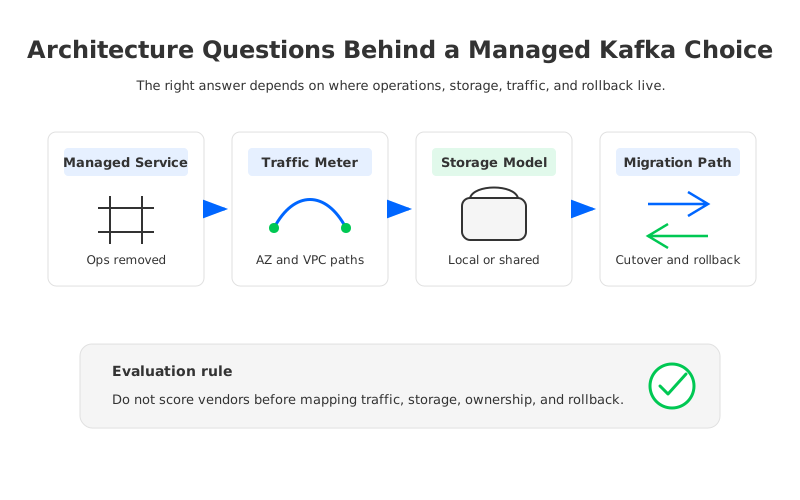
Cost needs its own model because Kafka turns architecture into a recurring bill. Start with a plain-language traffic equation: producer ingress, replicated writes, consumer egress, catch-up reads, inter-AZ movement, inter-region movement, and storage retention. Then assign each traffic path to the cloud or service meter that charges for it. The exact numbers will differ by region and contract, but the shape of the model is stable. If a workload has heavy consumer fan-out across zones, the network line matters. If retention is long, the storage layer matters. If consumer lag is common, catch-up reads matter.
Migration risk is the layer teams often underweight. A Kafka migration touches producers, consumers, schemas, ACLs, observability, offset management, disaster recovery, and rollback. The safest evaluation is not "Can we create a cluster?" It is "Can we move one representative workload, keep consumer progress understandable, observe it with our current tools, and roll back without data loss or hidden state?" That test should include at least one real client library, one security policy, one high-volume topic, and one failure scenario.
Finally, score operations against the team's actual ownership model. A fully managed service is valuable when it removes tasks the team does not want to own. It is less valuable when it hides controls the team is accountable for. This is why a good scorecard includes both managed convenience and control-plane transparency.
5Where AutoMQ Fits in the Evaluation
Once the evaluation reaches storage architecture, a different option enters the conversation: Kafka-compatible systems that keep Kafka protocol semantics while changing how durable log storage is implemented. AutoMQ is in this category. It is a cloud-native, Kafka-compatible streaming platform built around shared storage, stateless brokers, a write-ahead log layer, and object-storage-backed durability.
That design matters because several Kafka pain points come from tying compute, local disk, and partition data together. In traditional Kafka, storage growth and broker recovery often imply data movement between brokers. In a shared-storage architecture, retained data can live in object storage while brokers focus more on serving traffic and coordinating Kafka behavior. The operational question shifts from "How do we move large local logs safely?" to "How do we preserve Kafka semantics while making broker capacity more elastic?"
AutoMQ should not be evaluated as a drop-in answer to every Aiven Kafka search. The better use is as a comparison point when the buyer's requirements emphasize cloud cost, elastic scaling, data-plane control, and storage architecture. AutoMQ documentation describes Apache Kafka compatibility, S3Stream shared storage, stateless brokers, and approaches for reducing inter-zone traffic. Those are the right materials to compare against a managed Kafka shortlist when storage and networking dominate the decision.
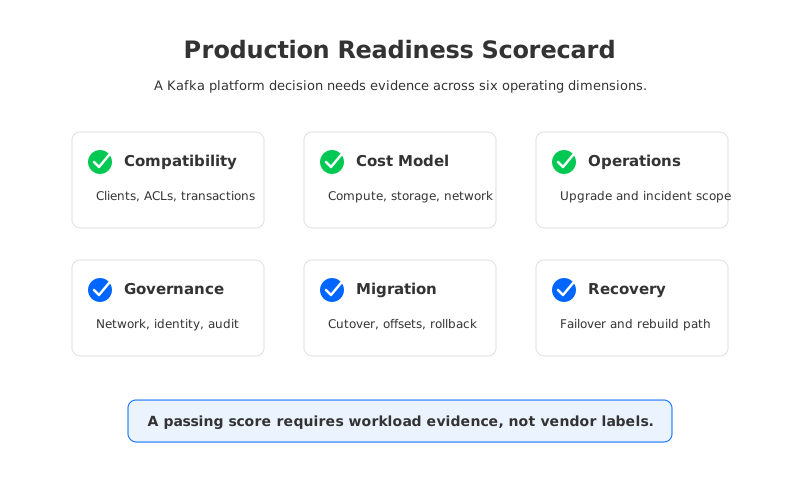
The evaluation remains the same: test real clients, model real traffic, validate security and governance, and run a migration rehearsal. The difference is that AutoMQ gives the team an architecture path that is not limited to "self-manage Kafka" versus "use a managed Kafka service." It lets platform owners ask whether the storage layer itself is the source of cost and operational friction.
6Buyer Checklist
Use this checklist before treating any Aiven Kafka quote, proof of concept, or alternative evaluation as complete:
- Compatibility: Which Kafka client versions, protocol features, ACL patterns, transactions, and Connect workloads must work without application changes?
- Workload shape: What are the sustained and peak write rates, read fan-out, retention period, partition count, and expected catch-up read volume?
- Network boundary: Which traffic crosses AZs, regions, VPCs, PrivateLink endpoints, or NAT gateways, and who pays for each path?
- Storage behavior: Does retained data live on broker-attached disks, tiered storage, shared object storage, or another model, and how does that affect recovery?
- Control model: Who owns upgrades, incident response, metrics access, configuration changes, audit evidence, and emergency rollback?
- Migration proof: Can one representative workload be migrated, observed, failed over, and rolled back with consumer progress intact?
The checklist is intentionally vendor-neutral. It helps a team compare Aiven Kafka, Amazon MSK, self-managed Kafka, Confluent, Redpanda, AutoMQ, or another Kafka-compatible platform without turning the process into a brand preference exercise.
Turn the checklist into a workload-specific test plan. If shared storage and Kafka compatibility are important parts of that plan, review the AutoMQ overview and compare it against the same migration, cost, and operations criteria you apply to managed Kafka services.
7References
- Aiven for Apache Kafka
- Apache Kafka Documentation
- Apache Kafka Tiered Storage Documentation
- Amazon MSK Pricing
- AWS EC2 On-Demand Pricing: Data Transfer
- AWS PrivateLink Pricing
- Amazon S3 Pricing
- AutoMQ Compatibility with Apache Kafka
- AutoMQ S3Stream Shared Streaming Storage
- AutoMQ Inter-Zone Traffic Overview
8FAQ
8.1Is Aiven Kafka the same as self-managed Apache Kafka?
No. Aiven for Apache Kafka is a managed service based on Apache Kafka, while self-managed Kafka leaves the infrastructure, upgrades, monitoring, and many operational tasks with the customer team. The API-level evaluation may overlap, but the operational boundary is different.
8.2What should be tested first in an Aiven Kafka proof of concept?
Start with a representative workload rather than a hello-world topic. Include real client libraries, authentication, ACLs, producer throughput, consumer fan-out, lag recovery, observability, and one rollback path. That test reveals more than a feature checklist.
8.3How should teams compare managed Kafka cost?
Model traffic paths before comparing prices. Broker compute and storage are only part of the bill; cross-zone data transfer, inter-region replication, PrivateLink, NAT, storage requests, and catch-up reads can change the result for production workloads.
8.4When should AutoMQ be part of the shortlist?
AutoMQ is worth evaluating when the team wants Kafka compatibility but suspects that broker-local storage, partition movement, cross-zone traffic, or slow elasticity are central cost and operations problems. It is especially relevant when a shared-storage Kafka-compatible architecture fits the cloud control model.
8.5What is the next step after this evaluation?
Turn the checklist into a proof plan for one representative workload. The first proof should include client compatibility, traffic shape, failure recovery, observability, rollback, and the cost paths that matter in your cloud environment.


