
Table of Contents
Table of Contents
Teams looking at Aiven Kafka are usually past the point of asking whether Kafka is useful. They are asking a harder question: can a managed service reduce the operational work without hiding the cost and architecture signals that decide production fit? That is a reasonable place to start. Aiven for Apache Kafka is a fully managed Apache Kafka service, and Aiven's docs describe two cluster types: Inkless Kafka, which stores topic data in cloud object storage, and Classic Kafka, which uses fixed plans with local broker storage and optional tiered storage.
That distinction matters because pricing is an architecture signal. A platform that bills around fixed broker plans, local storage, object storage, tiered reads, network paths, support, and ecosystem services is telling you how the system expects to be operated. Buyers who read those signals early avoid a familiar Kafka mistake: choosing for convenience, then discovering later that retention, replay, cross-zone traffic, or incident authority was the real constraint.
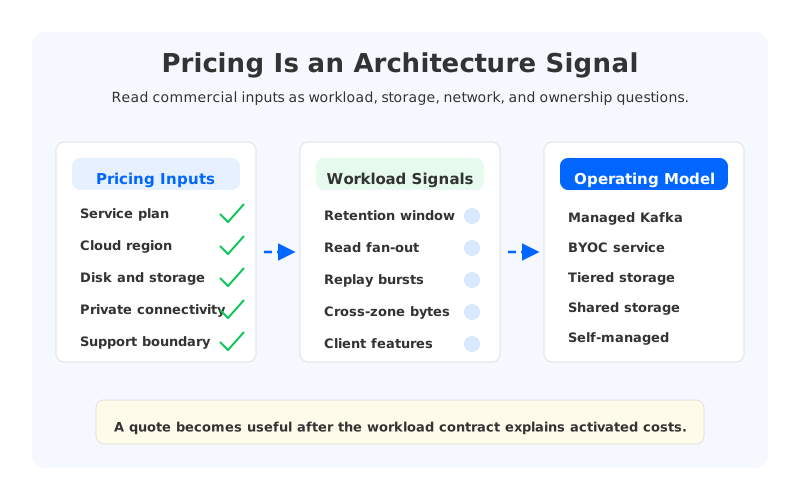
The right evaluation does not treat Aiven, Amazon MSK, Confluent Cloud, Redpanda, AutoMQ, WarpStream, or self-managed Kafka as entries in one flat comparison table. They sit near the same buyer conversation, but they assign cost and operational responsibility differently. A practical decision starts by translating price and product packaging into workload questions.
1Why Aiven Kafka Pricing Deserves an Architecture Review
Aiven's public pricing page is useful because it exposes several buyer-facing dimensions: service selection, cloud provider, region, plan, disk, backup, and support-related choices. The exact numbers vary by configuration, so a serious buyer should not copy a sample price into a production business case. The useful signal is the shape of the model. Kafka cost follows the architecture: broker capacity, storage placement, retention, network movement, private connectivity, management layer, and ecosystem components.
The same is true for operations. A managed service can remove routine work such as provisioning, lifecycle operations, monitoring integration, and version management. But managed does not erase the buyer's platform responsibilities. The buyer still owns the application contract, client behavior, retention policy, compliance boundary, disaster recovery expectation, and cost model under abnormal traffic.
This is where many Kafka evaluations become too shallow. A spreadsheet may compare monthly service estimates while leaving the hardest questions in prose. Which topics need long retention? Which consumers perform large replays? Which applications require private networking? Which teams need evidence from the data plane during an incident? Which workloads are sensitive to tiered-read behavior? Those questions turn pricing from a quote into an architecture review.
2The Signals Hidden Inside Kafka Pricing
Pricing pages rarely say "this is your architecture." They use billing terms. Platform teams have to translate those terms back into operating behavior. A low hourly service estimate may still be a poor fit if it requires overprovisioned brokers for retention, creates unpredictable replay cost, or moves data across expensive network boundaries. A higher managed-service estimate may be acceptable if it reduces operational labor and gives procurement a clean accountability model.
The translation is easier if buyers separate three cost types:
- Visible costs are estimated before traffic: service plan, storage, region, private connectivity, support, and add-on components.
- Activated costs appear outside the happy path: backfills, remote reads, cross-zone traffic, migration, incident recovery, and emergency scaling.
- Human costs include SRE time spent on tuning, capacity planning, upgrades, failure drills, evidence collection, and application support.
That split keeps the discussion fair. Aiven can fit teams that want managed Apache Kafka with broad cloud choice and ecosystem services. Amazon MSK can fit teams standardized on AWS-native identity, networking, and billing. A Kafka-compatible shared-storage system can fit teams whose primary pain is broker-local storage and cross-zone data movement. The buyer's job is to know which cost is dominant before finalizing the shortlist.
3Classic Kafka, Inkless Kafka, and Tiered Storage
Aiven's Kafka documentation makes a useful architectural distinction. Classic Kafka uses fixed plans with local broker storage and can optionally move older data to object storage using tiered storage. Inkless Kafka is described as a cluster type that supports storing topic data in cloud object storage and targets high-throughput workloads where storage elasticity and object-storage economics matter. That is a meaningful signal because the industry is moving away from treating broker-attached disk as the default durable foundation for Kafka data.
Apache Kafka's own tiered storage work, formalized through KIP-405 and documented in Kafka's tiered storage section, follows a different path from fully shared-storage Kafka-compatible systems. Tiered storage extends Kafka by retaining older log segments in remote storage while the broker remains central to log ownership, serving, and coordination. It helps long retention, but it does not erase every broker-local concern. Buyers still need to test remote-read behavior, cache effectiveness, retention rules, operational tooling, and failure recovery.
The storage question is not "object storage good, local disk bad." That framing is too crude for production engineering. The real question is which role object storage plays:
| Storage model | What changes | What buyers should test |
|---|---|---|
| Local broker storage | Brokers carry compute and durable log storage together | Disk growth, rebalancing, broker replacement, multi-AZ replication, and upgrade windows |
| Kafka tiered storage | Older segments can move to remote object storage | Remote-read latency, cache hit rate, retention operations, billing on reads, and compatibility with tooling |
| Object-storage-centered Kafka design | Durable data is designed around shared storage from the start | Write path, WAL behavior, broker statelessness, recovery, tail latency, and client compatibility |
This table matters because Aiven's Classic and Inkless options are not only plan names. They imply different questions for cost, throughput, retention, and operations. A buyer evaluating Aiven should ask which cluster type matches each topic family rather than assuming one Kafka service shape fits the entire estate.
4Network Cost Is a First-Class Kafka Requirement
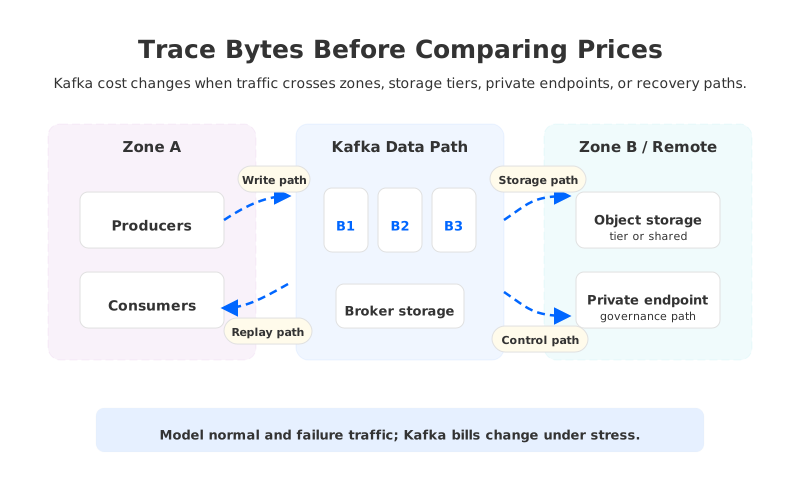
Kafka platforms look deceptively similar when the test is a producer writing and a consumer reading in the same environment. They diverge when bytes cross availability zones, VPC boundaries, regions, or private service endpoints. AWS publishes data transfer pricing separately from managed-service pricing, and AWS PrivateLink has its own hourly and data-processing dimensions. Amazon MSK also has separate pricing dimensions for brokers, storage, and related features. Network boundaries are architecture boundaries.
For Kafka, those boundaries are active. Producers may write from one zone to leaders in another. Brokers may replicate across zones for durability. Consumers may read from remote replicas or generate replay traffic after downtime. Connectors may move data between Kafka and object storage, databases, warehouses, or search systems. Private connectivity can be a governance requirement, but it also creates a cost meter that must be modeled.
A useful cost review therefore traces bytes rather than only instances:
- Write path: where producers run, where leaders live, how acknowledgments work, and whether writes cross zones.
- Replication path: whether durability depends on broker replication, cloud storage, remote tiers, or shared storage.
- Read path: whether consumers read locally, use closest replicas, pull from remote tiers, or trigger large backfills.
- Control path: how APIs, monitoring, schema services, connectors, and private endpoints move data and metadata.
- Recovery path: what happens during broker replacement, zone failure, consumer catch-up, disaster recovery, or rollback.
This byte-path review often changes the decision. A service that looks attractive on broker price may become expensive under replay-heavy workloads. A managed service that charges clearly for storage and networking may be easier for procurement but less flexible for unusual traffic shapes. A shared-storage design may reduce some replication and recovery traffic but require stricter compatibility and latency validation.
5Operations Signals Beyond the Monthly Estimate
Kafka buyers tend to over-index on the first monthly number because it is easy to compare. Operations cost is harder because it lives in interruptions: a broker reaches a disk limit, a rebalance drags on, a consumer group needs a replay, a security team asks for network evidence, or a region drill reveals that rollback is not executable. These events do not appear in the first estimate, but they determine whether the platform is sustainable.
The operations review should be concrete enough to assign owners:
| Operations signal | Buyer question |
|---|---|
| Upgrade authority | Who schedules upgrades, who approves them, and who owns rollback if a client breaks? |
| Observability boundary | Can the team see broker, network, client, and storage signals at the level needed for incidents? |
| Failure rehearsal | Which broker, zone, storage, and network failures must be tested before production cutover? |
| Capacity elasticity | Can compute, storage, and partitions scale independently, or does one dimension force overprovisioning? |
| Migration control | Can the team move topics incrementally and roll back without changing application semantics? |
The owner column is as important as the answer. In a fully managed service, the vendor may own many operational actions, but the customer still owns application risk. In BYOC or customer-controlled deployments, the customer may gain more data-plane control while sharing responsibility with the vendor. In self-managed Kafka, the customer owns almost everything. The wrong choice is the one whose responsibility model is discovered during an incident.
6A Technical Evaluation Framework for Kafka Buyers
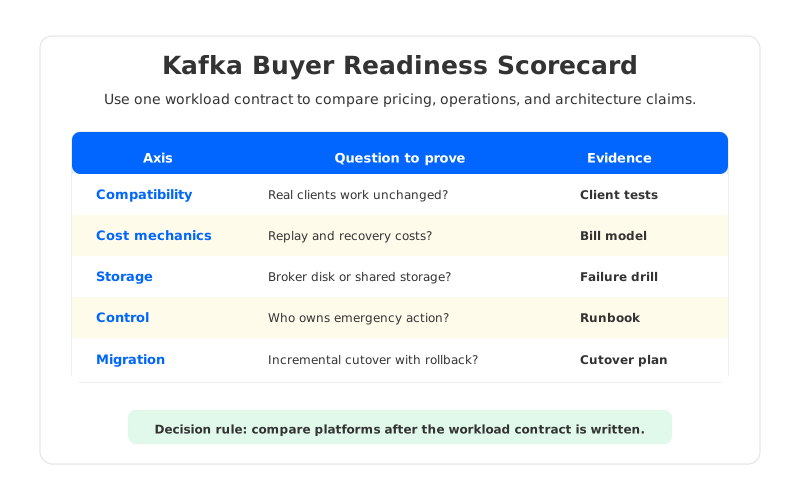
The cleanest evaluation starts with topic families, not vendors. Pick the workloads that represent the real estate: a high-throughput stream, a long-retention topic, a replay-heavy analytical feed, and a security-sensitive application. For each one, write down the same contract: write rate, message size, partition count, retention window, read fan-out, client libraries, authentication model, compaction use, transaction use, connector dependencies, and recovery objective.
Once the workload contract exists, score each platform on five axes:
- Compatibility: idempotence, transactions if used, consumer groups, offset seeking, ACLs, compaction, compression, connectors, Schema Registry, Streams, and scripts.
- Cost mechanics: plan, storage, remote reads, network transfer, private connectivity, observability, support, and replay or backfill cost.
- Storage and recovery: local disk pressure, tiered storage behavior, object-storage durability, WAL design, broker replacement, and zone failure.
- Control boundary: data-plane location, cloud account ownership, access model, audit evidence, maintenance authority, and emergency action.
- Migration path: replication plan, topic-by-topic cutover, offset handling, rollback boundary, client tests, and production freeze windows.
This structure keeps the conversation technical without becoming hostile to any vendor. It gives Aiven credit where managed Apache Kafka and ecosystem packaging are valuable. It gives cloud-native alternatives room to prove different storage and control assumptions. It gives self-managed Kafka a fair place when the team has deep operational capacity and needs maximum control.
7Where AutoMQ Fits the Evaluation
AutoMQ becomes relevant when the evaluation exposes a specific architecture requirement: Kafka compatibility is still needed, but broker-local durable storage should no longer be the center of scaling, recovery, and cloud cost. AutoMQ is a Kafka-compatible cloud-native streaming platform that uses S3Stream shared storage, stateless brokers, and a WAL path to separate compute from durable storage. In AutoMQ Cloud, the BYOC model lets the data plane run in the customer's cloud account while AutoMQ manages the service experience.
That puts AutoMQ in a different category from a classic managed Apache Kafka service. The buyer is not merely asking whether someone else can operate Kafka. The buyer is asking whether the storage architecture itself should change. AutoMQ's documentation also describes cross-AZ traffic cost reduction using shared storage and zone-aware routing, which is directly relevant when a Kafka bill is shaped by replication and client traffic across zones.
The evaluation still has to be strict. A platform team should test AutoMQ with the same workload contract it uses for Aiven, MSK, Confluent, Redpanda, or self-managed Kafka: producer behavior, consumer groups, transactions if present, connector flows, replay, compaction, latency under load, failure recovery, observability, and migration rollback. The reason to include AutoMQ is not that every Aiven buyer needs a replacement. The reason is that some buyers discover the real problem is not managed operations alone; it is the coupling between brokers, durable storage, and cloud network cost.
8A Buyer Checklist Before Committing
Before turning a pricing estimate into a purchase decision, ask the platform and FinOps teams to answer these questions in writing. The answers should be specific enough that a proof of concept can pass or fail.
- Which workloads should run on managed Apache Kafka as-is, and which ones are dominated by retention, replay, or storage elasticity?
- Which Kafka features are actually used by applications, and which must be validated before migration?
- Which byte paths cross zones, regions, cloud accounts, VPCs, private endpoints, or vendor boundaries?
- Which costs are visible in the initial estimate, and which costs activate only during replay, failure, or migration?
- Which team owns emergency access, rollback, observability evidence, and post-incident repair?
- Which topic family will be used as the production-like proof of concept, and what result would disqualify a platform?
The search for Aiven Kafka often begins with a vendor and a price. It should end with a workload contract, a byte-path model, and a responsibility map. If that review points toward Kafka-compatible shared storage, customer-side data-plane control, and independent compute/storage scaling, start with the AutoMQ Cloud Console and run one representative workload through the same pricing and operations scorecard.
9References
- Aiven documentation: Aiven for Apache Kafka
- Aiven pricing
- Apache Kafka documentation: Tiered Storage
- Apache Kafka KIP-405: Kafka Tiered Storage
- AWS EC2 On-Demand Pricing: Data Transfer
- AWS PrivateLink pricing
- Amazon MSK pricing
- AutoMQ Cloud overview
- AutoMQ documentation: S3Stream Shared Streaming Storage
- AutoMQ documentation: WAL storage
- AutoMQ documentation: Save cross-AZ traffic costs with AutoMQ
10FAQ
10.1Is Aiven Kafka pricing enough to choose a platform?
No. Pricing is a starting point, but Kafka cost depends on workload behavior. Buyers should model broker capacity, storage, retention, cross-zone traffic, private connectivity, replay, support, and operational labor before making a production decision.
10.2What is the difference between Classic Kafka and Inkless Kafka in Aiven?
Aiven's documentation describes Classic Kafka as a cluster type with fixed plans and local broker storage, with optional tiered storage for older data. Inkless Kafka is described as a cluster type that supports storing topic data in cloud object storage and targets workloads where storage elasticity matters.
10.3Why does tiered storage not solve every Kafka cost problem?
Tiered storage can reduce pressure from long retention by moving older log segments to remote storage, but buyers still need to test remote reads, cache behavior, broker recovery, billing under replay, and operational tooling. It changes the storage model; it does not remove every Kafka operations responsibility.
10.4When should AutoMQ be included in an Aiven Kafka evaluation?
Include AutoMQ when the workload analysis points to Kafka compatibility plus shared storage, customer-side data-plane control, independent compute/storage scaling, or cross-AZ traffic reduction. It should be evaluated with the same compatibility, latency, replay, cost, and recovery tests used for any Kafka platform.


