
Table of Contents
Table of Contents
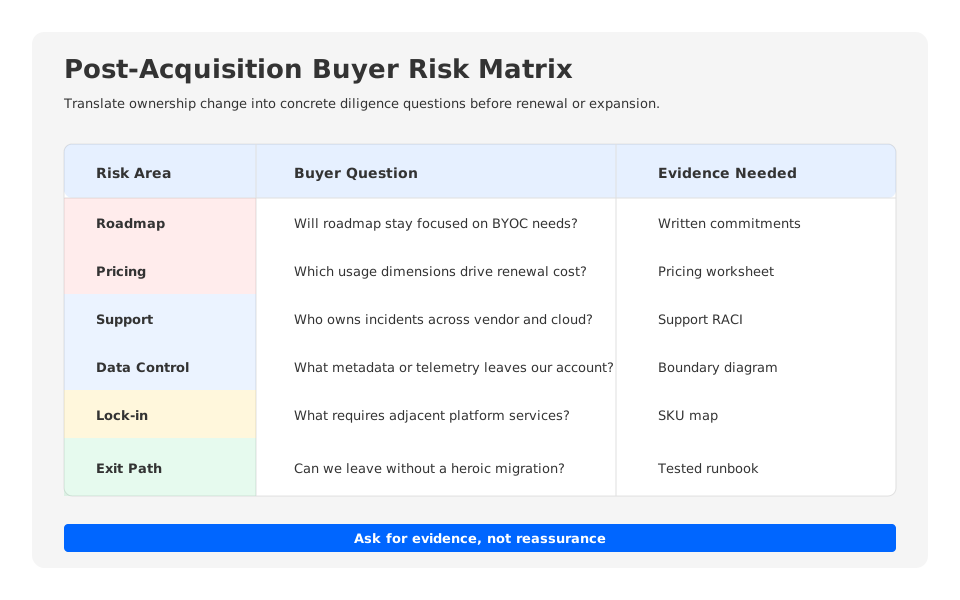
When a streaming infrastructure vendor is acquired, the first question is rarely "does the technology still work?" Production systems do not become better or worse overnight because a press release was published. The real question is whether the assumptions behind your procurement decision still hold: roadmap priority, commercial packaging, support model, deployment boundaries, and the practical cost of leaving if those assumptions change.
That is the right lens for teams evaluating an alternative to WarpStream after Confluent acquired WarpStream on September 9, 2024. Confluent described WarpStream as an Apache Kafka-compatible BYOC data streaming platform built for high-scale workloads with relaxed latency requirements, such as logging, observability, and feeding data lakes. That positioning matters because it tells buyers what WarpStream was being added to the portfolio to do, not only what it did as an independent company.
The buyer problem is sharper in 2026 because Confluent itself is now part of a broader enterprise software portfolio after IBM announced completion of its acquisition of Confluent on March 17, 2026. That does not automatically imply a product problem. It does mean that architecture teams, security reviewers, and procurement leaders should ask more explicit questions before renewing, expanding, or standardizing on any acquired streaming platform.
1What Changed When Confluent Acquired WarpStream
WarpStream's original appeal was easy to understand. Traditional Kafka binds partitions to broker-local disks and relies on broker replication for durability and availability. WarpStream took a different path: separate compute from storage, run agents in the customer's cloud, and use object storage as the durable data layer. Its documentation describes a design that separates storage and compute, data and metadata, and data plane and control plane.
That architecture still gives buyers a useful category to evaluate: Kafka-compatible streaming with object-storage-backed durability and a BYOC operating model. The acquisition changed the vendor context around that category. A buyer is no longer evaluating only a standalone company with one core product; they are evaluating a capability inside a larger portfolio that also includes Confluent Cloud, Confluent Platform, governance services, stream processing, and enterprise sales motions.
The practical concern is not "will Confluent shut it down?" Public announcements do not support that claim, and serious architecture work should not depend on guessing a vendor's private roadmap. The better concern is portfolio gravity. Once a product enters a larger platform, roadmap choices can be influenced by packaging, attach motions, support tiers, account ownership, and the need to align with adjacent products.
That is why post-acquisition diligence should be framed as a set of contract and architecture questions, not a rumor exercise.
2The Four Risks Buyers Should Evaluate
Acquisition risk sounds vague until you split it into the parts that affect production systems. Each part has a different owner inside your company. Architecture owns technical fit; platform engineering owns operations; security owns data and access boundaries; procurement owns commercial exposure. Good buyer diligence gives each group a concrete checklist.
| Risk area | What can change | Who should care | Evidence to request |
|---|---|---|---|
| Roadmap | Feature priority, integration path, API surface | Architecture, platform engineering | Written roadmap commitments and deprecation policy |
| Commercials | SKU, minimum commits, support tier, renewal terms | Procurement, FinOps | Pricing schedule, usage dimensions, exit clauses |
| Operating boundary | Control plane access, telemetry, support data | Security, compliance | BYOC security model and data-processing terms |
| Exit path | Migration tooling, metadata portability, cutover options | SRE, platform engineering | Tested migration plan and rollback runbook |
This framing keeps the conversation fair. WarpStream may still be a strong fit for workloads that match its design center. Confluent's portfolio may improve support, governance, or enterprise procurement for some buyers. The point is that an acquired product should be evaluated with the same discipline you would apply to any platform dependency that can affect years of infrastructure planning.
2.1Roadmap and Packaging Risk
Roadmap risk is not the fear that engineering stops. It is the risk that the roadmap you care about becomes secondary to the roadmap the larger platform needs. If your team chose WarpStream because it wanted a focused Kafka-compatible BYOC streaming layer, ask whether future investment is being optimized for that standalone use case or for integration into a broader Confluent and IBM platform motion.
The questions should be specific:
- Which WarpStream features are committed for the next renewal term, and which are directional?
- Will any capability require Confluent Cloud, Confluent Platform, governance products, or a higher support tier?
- Are there public compatibility commitments for Kafka clients, Kafka Connect, Schema Registry behavior, and migration tools?
- What is the deprecation policy for APIs, agent versions, CLI behavior, and deployment templates?
Do not settle for a roadmap slide if the workload is strategic. A slide helps the sales cycle; a written commitment helps the architecture review. The bigger the platform portfolio, the more important that distinction becomes.
2.2Pricing and Contract Risk
WarpStream's pricing page and billing documentation should be read before every renewal because BYOC pricing is often a composite model. The customer usually pays the vendor for the managed software or service layer and also pays the cloud provider for compute, object storage, requests, networking, monitoring, and any supporting infrastructure. A lower storage architecture can still surprise a FinOps team if the usage dimensions, minimum commits, or support requirements change.
Procurement should ask for the pricing model in operational language:
- What exact usage dimensions drive the bill: bytes written, bytes read, retained data, partitions, agents, clusters, support tier, or platform add-ons?
- Are there minimum monthly or annual commits, and do they aggregate across Confluent products?
- Are discounts tied to broader portfolio adoption?
- What happens to pricing if the workload shifts from observability-style throughput to lower-latency application eventing?
- Which costs remain in the customer's cloud account, and which costs appear on the vendor invoice?
The last question is the one teams miss. BYOC does not mean "all cost is inside your cloud bill." It means the deployment boundary is different from a fully managed SaaS cluster. That boundary needs a cost model, not a slogan.
2.3Data Control and Exit Risk
BYOC buyers often care about where data resides. WarpStream's security documentation describes the BYOC model and discusses the control plane, agent metadata, logs, profiling data, private IP addresses, availability zones, and other operational information that may be visible to or processed by the service. That is normal for a managed control plane, but it is exactly why the security review should be precise.
The most important distinction is raw event data versus operational metadata. A vendor can keep raw Kafka records in the customer's object storage while still depending on a vendor-operated control plane for cluster management, observability, billing, identity flows, metadata coordination, or support workflows. For many companies that is acceptable. For regulated teams, it must be documented.
Ask security and legal to validate these points before renewal:
- Where do raw records, metadata, logs, metrics, profiles, and support bundles reside?
- Which data leaves the customer VPC or account, and under what configuration can it be disabled?
- Who controls encryption keys for object storage and any metadata store?
- Can the cluster continue serving reads and writes during a control-plane connectivity incident?
- What evidence is available for audit logging, access review, and incident response?
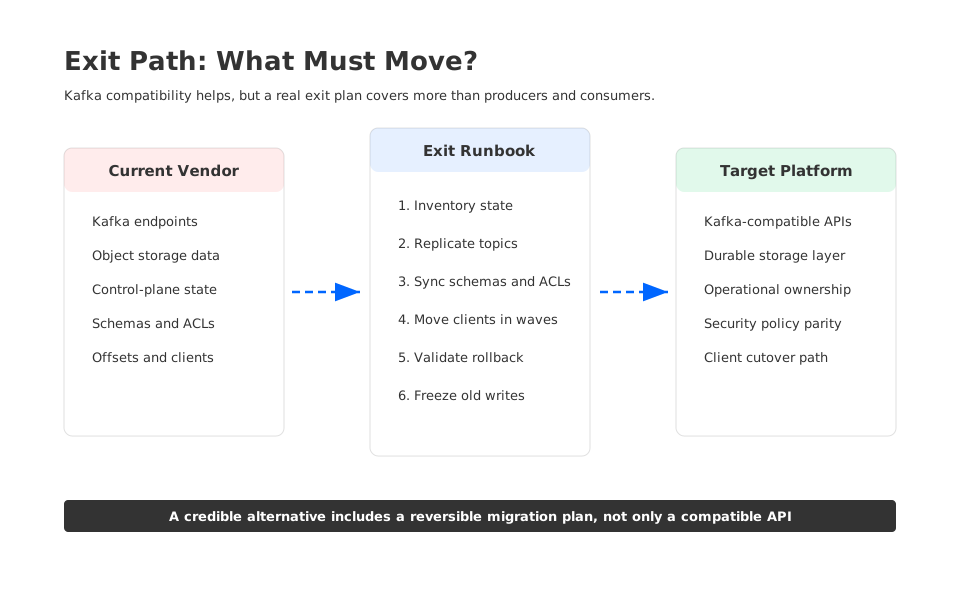
Exit risk is related but different. You need to know whether you can move your workload without a heroic project. The answer depends on how much state is portable: topic data, offsets, schemas, ACLs, client configuration, connector state, dashboards, alerts, and operational runbooks. A Kafka-compatible API helps, but API compatibility is not the same as complete platform portability.
3Questions to Ask Before Renewing or Expanding
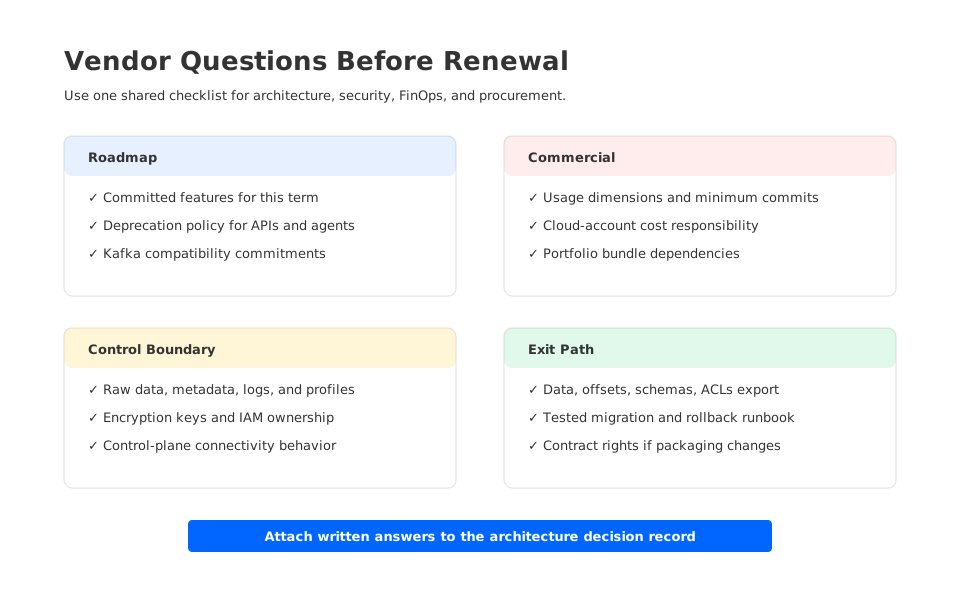
The cleanest way to run the evaluation is to make the vendor answer the questions in a shared document, then attach that document to the architecture decision record. A meeting is useful for nuance; the written answers are what survive the next reorg, renewal cycle, or incident review.
Use these 12 questions as the minimum buyer checklist:
- What is the committed product roadmap for the deployment model we are buying?
- Which features are available without adopting additional platform products?
- What Kafka protocol versions, clients, and ecosystem tools are formally supported?
- What usage dimensions drive pricing today, and can they change during the term?
- Which costs remain in our cloud account, including object storage requests and network traffic?
- What telemetry, logs, profiles, and metadata leave our account by default?
- Which telemetry paths can be disabled without losing support eligibility?
- Who controls encryption keys, object storage buckets, IAM roles, and network connectivity?
- What is the documented RTO/RPO behavior for agent failure and control-plane disruption?
- How do we export or replicate data, offsets, schemas, ACLs, and configuration?
- What migration tooling exists for leaving the platform, not only entering it?
- What contractual rights do we have if packaging, pricing, or roadmap commitments change?
This list is intentionally uncomfortable. It asks vendors to explain not only why you should buy, but how you would leave. Strong vendors can answer that without defensiveness because exit clarity is part of enterprise trust.
4How AutoMQ Fits in a Post-Acquisition Shortlist
Once the buyer questions are explicit, the shortlist becomes easier to structure. You are not choosing between brand names; you are choosing between architectural categories. Traditional self-managed Kafka gives maximum control but keeps broker-local storage, replication overhead, and operational burden. Fully managed Kafka reduces operational work but moves more of the data plane and control plane outside your account. BYOC streaming sits between those models, but implementations vary widely in what remains under customer control.
AutoMQ belongs in the Kafka-compatible, object-storage-backed category. It is open source, keeps Kafka protocol and ecosystem compatibility as a design goal, and uses shared object storage so brokers can be treated as stateless compute rather than durable data holders. In a buyer checklist, that maps to three concrete questions: can we verify the implementation, can we keep infrastructure and data in our cloud boundary, and can we scale or recover without moving large volumes of broker-local data?
That does not make AutoMQ the automatic answer for every WarpStream evaluation. It makes AutoMQ a useful comparison point when your main concerns are transparent architecture, Kafka compatibility, object storage as the primary durability layer, and deployment models where the customer keeps stronger control of the environment. If your workload is deeply tied to Confluent's governance, stream processing, support contracts, or enterprise platform bundle, those factors may outweigh the independence concern.
The strongest shortlist usually includes at least three categories:
- Keep WarpStream and negotiate stronger contractual clarity. This is reasonable when the workload fits, pricing is predictable, and the roadmap answers are specific.
- Compare another Kafka-compatible BYOC or shared-storage system such as AutoMQ. This is useful when you want object-storage-backed streaming with clearer implementation visibility and deployment control.
- Revisit managed Kafka or self-managed Kafka. This is appropriate when organizational constraints have changed more than the technology has.
The important move is to evaluate categories before vendors. Acquisitions change incentives; architecture defines constraints.
5A Procurement Checklist for the Final Decision
By the time a renewal reaches procurement, the technical team has often already decided what it prefers. That is risky. Commercial terms can quietly weaken an otherwise sound architecture decision, especially when a product is part of a larger portfolio.
Before signing, require four artifacts:
| Artifact | Why it matters | Minimum acceptable form |
|---|---|---|
| Architecture boundary diagram | Shows what runs in your account and what the vendor controls | Reviewed by security and platform engineering |
| Pricing model worksheet | Prevents hidden cloud and vendor cost surprises | Includes vendor invoice and cloud-account costs |
| Roadmap and deprecation note | Protects against packaging drift | Written commitments for the renewal period |
| Exit and rollback runbook | Keeps leverage after signing | Tested plan for data, clients, offsets, schemas, and ACLs |
The acquisition is not a reason to panic. It is a reason to replace informal assumptions with written evidence. If the vendor answers clearly, you have a stronger case to continue. If the answers are vague, your alternative evaluation is no longer a political exercise; it is risk management.
For teams comparing object-storage-backed Kafka-compatible architectures, the next useful step is to review how AutoMQ separates Kafka compute from durable storage and run a workload-specific proof of concept in your own environment. Start with the AutoMQ documentation and the AutoMQ GitHub repository so the discussion stays grounded in code, deployment model, and operational behavior rather than vendor positioning.
6References
- Confluent blog: Confluent + WarpStream = Large-Scale Streaming in your Cloud
- IBM Newsroom: IBM completes acquisition of Confluent
- WarpStream architecture documentation
- WarpStream security and privacy considerations
- WarpStream pricing
- Apache Kafka documentation
- AutoMQ documentation overview
- AutoMQ GitHub repository
7FAQ
7.1Is WarpStream still independent after the Confluent acquisition?
No. Confluent announced on September 9, 2024 that it had acquired WarpStream. Buyers should evaluate WarpStream as part of Confluent's broader data streaming portfolio, and as of March 17, 2026 they should also account for IBM's completed acquisition of Confluent in enterprise procurement reviews.
7.2Does the acquisition mean teams should leave WarpStream?
Not automatically. The right response is to ask for written clarity on roadmap, packaging, pricing, support, operating boundary, and exit path. If the answers fit your workload and risk model, staying may be rational.
7.3What is the main technical alternative category to evaluate?
The closest category is Kafka-compatible streaming with object storage as the durable storage layer and a deployment model that can run in the customer's cloud environment. AutoMQ is one option in that category, alongside other BYOC or shared-storage approaches.
7.4Is Kafka compatibility enough to avoid lock-in?
No. Kafka API compatibility helps preserve clients and ecosystem tools, but lock-in can still appear in metadata, schemas, ACLs, operational dashboards, connectors, billing dimensions, and migration tooling. Exit planning should cover all of those areas.
7.5What should procurement ask before renewal?
Procurement should ask for a pricing worksheet, a deployment boundary diagram, written roadmap and deprecation commitments, support terms, and an exit clause tied to packaging or price changes. The goal is not to make renewal difficult; it is to make the risk explicit before the contract is signed.


