
Table of Contents
Table of Contents
Amazon MSK is the default answer for many Kafka teams on AWS, and that default is rational. It runs open-source Apache Kafka versions, supports existing Kafka clients and tools, and moves a large part of cluster lifecycle work into the AWS control plane. The Amazon MSK developer guide describes the service as fully managed Apache Kafka: AWS handles operations such as creating, updating, deleting, detecting failures, and replacing unhealthy brokers, while applications continue to use Kafka data-plane APIs.
The question is not whether MSK is a serious Kafka platform. It is. The real question is whether MSK is still the right production foundation once your Kafka estate becomes a cost center, a scaling bottleneck, or a data-control boundary. For architects, SREs, data platform owners, CTOs, and FinOps teams, an Amazon MSK alternative is an operating model decision.
1Why teams look for an Amazon MSK alternative
Most MSK replacement conversations start with a bill, a scaling event, or a governance review. The team is usually not unhappy with Kafka itself. They want Kafka protocol compatibility, the existing producer and consumer model, Kafka Connect, stream processing integrations, and operational familiarity. What they are questioning is the infrastructure model underneath that Kafka API.
Apache Kafka's core abstraction is a partitioned, replicated log. The Apache Kafka documentation explains that each partition has one leader and zero or more followers, and that followers replicate the leader for fault tolerance. That model is elegant, durable, and widely understood. On cloud infrastructure, however, it turns storage, replication, broker sizing, and network placement into cost and elasticity decisions that are easy to underestimate.
The common drivers usually cluster around five pressures:
- Cost attribution gets harder as usage grows. AWS pricing separates broker or cluster hours, storage, throughput, reads, writes, partitions, and standard data transfer depending on the MSK mode. Different modes shift the cost surface rather than removing the need to model it.
- Scaling is still coupled to Kafka topology. Kafka partitions are distributed across brokers, so changes in capacity often lead to partition movement, leadership changes, rebalancing, or quota review. Express brokers improve this significantly, but the decision remains tied to broker type, supported versions, instance sizes, and throughput limits.
- Storage choices affect both operations and economics. MSK Standard brokers use customer-managed storage features such as EBS storage, tiered storage, storage autoscaling, and provisioned throughput. MSK Express brokers move storage management further into the service, but they also reduce some configuration freedom compared with Standard brokers.
- Networking becomes part of the Kafka architecture. Multi-VPC connectivity, PrivateLink, cross-region replication, client placement, and consumer fan-out change both cost and operational boundaries.
- Control boundaries matter. Some teams want AWS-native management. Others want stronger data-plane ownership, BYOC deployment, or a path that works across cloud accounts, regions, and eventually cloud providers.
None of these issues mean MSK is wrong. They mean "managed Kafka on AWS" is not one decision. It is a set of trade-offs across API compatibility, storage architecture, elasticity, operations, and commercial control.
2What MSK solves well
MSK is strongest when the main problem is reducing self-managed Kafka operations while staying within the AWS ecosystem. If your platform team is already standardized on AWS IAM, VPC networking, CloudWatch, KMS, PrivateLink, and AWS procurement, MSK gives you an AWS-native way to run Kafka without owning the full broker lifecycle. That is a meaningful reduction in operational surface area.
AWS has also broadened the MSK portfolio. MSK Provisioned now has Standard and Express broker types. The MSK broker type documentation positions Standard brokers as more configurable, while Express brokers offer more elasticity, throughput, resilience, and ease of use. For teams mainly blocked by Standard broker storage planning and partition movement, Express brokers deserve evaluation before a replacement project starts.
MSK also has managed adjacent services. MSK Connect runs Kafka Connect connectors, and MSK Replicator supports asynchronous replication between MSK clusters. These are practical building blocks when the target architecture is still AWS-first.
The decision to consider an AWS MSK alternative should therefore start with a fair baseline: are you using the right MSK mode, broker type, quotas, tiered storage setting, and client placement? A team on older Standard brokers with unmanaged rebalancing pain may be better served by an MSK optimization project than a platform migration.
3Where MSK can become difficult at scale
MSK inherits the strengths of Kafka, but it also inherits some of the design tension of broker-local storage. In traditional Kafka, brokers are request processors and partition-data owners. When a broker is added, removed, resized, or recovered, the storage layout of partitions matters. That is why scaling is not only an EC2 capacity question; it is a data placement question.
MSK tiered storage changes part of this picture. AWS documents tiered storage for Standard brokers as a low-cost tier that can scale to virtually unlimited storage and help retain data longer without increasing broker count. It also documents constraints, including provisioned-mode applicability, topic cleanup policy limitations, and client or Kafka version requirements.
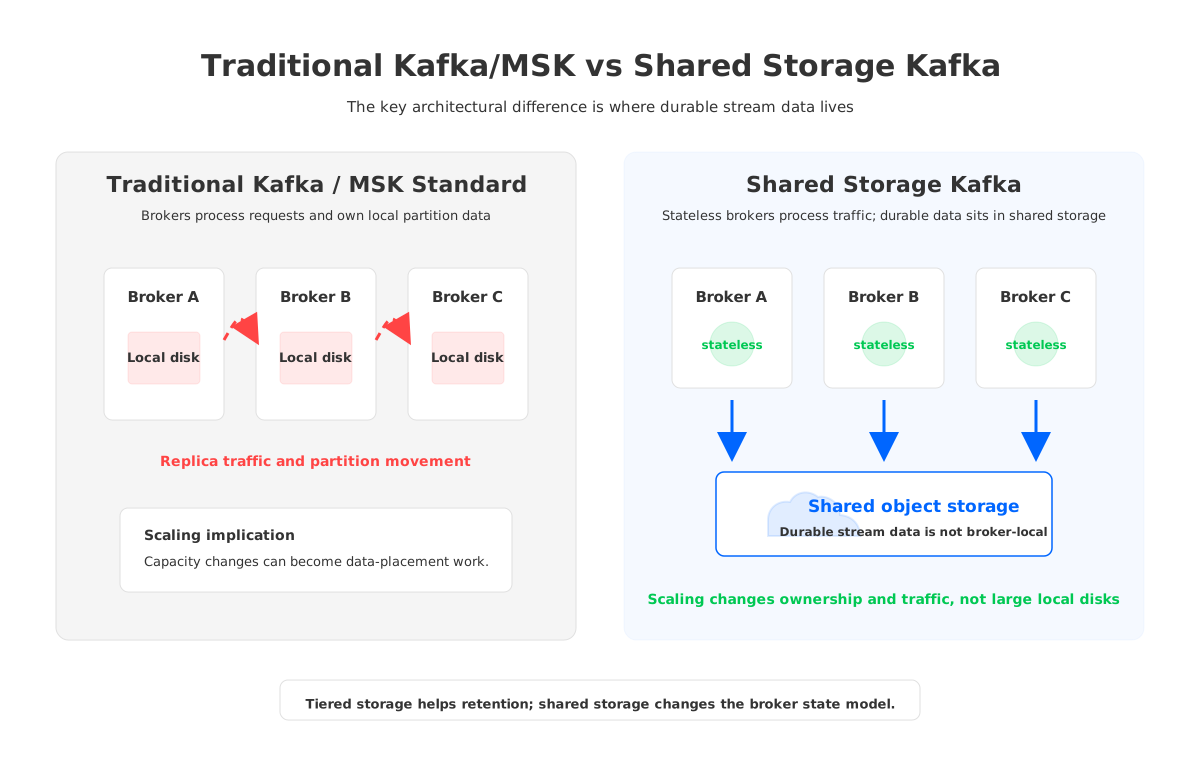
That distinction is important. Tiered storage offloads older segments; it does not make every broker stateless. The Apache Kafka tiered storage documentation describes a local tier plus a remote tier, with remote storage handling completed log segments while the local tier remains part of the broker model.
At scale, this creates a practical decision point. If your main issue is long retention, tiered storage may be sufficient. If your main issue is elastic capacity, broker-local state, over-provisioning for peak traffic, or a desire to separate compute from durable stream storage, then tiered storage is a partial answer.
The same nuance applies to MSK Serverless and Express brokers. Serverless reduces capacity management but has documented quotas. Express brokers reduce storage management and improve elasticity, but AWS documents limits around AZ configuration, instance families, and Kafka versions. These are good trade-offs for many teams, but they are still trade-offs.
4How to evaluate AWS Kafka alternatives
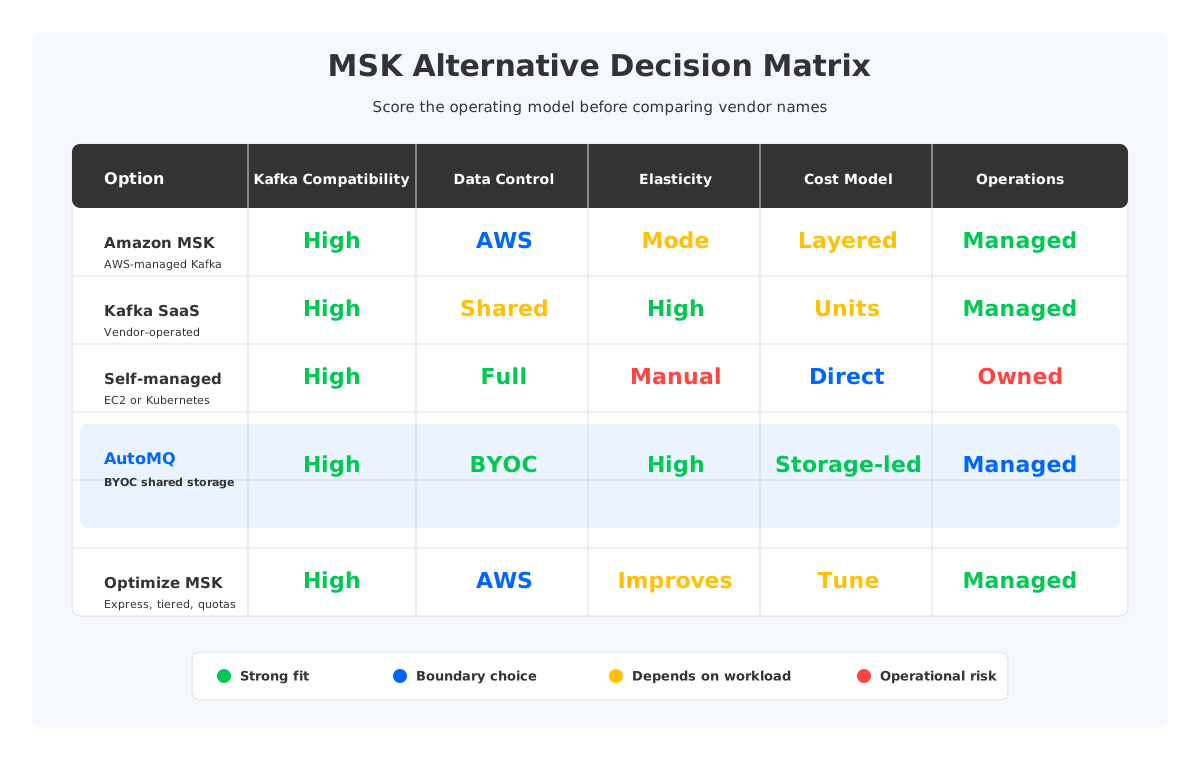
A useful comparison does not start with vendor names. It starts with the failure modes and constraints you are trying to escape. A managed Kafka AWS alternative should be scored against the workloads that are currently painful, not against a generic platform checklist.
| Evaluation dimension | What to ask | Why it matters |
|---|---|---|
| Kafka compatibility | Can existing clients, protocols, Connect pipelines, monitoring, ACLs, and offset semantics continue with minimal change? | Migration risk often sits in application behavior, not broker installation. |
| Cost model | Are costs driven by broker hours, storage provisioned, storage consumed, reads, writes, partitions, requests, network, or vendor units? | FinOps needs a forecastable model before committing to a platform change. |
| Scaling model | Does scaling require moving partition data, changing broker type, waiting for rebalancing, or requesting quotas? | Elasticity matters most during traffic spikes, incident recovery, and seasonal demand. |
| Data control | Where do records, logs, metrics, credentials, and control-plane metadata live? | CTOs and security teams care about account, VPC, region, and vendor-access boundaries. |
| Operational boundary | Who patches, monitors, rebalances, tunes quotas, handles connector runtime, and debugs client throttling? | "Managed" can mean different things across brokers, connectors, networking, and storage. |
| Migration path | Can you run dual writes, mirror topics, preserve offsets, test rollback, and cut over incrementally? | A clean target architecture is not useful if the migration path is too risky. |
This framework usually separates alternatives into four categories: MSK optimization, cloud Kafka SaaS, self-managed Kafka, and BYOC or customer-account Kafka-compatible systems. The last category tries to keep the managed experience while placing the data plane inside the customer's cloud boundary.
That category is often the most relevant when teams search for an alternative to Amazon MSK but do not want to leave AWS. They are asking for a different Kafka storage and operating model inside AWS.
5Where AutoMQ fits as an MSK alternative
If the root problem is that brokers both compute and own durable local state, then the alternative should not only be "another managed Kafka cluster." It should change the storage responsibility of the broker. This is where AutoMQ fits: it is a Kafka-compatible cloud-native streaming platform that keeps Kafka protocol and ecosystem compatibility while replacing the broker-local storage model with shared storage.
AutoMQ's architecture overview describes a Shared Storage architecture in which Kafka log storage is replaced by S3Stream, persistent data is offloaded to cloud storage, and brokers become stateless. The important architectural point is the separation of compute and storage.
For MSK alternative evaluation, AutoMQ is most relevant in four scenarios:
- Kafka compatibility is non-negotiable. AutoMQ's public documentation and FAQ describe standard Kafka protocol compatibility, so existing producers, consumers, Kafka Connect, MirrorMaker, Flink, Spark, and monitoring tools are intended to keep working without application rewrites.
- Data-plane ownership matters. AutoMQ BYOC is designed for deployment in the customer's AWS account and VPC. This matters when teams want managed operations but do not want streaming data leaving their cloud boundary.
- Elasticity is a storage problem, not only a compute problem. Stateless brokers can be added, replaced, or removed without treating partition reassignment as large-scale data copying. This changes the operational meaning of scale-out and scale-in.
- Cost pressure comes from over-provisioned brokers and local storage. Shared object storage can reduce dependence on broker-local disks and shift capacity planning toward consumed storage and active compute rather than peak provisioned disk.
This does not make AutoMQ the automatic answer for every MSK customer. If you mainly want to stay fully inside the AWS service catalog, MSK Express may be the cleaner step. If you want a vendor-operated global Kafka service with no customer-account data plane, a SaaS Kafka provider may fit better. AutoMQ is strongest when the team wants Kafka compatibility, AWS account control, object-storage-backed durability, and stateless broker elasticity.
6Replace, optimize, or stay: the decision checklist
The safest decision is often not "replace MSK" or "never replace MSK." It is a staged answer based on the specific pressure you are seeing.
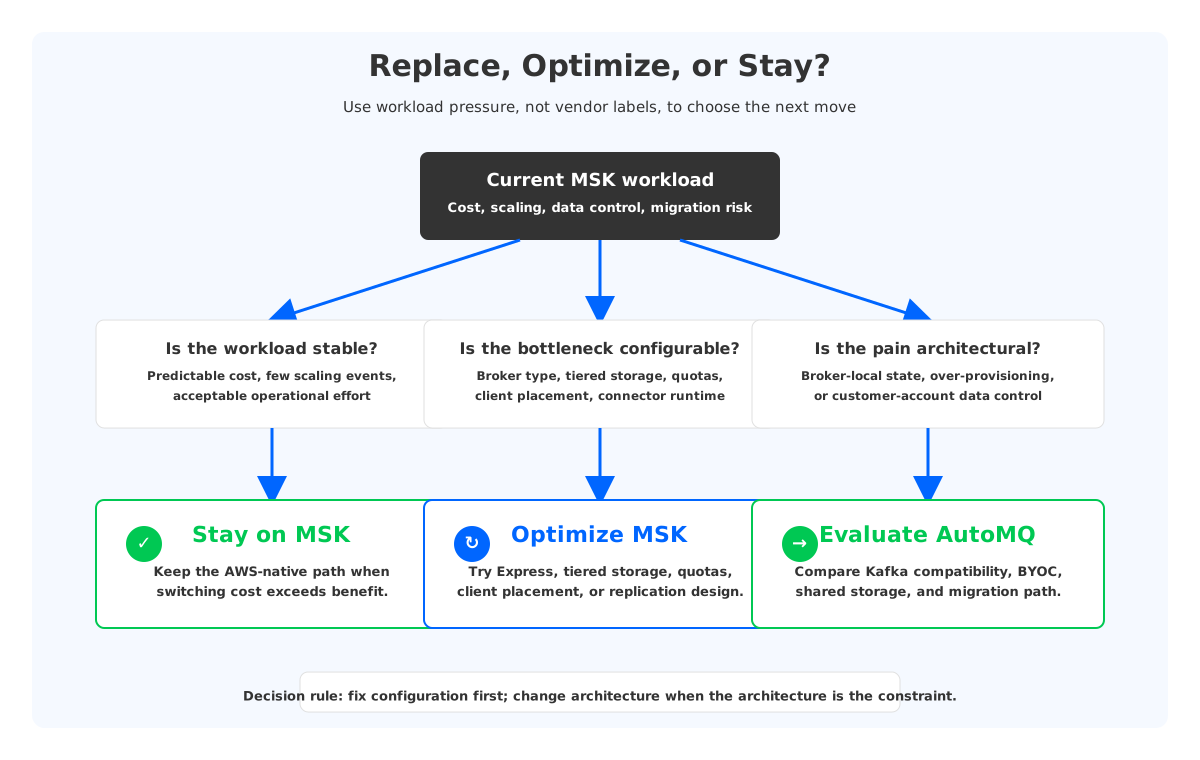
Stay on MSK when your workload is stable, your Kafka operations are mostly handled by AWS, your FinOps team can forecast the cost model, and your scaling events do not create unacceptable rebalancing or quota risk. In that case, the switching cost of an alternative may exceed the benefit.
Optimize MSK when you are on the wrong mode for the workload. Standard brokers, Express brokers, Serverless, tiered storage, MSK Connect, MSK Replicator, PrivateLink, client AZ placement, and quota adjustments are separate levers. Before replacing the platform, check whether the bottleneck is MSK as a category or the current configuration.
Evaluate an Amazon MSK alternative when the architecture itself is pushing back. Strong signals include persistent over-provisioning, repeated partition movement pain, long recovery or scaling windows, data-plane control requirements, multi-account or multi-cloud pressure, or a cost model that is no longer explainable to business owners. At that point, the evaluation should include Kafka-compatible BYOC and shared-storage options, not only another broker instance family.
For teams comparing MSK and AutoMQ, the most useful next step is a workload-specific model: broker count, partition count, write throughput, read fan-out, retention, cross-AZ traffic pattern, connector footprint, and growth curve. With those inputs, MSK, optimized MSK, SaaS Kafka, self-managed Kafka, and AutoMQ each have a place. The right Amazon MSK alternative is the one whose architecture matches the workload you actually run.
If your MSK review is driven by cost, elasticity, or data-control pressure, review AutoMQ's architecture and deployment model in the AutoMQ documentation, then compare it against your own Kafka workload profile rather than a synthetic benchmark.
7FAQ
7.1What is the best Amazon MSK alternative?
There is no universal best alternative. If you want to stay entirely within AWS-managed services, first compare MSK Standard, MSK Express, MSK Serverless, and tiered storage. If your priority is customer-account deployment, Kafka compatibility, and shared-storage elasticity, AutoMQ is worth evaluating. If your priority is a vendor-operated SaaS control plane, compare Confluent Cloud, Redpanda Cloud, WarpStream, and similar managed Kafka-compatible offerings using their official docs and pricing.
7.2When should a team replace MSK instead of optimizing it?
Replacement is worth considering when the pain is architectural rather than configuration-related. Examples include repeated scaling delays from partition movement, persistent over-provisioning, governance requirements for customer-owned data planes, or a cost model dominated by storage and network behavior that cannot be improved enough inside MSK.
7.3Is MSK Express an alternative to replacing MSK?
Yes, often. MSK Express reduces storage management and improves scaling compared with Standard brokers, according to AWS documentation. It is a strong option when the team wants to stay on MSK but reduce operational work. It is not the same as moving to a stateless shared-storage Kafka architecture, so teams should still compare data-control, compatibility, quota, version, and pricing requirements.
7.4Is AutoMQ compatible with Kafka clients and tools?
AutoMQ is designed to preserve Kafka protocol and ecosystem compatibility while changing the storage layer. Its documentation describes compatibility with existing Kafka clients and tools such as Kafka Connect, MirrorMaker, Flink, Spark, and monitoring systems. As with any platform migration, teams should validate protocol version, security configuration, transactions, compaction, connector behavior, and operational tooling against their own workload.
7.5Does an MSK alternative mean leaving AWS?
No. Many teams looking for an AWS MSK alternative still want to run in AWS. The key difference may be deployment and storage architecture: AWS service-managed MSK, vendor SaaS connected to AWS, self-managed Kafka on EC2 or Kubernetes, or a BYOC Kafka-compatible platform running in the customer's AWS account and VPC.
7.6How should FinOps compare MSK with alternatives?
Model the full cost surface: broker or compute hours, provisioned or consumed storage, partition-related charges, read and write charges, PrivateLink or cross-region replication charges, connector runtime, observability, support, and migration effort. Avoid comparing only broker instance pricing. Kafka cost often moves through storage, network, and over-provisioning before it appears as a line item.
8References
- AWS, Amazon MSK Developer Guide: What is Amazon MSK?
- AWS, Amazon MSK pricing
- AWS, Amazon MSK broker types
- AWS, Amazon MSK Express brokers
- AWS, Amazon MSK quota
- AWS, Tiered storage for Standard brokers
- AWS, Understand MSK Connect
- AWS, Amazon MSK Replicator
- AWS, Amazon EC2 On-Demand Pricing: Data Transfer
- Apache Kafka, Introduction: distribution and replication
- Apache Kafka, Tiered Storage
- Apache Software Foundation, KIP-405: Kafka Tiered Storage
- AutoMQ, Architecture overview
- AutoMQ, S3Stream shared streaming storage overview
- AutoMQ, Stateless Broker
- AutoMQ, AutoMQ FAQ


