
Table of Contents
Table of Contents
The surprising part of an Amazon MSK cost review is rarely the broker hourly line. Teams expect broker capacity, storage, monitoring, and support to show up somewhere. The line that takes longer to explain is data transfer, because it is produced by topology rather than by a single knob in the MSK console. A producer in one Availability Zone can write to a broker in another. A consumer group can rebalance onto clients that no longer sit near the partitions they read. A connector, Flink job, or Kubernetes deployment can look harmless at the application layer while turning every fetch into cross-zone traffic.
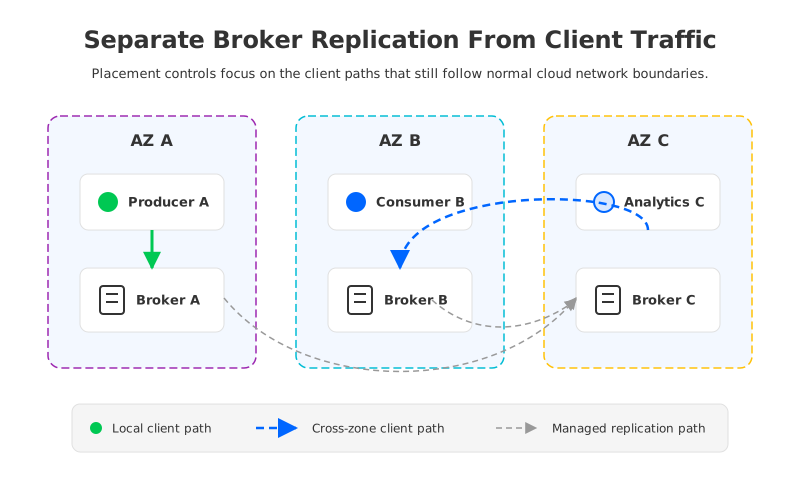
That is why "traffic costs Amazon MSK" is not only a pricing question. It is a placement question. MSK can remove some categories of managed-service complexity, and AWS states on the MSK pricing page that broker replication traffic inside MSK is not charged as data transfer by MSK. But client traffic in and out of the cluster still follows normal AWS data transfer rules. Once a Kafka platform spans multiple Availability Zones, the bill depends on where bytes enter, where they leave, and whether your clients are disciplined enough to stay close to the brokers that serve them.
The useful response is not to flatten every workload into one average GB/month number. Kafka traffic has direction, fan-out, retry behavior, and consumer lag. A better model starts with client placement controls: the practices that decide which producers and consumers may talk to which broker endpoints, from which subnets, and under which failover rules. Those controls will not make networking free, but they can turn a vague charge into an architecture decision you can reason about.
1Start With The Traffic You Can Attribute
Kafka cost models often begin with retained data because storage is easier to see. A topic has partitions, partitions have retention, and retention maps to GB. Network traffic is less visible because it is created by runtime behavior. The same topic can generate very different data transfer cost depending on consumer fan-out, compression ratio, batching, retries, and client location.
For Amazon MSK, the first split is between cluster-internal traffic and client traffic. AWS documents MSK pricing separately from standard AWS data transfer charges. The distinction matters because Kafka operators may assume that multi-AZ replication is the main cost driver. For MSK broker replication, that assumption can be wrong. The more exposed cost surface is often the traffic between client applications and broker endpoints, especially when those applications run in different subnets, accounts, VPCs, or Availability Zones.
Build the first pass of the model around four byte paths:
- Producer writes: application bytes, protocol overhead, compression behavior, and retries from producers to brokers.
- Consumer reads: fetch traffic from brokers to every consumer group, multiplied by fan-out and replay events.
- Administrative traffic: metadata requests, rebalances, controller interactions, and monitoring scrapes. This is usually smaller, but it explains noisy baselines.
- Boundary traffic: VPC peering, PrivateLink, NAT, Transit Gateway, cross-region replication, and analytics systems that read from outside the cluster's placement envelope.
This split changes the conversation. If a high bill is dominated by producer writes, batching and producer placement matter. If it is dominated by consumers, fan-out and consumer group placement matter. If it is dominated by boundary traffic, the right fix may be architectural: move compute closer or separate real-time consumers from bulk export workloads.
2Why Client Placement Becomes A FinOps Control
Kafka clients discover broker metadata and then connect to partition leaders. That discovery step gives Kafka its scalable client-side routing model, but it also means cost-aware placement must survive beyond the bootstrap address. A client that starts with a local bootstrap endpoint can still receive metadata for brokers in multiple zones and open connections across zone boundaries if the advertised listener topology allows it.
In a single-AZ test cluster, nobody notices. In a production MSK cluster spread across three Availability Zones, a few small choices compound quickly. Kubernetes schedulers may spread pods evenly without understanding Kafka partition leadership. Consumer groups may rebalance after a deployment and land in a different zone from the partitions they fetch most often. A shared service team may expose one bootstrap string to every workload because it is operationally convenient. Each decision is defensible in isolation; together they make the network bill hard to predict.
The most practical placement controls are not exotic. They are the same controls platform teams already use for resilience, made cost-aware:
| Control | What It Governs | Cost Question It Answers |
|---|---|---|
| Subnet and AZ affinity | Where producers and consumers are scheduled | Are clients close to the brokers they use most? |
| Listener design | Which broker addresses clients learn | Can clients avoid unnecessary cross-zone connections? |
| Workload segmentation | Which topics and groups share a cluster | Are high fan-out consumers isolated from write-heavy topics? |
| Failover rules | What happens when a zone becomes unhealthy | Does a resilience event create an uncontrolled traffic surge? |
| Boundary design | How external systems reach Kafka | Is traffic crossing VPC, account, or regional boundaries intentionally? |
The table is deliberately operational. Placement controls only work when they are enforceable by the platform, not when they live as tribal knowledge in a runbook. If the application team can deploy a consumer group anywhere and reuse any bootstrap string, the cost model is already stale.
3A Placement-Aware Cost Model
A placement-aware model does not need perfect precision to be useful. It needs enough structure to separate engineering actions. Start with logical Kafka traffic, then add locality.
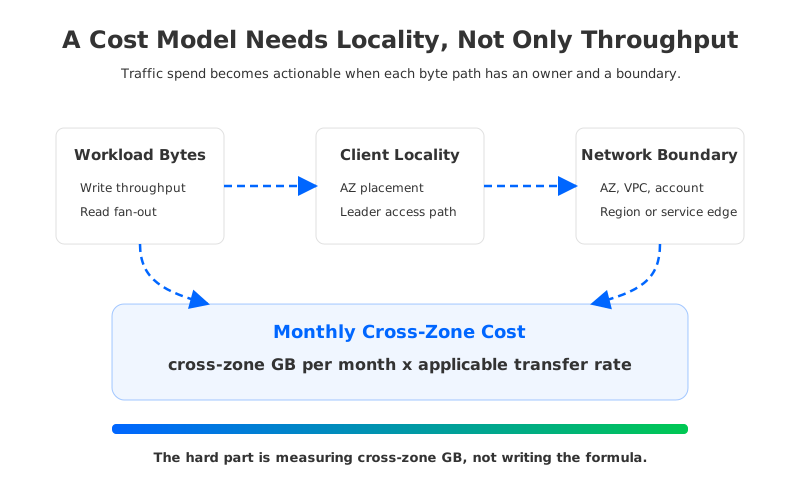
For each topic, estimate write throughput after compression, read fan-out, and replay behavior. A topic receiving 50 MiB/s with three independent consumer groups does not produce 50 MiB/s of network egress from brokers; it can produce roughly 150 MiB/s of broker-to-consumer fetch traffic before retries and replays. Then assign each producer and consumer group to an expected zone distribution. If one third of a consumer group's clients sit in each of three zones, but the partitions they read are not evenly local to those clients, a share of the fetch traffic becomes cross-zone.
The exact AWS data transfer rate depends on region and path, so the model should keep the rate as an input rather than hard-code it. That makes the math portable:
monthly_cross_zone_cost =
  cross_zone_GB_per_month
  * applicable_AWS_data_transfer_rate_per_GB
This formula looks too simple until you try to fill in cross_zone_GB_per_month. That number is where the architecture hides. It depends on client scheduling, partition leadership, consumer fan-out, network boundaries, and failure behavior. If the platform cannot estimate it by workload, the team is not really controlling traffic cost; it is discovering the cost after AWS publishes the bill.
4The Controls That Usually Move The Number
The first control is AZ-aware client scheduling. If producers and consumers run on EKS, ECS, EC2 Auto Scaling groups, or another orchestrator, scheduling policy should line up with Kafka access policy. A platform can expose zone-specific bootstrap endpoints, require clients to use subnets that match the intended cluster access path, and keep high-throughput services in the same region and zone envelope as the brokers.
The second control is listener and DNS design. Kafka's advertised listeners define what addresses clients receive after bootstrap. If those addresses are not aligned with the intended network path, the bootstrap endpoint becomes a false comfort. Many teams learn this during migrations: the connection test passes, but steady-state clients quietly talk to broker addresses that cross a less controlled boundary.
The third control is consumer placement by fan-out. Producer traffic is easier to reason about because write paths are concentrated. Consumer traffic can dwarf writes when multiple teams read the same topic, replay historical data, or run stream processing jobs with parallelism that changes during autoscaling. High fan-out topics deserve stronger locality rules than low-volume operational topics.
The fourth control is failure-mode budgeting. Multi-AZ architecture exists because zones fail, maintenance happens, and deployments go wrong. A placement plan that only works during perfect health is an accounting trick. Model the temporary cost of a zone evacuation, a broker replacement, and a consumer group rebalance.
5When Placement Controls Are Not Enough
Placement controls are powerful, but they do not change the deeper shape of traditional Kafka architecture. Brokers still own storage and serve client traffic from nodes placed in specific zones. Operators can tune placement, listeners, and workload boundaries, but the system remains sensitive to where compute and durable log storage live. That sensitivity becomes harder to manage when the business wants elastic throughput, large retention, many consumer groups, and strict multi-AZ resilience at the same time.
This is where the evaluation should broaden from "Can we tune MSK better?" to "Which storage architecture matches our traffic pattern?" Kafka tiered storage can reduce pressure on local disks for older data, but it does not make the active log path stateless. Self-managed Kafka gives teams more control over listener topology and broker placement, but it also returns operational burden. Managed Kafka services simplify operations, but they do not erase the cost consequences of client locality. Each option is valid; the mistake is evaluating them only on broker hourly price.
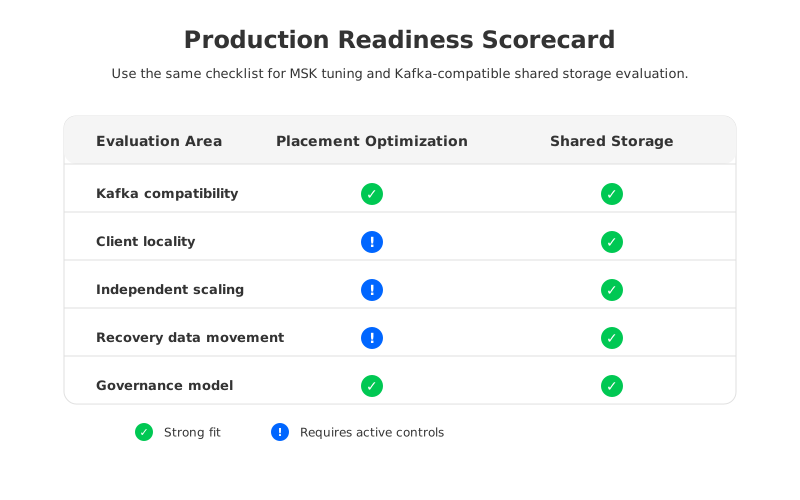
A useful architecture comparison asks three questions:
- Does the platform let compute scale independently from durable storage?
- Can it keep Kafka protocol compatibility while reducing cross-zone data movement?
- During failover or scaling, does recovery require large data movement between brokers?
Those questions point toward a different architecture category: Kafka-compatible shared storage. In this model, brokers become more stateless, durable log data is backed by object storage or shared storage, and the system tries to reduce the amount of data that must move between broker nodes when capacity changes.
6How AutoMQ Fits The Evaluation
AutoMQ belongs in that shared-storage category. It is a Kafka-compatible streaming system that keeps the Kafka API and client ecosystem while moving the storage layer away from broker-local disks. AutoMQ's architecture uses object-storage-backed durability with a WAL and cache design, so broker compute and durable storage can scale more independently than in a classic local-disk Kafka deployment. The point is not that every MSK cluster should be replaced. The point is that some traffic-cost problems are symptoms of an architecture that makes data locality expensive to maintain.
One AutoMQ capability is especially relevant to this discussion: zero cross-AZ traffic design for supported deployment patterns. Instead of treating cross-zone broker data movement as an unavoidable side effect of high availability, AutoMQ's shared-storage approach changes the path that durable data takes. That can matter for teams whose AWS bill is shaped by multi-AZ Kafka traffic, not only by broker instance size. It also changes operational recovery: adding or replacing broker compute does not have to mean moving large local log segments from one broker to another.
The evaluation still needs discipline. Kafka compatibility should be tested with real producers, consumers, ACLs, transactions if used, observability, and failure drills. Cost should include object storage, WAL, compute, network, support, and the operational time spent managing rebalances or capacity changes.
The right place for AutoMQ in the decision is after the team has mapped its traffic paths. If MSK traffic spend is small, stable, and well understood, placement controls may be enough. If the cost keeps reappearing because the workload has high fan-out, elastic compute, long retention, and frequent scaling events, shared-storage Kafka deserves a closer look.
7A Practical Review Checklist
Before changing platforms, run a placement review with the same seriousness as a security review. Pull AWS cost data, Kafka throughput metrics, and the current deployment topology for the main producers and consumers. The goal is not to blame a team for cross-zone traffic. The goal is to discover which bytes were intentional.
Start with the workloads that produce or read the most data, not the topics with the most political visibility. For each one, identify the broker access path, client subnets, consumer group count, replay patterns, and external sinks. Then tag each path as controlled local traffic, intentional boundary traffic, or accidental boundary traffic.
For teams evaluating alternatives, keep the comparison grounded:
| Evaluation Area | MSK Placement Optimization | Shared-Storage Kafka-Compatible Architecture |
|---|---|---|
| Best fit | Existing MSK estate with controllable client locality | Workloads where storage locality and scaling drive recurring cost |
| Primary work | Subnet, listener, scheduling, and boundary governance | Platform migration, compatibility validation, and changed operations |
| Cost lever | Reduce accidental cross-zone and boundary traffic | Reduce architecture-driven data movement and decouple compute/storage |
| Main risk | Rules drift as teams deploy clients | Migration planning and production validation |
The table separates two different kinds of work. MSK placement optimization improves an existing architecture. Shared-storage Kafka changes the architecture when placement work no longer addresses the root cause.
If your next MSK cost review starts with an unexplained data transfer line, begin by mapping the bytes before buying more capacity. For teams that find the same locality problem coming back after each scaling event, AutoMQ's Kafka-compatible shared-storage architecture is worth evaluating as a next step: review the AutoMQ Cloud architecture and deployment model.
8References
- Amazon MSK pricing
- AWS EC2 On-Demand pricing and data transfer
- Amazon MSK client access documentation
- Apache Kafka documentation
- AutoMQ architecture overview
- AutoMQ zero inter-zone traffic overview
9FAQ
9.1Does Amazon MSK charge for broker replication traffic?
AWS states on the Amazon MSK pricing page that data transfer used for replication between brokers, and between metadata nodes and brokers, is not charged by MSK as data transfer. Client traffic into and out of the cluster can still be subject to standard AWS data transfer charges depending on path, region, and network boundary.
9.2Is cross-AZ traffic always bad for Kafka?
No. Multi-AZ design is a resilience requirement for many production Kafka environments. The problem is accidental cross-AZ traffic: bytes that cross zones because clients, listeners, or schedulers were not designed with locality in mind. Intentional cross-zone traffic should be modeled and budgeted.
9.3What is the quickest way to reduce MSK traffic cost?
Start with the largest producers and highest fan-out consumer groups. Verify where they run, which broker addresses they learn, and whether their traffic crosses Availability Zones, VPCs, accounts, or regions without a clear reason. Placement fixes on high-volume consumers often move the number faster than small broker tuning changes.
9.4When should a team consider AutoMQ instead of only tuning MSK?
Consider AutoMQ when the recurring cost driver is tied to architecture rather than one misconfigured client: high fan-out, frequent scaling, large retention, elastic compute, and strict multi-AZ requirements. In that case, Kafka-compatible shared storage can be evaluated alongside MSK placement optimization.


