
Table of Contents
Table of Contents
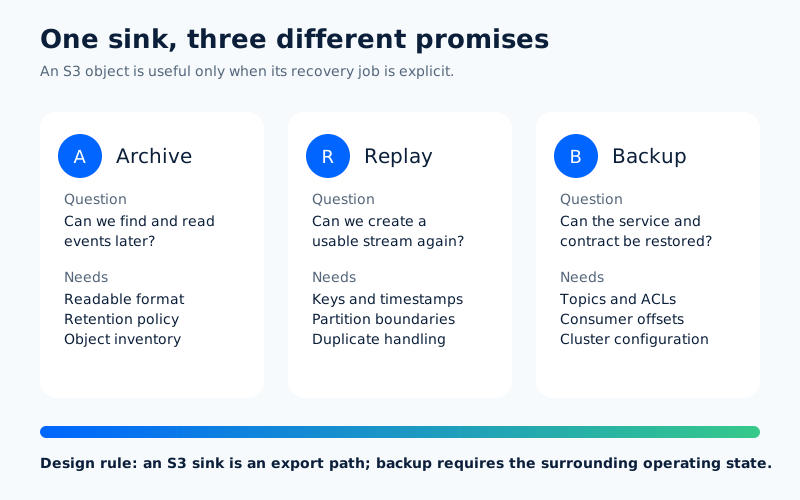
If you point an Amazon MSK Connect S3 sink at an Amazon MSK topic, what do you get: an archive, a replay system, or a backup? The answer is usually “some of each,” which is why teams discover gaps during the first recovery test. Objects in S3 can preserve event payloads without preserving Kafka offsets, topic settings, ACLs, or the exact connector state that produced them.
A useful design starts by separating three jobs:
- Archive: retain a readable copy of events for audit, analytics, or long-term history.
- Replay: recreate a Kafka stream, or feed another consumer, from a known point in that history.
- Backup: recover the Kafka service and its operational state after a destructive failure.
An Amazon MSK Connect S3 sink can be an excellent archive and a workable replay source. By itself, it is not a complete Amazon MSK backup. The rest of this article shows where the boundaries are, how delivery and file layout affect recovery, and when a storage-layer design such as AutoMQ changes the decision.
1An S3 sink exports records; it does not snapshot a cluster
Amazon MSK Connect is a managed runtime for Kafka Connect workers. It runs a connector plugin, and the plugin defines how records are batched, encoded, committed, and written to S3. The MSK Connect service does not add backup semantics to a connector that does not have them.
This distinction matters because a Kafka cluster contains more than record values. A practical backup inventory includes:
| What must be recovered | Where it normally lives | Does an S3 sink provide it? |
|---|---|---|
| Record key, value, and selected headers | S3 objects written by the sink | Often, depending on the format |
| Partition and source offset | Object metadata or encoded records | Sometimes; verify the plugin |
| Topic names and partition count | MSK/Kafka metadata | No |
| Consumer-group offsets | Kafka internal topics | No |
| ACLs, IAM policies, and encryption settings | MSK and AWS configuration | No |
| Connector configuration and plugin version | MSK Connect and deployment records | No |
| Event-time ordering across partitions | Per-partition ordering only | No global ordering |
The last column is deliberately cautious. “S3 sink” is a connector category, not one wire format. The Kafka Connect documentation describes the worker and task model, while each vendor’s S3 connector documents its own partitioner, converters, commit policy, and metadata. Read those semantics before treating an object as a recovery artifact.
For example, a connector may write Avro, JSON, Parquet, or raw bytes. A data lake consumer can read those files, but a Kafka producer cannot automatically reconstruct the original record key, headers, timestamp, and offset unless the format and replay process preserve them. A file that is perfectly useful for analytics may be a poor input for a byte-for-byte stream rebuild.
2Archive, replay, and backup have different acceptance tests
The easiest way to prevent an ambiguous design is to write one acceptance test for each job.
2.1Archive acceptance test
An archive answers: “Can an authorized person find and interpret the event later?”
Test at least:
- A topic, partition, event-time window, and object prefix identify the expected data.
- The object format remains readable after the schema evolves.
- The S3 bucket policy, encryption key, retention policy, and access logs match your governance requirements.
- A manifest or inventory can tell you which partitions and time windows have arrived.
A connector can be healthy while the archive still has gaps. Flush intervals, task restarts, permission errors, and late records can leave an interval represented by several objects or by no committed object yet. Monitor the connector’s task state and compare expected partition progress with S3 object arrival.
S3 offers strong read-after-write consistency for object operations, but that does not mean a connector has delivered every Kafka record. S3 consistency answers whether a completed object can be read; it does not answer whether the producer has flushed all records that belong in the time window. See the S3 consistency model when defining the verification boundary.
2.2Replay acceptance test
A replay system answers: “Can I produce a usable stream from a known time or offset?”
Replay requires more than files in a bucket:
- A mapping from source topic and partition to object prefix.
- A record format that retains the key, value, timestamp, headers, and any schema identifier required by consumers.
- A deterministic way to select a starting boundary.
- A producer that writes to a new topic or cluster without confusing replayed records with live traffic.
- A policy for duplicates, because replay is commonly at-least-once.
The safe default is to replay into a new topic with a new consumer group. Keep the original topic name in a record header or envelope, and include the source partition and offset when the connector format makes them available. Do not assume S3 object names alone are enough: a time-based partitioner can place records from adjacent Kafka offsets in the same object, and a connector retry can create a second file that overlaps a previous range.
If the application uses event time for deduplication, preserve it explicitly. If it uses Kafka offsets as an idempotency key, decide whether the replay producer will retain that offset as application metadata or whether consumers need a different deduplication key. A replay run that “finishes” but changes the application’s ordering or duplicate behavior has not passed the acceptance test. For a related connector recovery example, see Debezium CDC on Amazon MSK Connect.
2.3Backup acceptance test
A backup answers: “Can the service and its operating contract be restored after loss?”
For MSK, that contract includes:
- Cluster configuration and broker properties.
- Topic names, partition counts, replication settings, and retention.
- Authentication mode, ACLs, IAM policies, and KMS key access.
- Connect worker configuration, plugin artifacts, connector settings, and secrets.
- Consumer-group offsets when applications must resume at their previous position.
- A tested procedure for creating the replacement cluster and reconnecting clients.
An S3 sink does not capture these items automatically. Store them as versioned infrastructure and configuration, and test the restore path separately from the data export. AWS’s MSK Connect overview and MSK IAM access control guide describe the service and security boundaries; your runbook must add the organization-specific policy and secret recovery steps. If you are still choosing a cluster authentication mode, compare the operational trade-offs in Amazon MSK IAM, SCRAM, and TLS authentication.
3File layout determines whether “replay” is practical
An S3 prefix is a navigation scheme, not a replay protocol. A useful layout lets operators answer three questions quickly: which source partition produced this object, what time range does it cover, and has the object been finalized?
Many S3 sink connectors use a partitioner based on topic, Kafka partition, and record timestamp. That layout is convenient for analytics and lifecycle rules. It also creates several operational choices:
- Time partitioning: easy retention and time-window selection, but records near a boundary can be split across objects.
- Topic/partition partitioning: closer to Kafka ordering, but less convenient for time-based queries and lifecycle policies.
- Size or time flush thresholds: smaller files reduce replay startup latency but increase object count and request overhead; larger files are cheaper to enumerate but take longer to validate or reprocess.
- Commit markers or manifests: explicit completion signals make it easier to distinguish a partial upload from a replayable unit.
Do not publish a cost or performance promise from a generic file size. S3 request charges, storage class, compression, cross-region transfer, and connector flush behavior all affect the result. Use the Amazon S3 pricing page and your own object inventory to calculate the total.
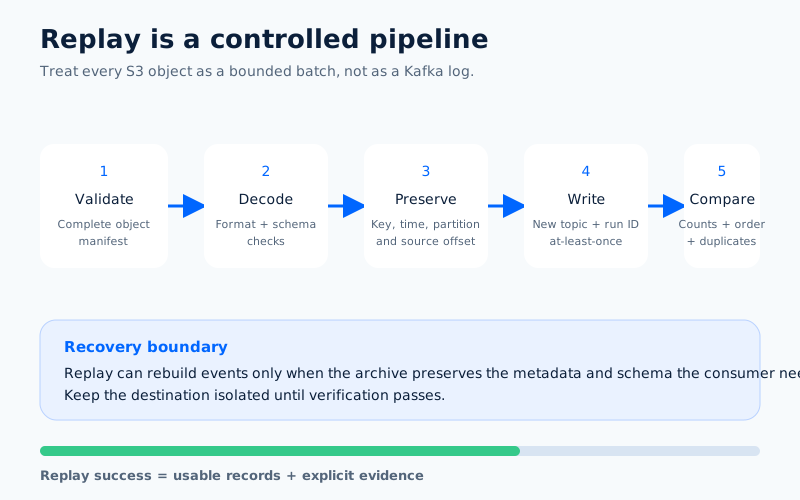
The replay path should treat every object as a bounded batch. First validate that the object is complete and readable. Then decode records, preserve the metadata your consumer needs, and write to a destination topic with a replay run identifier. Finally, compare source and destination counts by topic, partition, and time window. A count match is necessary, but it is not proof of ordering or schema compatibility.
4Retention is a policy, not a bucket setting
Archive retention is usually longer than Kafka retention, but “keep it in S3” is not a policy by itself. Write the intended retention in terms of recovery objectives:
- How many days of history must be replayable?
- How quickly must a selected window be available?
- Which event classes require legal hold or immutable retention?
- Which objects can move to a lower-cost storage class?
- How will you delete data when the source topic or tenant is retired?
Use S3 Lifecycle rules only after you know the replay window and the validation process. A lifecycle transition can lower storage cost while making a recovery test slower or adding retrieval charges. Object Lock, versioning, and KMS policies solve governance problems, but they do not repair a connector that wrote incomplete or incorrectly encoded records.
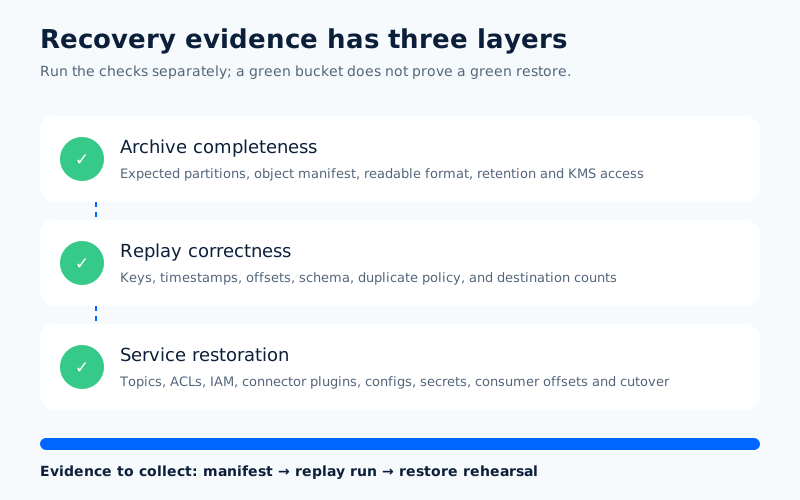
A good monthly exercise is to select a random topic and window, generate a manifest, replay it into an isolated topic, and compare:
- Records expected from the source inventory.
- Records successfully decoded.
- Records written to the destination.
- Duplicates and missing keys.
- Event-time and partition-order violations.
- Consumer behavior after schema evolution.
Store the test evidence beside the run metadata. “The bucket contains objects” is not a recovery result.
5When a storage-layer architecture changes the question
An S3 sink sits beside Kafka: it reads records from the broker and writes another copy to S3. That is useful when you need an independent export, a lake feed, or a compliance archive. It also means the broker still carries the retention, replication, and recovery workload while the connector adds another path to operate.
A storage-layer architecture approaches the problem differently. AutoMQ is a Kafka-compatible streaming system with shared object storage as its durable storage layer. That can reduce the need to treat a connector export as the primary long-term copy when the workload is designed around object storage from the start. It does not remove the need to define replay semantics, topic metadata, IAM, or application-level backups. It changes where the durable stream lives and how compute and storage capacity are separated.
This is the decision boundary:
- Keep an MSK Connect S3 sink when you need an independent downstream copy, a lake format, or a narrowly scoped archive.
- Add a replay process when recovery means rebuilding a stream, and test record metadata, duplicate handling, and ordering explicitly.
- Build a separate MSK backup runbook when recovery includes cluster configuration, ACLs, offsets, and client cutover.
- Evaluate a Kafka-compatible object-storage-backed platform when long retention is a first-class streaming requirement rather than a side export.
6FAQ
6.1Is an MSK Connect S3 sink a backup?
Usually no. It can preserve event data, but it does not automatically preserve MSK cluster metadata, consumer offsets, ACLs, connector configuration, or a tested restore procedure.
6.2Can I replay Kafka data from S3?
Yes, if the connector format retains the metadata and schema your replay consumer needs, and you have a deterministic way to select complete objects. Plan for duplicates and write to an isolated destination first.
6.3Does S3 preserve Kafka ordering?
S3 stores objects; it does not provide Kafka’s partition ordering semantics. Preserve source partition and offset metadata, then enforce ordering in the replay producer or consumer where required.
6.4Which S3 sink connector should I use with MSK Connect?
Choose based on format, converter support, partitioner, flush and commit behavior, schema handling, IAM/KMS integration, and operational ownership. MSK Connect supplies the managed runtime; the connector documentation supplies the data contract.
6.5What should a backup runbook include?
Include infrastructure-as-code for the cluster, topics, security, KMS, MSK Connect plugins and connectors, application configuration, consumer offsets where needed, and a tested data restore or replay procedure.
The first question to ask after creating an S3 sink is not “Are objects appearing?” Ask which of the three jobs the objects are meant to perform. Archive, replay, and backup can share a bucket, but they need different metadata, tests, and ownership. Once that boundary is explicit, an MSK Connect S3 sink becomes a deliberate part of the recovery design instead of a backup assumption. If you want to evaluate a Kafka-compatible, object-storage-backed architecture against your current MSK design, start with AutoMQ.


