
Table of Contents
Table of Contents
When several product teams share one Amazon MSK cluster, Amazon MSK cost allocation becomes a measurement problem before it becomes an accounting problem. The AWS bill tells you what the platform spent but rarely tells you who caused each unit of spend. A cluster can have one broker fleet, one storage bill, and one set of cross-Availability Zone flows while dozens of teams publish and consume different topics. A tag on the cluster can identify the owner of the infrastructure. It cannot, by itself, explain which team made retention longer, increased replication traffic, or kept a high-volume consumer running.
That distinction is the starting point for an MSK FinOps program. The accounting total should come from AWS billing data. The allocation key should come from Kafka and connector usage. The policy should make the assumptions visible enough that a product team can challenge a charge and a platform team can reproduce it. This article lays out that model for showback and chargeback without pretending that a shared cluster produces tenant-level prices automatically.
1Separate the bill from the allocation key
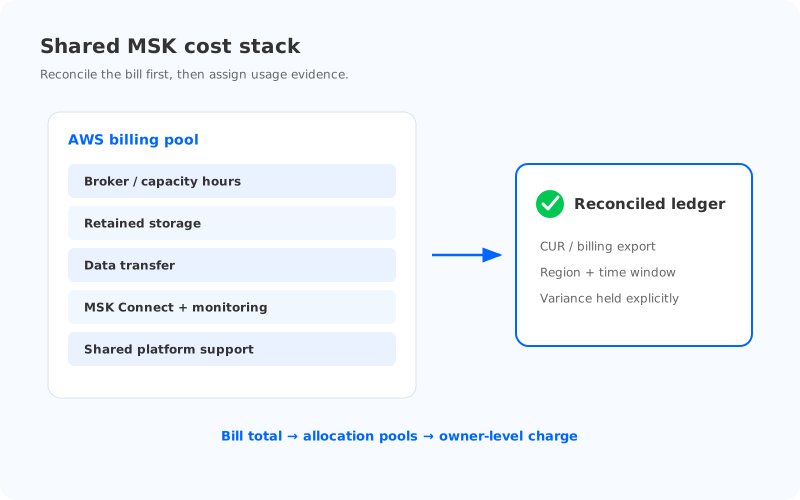
Start with a cost ledger that reconciles to the AWS Cost and Usage Report (CUR) or the billing export used by your organization. Amazon MSK pricing has separate dimensions for the cluster configuration and for data-related usage; the exact line items depend on the deployment mode, Region, and features enabled. Data transfer, storage, MSK Connect, monitoring, and support may appear outside the cluster line item. Keep those dimensions separate before assigning a team a share.
| Cost dimension | What it represents | Useful allocation evidence |
|---|---|---|
| Broker or capacity hours | The provisioned cluster capacity over time | Cluster, Region, broker type, and time window |
| Storage | Retained log data and storage-related usage | Topic retention policy, bytes retained, and partition history |
| Data transfer | Traffic crossing an Availability Zone, Region, or service boundary | Producer and consumer bytes, network path, and Region |
| MSK Connect | Connector workers and connector-level processing | Worker-hours, tasks, records, retries, and connector owner |
| Monitoring and logs | CloudWatch metrics, log ingestion, and retention | Metric level, log group, retention, and owner |
| Support and shared platform | Support plan and engineering operations | Agreed fixed or pooled policy |
The ledger and the allocation model answer different questions. The ledger asks, “What did AWS charge?” The model asks, “Which workload used the capacity that produced this charge?” Reconcile the sum of allocated amounts to the ledger every month. If it does not tie out, hold the variance in a shared platform bucket and investigate it rather than silently changing team rates.
2Why cluster tags are necessary but insufficient
AWS supports tagging Amazon MSK clusters, and AWS Billing can use activated cost allocation tags in billing reports. Tags are useful for identifying an environment, business unit, or platform owner. They are a reliable first partition of infrastructure spend when each cluster has one clear owner. They become a weak key when many products share the same cluster, because the tag describes the resource rather than each topic’s traffic.
Use a small, controlled tag vocabulary such as CostCenter, Environment, DataClassification, and PlatformOwner. Do not put a team name in a tag unless that team actually owns the whole resource. A shared cluster tagged team=platform should still have product-level allocations calculated from usage records. Avoid high-cardinality tags that change every deployment; they make reporting harder and do not create a finer billing line item.
The practical rule is simple: use AWS tags to assign the fixed resource owner, and use Kafka telemetry to assign variable usage. Confirm which tags appear in your billing export before making them contractual. AWS documentation describes cost allocation tags and CUR fields, but the presence and timing of a tag in a report still depend on activation, account structure, and report configuration.
3Build usage attribution at the topic and client boundary
The most defensible chargeback key starts with a stable ownership registry. Map each production topic to a product, cost center, environment, data classification, and accountable owner. Require the owner to be present before a topic is created, and make transfers explicit when a topic changes teams. Topic names are not a sufficient registry: aliases, shared topics, and temporary migration topics need an owner record of their own.
Collect usage over the same period as the billing ledger. At minimum, capture:
- Bytes produced and consumed by topic, with the time window and Region.
- Partition count, replication factor, and retention settings.
- Consumer-group and connector ownership, including retries or replay traffic.
- Cross-AZ or cross-Region paths that create data transfer.
- The cluster and MSK Connect worker pool that carried the workload.
CloudWatch can provide cluster and broker context, while Kafka client metrics, connector metrics, or an application telemetry pipeline provide topic and consumer detail. Keep the measurement boundary consistent. Producer bytes are a useful key for write-heavy workloads; consumer bytes are more appropriate for read-heavy workloads. For a topic with multiple consumer products, allocate its retained storage to the topic owner and its read-side network cost to the consuming teams.
Do not sum producer and consumer bytes and call the result “traffic” without defining what it means. A replicated record can create broker, storage, and network work that is not visible in a single client metric. Treat replication and protocol overhead as a shared factor or model it explicitly. The goal is a repeatable proxy for causality, not false precision.
4Allocate shared-cluster cost with an explicit waterfall
Use a waterfall so every dollar has a visible home. A typical sequence is:
- Reconcile the pool. Start with the CUR total for the cluster, related data transfer, MSK Connect, monitoring, and approved shared support costs.
- Remove direct charges. Assign dedicated connectors, dedicated worker pools, or separately tagged resources to their owners.
- Allocate capacity. Distribute remaining broker or capacity-hours using a declared key, such as peak broker bytes, partition footprint, or a weighted combination.
- Allocate retained storage. Use average retained bytes or storage-hours by topic. A topic with a long retention window should carry the storage effect it creates.
- Allocate traffic. Use measured client bytes and the network path to distribute transfer charges. Keep cross-AZ and cross-Region traffic as separate pools when their rates differ.
- Apply shared overhead. Assign monitoring and platform operations with a published fixed fee, proportional share, or hybrid policy.
The key is to publish the formula before publishing the invoice. For example, a platform may allocate 60% of the residual broker pool by peak bytes, 25% by partition footprint, and 15% equally across production tenants. Those percentages are policy inputs, not AWS defaults. Review them after a quarter of actual usage and change them only through a documented policy update.
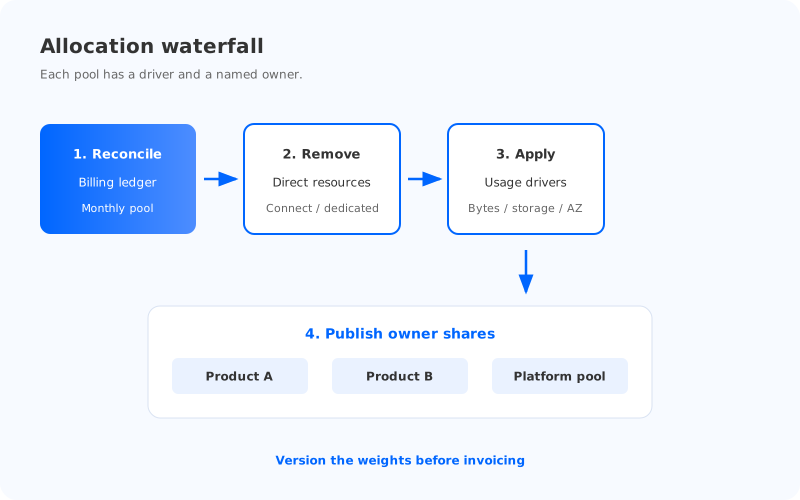
An illustrative calculation makes the mechanics clear. Assume a monthly residual capacity pool of $10,000 after direct charges. Team A accounts for 40% of the measured peak-byte score, 30% of the partition score, and 10% of the tenant count. Under weights of 60%, 25%, and 15%, its allocation is 10,000 × (0.60 × 0.40 + 0.25 × 0.30 + 0.15 × 0.10) = $3,075. The amount is an example to explain the formula, not a forecast or a quoted MSK price. Store the input metrics with the invoice so the team can reproduce the result.
5Detect anomalies before the invoice arrives
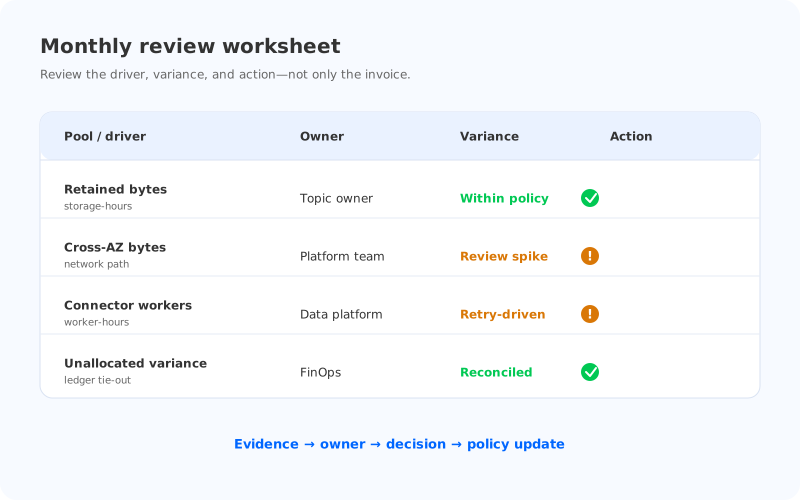
Chargeback is most useful when it changes behavior before month-end. Build a weekly review that compares allocation drivers with their baseline and with product activity. A sudden increase in retained bytes may indicate a retention change. A jump in cross-AZ bytes may indicate a consumer or connector moved to a different subnet. A rise in connector worker-hours may be a deployment issue rather than a product demand signal.
Use separate alerts for cost and for the driver that explains it:
| Signal | Example question | First owner to page |
|---|---|---|
| Allocated spend | Did this team’s share exceed its approved envelope? | Product owner and FinOps |
| Retained bytes | Did a retention or compaction policy change? | Topic owner |
| Cross-AZ bytes | Did placement or client topology change? | Platform team |
| Connector worker-hours | Is a task retrying or over-provisioned? | Data platform team |
| Unallocated variance | Why does the allocation total not reconcile? | FinOps and platform |
Use a trailing baseline instead of a single global threshold. A low-volume topic can have a large percentage change with little spend, while a large product can create a smaller percentage change with a material dollar impact. Set an absolute dollar threshold and a driver threshold, then require an owner and a note for exceptions.
6Govern showback before chargeback
Start with showback for at least one billing cycle. Showback exposes the model while teams can still correct ownership, topic metadata, and network assumptions without disputing an invoice. The monthly worksheet should include the ledger total, allocation pools, driver values, allocated amount, variance, and an owner for every exception.
Move to chargeback when four controls work consistently:
- The topic and connector ownership registry has no unexplained production resources.
- The allocation formula is versioned and can be reproduced from retained data.
- The allocated total reconciles to the billing ledger within a documented tolerance.
- Teams have a process to challenge a charge and correct the source metadata.
Chargeback policy should also define how to handle migrations, incident replays, disaster-recovery exercises, and platform tests. A replay may be charged to the incident owner, the platform pool, or the product depending on the policy. Choose one rule and apply it consistently. Otherwise, teams will tune for the accounting treatment rather than the engineering cause.
For the same reason, connect the worksheet to the service objectives that explain why a cost change matters. The AWS Kafka pricing breakdown and connector observability guide provide useful context for joining cost drivers to traffic, lag, and connector decisions.
7Where AutoMQ fits in the decision
The allocation exercise can reveal a structural problem: a large share of spend may come from keeping broker-local capacity and replicated storage available for uneven workloads. At that point, a team can evaluate a different storage and traffic architecture, rather than assuming that a tagging change will fix the bill.
AutoMQ is a Kafka-compatible cloud-native streaming platform with a shared-storage data plane. Its architecture overview and Kafka compatibility guidance describe the separation of compute and object-storage-backed durability that can be evaluated against the same ledger and workload drivers: broker capacity, retained bytes, network paths, connector work, and operational ownership. That does not make every deployment cheaper, and it does not remove the need for attribution. It gives the platform team another architecture to test when broker capacity and replicated local storage are the dominant cost drivers.
Keep the comparison on equal terms. Use the same workload window, retention policy, availability target, network topology, and operational scope. Compare measured cost per retained byte or processed event only after the service boundaries and reliability requirements match. A lower infrastructure line item is not a valid conclusion if the replacement moves work into an unmeasured connector or support pool.
If the model points to an architecture review, start with AutoMQ using the same measurement boundaries and a written migration hypothesis.
8FAQ
8.1Can Amazon MSK cost allocation be done with tags alone?
Tags can identify the owner of a cluster and support account-level reporting. They cannot reliably split a shared cluster’s broker, storage, or transfer usage by topic. Combine activated cost allocation tags with topic, consumer, connector, and network usage metrics.
8.2What is the best chargeback key for a shared MSK cluster?
There is no universal key. Use the driver that matches the cost pool: retained bytes for storage, client or network bytes for transfer, partition or peak-byte scores for capacity, and worker-hours or task metrics for MSK Connect. Document a hybrid key when one metric cannot explain the pool.
8.3Should producer or consumer traffic carry the network charge?
Assign the charge to the side that controls the network path. Producer bytes are a reasonable key for ingress-related work; consumer bytes are usually better for read-side transfer. For cross-AZ traffic, verify the actual path and keep the assumption visible in the worksheet.
8.4How often should MSK allocation rules change?
Review drivers monthly and the policy quarterly, or sooner after a topology or pricing change. Changing weights every month makes invoices impossible to compare. Version the policy and preserve the previous formula for audit and dispute handling.
8.5Does moving to a different Kafka-compatible platform eliminate FinOps work?
No. It may change which dimensions are structural, but teams still need an owner registry, usage measurements, a ledger reconciliation, and a policy for shared services. Evaluate the new architecture with the same service and cost boundaries.


