
Table of Contents
Table of Contents
Teams usually search for "MSK Cost" after the first architecture question has already been answered. They know they need Apache Kafka or a Kafka-compatible streaming layer. They may already prefer a managed service because they do not want to operate ZooKeeper, patch brokers, replace failed nodes, or build deployment automation from scratch. The harder question is whether the monthly bill will still make sense once the workload moves from a small proof of concept into a multi-AZ production platform.
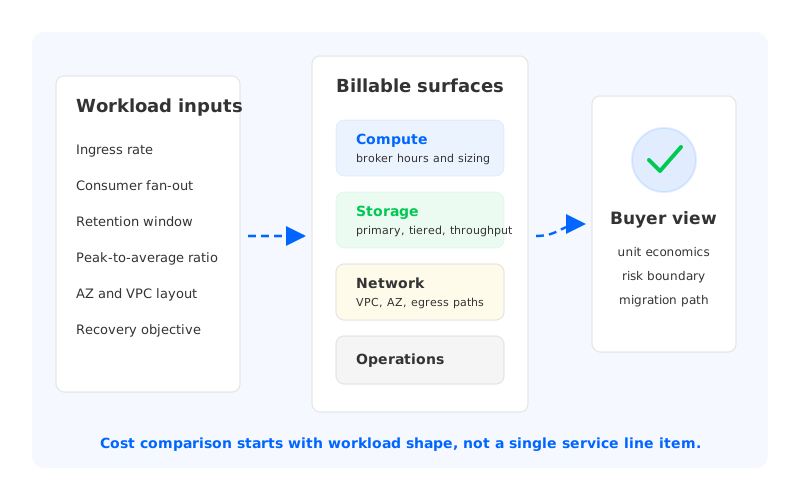
That question is easy to underestimate because Amazon MSK pricing is not one number. It is a set of surfaces: broker instance hours, provisioned or used storage, optional storage throughput, tiered storage, data ingress for some broker types, PrivateLink-style connectivity, and the AWS data transfer paths around the cluster. The architecture also changes the bill. A low-retention internal event bus, a high-retention audit stream, and a consumer-heavy analytics backbone may all be "Kafka", but they stress different parts of the cost model.
The right comparison starts with workload shape, not with a single pricing table.
1Why MSK cost is a buyer problem, not only a pricing problem
Amazon MSK is a strong fit for teams that want AWS to manage Kafka control-plane operations while preserving open-source Apache Kafka compatibility. AWS describes MSK as a managed service for applications that use Apache Kafka, with support for Kafka data-plane operations such as producing and consuming records. That matters because existing Kafka applications, clients, and operational assumptions can often carry forward without a full application rewrite.
The cost question appears after that compatibility benefit is accepted. A platform team may ask FinOps for a forecast, but FinOps cannot answer it from a broker hourly rate alone. Kafka capacity is shaped by throughput, partition count, replication, retention, consumer fan-out, availability-zone placement, and recovery expectations. A cluster that looks efficient during normal traffic can become expensive when it is sized for peak throughput, long retention, or multiple independent consumers that repeatedly scan older data.
For platform buyers, "MSK Cost" usually hides four different decisions:
- Service mode: MSK Provisioned, MSK Serverless, Express brokers, Standard brokers, or a Kafka-compatible alternative have different billing boundaries.
- Storage architecture: local primary storage, provisioned storage throughput, tiered storage, and object-storage-backed designs move cost into different places.
- Network boundary: producers, consumers, private connectivity, cross-VPC access, and cross-region movement can create charges outside the Kafka line item.
- Operating model: managed recovery, upgrades, observability, scaling workflows, and migration tooling affect staffing cost and risk.
The mistake is to compare the visible line item and stop there. A lower hourly broker shape can still be the wrong choice if it forces over-provisioning, slow recovery, or a network pattern that grows with every additional consumer group. A higher managed-service line item can be reasonable if it removes operational burden and keeps the architecture predictable.
2Build the comparison from workload inputs
A practical framework begins with a short worksheet. The worksheet should be filled out before requesting quotes or building a detailed AWS calculator scenario, because each input maps to a different cost driver. The numbers do not need to be perfect on the first pass. They need to be explicit enough that engineering, finance, and procurement are discussing the same workload.
| Input | Why it changes cost | Questions to answer |
|---|---|---|
| Write throughput | Drives broker sizing, storage growth, and replication pressure. | What is the sustained MiB/s rate and the peak-to-average ratio? |
| Read fan-out | Turns one write stream into multiple downstream data paths. | How many consumer groups read hot data, and how many replay older data? |
| Retention | Determines whether primary storage dominates or tiered storage becomes relevant. | Is retention measured in hours, days, or months? |
| Availability design | Multi-AZ layouts improve resilience but change network and replication assumptions. | Which clients live in which AZs, VPCs, and accounts? |
| Recovery objective | Determines how much spare capacity and data movement risk you can accept. | How fast must the platform recover from broker or AZ failure? |
| Governance | Changes who owns IAM, VPC design, upgrades, and observability. | Does the team need AWS-managed operations, BYOC control, or self-managed flexibility? |
This worksheet also prevents a common procurement error: treating storage as independent from compute. In Kafka, storage placement, partition leadership, and broker health are tightly related. Increasing retention can increase storage cost, but it can also affect rebalance duration, recovery behavior, and the amount of data that must move when the cluster changes shape. When a cost model ignores those relationships, it becomes a spreadsheet that looks precise while answering the wrong question.
3Separate the five cost surfaces
MSK Provisioned pricing separates broker instance usage from storage-related charges. AWS pricing pages describe hourly broker instance usage for Standard brokers, storage charged in GB-months, and optional provisioned storage throughput charged by provisioned throughput over time. For Express brokers, AWS describes broker instance usage, used storage, and a per-GB rate for data written to an Express broker. These pricing details can change by region and broker type, so the framework should point readers to the live AWS pricing page for current rates rather than freezing a number in an internal model.
The more useful exercise is to split the bill into five surfaces and assign an owner to each one.
Compute is the easiest surface to see. It includes broker instance type, broker count, and whether capacity is sized for average or peak traffic. Compute also carries a hidden design question: if the workload is bursty, can the platform scale without heavy data movement, or does the team keep extra brokers online to avoid a painful rebalance later?
Storage includes primary storage, tiered storage, and any provisioned storage throughput. Tiered storage can reduce pressure on primary broker storage for long retention workloads, and AWS documents it as a low-cost storage tier for MSK Standard brokers that scales to virtually unlimited storage. It also has constraints: it applies to provisioned mode clusters, has topic and version requirements, and can introduce read-latency behavior when applications begin reading from the tiered layer.
Network is where many Kafka cost models become vague. AWS pricing notes that MSK does not charge for data transfer used for replication between brokers or between metadata nodes and brokers, while standard AWS data transfer charges apply for data transferred in and out of MSK clusters. Multi-VPC private connectivity and AWS PrivateLink-style endpoints can add hourly and per-GB processing dimensions. Cross-region traffic is a separate design decision, not a footnote.
Operations includes the work that does not show up as an MSK SKU: capacity planning, partition rebalancing, client rollout, version upgrades, incident response, and cost attribution. Managed services reduce some of this work, but they do not remove the need to understand the platform.
Migration risk belongs in the cost model because it changes the path to value. A lower target-state bill is not useful if the migration requires client rewrites, long dual-running periods, or an unclear rollback plan.
4Architecture choices change the curve
The reason cost comparison is hard is that Kafka's architecture links the bill to the failure model. Traditional Kafka brokers hold partition data locally and use replication for durability and availability. This design is well understood and battle tested, but in cloud environments it means broker storage, data movement, and placement decisions are part of the economic model.
Tiered storage changes part of that model by moving older data to a lower-cost tier while retaining a primary storage layer for hot data. This can be a good fit when long retention is the main driver and when the workload tolerates the documented tiered-storage constraints. It does not make every broker stateless. The hot set, partition leadership, and Kafka operational model still matter.
Kafka-compatible shared-storage engines take a more structural approach. Instead of treating object storage as only a cold tier, they move the durable log into shared cloud storage and make brokers closer to stateless compute. That changes the questions buyers should ask. The comparison is no longer "Which broker hourly rate is lower?" It becomes "Which architecture keeps compute, storage, and network cost from scaling together?"
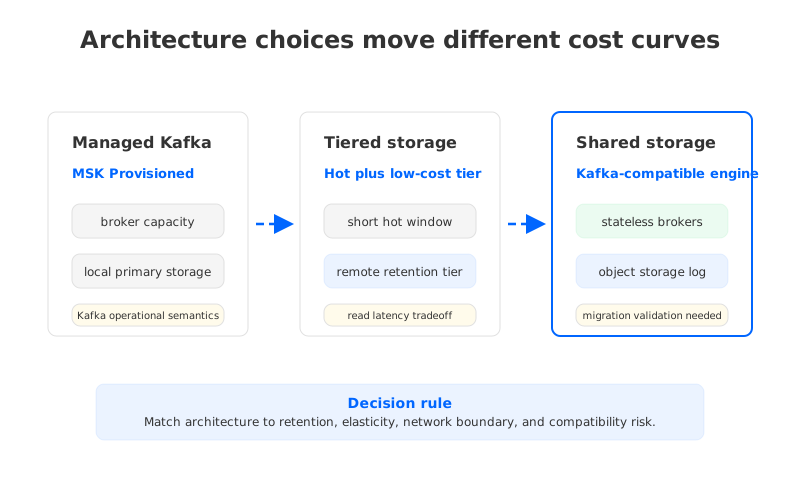
There is no universal answer. A small AWS-native team with moderate throughput may prefer MSK because the managed-service boundary is valuable and the workload is predictable. A team with long retention may first evaluate MSK tiered storage. A platform group with high fan-out, frequent elasticity needs, or strict control over the data plane may evaluate Kafka-compatible shared storage. The important point is to make the tradeoff explicit before a vendor comparison begins.
5Network cost deserves its own review
Network cost is often discovered late because it is spread across AWS billing categories. Kafka traffic has several paths: producer to broker, broker to broker, consumer to broker, administrative clients, replication or linking across clusters, and private connectivity across VPCs or accounts. Some paths are internal to the managed service. Others are ordinary AWS network flows.
A useful network review asks where each byte crosses a boundary:
- Does producer traffic stay inside the same AZ as the broker that owns the leader partition, or does it cross AZs by default?
- Do consumers read from local replicas, leaders in another AZ, or a remote cluster?
- Are applications in the same VPC, peered VPCs, multiple accounts, or another region?
- Does private connectivity introduce endpoint-hour and data-processing charges?
- Does a disaster recovery design replicate the full topic set or only selected critical streams?
These questions are not anti-MSK. They are basic cloud architecture hygiene. AWS provides the primitives, but the buyer still owns traffic placement and cost attribution. A platform team that can explain its data paths will make a better MSK decision, and it will also make a better decision if it evaluates alternatives.
6How AutoMQ fits the evaluation
After the neutral framework is clear, AutoMQ becomes relevant as one architecture category: a Kafka-compatible, cloud-native streaming system that uses shared object storage and stateless brokers rather than traditional broker-local durable storage. AutoMQ documentation describes a shared storage architecture built around object storage, a WAL layer, and S3Stream, with brokers made stateless by replacing Kafka's native log storage path. The public AutoMQ project also positions itself as diskless Kafka on S3-compatible storage.
That architecture matters for a cost comparison because it attacks the coupling behind many Kafka expenses. If brokers are closer to stateless compute, scaling decisions can be less tied to large partition-data movement. If object storage is the primary durable layer, retention can be modeled differently from local broker disk. If the data plane can route traffic with awareness of AZ placement, cross-AZ producer and consumer patterns can be reduced in designs that support that feature.
AutoMQ is not a drop-in answer to every MSK buyer. A fair evaluation still checks client compatibility, operational ownership, workload latency requirements, security controls, observability, migration tooling, and support model. For teams that want Kafka semantics but are questioning the long-term economics of broker-local storage and cross-AZ traffic patterns, it deserves a place in the architecture shortlist.
7A buyer checklist for the final comparison
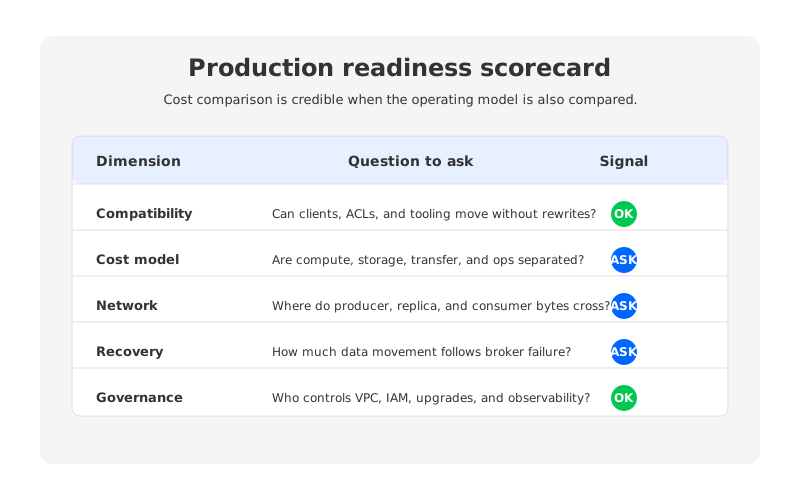
Before the final purchase or migration decision, compare MSK and any alternative under the same workload assumptions. Keep the table boring. Boring is good here because it forces every team to defend its assumptions.
| Dimension | MSK evaluation | Alternative evaluation |
|---|---|---|
| Compatibility | Kafka version, client behavior, ACLs, auth, schema tooling, connectors. | Same tests, plus migration behavior and protocol edge cases. |
| Compute | Broker type, count, peak sizing, scaling workflow. | Compute units, autoscaling model, statelessness claim, throttling behavior. |
| Storage | Primary storage, tiered storage, provisioned throughput, retention. | Object storage layout, WAL design, cache behavior, retention economics. |
| Network | VPC, AZ, PrivateLink, cross-region, client placement. | Data-plane placement, AZ-aware routing, egress boundaries. |
| Recovery | Broker replacement, rebalance behavior, restore path, blast radius. | Failure model, object storage dependency, control-plane recovery. |
| Operations | AWS-managed tasks, team-owned tasks, observability, upgrades. | BYOC or managed boundary, SRE burden, support contract. |
| Migration | Dual running, rollback, client config changes, data copy. | Linking, mirroring, cutover plan, validation window. |
The best comparison will usually produce more than one acceptable answer. That is normal. The goal is not to make MSK look expensive or alternatives look effortless. The goal is to understand which platform has the cleanest cost curve for your workload and the lowest operational risk for your team.
For teams exploring a Kafka-compatible shared-storage path, review the AutoMQ architecture docs and validate the design against your own MSK worksheet. A practical next step is to discuss your workload assumptions with the AutoMQ team through the AutoMQ contact page and compare the model against your current AWS bill.
8References
- Amazon MSK Developer Guide: What is Amazon MSK?
- Amazon MSK pricing
- Amazon MSK tiered storage for Standard brokers
- Amazon MSK multi-VPC private connectivity
- AWS PrivateLink pricing
- Apache Kafka documentation
- AutoMQ architecture overview
- AutoMQ cross-AZ traffic documentation
- AutoMQ open-source repository
9FAQ
9.1Is Amazon MSK always more expensive than self-managed Kafka?
No. A self-managed Kafka cluster can look lower cost on infrastructure alone, but the comparison must include engineering time, upgrades, recovery work, monitoring, security operations, and scaling risk. MSK can be cost-effective when the managed-service boundary removes work your team would otherwise perform manually.
9.2When should MSK tiered storage be evaluated?
Evaluate tiered storage when retention is a major cost driver and older data is read less frequently than hot data. Check AWS requirements and constraints carefully, especially Kafka version, topic configuration, unsupported topic patterns, and read-latency behavior for tiered reads.
9.3What is the most common blind spot in MSK cost models?
Network and elasticity are the usual blind spots. Teams often model broker hours and storage, then discover that VPC boundaries, private connectivity, consumer placement, or peak-capacity over-provisioning change the final monthly cost.
9.4How is AutoMQ different from MSK tiered storage?
MSK tiered storage adds a low-cost remote tier to MSK Standard brokers. AutoMQ uses a Kafka-compatible shared-storage architecture where object storage is part of the primary durable log design and brokers are closer to stateless compute. The evaluation should test compatibility, latency, operations, and migration risk rather than relying on architecture labels alone.
9.5Can this framework be used for Confluent, Redpanda, Aiven, or self-managed Kafka?
Yes. The same worksheet applies to any Kafka or Kafka-compatible platform. The pricing units will differ, but the buyer still needs to compare compute, storage, network, recovery, governance, and migration risk under the same workload assumptions.


