
Table of Contents
Table of Contents
Amazon MSK cost usually becomes painful in a familiar way: the cluster is healthy, producers are not blocked, consumers are not dramatically behind, and yet the monthly AWS bill keeps moving upward. The expensive part is rarely a single bad setting. It is the interaction between Kafka's broker-local architecture and AWS's metered model for compute, storage, and network transfer.
Kafka was designed around brokers that own local log segments and replicate partitions across brokers for availability. On AWS, those brokers run as continuously billed capacity, retain data on provisioned storage, and often span Availability Zones for resilience. Amazon MSK removes much of the operational burden of running Kafka, but it does not remove Kafka's economic shape. The useful way to reduce MSK cost is to treat it as attribution first and tuning second.
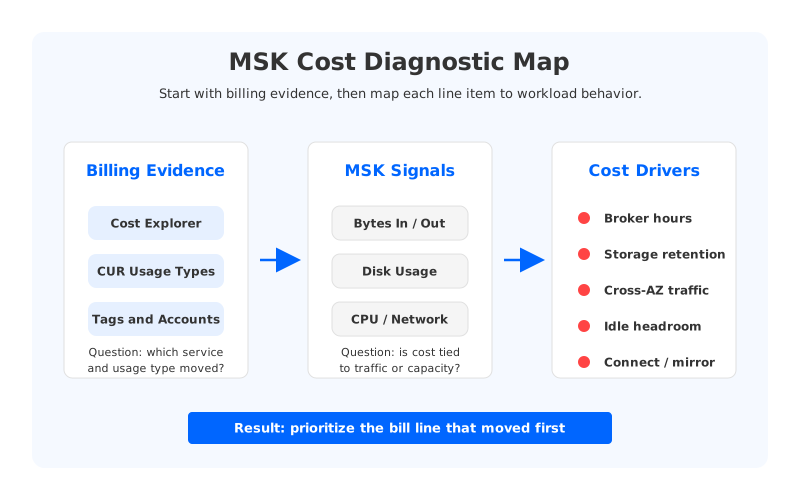
1The Five Biggest MSK Cost Drivers
AWS's Amazon MSK pricing page separates charges by the resources and features you use, including broker instance usage, storage, provisioned throughput options, serverless dimensions, data transfer, and add-on services such as MSK Connect. The exact line items and rates vary by region, broker type, storage mode, and feature selection, so verify the live AWS pricing page instead of copying a static price into a spreadsheet.
For provisioned MSK clusters, the first visible driver is broker hours. A broker allocated for production is billed whether the cluster is busy or quiet. Kafka also makes sizing harder because brokers must be sized for CPU, memory, disk, network, partition count, and recovery headroom. A cluster can look underutilized on CPU while still being constrained by network or disk, which leads teams to keep extra brokers.
Storage is the second driver, and it is tied directly to retention. Kafka persists logs by topic partition, and retention settings determine how long log segments stay available before deletion. With a replication factor greater than one, retained logical data also has physical copies across replicas. Longer retention is often a product requirement; the mistake is letting every topic inherit long retention because nobody owns lifecycle decisions.
Cross-AZ traffic is the third driver and often the least intuitive one for application teams. A multi-AZ Kafka deployment is the right reliability posture for many production workloads, but leaders, followers, producers, and consumers do not always sit in the same Availability Zone. Replication, client reads, rebalance events, and catch-up reads can all create network paths that are invisible at the Kafka API level but visible in AWS billing and network metrics.
The fourth driver is over-provisioning. Kafka teams tend to keep spare broker and storage capacity because rebalancing partitions, expanding disks, or recovering from broker failure can be disruptive. That caution is rational. The cost problem appears when peak capacity becomes permanent capacity, especially for workloads with daily or weekly traffic patterns.
The fifth driver is surrounding data movement: MSK Connect, MirrorMaker-style replication, ETL consumers, observability pipelines, and data lake ingestion. These systems may sit outside the core broker bill, but they are part of streaming platform cost.
| Cost driver | What to inspect | Why it grows |
|---|---|---|
| Broker hours | Broker family, count, utilization, partition load | Capacity is allocated continuously and sized for headroom |
| Storage and retention | Topic retention, disk usage, storage autoscaling | Log data accumulates per partition and per replica |
| Cross-AZ transfer | Client placement, replication paths, consumer locality | Reliable multi-AZ layouts create metered network movement |
| Over-provisioning | Peak-to-average traffic, idle brokers, recovery margin | Kafka scaling and rebalancing are stateful operations |
| Connect and replication | Connector workers, mirror pipelines, downstream reads | Data movement expands beyond the broker cluster |
Different cost drivers have different remedies. Reducing retention will not fix idle broker capacity. Moving consumers closer to brokers will not fix a cluster sized for last year's peak.
2How to Diagnose Your MSK Bill
AWS Cost Explorer lets teams analyze AWS cost and usage over time, filter by dimensions, and group data by service or usage type. AWS Cost and Usage Reports go deeper: CUR is AWS's detailed dataset for cost and usage, and it can be queried when the Cost Explorer UI is too coarse. For MSK, Cost Explorer gives the trend; CUR gives the join keys for durable attribution.
The practical diagnostic loop looks like this:
- Group cost by service and usage type to find whether the movement is in Amazon MSK, EC2-related infrastructure, data transfer, storage, or a connected service.
- Compare the billing window with MSK metrics such as bytes in, bytes out, disk usage, network throughput, CPU, under-replicated partitions, and consumer lag.
- Join the spike to Kafka configuration changes: retention, topic creation, replication factor, partition count, broker count, storage autoscaling events, or added consumer groups.
- Tag clusters, accounts, and environments so production, staging, and experimentation are not blended into one noisy number.
Storage diagnosis should start at the topic level. A topic with high write throughput and long retention can dominate storage even if it is not operationally noisy. Kafka's log model makes this predictable: logs are retained according to topic or broker retention settings, and segments are deleted when retention conditions are met.
Cross-AZ diagnosis needs a topology view. Map producers, consumers, and brokers by Availability Zone. Then ask where bytes cross zone boundaries during reads, leader failover, consumer catch-up, and replication. The application team may only see a bootstrap endpoint, while the network bill sees the actual route.
Broker over-provisioning diagnosis is less about finding one wrong broker size and more about identifying why spare capacity exists. Sometimes the reason is partition count or network throughput. Sometimes the team keeps extra brokers because partition reassignment takes too long during scale events. That last reason points to an architecture tax.
3Short-Term MSK Cost Optimization Tactics
The first round of MSK cost optimization should be specific, measurable, reversible, and backed by billing evidence. Start by removing waste from the platform you already run.
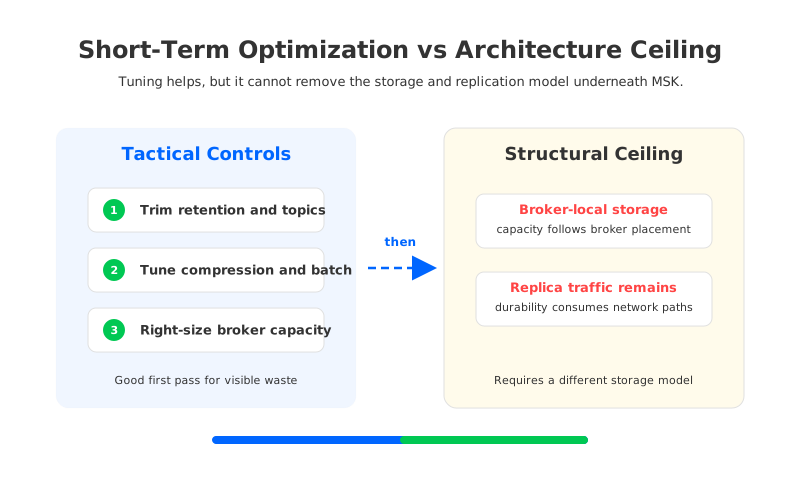
Retention is usually the cleanest starting point. Review topic-level retention against replay and compliance needs. Some topics need a long replay window; many operational topics do not. Where long-term retention is needed, evaluate whether tiered storage or an external data lake path fits better than keeping all data hot on broker-attached storage.
Compression and batching come next because they affect several cost surfaces at once. Better compression can reduce broker storage growth and network transfer, while producer batching can improve throughput efficiency. The trade-off is latency and CPU, so this is not a blanket recommendation. Measure before and after, and apply changes to topics where the producer and consumer latency budget allows it.
Broker sizing deserves a careful pass. Use AWS's MSK guidance and workload metrics to decide whether the cluster is constrained by CPU, disk, network, or partitions. If CPU is low but network is high, downsizing may make the cluster less stable. If disk is the only pressure, retention or tiered storage may help more than adding brokers.
Client locality can reduce unnecessary network movement. When producers and consumers run in the same VPC and Availability Zones as the MSK cluster, validate whether clients connect to brokers in a way that respects locality. Kafka rack awareness and follower fetching can help certain read paths, but the details depend on client version, topology, and broker configuration.
Finally, clean up the ecosystem around the cluster. Connector tasks, mirror pipelines, and analytics consumers often outlive the use case that created them. Each one may multiply reads, network transfer, and downstream writes.
4When Tuning MSK Is Not Enough
Short-term optimization has a ceiling because Kafka's default storage model still binds compute and persistent log storage to the broker. A broker is not only a compute process that serves requests; it is also a storage owner for partition replicas. That dual role explains why scaling a busy Kafka cluster can be expensive even when the cloud has abundant elastic capacity available.
When you add brokers to a traditional Kafka-style cluster, capacity does not become useful until partitions move and load rebalances. When you remove brokers, data ownership has to be drained carefully. These operations are correct behavior for Kafka's architecture, but they create a bias toward permanent headroom.
This is the point where cost optimization stops being a list of settings. If the cluster keeps extra brokers because scaling is slow, right-sizing only reduces the margin until the next incident. If storage is expensive because every broker owns local durable data, topic cleanup only delays the next retention discussion. If cross-AZ traffic is dominated by replication and catch-up reads, client placement can reduce avoidable traffic but not remove the underlying replication pattern.
The question is not "Can MSK be tuned?" It can. The question is whether broker-local storage and application-level replication are now the main cost shape. At that point, a different architecture may be the only way to change the slope of the bill.
5How AutoMQ Reduces Structural Kafka Cost on AWS
The architecture-level alternative is to separate Kafka-compatible compute from durable storage. Durable data lives in shared storage, while brokers focus on serving the Kafka protocol, coordinating traffic, and scaling with workload demand.
AutoMQ is one implementation of this category: a Kafka-compatible, cloud-native streaming platform that rebuilds Kafka's storage layer on object storage such as S3 while preserving Kafka protocol compatibility. Its documentation describes a shared storage architecture in which data is stored in object storage, a WAL layer handles low-latency write persistence, and broker nodes become stateless. The relevant cost idea is not that every workload gets a magic discount. The relevant idea is that cost moves from permanent broker-local replicas toward elastic compute plus shared storage.
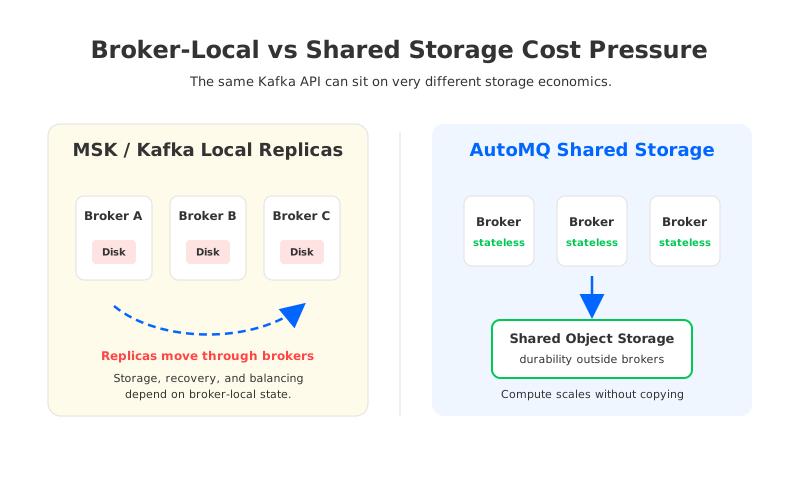
This changes several MSK cost pressures:
- Broker capacity can track compute demand more closely because brokers are not carrying all persistent data locally.
- Scaling and rebalancing do not require the same volume of broker-to-broker data movement because storage is shared outside the broker.
- Object storage can become the primary durable repository, which changes the storage cost model for retained Kafka data.
- Cross-zone replication pressure can be reduced because durability is not implemented solely by moving full broker-local replicas across zones.
There are trade-offs. A shared-storage Kafka architecture must handle write latency, object storage request patterns, metadata coordination, and failure recovery carefully. AutoMQ's design uses S3Stream and WAL storage to bridge those gaps, according to its architecture documentation. Architects should ask whether the architecture preserves Kafka semantics while changing the cost drivers that dominate their workload.
For teams committed to AWS, AutoMQ's BYOC model is also relevant because infrastructure can remain in the customer's cloud account while the storage architecture changes. That matters for security, data residency, and procurement. It also makes cost comparison more concrete: compare the current MSK bill against a workload model with equivalent throughput, retention, availability, and client behavior.
6A Practical Cost-Reduction Sequence
Start with a two-week billing and metrics review. Identify the top cost movement by service and usage type, then map it to Kafka behavior. If storage is the driver, review retention and topic lifecycle. If network is the driver, map client and broker locality. If broker hours are the driver, inspect utilization by constraint rather than by CPU alone.
After the first review, apply low-risk changes in small batches. Change retention topic by topic. Adjust compression where latency budgets allow it. Remove unused connectors and consumers. Right-size brokers only after you understand the limiting resource. Every change needs a before-and-after view in Cost Explorer or CUR plus health metrics.
Then evaluate the ceiling. If the same structural drivers remain after cleanup, build a comparison model using the same write throughput, read fan-out, retention, availability target, and peak-to-average traffic ratio. Compare MSK tuning options, MSK tiered storage where appropriate, self-managed Kafka if your team can operate it safely, and shared-storage Kafka alternatives such as AutoMQ.
Back to the AWS bill that started the investigation: the number is not mysterious once you trace it to Kafka mechanics. MSK gets expensive when always-on brokers, retained replicas, cross-zone movement, and cautious headroom grow together. Tuning removes waste. Architecture changes are for the part of the bill that keeps coming back.
If you want to model that second track, review AutoMQ's architecture documentation or talk with the AutoMQ team through the verified contact page: AutoMQ contact.
7References
- AWS, Amazon MSK Pricing
- AWS, Best practices for Amazon MSK
- AWS, What is AWS Cost Explorer?
- AWS, What are AWS Cost and Usage Reports?
- Apache Kafka, Documentation
- AutoMQ Docs, Architecture overview
- AutoMQ Docs, What is AutoMQ
8FAQ
8.1Why is Amazon MSK expensive?
Amazon MSK can become expensive because several cost surfaces grow together: always-on broker capacity, retained storage, multi-AZ data movement, operational headroom, and surrounding services such as connectors or replication pipelines. The managed service reduces operational work, but Kafka's broker-local storage and replication model still shape the bill.
8.2What is the fastest way to reduce MSK cost?
Start with billing attribution. Use Cost Explorer and CUR to identify the service and usage type that moved, then map that movement to MSK metrics and Kafka configuration. The fastest low-risk wins are often topic retention cleanup, unused connector removal, compression tuning where latency allows it, and broker right-sizing after the limiting resource is clear.
8.3Does reducing retention always reduce MSK cost?
Reducing retention can reduce storage pressure, but it only helps when storage is the dominant cost driver. It will not solve idle broker capacity, cross-AZ transfer, or unnecessary consumer fan-out. Retention changes should also respect replay, compliance, and incident investigation requirements.
8.4How do cross-AZ costs happen in Kafka on AWS?
Cross-AZ costs can appear when brokers replicate data across Availability Zones, when producers or consumers communicate with brokers in another zone, or when catch-up reads and rebalances move data across zone boundaries. The exact bill impact depends on topology, client placement, traffic volume, and AWS data transfer rules.
8.5When should a team consider AutoMQ instead of only tuning MSK?
Consider an architecture evaluation when the same cost drivers remain after cleanup: permanent broker headroom, retained replicas, slow scaling, and recurring cross-zone replication pressure. AutoMQ is relevant when a team wants Kafka protocol compatibility but needs a shared-storage, stateless-broker architecture.


