
Table of Contents
Table of Contents
Searching for traffic costs Amazon MSK usually means the broker-hour estimate is no longer the hard part. The team has already found the managed Kafka pricing page, added a broker count to a spreadsheet, and discovered that the real question lives outside the obvious line item. Kafka traffic moves through availability zones, VPCs, accounts, Regions, private connectivity, consumers, replicas, connectors, and recovery paths. Every boundary can turn a clean throughput number into a different bill.
Amazon MSK is a strong AWS-native option for teams that want managed Apache Kafka without owning every broker operation. AWS also makes one important point clear on the MSK pricing page: replication traffic between brokers is not charged as MSK data transfer, while data transferred in and out of MSK clusters is subject to standard AWS data transfer charges. That split helps, but it is not a complete model. Platform architects still need to decide where clients run, whether reads stay local, how replays behave, and which traffic leaves the cluster boundary.
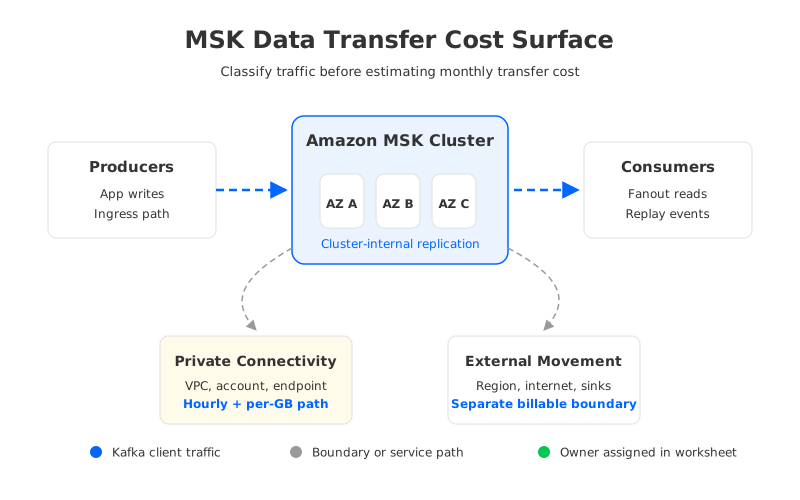
The useful model starts with a plain distinction: broker replication, client access, and external movement are different traffic classes. They may all originate from the same Kafka workload, but AWS billing treats network paths according to service and boundary. Treating them as one "throughput" number hides the decision that matters most: which traffic must cross a paid boundary to satisfy the platform contract?
1Start with traffic classes, not a single throughput number
Kafka teams often describe workload size as write throughput plus read fanout. That is a reasonable operational shorthand, but it is too coarse for cloud cost modeling. A workload with the same write rate and consumer count can land very differently depending on whether clients run in the same VPC, the same AZ, a connected VPC, another account, a separate Region, or outside AWS.
For MSK Provisioned clusters, the cost model starts with broker instance usage and provisioned storage. Data transfer becomes a separate concern when traffic moves in or out of the cluster. For MSK Serverless, AWS lists per-GB write and read charges in addition to cluster and partition dimensions, and standard data transfer can still apply for traffic to another Region or the public internet. Private connectivity adds another axis because AWS PrivateLink has hourly and per-GB processing charges.
| Traffic class | What creates it | Why architects should model it separately |
|---|---|---|
| Broker replication | Kafka durability and high availability inside the cluster | AWS MSK pricing states inter-broker replication traffic is not charged as MSK data transfer, but it still shapes broker sizing and recovery behavior |
| Producer writes | Application clients sending records to partition leaders | Cost depends on whether producers reach brokers through local VPC paths, cross-AZ paths, PrivateLink, public access, or another Region |
| Consumer reads | Consumer groups fetching records, often with fanout | Read fanout can multiply egress from brokers even when write throughput is stable |
| Replay and backfill | Consumers reading historical data after incidents or batch jobs | A rare replay can dominate the monthly transfer profile if it crosses VPC, account, or Region boundaries |
| Replication and connectors | MSK Replicator, MirrorMaker, Kafka Connect, sink/source services | These paths often leave the cluster boundary and can combine processing charges with standard transfer charges |
This table is not a replacement for the AWS Pricing Calculator. It is the input discipline the calculator needs. The mistake is to enter average throughput before classifying the path. A platform owner should be able to point to each GiB and say whether it is inside the cluster, entering the cluster, leaving the cluster, or crossing a connectivity service.
2Availability zones change the shape of Kafka traffic
AWS states that data transferred between EC2 instances and elastic network interfaces across availability zones in the same Region is charged in each direction, while data transfer between certain services and EC2 in the same Region can be free when no other processing service is in the path. The exact bill depends on the service path, but the design principle is stable: same-AZ placement is different from cross-AZ placement, and an intermediate service such as PrivateLink, NAT Gateway, or Transit Gateway can add processing cost.
Kafka makes this more interesting because it has two kinds of locality. Broker locality is about where partition replicas and leaders live. Client locality is about where producers and consumers connect from. A cluster can be well distributed across AZs for availability and still serve clients in ways that create cross-AZ reads or writes. The traffic pattern is not wrong by default; cross-AZ access may be required for resilience or application placement. It becomes a cost problem when nobody models the boundary.
Rack awareness is the main Kafka-native tool for making this explicit. Apache Kafka supports broker rack metadata, and KIP-392 introduced the ability for consumers to fetch from the closest replica when the broker is configured with a replica selector and clients provide rack information. In practical terms, that lets a consumer prefer a replica in its own rack or AZ when the architecture supports it. It does not eliminate every paid path, but it gives architects a lever that is more precise than hoping the default leader placement matches client placement.
3The worksheet should follow the data path
A useful MSK transfer model can fit on one page if it follows the data path instead of the org chart. Start with producers, then cluster ingress, then broker-local serving, then each consumer group, then any replication or connector path. For each hop, record the source, destination, network boundary, expected GiB per month, peak behavior, owner, and mitigation.
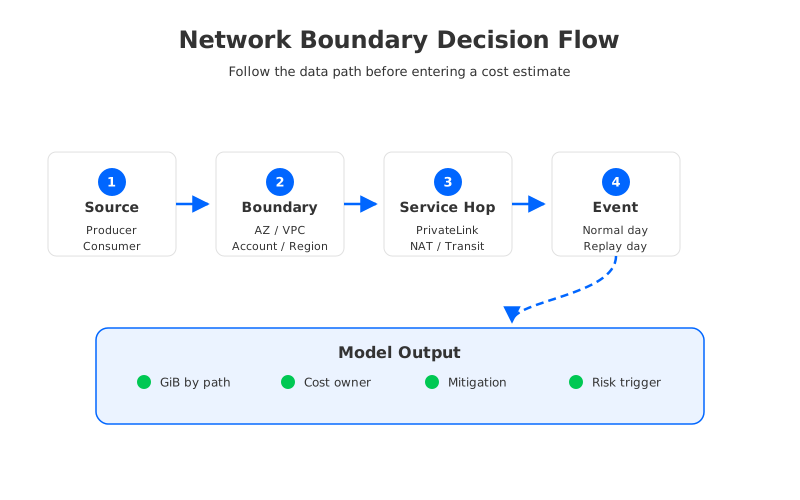
Answer these questions before procurement turns the estimate into a fixed budget:
- Where do producers run? Same VPC and AZ as the selected broker endpoint is different from another VPC, another account, public access, or cross-Region ingestion.
- How many full-read consumer groups exist? A single write stream with five independent consumers can produce more billable movement on the read side than the write side.
- Which consumers need historical replay? Incident recovery, feature backfills, machine learning pipelines, and audit exports can turn old data into a transfer event.
- Which paths use private connectivity? PrivateLink is often the right security design, but it should be modeled as both a connectivity decision and a per-GB processing path.
- Which services sit between client and cluster? NAT Gateway, Transit Gateway, load balancing, cross-VPC routing, and data processing services may add charges outside the MSK line item.
- Who owns the cost center? A shared Kafka platform can make the central team pay for traffic generated by another application team unless chargeback follows the path.
This path-first approach avoids a common trap: arguing about broker price while ignoring read fanout. A topic with many consumer groups can export the same retained byte multiple times. If those consumers are spread across VPCs or accounts, the cost driver is often application topology rather than Kafka storage.
4Use scenarios to expose non-average traffic
Averages are comforting because they are easy to divide by seconds in a month. They are also where transfer models lose credibility. Kafka platforms are sized for production events: peak ingestion, consumer lag recovery, backfills, Regional replication, connector exports, and failover tests. These events may be rare, but they are exactly when traffic crosses the most expensive boundaries.
Model at least three scenarios. The first is the normal day: steady writes, ordinary consumer reads, expected fanout, and no unusual recovery. The second is the replay day: one or more consumers read a large retained window after an incident or downstream fix. The third is the migration or resilience day: data moves between clusters, Regions, or VPCs for a cutover, disaster recovery drill, or workload relocation.
| Scenario | Transfer behavior to inspect | Architectural question |
|---|---|---|
| Normal day | Producer ingress, consumer egress, private connectivity, service hops | Are clients placed close enough to the brokers they use most? |
| Replay day | Historical reads, fanout multiplication, catch-up pressure | Does replay stay inside the platform boundary or leave it repeatedly? |
| Resilience day | Cross-Region replication, migration mirroring, connector export | Is the transfer event planned, throttled, observable, and owned? |
The outcome should be a range, not a single monthly number. A range is more honest because the cost depends on operational events. It also makes engineering trade-offs visible: move consumers, change retention access patterns, add locality controls, or accept the cost as a deliberate resilience premium.
5Architecture choices that change the transfer curve
Once the model exposes the paths, the architecture conversation becomes clearer. MSK can be the right choice when teams want a managed AWS Kafka service, their clients are mostly colocated, and their operational model fits AWS-native networking. The data transfer work is then about disciplined placement, rack-aware reads where appropriate, private connectivity design, and clear chargeback.
There are also workloads where the transfer curve is a symptom of deeper coupling. Traditional Kafka brokers serve as compute nodes, network endpoints, and owners of local durable replicas. That model ties data movement to broker placement, so clients, replicas, and recovery flows can make the platform pay for topology as much as for data volume.
Tiered storage changes one part of the equation by moving older log segments to remote storage. It can be valuable for long retention, but it does not by itself make producers AZ-local, make consumers fetch from the closest replica, or make brokers stateless. It is a retention feature with important operating implications, not a universal answer to every transfer path.
A shared-storage Kafka-compatible architecture attacks a different part of the problem. If durable data is held in shared cloud storage and brokers are treated more like stateless compute, the platform can reduce the amount of server-side replica movement and decouple compute placement from long-term data ownership. This is the point where AutoMQ enters the evaluation naturally. AutoMQ is a Kafka-compatible, cloud-native streaming system that keeps the Kafka API while using an object-storage-backed S3Stream architecture and a WAL design for low-latency writes.
AutoMQ's cross-AZ traffic cost documentation describes an architecture that avoids server-side replica replication traffic and supports AZ-aware producer and consumer placement. That does not remove the need to model application traffic, PrivateLink, or cross-Region movement. It does change the evaluation question: instead of asking whether one broker price is lower than another, architects can ask whether the storage architecture reduces the amount of data that has to cross an AZ boundary in the first place.
6A production-ready scorecard
The final decision should combine cost, compatibility, and operations. A transfer model that ignores client behavior will be wrong. A cost model that ignores Kafka semantics will be risky. A migration plan that ignores chargeback will be unpopular after the first replay.
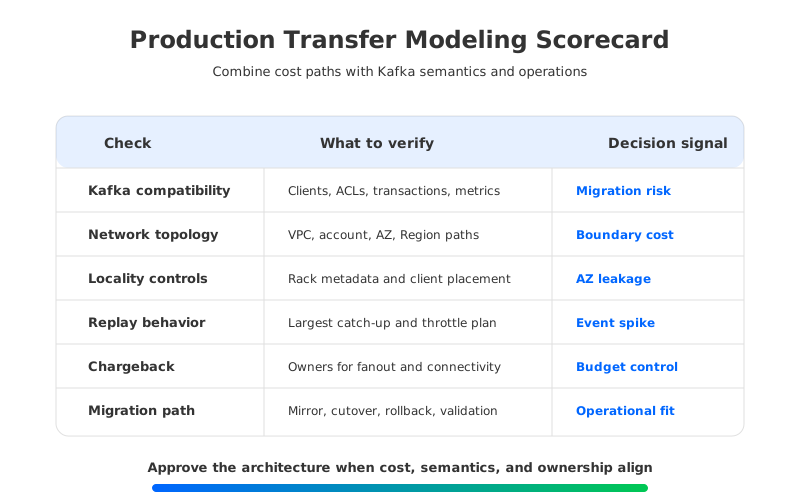
Use this scorecard before approving a platform design:
- Kafka compatibility: Verify client versions, authentication, ACLs, transactions, idempotent producers, consumer group behavior, and observability integrations.
- Network topology: Record VPCs, accounts, AZs, subnets, endpoints, connectivity services, and public/private access choices.
- Locality controls: Decide whether broker rack metadata, client rack configuration, closest-replica fetch, or application placement policies are required.
- Replay behavior: Define the largest expected replay, where it runs, how it is throttled, and whether it crosses paid boundaries.
- Chargeback: Assign cost ownership for shared topics, fanout consumers, private connectivity, connector exports, and replication jobs.
- Migration path: Test mirroring, cutover, rollback, schema tooling, monitoring, and data validation under the same network paths used in production.
Traffic costs are not an accounting afterthought; they are a signal that the platform boundary has become part of the architecture. The right answer may be disciplined MSK placement, rack-aware consumer reads, PrivateLink with explicit ownership, a shared-storage Kafka-compatible system, or a mix of these across workloads.
7The practical conclusion
The next time the AWS bill shows an unexpected data transfer line near an MSK workload, resist the urge to hunt for one hidden setting. Start by drawing the path. Identify whether the byte is replication, producer ingress, consumer egress, replay, private connectivity, connector movement, or cross-Region replication. Then ask whether the path is required by the workload contract or created by placement that can be changed.
That drawing changes the conversation. It turns traffic costs Amazon MSK from a pricing lookup into an architecture review. The output is not a perfect monthly estimate; it is a model that explains which workload events move the bill, which teams own those events, and which architecture choices can reduce unnecessary movement.
If cross-AZ traffic and broker/storage coupling are part of your Kafka cost problem, evaluate the same workload contract against a shared-storage Kafka-compatible design. AutoMQ's cloud deployment path is a practical next step for testing Kafka API compatibility, AZ-aware traffic behavior, and operational assumptions against your own topology.
8References
- Amazon MSK pricing
- Amazon EC2 On-Demand pricing: Data Transfer
- AWS PrivateLink pricing
- Access an Amazon MSK cluster
- Apache Kafka KIP-392: Allow consumers to fetch from closest replica
- Apache Kafka broker configuration documentation
- AutoMQ architecture overview
- AutoMQ compatibility with Apache Kafka
- AutoMQ cross-AZ traffic cost optimization
9FAQ
9.1Does Amazon MSK charge for broker replication traffic?
AWS states on the MSK pricing page that data transfer used for replication between brokers, and between metadata nodes and brokers, is not charged as MSK data transfer. Standard AWS data transfer charges can still apply for data transferred in and out of MSK clusters, so client topology remains important.
9.2Why can consumer reads create more transfer cost than producer writes?
Kafka read fanout multiplies traffic. One producer stream may be read by several independent consumer groups, and each group can read the same bytes from the cluster. If those consumers run across VPCs, accounts, AZs, or Regions, the read side can become the dominant transfer path.
9.3Does rack awareness eliminate MSK traffic costs?
No. Rack awareness and closest-replica fetching can help consumers prefer local replicas when the cluster and clients are configured for it. They do not remove every transfer boundary, and they do not replace planning for producers, private connectivity, connectors, or cross-Region replication.
9.4When should PrivateLink be included in the model?
Include it whenever clients connect from different VPCs or accounts through private connectivity. PrivateLink can be the correct security and network isolation choice, but it has hourly and per-GB processing dimensions that should be visible in the estimate.
9.5How should AutoMQ be compared with Amazon MSK for transfer-heavy workloads?
Compare both against the same workload contract: producer placement, consumer fanout, replay size, retention, latency target, AZ layout, VPC/account boundaries, and migration requirements. AutoMQ is most relevant when Kafka compatibility is required and the main pressure comes from cross-AZ traffic, broker/storage coupling, or frequent recovery movement.


