
Table of Contents
Table of Contents
A Kafka client can be perfectly reachable and still be unable to produce a single record. The network path may be open, the bootstrap broker may resolve, and the topic may exist, yet the connection fails because the client presented an identity the cluster does not accept. In Amazon MSK, that identity can come from an AWS principal, a username and password stored in Secrets Manager, or a client certificate signed by an AWS Private CA.
Those choices affect more than the first handshake. They decide which Kafka clients and connectors can connect, where authorization rules live, how credentials are rotated, and how much of the fleet can fail when one identity is compromised. The useful question is not “Which MSK authentication mode is most secure?” It is “Which identity lifecycle and authorization boundary can this workload operate reliably?”
This comparison treats IAM, SASL/SCRAM, and mutual TLS as production operating models. It also separates transport encryption from client identity, because “TLS” can mean an encrypted connection or certificate-based authentication. The distinction matters when you are reviewing a connector, planning a secret rotation, or investigating a client that suddenly receives SASL authentication failed.
1Start with the boundary, not the mechanism
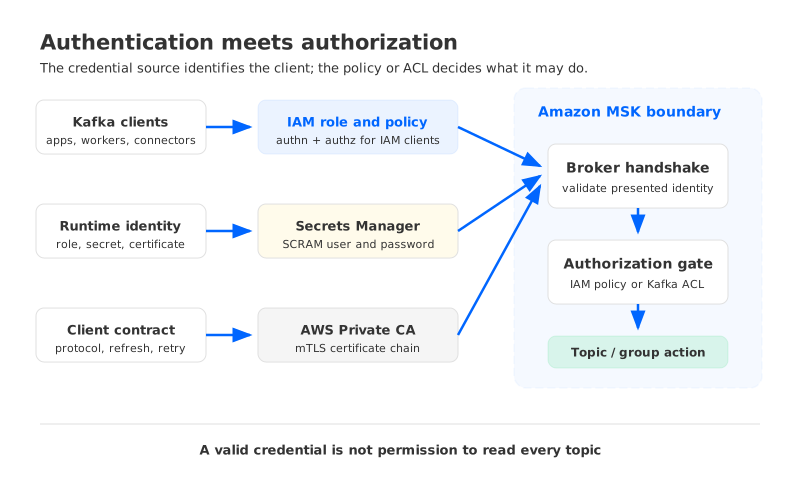
Authentication answers who is connecting. Authorization answers what that identity may do. Encryption answers whether the connection contents are protected in transit. Kafka deployments often configure all three, but Amazon MSK puts the control points in different places depending on the selected mode.
The Amazon MSK authentication and authorization guide describes two broad patterns. IAM can authenticate a client and allow or deny Kafka actions through IAM policies. TLS or SASL/SCRAM can authenticate a client while Apache Kafka ACLs authorize the client. A certificate can therefore identify a client while an ACL decides whether that identity may read a topic. A password can identify a connector while a different ACL controls its consumer group.
That separation is the first operational fork. If a security team wants one AWS identity to be visible in IAM audit tooling and in the Kafka authorization decision, IAM has a compact control plane. If an existing platform already provisions Kafka users and ACLs, SCRAM or mTLS may fit the current workflow with less change. Neither option removes the need to define topic, group, and cluster permissions deliberately.
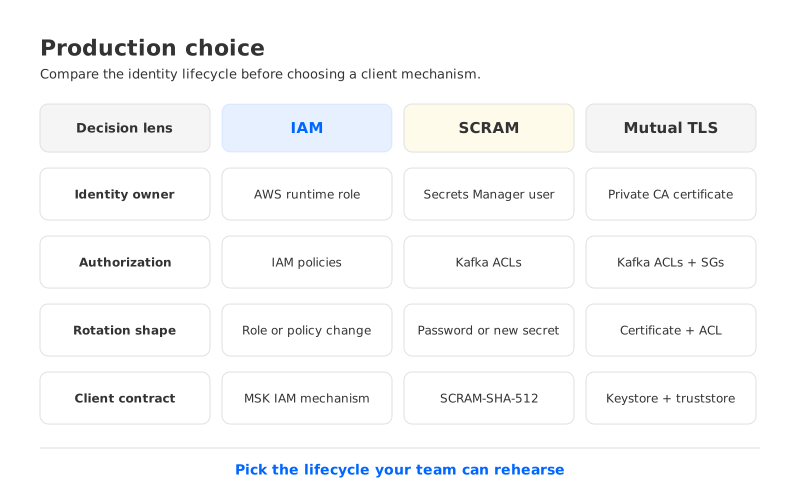
A production review should record four boundaries before it records a mechanism:
- Identity owner: AWS IAM, a secrets platform, or a certificate authority.
- Authorization owner: IAM policies, Kafka ACLs, or a combination for different client classes.
- Rotation trigger: credential expiry, a scheduled secret change, certificate expiry, or a security event.
- Failure scope: one workload, one connector, one team, or every client using a shared identity.
These boundaries are more durable than a client library setting. A team may later replace a connector or move from EKS to ECS, but the questions remain the same.
2IAM authentication: AWS identity and Kafka authorization in one policy model
IAM access control is the most AWS-native option. Amazon MSK evaluates the IAM identity and its permission to perform the Kafka action, so the same policy model handles authentication and authorization. AWS documents IAM access control for Java clients and for non-Java clients such as Python, Go, JavaScript, and .NET. The non-Java support described in the guide applies to MSK clusters running Kafka 2.7.1 or later, so client and broker version checks belong in the rollout plan.
The client still needs an IAM-aware Kafka integration. A stock Kafka client configured only with SASL_SSL does not gain IAM semantics by implication. The application or connector must obtain AWS credentials from its runtime identity and use the Amazon MSK IAM mechanism or callback implementation described in the AWS client configuration documentation. That extra integration is usually straightforward for workloads already running with IAM roles, but it is a real compatibility requirement for older connectors, appliances, and third-party tools.
IAM is a strong fit when the workload already has a clear AWS runtime identity. An EKS pod using an IAM role for service accounts, an ECS task role, or an EC2 instance profile can obtain temporary credentials without embedding a Kafka password in a deployment manifest. The identity is tied to the workload role, so revoking that role or narrowing its policy can change access without editing every client configuration file.
The same coupling creates a different failure mode. A policy change can affect both the ability to authenticate and the ability to perform a Kafka action. The IAM access control documentation also states that Kafka ACL APIs do not authorize IAM identities. If your cluster has both IAM clients and mTLS or SCRAM clients, document the split explicitly. An ACL change will not fix an IAM AccessDenied response, and an IAM policy change will not grant a certificate principal access to a topic.
A useful IAM rollout checks these points in order:
- The runtime can obtain the intended AWS credentials without static keys.
- The client or connector supports the MSK IAM mechanism and the broker version in use.
- The IAM policy grants only the Kafka actions and resources required by that workload.
- The policy path is observable, so an operator can distinguish expired credentials, a missing role assumption, and a denied Kafka action.
- A rollback role or policy version exists before the production change.
IAM reduces the number of credential stores, but it does not reduce the need for client-level testing. A connector can support Kafka over TLS and still lack the callback or token flow required for MSK IAM.
3SCRAM: familiar Kafka credentials with a managed secret lifecycle
SASL/SCRAM is often the least disruptive choice for an established Kafka estate. The client presents a username and password, while Amazon MSK stores the credentials in AWS Secrets Manager. According to the MSK SCRAM guide, MSK syncs credential data from an associated secret periodically and lets the same secret be associated with multiple clusters.
That familiarity is useful for Kafka Connect workers, legacy applications, and vendor software that already supports SASL/SCRAM. It also makes the authorization boundary clear to recognize: the username is authenticated by SCRAM, and Kafka ACLs govern its topic and consumer-group permissions. The boundary is less compact than IAM, but it maps cleanly to the standard Kafka operating model.
SCRAM still has MSK-specific constraints that belong in capacity and security reviews. The service supports SCRAM-SHA-512, requires a customer-managed symmetric KMS key for an associated secret, and limits a cluster to 1,000 users and 10 associated SCRAM secrets at a time, as listed in the current limitations page. These are service limits, not recommendations for how many applications should share one account. A shared username may reduce administrative work while increasing the blast radius of a leaked password and making audit trails less precise.
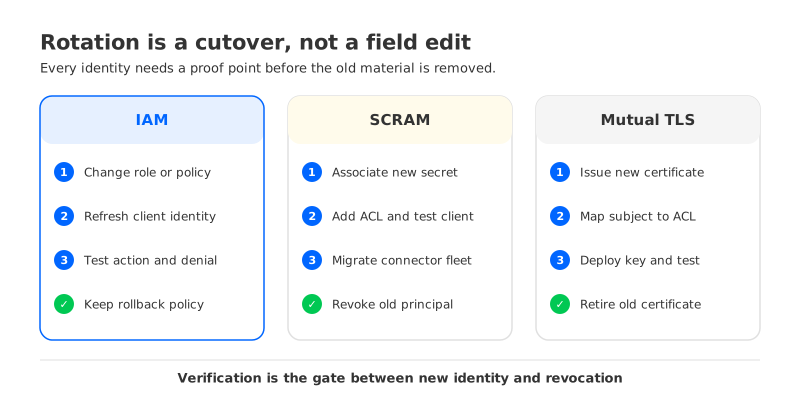
Password rotation is where a familiar mechanism can surprise teams. MSK supports password-only rotation for an associated secret. After the updated password propagates to brokers, updated authentication attempts require the new value and the previous password stops authenticating. The rotation documentation warns that changing the username in an already associated secret can leave previously cached credentials available for an undefined period. That cache is not a supported overlap window.
The safer username migration pattern is deliberately staged:
- Create a separate secret for the replacement username and associate it with the cluster.
- Add the Kafka ACLs for the replacement principal.
- Wait for propagation, then test a real producer or consumer with the new identity.
- Migrate clients and connectors in controlled batches.
- Revoke the old principal and disassociate the old secret after the fleet is confirmed.
This is a better rollback shape than editing a shared secret in place. It creates two explicit identities for the transition, which lets an operator see which clients have moved and remove the old identity after the cutover.
4TLS and mutual TLS: certificate identity at the edge
TLS protects the connection in transit, but server-side TLS alone does not tell the broker which application is connecting. Mutual TLS adds client authentication: the client presents a certificate, and the broker validates the certificate chain. For Amazon MSK, the mutual TLS guide requires an AWS Private CA. The CA may live in the same AWS account as the cluster or in another account.
mTLS fits environments that already issue certificates to workloads and want the certificate subject to become the Kafka principal. It can also be a useful boundary for clients that cannot assume AWS roles but can load a keystore and truststore. The client configuration is more involved than a password, though. The certificate, private key, trust chain, file permissions, and renewal process all become part of the application’s runtime contract.
The authorization step remains Kafka ACL-based. AWS states that Amazon MSK does not support certificate revocation lists. To restrict topic access or block a compromised certificate, use Apache Kafka ACLs and AWS security groups, as described in the mTLS documentation. In other words, issuing a certificate proves possession of a key signed by the CA; it does not automatically grant the principal access to every topic.
Certificate rotation should therefore be treated as an overlap and cutover problem. Issue the replacement certificate, deploy the new key material, establish a connection, produce or consume a test record, and only then retire the old certificate. The exact overlap method depends on how the client maps certificate identity to an ACL principal. If the subject name changes, the ACL migration is part of the rotation, not a follow-up task.
mTLS also changes incident response. A stolen password can be changed in Secrets Manager, and an IAM role can be restricted by policy. A stolen certificate requires a plan for removing the corresponding principal’s access while the certificate itself may remain valid. Because MSK does not provide CRLs, the response should include ACL changes, security-group controls, certificate replacement, and a client restart strategy.
5Client and connector compatibility is the practical tie-breaker
Security architecture is only useful when the client can implement it. A Java service under your control may support all three paths. A managed connector, partner appliance, or older data pipeline may expose only a subset. The client matrix should be built from the actual connector version and deployment mode, not from the Kafka protocol name on a product page.
For IAM, verify the MSK IAM mechanism, credential provider chain, and connector support. For SCRAM, verify SASL/SCRAM-SHA-512, secret access, and reconnect behavior after a password change. For mTLS, verify keystore and truststore formats, certificate subject mapping, private-key handling, and reload or restart behavior. A test that reaches the broker proves network access; it does not prove that the connector can renew identity or recover from a failed handshake.
MSK Connect deserves its own row in the matrix. AWS describes it as a managed Kafka Connect service that can run third-party connectors such as Debezium and connect to Kafka clusters reachable through an Amazon VPC. Its worker and connector configuration still needs a compatible authentication path to the target cluster. Treat the connector’s authentication settings, worker role, plugin behavior, and restart policy as one unit. A connector may have permission to read a secret while the Kafka principal in that secret lacks access to the required topic.
A production compatibility test should include the failure, not only the happy path:
| Test | IAM | SCRAM | Mutual TLS |
|---|---|---|---|
| Fresh client connection | Assume the intended runtime role and perform a Kafka action | Read the associated secret and authenticate with SCRAM-SHA-512 | Load the certificate chain and authenticate with the intended principal |
| Authorization denial | Remove one IAM action and confirm the client receives a policy denial | Remove one ACL and confirm the username remains identifiable but cannot act | Remove one principal ACL and confirm the certificate alone is insufficient |
| Rotation | Change policy or role binding in a controlled test | Rotate password or stage a replacement secret | Deploy a replacement certificate and update its ACL mapping |
| Recovery | Restart after credential refresh or role change | Restart after secret propagation and password change | Restart or reload after key and truststore replacement |
The purpose of this table is not to rank the mechanisms. It is to expose the work each one moves into your client platform.
6Authorization and blast radius
The safest identity is the one that gives operators a narrow, observable way to remove access. IAM can map a workload role to a policy, but a broadly shared role can still authorize too many clients. SCRAM can create a user per connector, but a single secret reused across clusters expands the effect of a leak. mTLS can provide strong cryptographic identity, but a certificate subject that maps to broad ACLs has the same practical problem as an over-permissive password.
Use separate principals for separate operational roles. A producer that writes to one topic should not share a principal with a sink connector that reads an entire namespace. A deployment pipeline should not use the same identity as a long-running application. This separation makes audit logs meaningful and turns revocation into a bounded change rather than a cluster-wide emergency.
Failure analysis should also distinguish identity failure from authorization failure:
- Handshake or token failure: the broker cannot validate the presented identity, or the client cannot obtain the material required to present it.
- Policy or ACL denial: the identity is recognized, but the requested Kafka operation is not allowed.
- Propagation or cache delay: the control-plane change has not reached the broker or the client is still using old material.
- Client recovery failure: the identity is valid, but the connector or application does not reload it or reconnect correctly.
The runbook should capture the exact client, principal, cluster, topic, and authorization source for each failure class. “MSK authentication failed” is too broad to guide a safe rollback.
7A selection matrix for production clients
Choose IAM when the workload already has an AWS identity lifecycle and you want IAM policies to make the Kafka authorization decision. It is particularly attractive for AWS-native applications where role assumption, policy review, and audit tooling are already standard. Budget time for the MSK IAM client integration and for validating non-Java or connector support.
Choose SCRAM when compatibility with existing Kafka users and connectors is the primary constraint. Keep the user-to-secret relationship explicit, use separate secrets for migration, and test the propagation and reconnect path before rotating a production password. SCRAM is not a reason to share one username across every service.
Choose mTLS when certificate issuance is already a controlled platform capability or when a client cannot use AWS credentials but can manage key material safely. Plan the CA ownership, subject-to-ACL mapping, renewal overlap, compromise response, and the absence of CRLs before enabling it for a large fleet.
| Decision question | IAM | SCRAM | Mutual TLS |
|---|---|---|---|
| Who owns identity? | AWS IAM and runtime role | Secrets Manager and Kafka user | AWS Private CA and certificate platform |
| Where is authorization? | IAM policies for IAM identities | Kafka ACLs | Kafka ACLs and security groups |
| Main client requirement | MSK IAM mechanism and AWS credentials | SASL/SCRAM-SHA-512 and secret access | Keystore, truststore, private key, and certificate chain |
| Rotation shape | Policy or role change, then client refresh | Password rotation or staged replacement secret | Replacement certificate, ACL mapping, and client reload |
| Typical blast-radius control | Separate IAM roles and narrow resource policies | One user and secret per workload or connector | One certificate subject and narrow ACLs |
| Main operational risk | Connector does not support IAM token flow | Shared users and unsafe in-place username edits | Key handling, renewal gaps, and no CRL support |
The matrix makes one point clear: authentication mode is an ownership decision. A security team can select IAM and still fail if the application team cannot rotate or observe the IAM client integration. A platform team can select mTLS and still create excessive risk if certificate subjects are shared. The winning mode is the one whose lifecycle your organization can rehearse.
8Where a Kafka-compatible platform changes the question
The same review applies when you evaluate a Kafka-compatible platform outside Amazon MSK. The client contract still matters: bootstrap behavior, TLS or SASL settings, principal mapping, ACL semantics, connector support, and rotation behavior must be tested against the target platform. “Kafka-compatible” is a starting assumption for a migration test, not proof that an MSK IAM callback or an MSK-specific control-plane feature will work unchanged.
AutoMQ is a Kafka-compatible cloud-native streaming platform with a different storage and control-plane model. That means a team considering AutoMQ should carry the identity questions forward and verify the platform’s documented authentication and authorization options for its chosen deployment. The useful portability artifact is a client contract: which Kafka security protocol is used, where identities are issued, how principals map to permissions, and how a rotated credential is observed by each client.
This is also where architecture and identity boundaries meet. Moving brokers or storage does not automatically move the identity provider, secret rotation process, or certificate authority. If an exit plan depends on changing platforms, run an authentication migration alongside the data-plane migration. Prove one producer, one consumer, and one connector through the full rotation and rollback path before treating protocol compatibility as complete.
9FAQ
9.1Is IAM authentication the same as TLS encryption in Amazon MSK?
No. IAM is an identity and authorization mechanism for Kafka actions. TLS protects the connection and may also be used with IAM through a SASL-over-TLS configuration. Review the client’s security protocol and authentication mechanism separately.
9.2Does Amazon MSK support SCRAM-SHA-256?
The current MSK limitations documentation lists SCRAM-SHA-512 as the supported SCRAM mechanism. Confirm the service documentation and client configuration before migrating an existing SCRAM-SHA-256 deployment.
9.3Can Kafka ACLs authorize IAM identities on MSK?
No. AWS states that Kafka ACL APIs have no effect on authorization for IAM identities. Use IAM policies for IAM-authenticated clients. Kafka ACLs remain relevant to TLS and SCRAM clients.
9.4Does changing a SCRAM password immediately remove the old password?
After the updated password propagates to brokers, updated authentication attempts require the new value and the previous password stops authenticating. Do not treat cached credentials after a username edit as a supported overlap period. For a username change, stage a replacement secret and migrate clients before removing the old one.
9.5Does mutual TLS let every certificate read every topic?
No. A certificate establishes client identity. Kafka ACLs and security groups still control access. Amazon MSK does not support CRLs, so certificate compromise response must include principal access changes and certificate replacement.
9.6What should I test first when a connector cannot connect to MSK?
Identify the client’s security protocol, authentication mechanism, principal, and credential source. Then test network reachability, identity presentation, authorization to the target topic and group, and recovery after rotating the identity material. A successful DNS or port check does not validate authentication.
10Sources for implementation details
- Authentication and authorization for Apache Kafka APIs
- IAM access control for Amazon MSK
- SCRAM credentials with AWS Secrets Manager
- SCRAM credential rotation
- SCRAM limitations
- Mutual TLS client authentication
- Apache Kafka ACLs on MSK
- Understand MSK Connect
- Temporary security credentials in IAM
- Secrets Manager rotation
- Kafka security documentation
When you choose the mechanism, choose the operating model with it. If you want to test a Kafka-compatible architecture and its identity boundary in a controlled environment, start with AutoMQ.


