
Table of Contents
Table of Contents
Amazon MSK cost reviews often start with a reasonable question: "What will this Kafka workload cost on AWS?" The difficult part is that the answer is not one number. A production streaming platform turns application behavior into several different meters: broker hours, provisioned or consumed storage, storage throughput, data written and read, private connectivity, cross-region movement, connectors, replication, monitoring, and the engineering work required to keep the platform healthy.
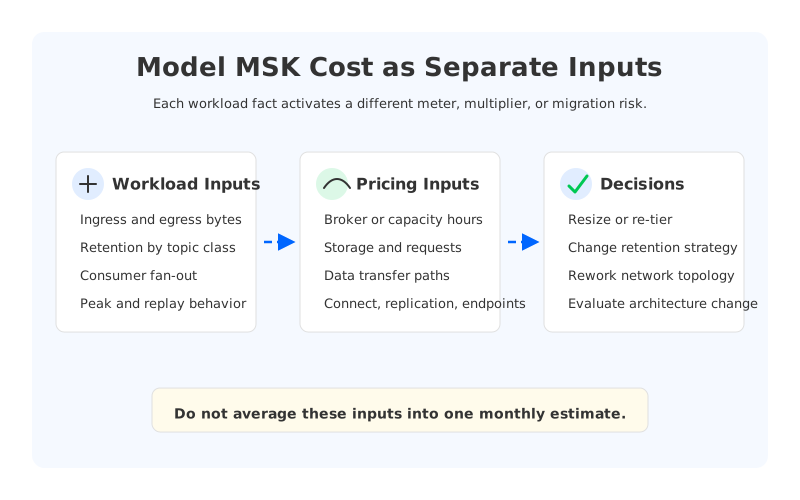
That mix makes a single monthly estimate dangerous. It can help budgeting, but it hides the reason a bill changes when traffic grows, retention expands, consumers replay history, or the platform team adds a second region. The goal is not to memorize every price line. It is to isolate each input so architecture, FinOps, and procurement teams can decide which cost is necessary, which one is controllable, and which one is a symptom of the wrong data path.
1Why Teams Search for MSK Cost
Teams search for MSK Cost when they are past generic Kafka exploration and close to a platform decision. Some are comparing self-managed Apache Kafka with Amazon MSK Provisioned. Some are deciding between Standard brokers, Express brokers, and MSK Serverless. Others already run MSK and need to explain why a familiar workload produced an unfamiliar bill. The search intent is commercial, but the underlying problem is architectural.
AWS publishes the billing dimensions clearly. MSK Provisioned charges for broker instance usage and storage, with different details for Standard and Express brokers. Standard brokers can include provisioned storage throughput. Express brokers include broker instance usage, storage consumed, and data written. MSK Serverless uses cluster-hours, partition-hours, data-in, data-out, and storage consumed. MSK Connect is measured in connector worker capacity, and MSK Replicator includes replicator-hours, data processed, and, for cross-region replication, standard data transfer charges.
Those dimensions explain the invoice, but they do not tell a platform team what to change. A high broker-hour charge can mean the cluster is overprovisioned, but it can also mean peak traffic, partition count, or failure headroom requires that capacity. A high storage charge can reflect long retention, oversized broker disks, a low-cost tier strategy, or topics that were never cleaned up. A high network bill can come from application placement, multi-VPC access, internet egress, cross-region replication, or consumer reads that travel farther than expected.
The right model begins by refusing to blend those causes together. A blended estimate says, "MSK will cost this much." A useful model says, "This workload creates this many broker-hours, this much retained data, this much data-in and data-out, and this much private or regional movement." Once the inputs are separate, the team can tune the workload, rework topology, or evaluate a different Kafka-compatible architecture with less guesswork.
2Start With Workload Shape, Not Broker Price
Broker price is visible, so teams often start there. Workload shape is less tidy, but it is the input that determines how many priced units the system creates. A Kafka platform with steady write traffic, short retention, and one consumer group has a different cost profile from a platform with bursty ingest, many analytical consumers, frequent backfills, and 30-day replay requirements. Both may use the same broker family, but the bill will not behave the same way.
The workload model should separate facts that are often mixed together in capacity plans:
- Ingress bytes and compression ratio. These determine the first copy of data entering the platform and influence broker throughput, storage growth, and data-in charges in pricing models that meter writes.
- Partition count and topic layout. Partitions affect scheduling, metadata, serverless partition-hour dimensions, operational overhead, and the amount of parallelism available to consumers.
- Retention by topic class. Short-lived operational streams, compliance streams, compacted topics, and replay-heavy event logs should not share one retention average.
- Consumer fan-out and replay behavior. One write can become many reads. Backfills can turn historical retention into active network and storage retrieval pressure.
- Peak-to-average ratio. Streaming systems are sized for bursts, maintenance windows, and failure recovery, not for the calm hour used in a spreadsheet.
This is why a 1 TiB/day workload is not a cost model. It is a starting point. If that TiB is retained for 24 hours, read once, and kept inside one VPC, the architecture conversation is one thing. If it is retained for 30 days, replayed by several teams, copied to a second region, and consumed from multiple VPCs, the same write volume activates a very different set of MSK and AWS meters.
3Separate the MSK Pricing Inputs
A production model should group MSK cost into buckets that map back to engineering decisions. The exact regional rates belong in the AWS pricing page or AWS Pricing Calculator. The architecture review should focus on why each bucket exists and which team can influence it.
| Input Bucket | What It Usually Represents | What To Model Separately |
|---|---|---|
| Broker or cluster capacity | Serving compute, memory, network, and headroom | Standard broker-hours, Express broker-hours, serverless cluster-hours |
| Partition footprint | Topic layout and parallelism | Serverless partition-hours, metadata scale, operational limits |
| Storage | Retention and durability | Provisioned storage, consumed storage, low-cost tier storage, retrieval patterns |
| Storage throughput | Disk throughput headroom | Provisioned throughput for Standard brokers when enabled |
| Data written and read | Workload movement through the service | Express data written, Serverless data-in and data-out |
| Network and connectivity | Where clients and replicas move bytes | Data transfer, PrivateLink, multi-VPC access, cross-region replication |
| Adjacent services | Connectors, replication, observability | MSK Connect worker capacity, MSK Replicator data processed, CloudWatch volume |
The table has one job: prevent false substitutions. Broker-hours are not a proxy for storage. Storage is not a proxy for data-out. Private connectivity is not a proxy for inter-region replication. Treating them as separate inputs keeps the review anchored in actions the team can take.
For example, reducing retention will not solve a cost issue dominated by consumer reads through private connectivity. Shrinking broker size will not solve a bill driven by cross-region replication. Moving to a serverless model may reduce capacity planning work, but partition-hours, data-in, data-out, and consumed storage still have to be modeled against the real workload. These are not arguments against MSK. They are reminders that managed service packaging and workload physics are different layers.
4Architecture Choices That Change the Cost Curve
MSK cost is not only a matter of AWS pricing. It is also a matter of Kafka architecture. Traditional Apache Kafka stores log data on brokers and uses replication between brokers for durability and availability. In a managed service, AWS operates the service boundary, but the workload still creates broker, storage, and network demand through Kafka's data path.
That distinction matters when a cost review points to a multiplier rather than a unit price. If storage growth forces larger broker disks while CPU remains underutilized, the issue is resource coupling. If scaling requires partition movement before the cluster benefits from capacity, the issue is stateful data placement. If a large share of the bill sits outside the MSK service line in data transfer or private connectivity, the issue may be topology. If recovery planning forces excess headroom, the issue may be operational risk rather than nominal price.
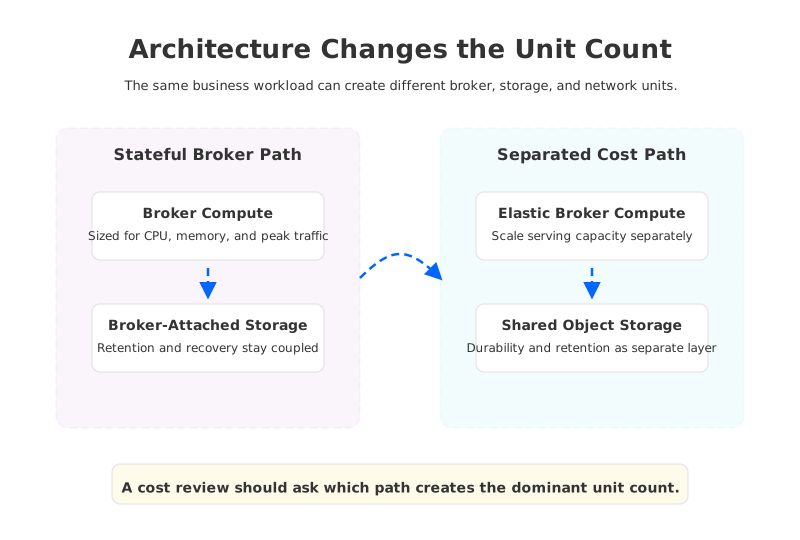
Tiered storage changes one part of the model by placing older log data in remote storage while the active log remains broker-centered. The Apache Kafka documentation frames tiered storage as a way to move completed log segments to remote storage, which can be valuable for retention-heavy workloads. The cost review still has to ask which data is active, how much historical data is read, what retrieval path is used, and how recovery behaves under the workload.
MSK Express brokers change another part of the model. AWS positions Express brokers as a managed broker option designed to make Apache Kafka easier to manage, with a different pricing structure from Standard brokers. That can be attractive when the operational or throughput profile fits. It still should be modeled as its own path because data written, consumed storage, and external data transfer are not the same inputs as Standard broker provisioned storage and optional storage throughput.
MSK Serverless changes the capacity planning boundary again. Instead of selecting broker instances, teams model cluster-hours, partition-hours, data-in, data-out, and storage consumed. That can reduce broker sizing work, but it makes partition count and read/write volume first-class pricing inputs. A workload with many lightly used partitions or heavy read fan-out should not be evaluated with the same assumptions as a compact, write-heavy workload.
5The Inputs Most Often Missing From Cost Pages
The missing inputs are rarely hidden. They are omitted because they belong to architecture, operations, or migration rather than a service pricing table. For a CTO or FinOps team, those omissions are where the decision risk lives.
Network path is the first one. AWS states that standard data transfer charges can apply for data transferred in and out of MSK clusters, and MSK private connectivity uses PrivateLink-style hourly and data-processing charges. That means the model needs a byte map: producers to brokers, brokers to consumers, clients across VPCs, data crossing regions, and replication paths. The invoice category may be network, but the cause may be client placement or tenancy boundaries.
The second missing input is operational change. Standard brokers, Express brokers, and Serverless clusters place different amounts of work on the service and the platform team, but none of them remove the need for governance. Teams still have to manage topic lifecycle, ACLs, quotas, schema discipline, consumer behavior, observability, and incident response. A model that compares only metered service charges can understate the cost of slow scaling, long recovery, or manual remediation.
Migration risk is the third missing input. A lower modeled cost has limited value if the migration requires application rewrites, breaks Kafka client assumptions, or leaves no rollback path. For Kafka platforms, the compatibility surface is broader than produce and consume APIs. It includes client versions, authentication, authorization, transactions if used, Kafka Connect, stream processors, monitoring, topic configuration, consumer offset handling, and operational runbooks.
6A Practical Modeling Workflow
The workflow should produce a decision record rather than a prettier spreadsheet. Start with one workload class and model it as a set of byte paths. Price each path with current AWS rates, but mark every assumption that came from estimates rather than production metrics. Then run the model against three scenarios: normal day, peak day, and recovery or replay day. Kafka platforms rarely fail financially on the average day.
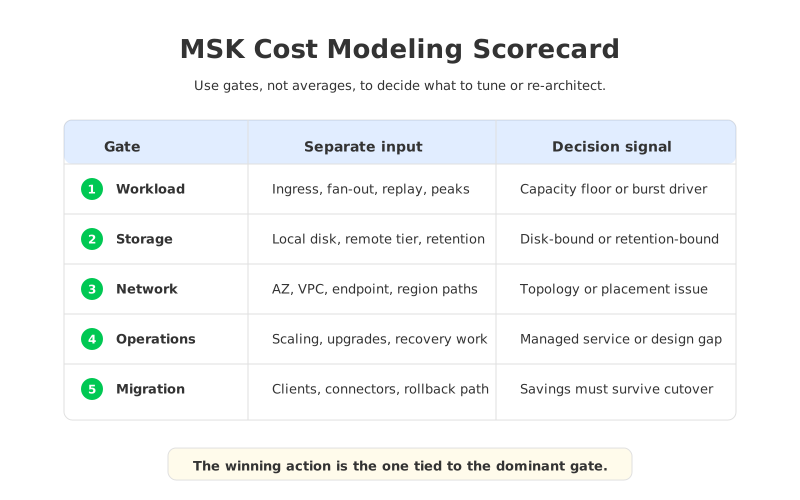
Use five gates to keep the review honest. First, confirm workload shape: ingress, partitions, consumer groups, retention, and bursts. Second, confirm storage behavior: active log, retained history, low-cost tier or remote storage, and read-back frequency. Third, confirm network paths: AZ, VPC, region, internet, and PrivateLink movement. Fourth, confirm operational responsibility: scaling, upgrades, incident response, and recovery drills. Fifth, confirm migration constraints: client compatibility, cutover plan, rollback path, and governance requirements.
Each gate should end with a clear diagnosis. "Broker capacity dominates" leads to a different action than "consumer data-out dominates." "Retention dominates" leads to different options than "cross-region replication dominates." "Operational toil dominates" may justify managed service features even when raw infrastructure cost looks higher. Without that diagnosis, the review tends to collapse back into vendor line-item comparison, which is where the important architecture signal gets lost.
7How AutoMQ Fits the Evaluation
After the MSK inputs are separated, a Kafka-compatible shared-storage architecture becomes easier to evaluate on technical grounds. AutoMQ is in that category: it keeps Kafka protocol compatibility while using a shared storage architecture backed by object storage, with stateless brokers and a write-ahead-log path designed for streaming writes. The point is not that every MSK workload should move. The point is that some cost drivers come from coupling compute, local broker storage, and recovery behavior in the same layer.
For a workload where broker-attached storage and recovery headroom dominate the model, shared storage changes the question. Durable data is no longer tied to a particular broker's local disk in the same way, so compute and storage can be evaluated as separate resources. For a workload where cross-AZ movement is material, AutoMQ's documented zero cross-AZ traffic design is a specific claim to test with production-like traffic. For a workload where Kafka client compatibility is mandatory, the evaluation should include real producers, consumers, connectors, ACLs, monitoring, and rollback procedures.
That framing keeps the comparison fair to MSK and useful to the buyer. Amazon MSK remains a strong managed Kafka option for teams that want AWS-operated Kafka with multiple deployment choices. AutoMQ becomes relevant when the dominant cost or operational risk points to the storage architecture itself, especially for teams that want Kafka-compatible behavior with object-storage-backed durability and more independent scaling of compute and storage.
The practical next step is measurement. Export current MSK metrics, annotate the invoice by input bucket, and run a representative test for any alternative architecture before committing to a migration plan. If the evidence shows that storage coupling, cross-zone movement, or slow recovery is driving the curve, evaluate AutoMQ as part of your Kafka architecture review.
8References
- Amazon MSK pricing: https://aws.amazon.com/msk/pricing/
- Amazon MSK Developer Guide: https://docs.aws.amazon.com/msk/latest/developerguide/what-is-msk.html
- AWS EC2 data transfer pricing: https://aws.amazon.com/ec2/pricing/on-demand/#Data_Transfer
- AWS PrivateLink pricing: https://aws.amazon.com/privatelink/pricing/
- Apache Kafka tiered storage documentation: https://kafka.apache.org/38/operations/tiered-storage/
- AutoMQ Apache Kafka compatibility: https://docs.automq.com/automq/what-is-automq/compatibility-with-apache-kafka?utm_source=blog&utm_medium=reference&utm_campaign=gs100-0082
- AutoMQ architecture overview: https://docs.automq.com/automq/architecture/overview?utm_source=blog&utm_medium=reference&utm_campaign=gs100-0082
- AutoMQ inter-zone traffic overview: https://docs.automq.com/automq/eliminate-inter-zone-traffics/overview?utm_source=blog&utm_medium=reference&utm_campaign=gs100-0082
9FAQ
9.1What is the biggest mistake in estimating MSK Cost?
The biggest mistake is averaging different pricing inputs into one monthly number too early. Broker capacity, storage, data-in, data-out, PrivateLink processing, replication, and connector capacity respond to different workload behaviors. Keep them separate until the dominant driver is clear.
9.2Should teams compare Standard brokers, Express brokers, and MSK Serverless with the same spreadsheet?
Use the same workload assumptions, but not the same pricing buckets. Standard brokers, Express brokers, and Serverless clusters expose different meters. A fair comparison maps the same workload to each model rather than forcing every option into broker-hours and storage alone.
9.3Does tiered storage remove the need to model retention?
No. Tiered storage can change retention economics by moving completed log segments to remote storage, but read-back frequency, retrieval path, active log size, compaction behavior, and recovery expectations still matter. Long retention becomes easier to reason about, not free of modeling.
9.4When should AutoMQ enter the MSK cost conversation?
AutoMQ belongs in the evaluation after the team has identified the dominant cost driver. If the model points to stateful broker storage, cross-zone movement, slow recovery, or compute and storage coupling, a Kafka-compatible shared-storage architecture is worth testing against the same workload and compatibility gates.


