
Table of Contents
Table of Contents
Replacing Amazon MSK is rarely blocked by Kafka itself. The harder part is everything attached to the cluster: producer bootstrap strings, IAM or SASL settings, TLS certificates, topic configuration, consumer group offsets, schema registries, connectors, DNS, alarms, and rollback. Teams searching for an Amazon MSK replacement usually already know why tuning the current cluster is not enough. What they need is a plan that turns "move off MSK" from a risky infrastructure rewrite into a controlled Kafka migration.
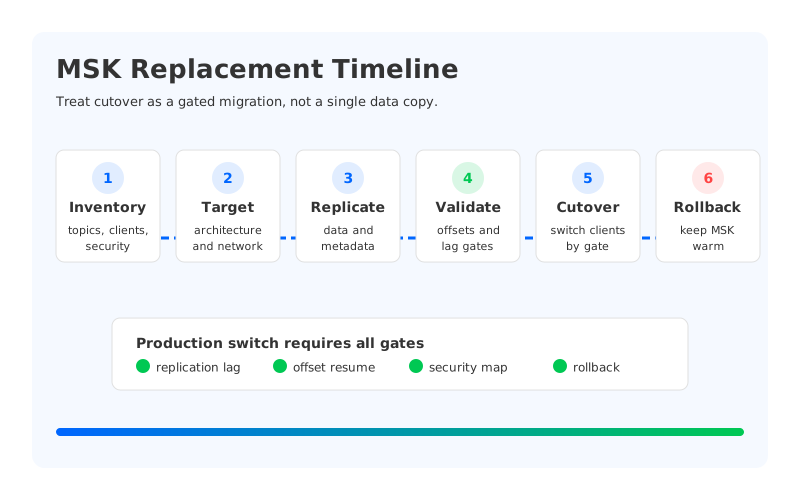
The safest framing is not "copy data, switch clients." It is "prove that the target can carry the same protocol, security boundary, workload shape, and recovery path before any production client depends on it." AWS documents MSK Replicator and Apache MirrorMaker 2.0 as migration and replication options. Their shared lesson is clear: data replication, metadata replication, offset translation, and failover behavior are separate workstreams.
1When Replacement Is Better Than MSK Tuning
MSK tuning still makes sense when the problem is local: an undersized broker class, a retention policy that grew without review, inefficient producers, noisy consumer groups, or topic partitioning that no longer matches the workload. Replacement becomes the better project when the pain comes from the operating model itself. FinOps may want a different cost curve for retained log data, SRE may want faster scaling without moving large volumes of local broker storage, and platform teams may want tighter control over the data plane.
That distinction matters because an MSK replacement is not a rebellion against AWS. Many projects stay on AWS because the applications, IAM model, VPC topology, observability, and compliance controls already live there. The real decision is the Kafka runtime and storage architecture.
Use replacement rather than tuning when scaling is constrained by state movement, cost is driven by always-on broker and storage shape, or security boundaries need to change. AWS MSK pricing includes dimensions such as broker usage, storage, provisioned throughput where applicable, data transfer, and optional replication features, so compare with your own throughput, retention, replication, and network paths. The same reasons make migration harder: a high-value MSK environment usually has many clients, multiple authentication paths, and a long tail of consumer groups.
2Inventory Your MSK Environment Before Migration
A replacement plan starts with an inventory that is boring on purpose. Every surprise discovered during cutover becomes a rollback conversation. The inventory should describe what exists in MSK, what must be identical on the target, what can be normalized, and what should be retired.
For topics, collect partition counts, replication factors, cleanup policies, retention settings, compaction settings, message size assumptions, and topic-level overrides. Apache Kafka stores and replicates data at the partition level, so partition count and key distribution affect migration and post-cutover behavior. Avoid repartitioning critical topics during the same migration unless you can validate ordering and stateful processing assumptions.
Consumer groups deserve their own worksheet. Kafka consumers commit offsets so a group can resume from its last processed position. During replacement, those committed positions become the difference between a clean switch, duplicate processing, or a missed-read incident. AWS notes that MSK Replicator can synchronize consumer group offsets from source to target, but also documents that offset translation is approximate and intentionally conservative, so applications should tolerate some re-reading after failover.
The minimum inventory should include:
| Area | What to Capture | Migration Decision |
|---|---|---|
| Topics | Partitions, retention, cleanup policy, configs | Preserve, rename, merge, or retire |
| Producers | Bootstrap, acks, idempotence, client version | Compatible as-is or update |
| Consumers | Group IDs, offset reset policy, lag, idempotency | Offset sync, seek, or replay |
| Security | IAM, SASL/SCRAM, mTLS, TLS, ACLs | Equivalent mapping |
| Integrations | Connect, schemas, Flink, Spark, CDC | Repoint or redeploy |
| Operations | Metrics, alerts, quotas, runbooks | Recreate before cutover |
Security mapping is often where replacement plans lose time. AWS states that enabling IAM, SASL, or TLS authentication also requires encryption between clients and brokers. If clients use IAM access control, a non-MSK target may require another authentication mechanism. If they use SASL/SCRAM or mTLS, test certificates, secret rotation, and ACL behavior before data replication becomes the focus.
Networking is equally concrete. MSK multi-VPC private connectivity uses AWS PrivateLink to connect clients in different VPCs and accounts while keeping traffic on the AWS network. MSK Replicator requirements depend on region topology, security groups, subnets, IAM access, and port 9098 for IAM-based MSK connectivity. Define every path explicitly: source to replicator, replicator to target, clients to target, observability endpoints, and rollback traffic.
3Choose the Target Kafka Architecture
The phrase "replace MSK" hides several target architectures. Self-managed Kafka on EC2 gives the most operational control, but returns broker lifecycle, disk planning, upgrades, and failure handling to your team. Kafka SaaS removes more operations, but the data plane, networking model, and compliance boundary may change. BYOC Kafka keeps infrastructure in your cloud account or VPC while delegating more lifecycle management to the provider. Shared-storage Kafka changes the storage model by moving durable log data away from broker-local disks.
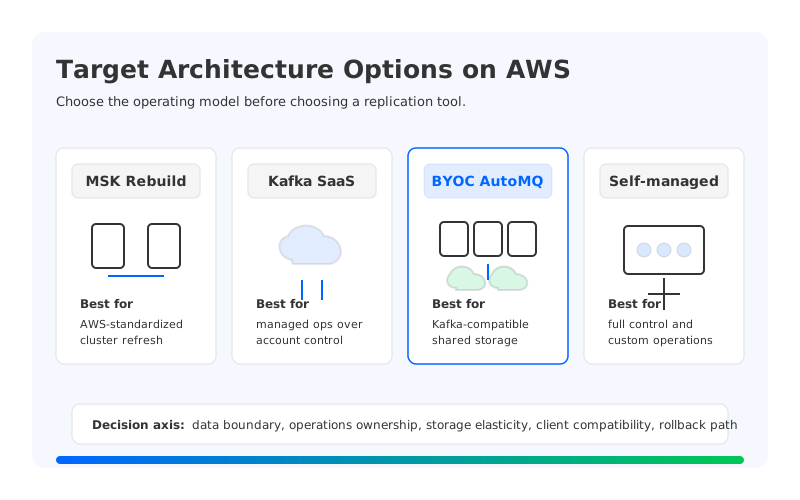
Make this choice before tooling. Replication tools move bytes and offsets; they do not decide whether your future operating model should optimize for managed simplicity, in-account data control, storage elasticity, or deep self-management.
| Target Pattern | Good Fit | Trade-Off to Validate |
|---|---|---|
| Another MSK cluster | Clean rebuild, region move, or cluster class change | Still inherits MSK operations |
| Kafka SaaS | Managed operations over account control | Network, residency, egress, and auth may change |
| Self-managed Kafka on EC2 | Strong Kafka operations and custom needs | You own upgrades, failures, disks, and rebalancing |
| BYOC shared-storage Kafka | Kafka compatibility with account control and storage elasticity | Validate compatibility and migration tooling |
This is where AutoMQ can be evaluated without turning the migration plan into a product pitch. AutoMQ is a Kafka-compatible cloud-native streaming platform that uses object storage as the durable storage foundation and stateless brokers for compute. Its documentation describes Apache Kafka compatibility, and AutoMQ Cloud documents BYOC environments where cloud resources run in the user's cloud account. For an MSK replacement on AWS, that combination is relevant when the target requirement is Kafka compatibility, data-plane control, object-storage economics, and scaling less tied to local log movement.
The bar is evidence, not aspiration. Before selecting AutoMQ or any other target, test your actual clients, topic configuration, security model, and failure procedures.
4Replicate Data and Validate Consumers
Once the target architecture is chosen, replication becomes an engineering system with measurable gates. AWS documents MSK Replicator for supported MSK-related paths and Apache MirrorMaker 2.0 as the open-source Kafka mirroring tool. AutoMQ also documents migration paths, including Kafka Linking. The correct tool depends on source and target support, authentication, topic naming, offset handling, and rollback requirements.
Do not begin with all topics. Start with a representative slice: one high-throughput topic, one compacted topic if you use compaction, one topic with ordering expectations, and one consumer group that is safe to replay. This pilot should prove that topic configuration, replication catch-up, consumer resume behavior, and observability work on both sides.
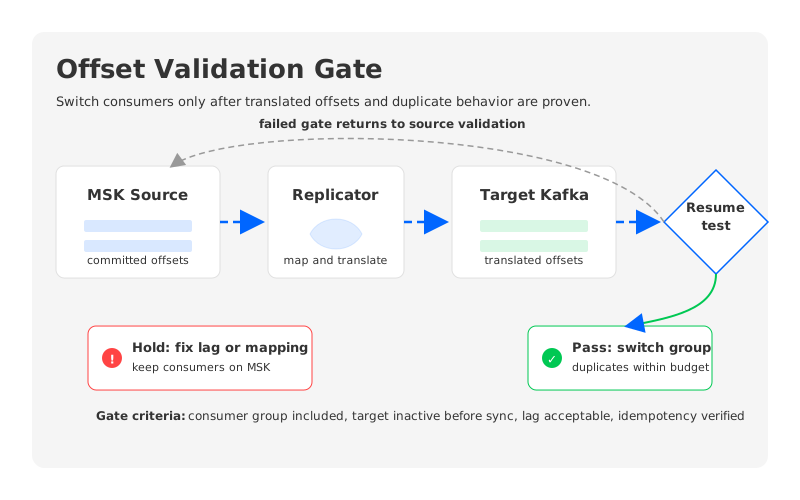
Offset validation deserves the most discipline. AWS explains that offset synchronization maps source offsets to target offsets, translates committed offsets, and commits translated values into the target cluster's __consumer_offsets topic. Common pitfalls include conservative translated offsets, active target-side consumers preventing overwrite, lagging source consumers causing more duplicates, and filters excluding expected groups.
That leads to a practical rule: define acceptable duplicate processing instead of promising zero duplicates. If a system cannot tolerate duplicates, fix idempotency or choose a controlled drain-and-resume pattern. If a stream job owns external state, validate its checkpoints separately from Kafka offsets.
Use these validation gates before a broad client switch:
- Replication catch-up gate. Replication lag is stable and within a workload-specific cutover threshold.
- Offset gate. Test consumers using the same group IDs start on the target from the expected position, and duplicates stay within the application's idempotency budget.
- Security gate. Representative clients authenticate with the planned production mechanism.
- Operational gate. Alerts, dashboards, quotas, and runbooks exist before production traffic moves.
- Rollback gate. The team can stop target traffic and resume MSK traffic with a documented offset or replay policy.
At this point, a dry run is more valuable than another design review. Run the procedure in a low-risk slice, capture commands, record timing, and document what can be automated. Do not turn those timings into universal downtime claims; they are valid only for that workload and procedure.
5Cut Over Safely and Keep Rollback Possible
Cutover is not one moment. It is a sequence of writes, reads, offsets, and names moving from one system to another. AWS planned failover guidance for MSK Replicator includes stopping producers and consumers on the source, starting them on the target, and, depending on ordering requirements, waiting for replicated-topic consumers to drain before switching to local topics. Even if your target is not MSK, the control logic is useful: stop the side that creates ambiguity, verify lag, then start the side that owns the target truth.
For many teams, DNS or configuration indirection is the cleanest switch mechanism. Applications should not have MSK broker strings hard-coded across dozens of repositories. Use a central configuration service, secret manager, deployment variable, or DNS abstraction, and make it reversible at the same layer.
A conservative cutover often follows this shape:
- Freeze non-essential topic and connector changes.
- Confirm replication health, target health, offset sync status, and network reachability.
- Stop or drain selected producers and consumers on MSK according to ordering requirements.
- Wait for replication and consumer lag gates.
- Repoint producers, then start consumers with validated offset behavior.
- Keep MSK intact for the rollback window.
- Decommission after retention, audit, and replay requirements are satisfied.
Rollback should be designed while the source is still warm. If rollback means moving consumers back to MSK, offset translation in the reverse direction must be planned. AWS distinguishes legacy unidirectional offset sync from enhanced bidirectional setups for scenarios such as migration with rollback capability. In non-MSK targets, prove the offset story in both directions or accept a documented replay window.
6How AutoMQ Changes the Target Architecture
AutoMQ becomes interesting after the replacement requirements are clear. If the desired end state is "Kafka protocol, AWS-side data control, less broker-local state management," then a Kafka-compatible shared-storage architecture is a different category from both MSK tuning and self-managed Kafka. AutoMQ separates stateless broker compute from durable data stored on object storage such as S3, changing the scaling question from log movement to compute elasticity.
For an MSK replacement, this matters in three places. Compatibility reduces migration surface area because existing Kafka clients and ecosystem integrations can be tested against a Kafka-compatible API. BYOC can preserve a cloud-account and network boundary familiar to AWS platform teams. Object-storage-backed durability can change the cost and elasticity model for retained streaming data, although the result still depends on workload, retention, read pattern, AWS region, and deployment choices.
Evaluate AutoMQ with the same gates as any target: client compatibility, BYOC data control, VPC and IAM requirements, migration tooling for topics and offsets, rollback policy, and a cost model that includes brokers, object storage, requests, network paths, support, and operational labor.
That last point is where architecture and FinOps meet. MSK, SaaS Kafka, self-managed Kafka, and AutoMQ-style shared storage each move cost between compute, storage, networking, and operations. Compare with your actual ingress, egress, consumer fan-out, retention, compaction, replication, network paths, and failure scenarios.
7A Replacement Plan You Can Actually Run
An Amazon MSK replacement succeeds when it narrows uncertainty before the production switch. Begin with inventory, choose a target architecture, replicate a narrow slice, validate offsets and security, then cut over behind a reversible client abstraction.
The useful deliverable is a runbook with gates, owners, and rollback criteria. It should say which topics are in scope, which consumer groups must be synced, which applications tolerate duplicates, which clients require authentication changes, which dashboards prove health, and which condition stops the cutover. The runbook should also say when MSK can be decommissioned.
If you are evaluating AutoMQ as the target for an MSK replacement, start with a workload-based migration assessment rather than a generic benchmark. Map your MSK topics, client versions, retention, security model, and cutover constraints to an AutoMQ BYOC architecture, then test the riskiest consumer group first. The strongest migration plan is the one that makes the final switch uneventful.
8FAQ
8.1What is an Amazon MSK replacement?
It is a migration from MSK to another Kafka-compatible target: another MSK cluster, self-managed Kafka, Kafka SaaS, or a BYOC/shared-storage Kafka platform. The project includes replication, security mapping, offsets, client repointing, observability, cutover, rollback, and decommissioning.
8.2Can I move off MSK with zero downtime?
Do not assume zero downtime. Interruption depends on client behavior, replication lag, offset handling, deployment automation, authentication changes, and ordering requirements. Downtime claims should be based on your measured dry run.
8.3How should consumer offsets be handled during MSK replacement?
Map source offsets to target offsets, validate committed positions, and test restart behavior before cutover. AWS documents that MSK Replicator offset translation is approximate and may cause some re-reading after failover. Applications should be idempotent, or the migration should use a controlled drain-and-resume procedure.
8.4Is MirrorMaker 2.0 enough for replacing MSK?
MirrorMaker 2.0 can be enough when you need open-source control across Kafka clusters. It still requires setup, monitoring, offset handling, security configuration, and rollback planning. Managed or target-specific tools can reduce work when they support your exact path.
8.5Why consider AutoMQ as an MSK replacement target?
AutoMQ is relevant when the target requirement is Kafka compatibility plus a different cloud-native storage and operations model. It uses object storage for durable log data and stateless brokers for compute, and AutoMQ Cloud documents BYOC environments in the user's account. Validate it against your clients, security model, topics, offsets, and cost assumptions.
9References
- AWS, Migrate Kafka workloads to an Amazon MSK cluster
- AWS, Amazon MSK pricing
- AWS, Amazon MSK multi-VPC private connectivity in a single Region
- AWS, Update security settings of an Amazon MSK cluster
- AWS, MSK Replicator consumer group offset synchronization
- AWS, MSK Replicator network requirements
- AWS, MSK Replicator planned failover
- Apache Kafka, Kafka documentation: operations and geo-replication
- Apache Kafka, Kafka implementation: distribution and replication
- AutoMQ, Migrate to AutoMQ overview
- AutoMQ, Compatibility with Apache Kafka
- AutoMQ, AutoMQ Cloud environment overview


