
Table of Contents
Table of Contents
Teams searching for msk alternatives are not asking whether Amazon MSK can run Kafka. It can, and for many AWS-first teams it has been the obvious managed Kafka path. The harder question appears later, after the platform has real tenants, longer retention, cross-account access, stricter audit needs, and a cloud bill that no longer fits the first architecture diagram.
At that stage, "alternative" is the wrong unit of analysis. A platform team is not replacing a product name; it is replacing an operating model. Amazon MSK removes some broker operations, but the customer still owns workload design, client behavior, networking choices, security configuration, cost attribution, and incident interpretation.
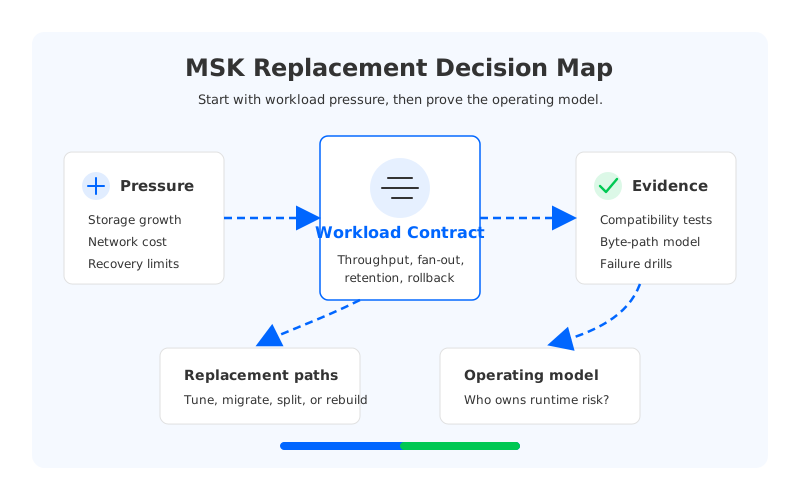
AWS documentation describes MSK as a service for building and running applications that use Apache Kafka to process streaming data. AWS also documents tiered storage, multi-VPC private connectivity, serverless clusters, and provisioned clusters. Those capabilities make MSK a broad AWS-native option. The reason teams still evaluate alternatives is that managed Kafka does not automatically solve every Kafka platform constraint.
1Why MSK Alternatives Searches Start After The First Production Cluster
The first MSK cluster often starts with a narrow goal: stop managing ZooKeeper or brokers directly, stay inside AWS, and give application teams a Kafka endpoint. That goal is reasonable. A managed service can reduce the burden of patching, provisioning, and availability mechanics compared with a hand-built cluster on EC2.
The replacement conversation starts when the platform becomes larger than the cluster. Multi-team Kafka creates questions that a service creation page cannot answer by itself. Which topics need strict compatibility with existing clients? Which workloads are dominated by retention instead of write rate? Which consumers create cross-zone movement? Which teams need account-level control over data placement?
Those questions tend to cluster into four pressure points:
- Architecture pressure: broker-local storage, replica placement, tiered storage behavior, and failure recovery determine whether the platform can scale without long operational windows.
- Cost pressure: broker instance hours, storage, cross-AZ transfer, PrivateLink, NAT, S3, and consumer fan-out can all matter. The bill is not one line item.
- Migration pressure: Kafka clients, ACLs, topic configs, offsets, DNS, observability, and rollback need a real cutover plan.
- Ownership pressure: the team must decide whether it wants AWS-managed Kafka, a different managed provider, self-managed Kafka, or a Kafka-compatible engine in its own cloud boundary.
This is why a useful MSK alternatives evaluation should begin with workload classes. A payments topic with strict latency expectations, a feature pipeline with large fan-out, and an audit stream with long retention may not deserve the same destination. Treating them as one cluster-level decision makes the comparison look simpler than it is.
2The Replacement Paths That Actually Matter
Most shortlists collapse into five paths. None is universally right. Each moves responsibility across the cloud provider, Kafka platform team, vendor, and application owners in a different way.
| Path | What changes | Main risk to test |
|---|---|---|
| Stay on MSK and tune | Keep AWS-native managed Kafka, improve sizing, storage, topic policy, and network paths | Cost and operational pain may be architecture-driven rather than configuration-driven |
| Move to another managed Kafka service | Shift provider operating model, commercial model, and surrounding ecosystem | Data-plane control, migration complexity, and cloud boundary fit |
| Self-manage Apache Kafka | Regain low-level control over brokers, disks, upgrades, and configs | Operational burden returns to the team |
| Adopt a Kafka-compatible engine | Keep Kafka-facing APIs while changing storage and operations architecture | Compatibility and edge-case behavior must be proven with real clients |
| Split workload classes | Keep some topics on MSK and move storage-heavy or cost-sensitive classes elsewhere | Governance complexity across multiple streaming platforms |
The fifth path is often the most realistic. Platform teams rarely replace every Kafka workload at once. They isolate a workload class where the current model is under pressure, run a proof, and then decide whether the operating model is worth broadening.
The evaluation should also separate "Kafka service" from "Kafka semantics." A service can expose Kafka endpoints and still differ in security mechanisms, transaction behavior, quotas, connector ecosystem, observability hooks, partition movement, and recovery mechanics.
3Architecture Criteria Behind The Shortlist
The first architecture question is whether broker storage is still the center of the platform. Traditional Kafka ties compute and durable log storage tightly to brokers. Replication protects availability, but it also means data movement is part of the application-layer design. On cloud infrastructure, that movement touches paid network paths, disk sizing decisions, and broker recovery time.
Tiered storage changes part of that picture by moving older log segments to lower-cost storage while hot data remains on brokers. AWS documents MSK tiered storage as a feature for eligible provisioned clusters, and Apache Kafka documents tiered storage as part of Kafka's storage model. Tiering can help with retention-heavy workloads, but it is not the same as making brokers stateless. The hot path, failure behavior, and operating model still need workload-specific testing.
The second question is who controls the data plane boundary. An AWS-native team may prefer MSK because it aligns with existing VPC, IAM, logging, and procurement patterns. Another team may need a BYOC or software deployment where the streaming data plane runs inside its own cloud account. A third team may accept a fully managed external service if the migration and compliance model fit.
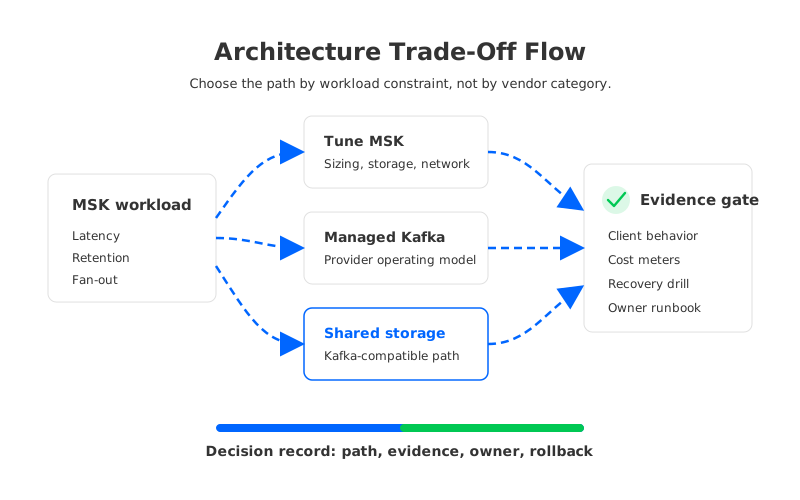
The third question is how the platform recovers. A broker failure, zone event, client misconfiguration, or failed cutover should not require guesswork. Teams evaluating MSK alternatives should rehearse recovery with realistic partition count, producer settings, consumer lag, and authentication methods. A shallow benchmark proves the endpoint works; it does not prove the platform will survive the failure mode that prompted the search.
4Cost Evaluation Starts With Byte Paths
MSK replacement decisions often start with broker price but end with network topology. AWS publishes separate pricing pages for MSK, EC2 data transfer, PrivateLink, and S3 because these meters are different. A Kafka platform can touch several of them at once: producer ingress, broker replication, consumer egress, cross-AZ reads, multi-VPC connectivity, object storage access, and catch-up after lag.
Do not begin the cost model with a provider comparison table. Begin with byte paths. For each workload class, document write rate, read fan-out, retention window, durability model, consumer placement, network boundary, and replay expectations. Then map those paths to billable meters in the destination architecture.
That exercise usually reveals three hidden assumptions:
- A storage-heavy topic is not the same as a throughput-heavy topic. Long retention can dominate the architecture even when write rate is moderate.
- Consumer placement can be as important as producer traffic. A fan-out-heavy estate may move far more bytes on the read side than the write side.
- Cross-boundary traffic needs a design owner. Cross-AZ, cross-VPC, PrivateLink, NAT, and inter-region paths can be valid choices, but they should be explicit choices.
The replacement path should make cost attribution easier, not harder. A team that cannot explain which application, topic class, or network path drives cost will struggle after migration even if the destination service has a better headline price.
5Migration And Ownership Questions For Platform Teams
A credible MSK replacement proof starts with one representative workload and a rollback plan. The workload should include existing client libraries, authentication, ACLs, topic configs, observability agents, producer retry settings, and consumer group behavior. It should also include the operational people who will own the destination after cutover.
The migration record should answer practical questions before production traffic moves:
- Can current producers and consumers run without rewrites?
- Which topic configs, ACLs, quotas, and client settings transfer cleanly?
- How will offsets be handled, verified, and rolled back?
- Which DNS, bootstrap, certificate, and firewall changes are reversible?
- What signal proves lag, throughput, errors, and cost are normal after cutover?
- Who owns incidents that cross Kafka semantics, cloud networking, and provider automation?
These questions are not vendor-specific. They apply to MSK, Confluent Cloud, Aiven, Redpanda, self-managed Apache Kafka, or another Kafka-compatible platform. The point is to make the migration evidence comparable.
Ownership is the part buyers underweight. Replacing MSK may reduce one dependency and introduce another. A fully managed provider can change the support model. Self-managed Kafka can give maximum control but reintroduce labor. A Kafka-compatible shared-storage platform changes storage and scaling, but still requires proof that the team understands WAL, object storage, network, and observability behavior.
6How AutoMQ Fits The Evaluation
After the neutral framework is clear, AutoMQ becomes relevant as a specific architecture category: a Kafka-compatible cloud-native streaming platform that uses S3Stream shared storage, stateless brokers, and a WAL/cache design so durable stream data is not tied to broker-local disks in the traditional Kafka model.
That design belongs in an MSK alternatives shortlist when workload pressure is tied to storage coupling, independent compute and storage scaling, cross-zone data movement, or customer-side control of the cloud data plane. Evaluate it with the same workload contract used for MSK: compatibility, latency, retention, recovery, network paths, security, observability, and rollback.
The architectural difference is useful because it changes the questions. Instead of asking only how many brokers and how much broker-attached storage are needed, the team asks how stream data is persisted to object storage, how the WAL handles the write path, how brokers scale, and which network paths remain inside or across zones.
AutoMQ is not the automatic replacement for every MSK cluster. Some teams should keep MSK and tune the architecture. Some should standardize on another managed service because procurement or ecosystem fit matters more. AutoMQ is worth testing when the desired end state is Kafka compatibility with shared storage, cloud-account control, elastic broker capacity, and clearer byte-path economics.
7A Practical Readiness Scorecard
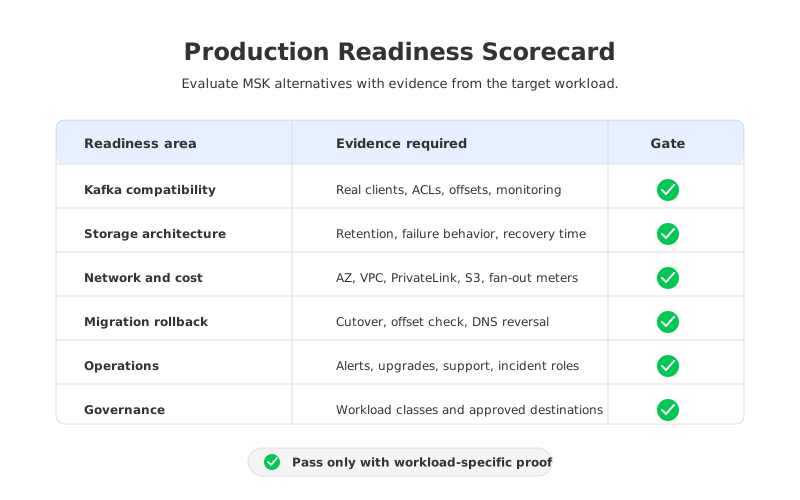
Apply the scorecard after the team has identified the workload class and replacement path. Scoring every vendor against generic features creates noise. Scoring the target workload against concrete production evidence creates a decision record.
| Readiness area | What "ready" means | Weak signal |
|---|---|---|
| Kafka compatibility | Existing clients, security, ACLs, transactions if used, offsets, and monitoring behave as expected | A sample producer and consumer succeeded |
| Storage architecture | The team understands hot data, retained data, recovery behavior, and broker failure impact | Retention cost is modeled without failure testing |
| Network and cost | AZ, VPC, PrivateLink, NAT, S3, and consumer fan-out paths are mapped to meters | Cost review only compares service pricing pages |
| Migration and rollback | Cutover, offset verification, DNS/client changes, and rollback are rehearsed | Migration plan assumes one-way success |
| Operations | Alert ownership, upgrade policy, support path, logs, and incident roles are documented | Provider SLA is treated as the whole runbook |
| Governance | Platform standards define which workload classes can use which destination | Every team chooses its own Kafka path |
The strongest MSK replacement decision may still be "do not replace it yet." That is a valid outcome if the evidence shows the problem is sizing, topic hygiene, client placement, or cost attribution rather than architecture. It is also valid to move one workload class first and leave the rest on MSK.
Return to the original search with a sharper question: which Kafka operating model can your team own under real workload pressure? If shared storage, Kafka compatibility, cloud-account control, and byte-path cost visibility are part of that answer, test the AutoMQ Cloud Console with one representative MSK workload and score it against the migration and operations evidence you require from every alternative.
8References
- Amazon MSK Developer Guide: What is Amazon MSK?
- Amazon MSK Pricing
- Amazon MSK Tiered Storage
- Amazon MSK multi-VPC private connectivity
- AWS EC2 On-Demand Pricing: Data Transfer
- AWS PrivateLink Pricing
- Amazon S3 Pricing
- Apache Kafka Documentation
- Apache Kafka Tiered Storage Documentation
- AutoMQ Overview
- AutoMQ Compatibility with Apache Kafka
- AutoMQ S3Stream Shared Streaming Storage
- AutoMQ Inter-Zone Traffic Overview
9FAQ
9.1What is the strongest reason to look for MSK alternatives?
The strongest reason is not dissatisfaction with MSK in general. It is a workload-specific constraint that MSK no longer addresses cleanly, such as storage growth, cross-boundary traffic, recovery time, data-plane control, or migration governance. Start with the workload and evidence, not the vendor list.
9.2Should every MSK replacement project move all Kafka workloads at once?
No. Most teams should start with one representative workload class. A storage-heavy topic, a fan-out-heavy pipeline, or a workload with strict cloud-boundary requirements can teach more than a broad but shallow migration. Keeping some topics on MSK while testing another path can be the lowest-risk decision.
9.3How is tiered storage different from shared-storage Kafka architecture?
Tiered storage moves older log data to a lower-cost storage tier while the Kafka broker model still matters for the hot path and operational behavior. Shared-storage Kafka-compatible architectures change the role of broker-local storage more deeply by moving durable stream data into shared storage and making brokers more stateless. Both models should be tested under the workload's own latency, retention, and recovery requirements.
9.4What should be included in an MSK alternatives proof of concept?
Use real client libraries, authentication, ACLs, topic configuration, producer retry behavior, consumer groups, observability, cost measurement, failure drills, and rollback. A basic produce-consume test is useful as a smoke test, but it is not enough for a platform replacement decision.
9.5When should AutoMQ be evaluated as an MSK alternative?
Evaluate AutoMQ when the decision criteria include Kafka compatibility, shared storage, object-storage-backed durability, independent compute and storage scaling, cloud-account control, and network cost visibility. It should be tested with one real MSK workload and scored against the same compatibility, migration, recovery, and operations gates used for every other option.


